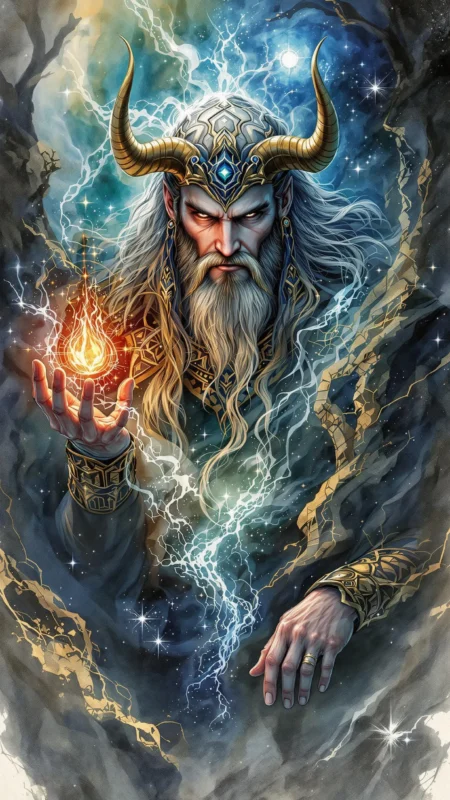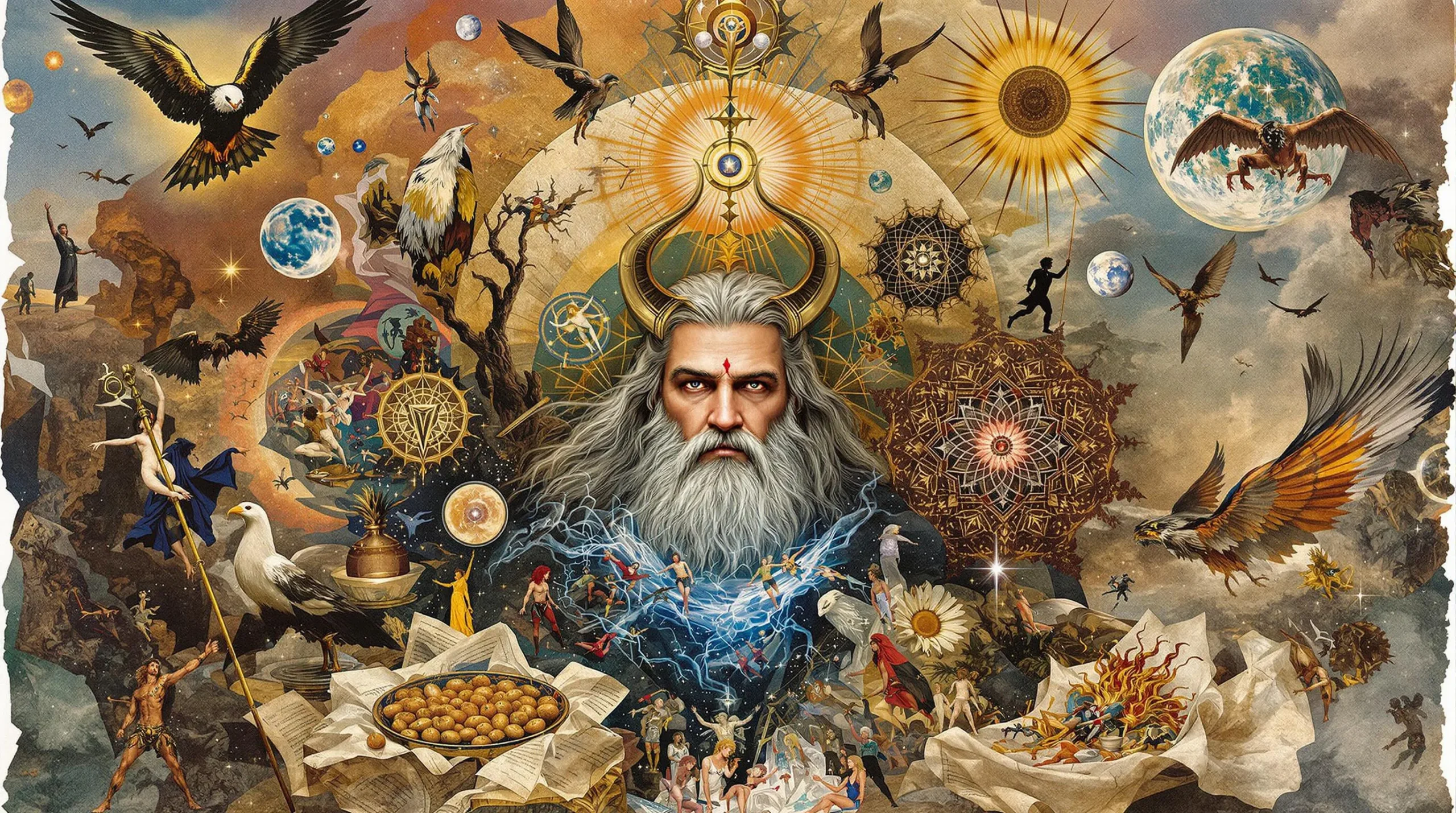


Odin

Archetype Meaning & Symbolism

seeker, wanderer, relentless, wise, shamanic, poetic, self-sacrificing, mercurial, distant, strategic

  • To know the world, I gave an eye. To know myself, I gave my life. What will you trade for a single, true word?

If Odin is part of your personal mythology, you may...

Believe

  • That all knowledge is interconnected, and the pursuit of it is the highest spiritual calling, justifying nearly any sacrifice.
  • That the world speaks in a language of symbols and omens, and that personal destiny is intertwined with a larger, cosmic drama.
  • That words possess a primordial power to shape reality, and that mastery of language is a form of magic.

Fear

  • Intellectual stagnation; the horror of a day passing without a new idea or a deeper question.
  • Being deceived or outmaneuvered; a deep dread that your hard-won foresight could fail you at a critical moment.
  • That the ultimate truth you seek is either nonexistent or so devastating that its discovery would annihilate you.

Strength

  • A powerful capacity for long-term strategic thinking, allowing you to see consequences and opportunities that others miss.
  • An immense intellectual and spiritual resilience, a willingness to endure hardship and ambiguity in the pursuit of a goal.
  • A gift for persuasive, poetic, and inspiring communication that can motivate and influence others on a profound level.

Weakness

  • A tendency toward emotional detachment, viewing people as components in a system rather than as individuals with feelings.
  • A temptation to use your insights manipulatively, guiding others toward outcomes that serve your own quest.
  • A chronic restlessness and inability to be content, always feeling the pull of the next mystery, which prevents you from enjoying the present.

The Symbolism & Meaning of Odin

To find Odin walking the paths of your personal mythology is to consecrate your life to the quest. It symbolizes a relentless, often painful, pursuit of knowledge that transcends mere information. This is not the clean, well-lit library of Athena; it is the wind-whipped mountaintop, the dark forest, the gallows tree. Wisdom, in this context, is not a gift. It is a spoil of war, wrestled from a reluctant reality at great personal cost. The symbolism is one of transaction: an eye for a glimpse of the cosmic, a life risked for the alphabet of magic. This may manifest as a life defined by a series of intense, initiatory experiences rather than a steady, linear progression.

The archetype is also that of the eternal wanderer, the perpetual outsider looking in. Odin is the All-Father, yet he is rarely at home in Asgard. He is on the road, cloaked and disguised, gathering intelligence. For an individual, this may foster a mythology of the self as a pilgrim or an observer. You may feel you are traveling through life, a visitor in your own communities, your own relationships, even your own body. This distance provides a unique, panoramic perspective, the ability to see the whole board, but it comes with a persistent, gnawing loneliness. The symbolism here is of the lens: you are the eye that sees, but you are not always part of the scene you witness.

Finally, Odin is the master of the inspired word: the poet, the sorcerer, the sayer of runes. His is the magic of language, the power of a name, the force of a perfectly crafted verse. To have this aspect in your mythos is to believe that reality is shaped by narrative. Your primary tool for engaging with the world could be your voice, your pen, your ability to frame events in a compelling story. It symbolizes a life where the greatest power lies not in physical strength or material wealth, but in the subtle, profound art of communication, of casting spells with sentences and changing fates with stories.


Odin Relationships With Other Archetypes

The Well

Odin's relationship with The Well is perhaps less a transaction than a merging with a silent oracle. To drink from its depths, he offers his eye, suggesting that true wisdom demands not just sacrifice, but a fundamental alteration of perception—an exchange of worldly sight for an inner, cosmic vision. The Well may be seen as a dark mirror, reflecting not the seeker's face but the vast, liquid abyss of what is knowable, a truth so profound it must be paid for in living tissue. Their pact is a quiet indictment of superficial knowing, implying that enlightenment is not a treasure to be seized, but an emptiness one must be willing to carry within oneself, a pool of disquieting stillness where the ego has been drowned.

The Raven

The Raven seems to be Odin’s outsourced consciousness, a shard of the night sky given the frantic pulse of thought. In Huginn and Muninn, he finds not pets but extensions of his own restless mind, whispers made flesh sent out to gather the world’s anxieties. Their relationship could be one of codependence; he relies on them for omniscience, yet their daily return brings the ceaseless ticker tape of worldly sorrows, a burden that deepens the furrows in his brow. The ravens, then, are not merely messengers. They may represent the double-edged nature of intellect itself—the ravenous hunger to know, forever paired with the melancholy weight of what is known.

The Gallows Tree

With The Gallows Tree, Odin engages in a brutal and voluntary embrace, a relationship of agonistic alchemy. The Tree is not a source of comfort but an axis of suffering, a splintered doorway to deeper gnosis. By hanging from its limbs, Odin may be enacting a sacred paradox: that ultimate power is found in ultimate surrender, and cosmic literacy is a script written in pain. This is not a battle to be won but an ordeal to be endured, where the self is willingly suspended between worlds, a chrysalis of agony from which a new, rune-etched consciousness might emerge. The Tree, in this sense, could be the starkest teacher, its lesson being that the most profound truths are found only when the seeker has been stripped of everything, including life itself.

Using Odin in Every Day Life

Navigating a Career Change

When standing at a professional crossroads, the Odin archetype encourages a long-view. It is not about the next logical step but about the path that promises the most potent knowledge. It may mean taking a pay cut for a role that offers a new skill, or moving to a new city not for the job, but for the experience. It is the conscious sacrifice of immediate security for the sake of a more profound future competency, trading a safe present for a wise future.

Deepening Intellectual Pursuits

For the student, writer, or artist, Odin offers a model of total immersion. He did not dabble: he hung himself from the world tree for nine nights to grasp the runes. This could translate to a personal commitment to mastery: a period of self-imposed isolation to finish a dissertation, a vow of silence to better hear one's creative voice, or the deliberate engagement with difficult, world-altering ideas. It is the sanctification of the study, turning a desk into an altar.

Leading with Vision

In a position of leadership, the Odin archetype is not the king who rules by decree but the chieftain who inspires through poetry and foresight. It is the ability to articulate a vision so compelling it becomes a shared reality. This leader speaks in metaphor, understands the hidden motivations of their team, and always operates with a sense of the grand, overarching narrative. They see the entire battlefield of the market, not just the next skirmish.

Odin is Known For

Sacrifice for Wisdom

Most famously, Odin traded one of his eyes for a drink from Mimir's Well of Wisdom, gaining cosmic knowledge at the price of physical sight.

Discovery of the Runes

He underwent a shamanic ordeal, hanging for nine days and nights from Yggdrasil, the world tree, wounded by his own spear, to receive the knowledge of the runes.

The Wanderer

Odin frequently traveled the realms in disguise, often as a grey-bearded old man in a broad-brimmed hat, seeking knowledge and testing the hospitality and wisdom of mortals and gods.

How Odin Might Affect Your Personal Mythology

How Odin Might Affect Your Mythos

When Odin enters your personal story, your life's narrative may shift from a comedy or a romance to a high-stakes epic quest. The central plot is no longer the search for happiness or stability, but the hunt for a singular, transformative truth. Each chapter of your life might be framed as a trial, each challenge a riddle to be solved, each loss a necessary sacrifice on the road to gnosis. Your personal myth becomes a pilgrimage. You might see your past not as a series of mistakes and successes, but as a deliberate, winding path designed to forge your intellect and spirit, with every heartbreak and failure serving as a harsh but necessary teacher.

The presence of this archetype can also imbue your personal myth with a sense of inescapable destiny, a touch of the tragic. Odin knew of his own demise at Ragnarök but played his part regardless. Similarly, you might operate with a keen awareness of the limitations and endings inherent in life, love, and work. This doesn't necessarily lead to despair, but to a kind of noble gravity. Your story becomes less about achieving a happy ending and more about playing your assigned role with wisdom and courage, however it is fated to end. Your mythos is the tale of the strategist who sees the final move but continues to play the game with beautiful, defiant precision.

How Odin Might Affect Your Sense of Self

Your very concept of self may be reconstructed around the mind. The 'I' is not the heart, the body, or the social role; the 'I' is the seeker, the thinker, the strategist. Self-worth could be tethered to intellectual prowess, to the ability to understand what others cannot, to see the hidden connections. This creates a self-image that is potent and self-reliant but perhaps starkly isolated. You might see your consciousness as a lonely watchtower, granting a magnificent view but set far apart from the warmth of the village below. The self is a vessel for knowledge, and its primary purpose is to know.

This can create a functional, almost instrumental, view of your own being. Like Odin, you may be willing to sacrifice parts of yourself for a greater goal. This could be literal: pushing the body to its limits of exhaustion in pursuit of a breakthrough. It may also be metaphorical: sacrificing emotional comfort for a difficult truth, or trading a piece of your innocence for a sliver of wisdom. There can be a profound disconnect from the self's more 'mundane' needs—for rest, for simple joy, for belonging—as they are viewed as distractions from the great and primary work of knowing.

How Odin Might Affect Your Beliefs About The World

The world, seen through an Odinic lens, ceases to be a solid, predictable place. It becomes a text, a forest of symbols, a web of interconnected meanings. Nothing is merely what it is; everything is an omen, a sign, a rune waiting to be read. A chance encounter, a strangely shaped cloud, a line from a song heard in passing—all may be woven into a larger, cosmic narrative. This imbues life with a constant, humming sense of magic and significance, but it can also be exhausting, a world that never stops speaking and demanding interpretation.

The worldview is one of inherent conflict and paradox. It rejects simple binaries of good and evil, success and failure. Instead, it sees creation and destruction as two hands of the same god, knowledge and sorrow as inextricable partners. The world is a place of beautiful, brutal dynamism, where peace is merely the prelude to the next storm, and wisdom is forged in the heart of that storm. This perspective fosters a deep appreciation for complexity and a profound skepticism towards easy answers or utopian ideals. The world is a grand, tragic, and magnificent poem, and its primary engine is struggle.

How Odin Might Affect Your Relationships

Relationships may be unconsciously framed as expeditions for knowledge. You might be drawn to people who are puzzles to be solved, who hold a key to a new way of seeing, or who can serve as a whetstone for your own intellect. The central question in a connection may not be 'how does this feel?' but 'what can I learn here?'. This can lead to intense, transformative encounters, but it can also keep others at a strategic distance, valued for their intellectual or spiritual utility rather than their intrinsic being. The lover as muse, the friend as informant: these are Odinic roles.

Consequently, a deep-seated tension between connection and autonomy may define your relationships. The archetype is the Wanderer, and the wanderer's path is fundamentally a solitary one. You may fear that deep intimacy will become a cage, a comfortable home that dulls the edge of your perception and stills your restless feet. This can create a pattern of approach and withdrawal, of profound engagement followed by sudden distance. You might offer immense wisdom and insight to those you love, but you may withhold the final piece of yourself, the one that stays, the one that truly belongs.

How Odin Might Affect Your Role in Life

You may perceive your role in any group—family, work, community—as that of the sage or the strategist who operates from the wings. You are not the figurehead, but the advisor to the throne, the one who whispers the critical insight at the pivotal moment. Your value lies in your perspective, your ability to see the entire field of play while others are focused on their immediate position. This is the role of the seer, the consultant, the keeper of secrets whose counsel is sought in times of crisis or confusion. It is a role of influence rather than direct power, shaping outcomes through wisdom and foresight.

Alternatively, you might adopt the role of the catalyst, the agent of necessary change. Like Odin stirring up conflicts among men to harvest the best warriors for his hall, you might believe that stagnation is the greatest enemy. In this role, you may be the one who introduces uncomfortable truths, challenges ingrained assumptions, or provokes a crisis to force growth and evolution. It is the role of the gadfly, the visionary disruptor who understands that sometimes, structures must be shaken, or even broken, for something new and stronger to emerge. You see yourself not as a troublemaker, but as a tender of the creative fire, even if it burns.

Dream Interpretation of Odin

In a positive context, a dream of Odin—or his symbols like a single watchful eye, his ravens Huginn and Muninn, or the world tree Yggdrasil—may serve as a powerful affirmation from the deep psyche. It could be a sign that your current path of intellectual struggle, sacrifice, or solitary seeking is correct and meaningful. The dream might deliver a flash of insight, a 'rune' that unlocks a problem you've been wrestling with. It is an encouragement to trust your intuition, to value wisdom over comfort, and to embrace the role of the seeker on your life's journey.

In a negative context, a dream of a threatening or menacing Odin could signify the archetype's shadow taking hold. You may be pursued by The Wild Hunt, symbolizing a relentless ambition that has become destructive, chasing you away from your own humanity. It might reflect a deep-seated fear of the sacrifices that your quest for knowledge demands, or a warning that you are becoming too manipulative, cold, and calculating. Such a dream could also be a manifestation of a dread of inescapable fate, a vision of your personal Ragnarök, representing a difficult truth or ending that you are consciously trying to avoid but that your subconscious knows is coming.

How Odin Archetype Might Affect Your Needs

How Odin Might Affect Your Physiological Needs

Physiological needs, when viewed through the Odinic archetype, may be relegated to the status of necessary maintenance for the true engine: the mind. Food, sleep, and physical comfort are often seen as distractions from the 'Great Work' of knowing. There could be a tendency to mirror Odin's shamanic ordeal on the world tree, pushing the body to its absolute limits. You might forget to eat while absorbed in a project, pull consecutive all-nighters to solve a problem, or ignore physical ailments, viewing the body as a stubborn but ultimately secondary vessel for the questing consciousness.

This is not the self-denial of an ascetic who renounces the flesh, but the strategic prioritization of a general who allocates resources. The body's needs are legitimate but ranked far below the need for an answer, an insight, a breakthrough. Physical well-being is a resource to be spent, sometimes recklessly, in the currency of discovery. This can lead to a state of being perpetually travel-worn and weary, where the body bears the physical cost of the mind's relentless journey.

How Odin Might Affect Your Ideas of Belonging

The need for belongingness and love may be satisfied in unconventional ways. Rather than finding community in a neighborhood or social club, you might feel a profound kinship with a lineage of thinkers, mystics, and poets, a 'kith of mind' that transcends time and space. Your true fellows are the other seekers, living or dead, who share the same restless fire. Love and intimacy are desired, but they must accommodate the central quest. You might seek a partner who is a fellow wanderer, a 'Mimir' whose wisdom complements your own.

However, the archetype's inherent solitude creates a constant tension. The path of the seeker is lonely, and the wanderer resists being tied down. This can create a deep ambivalence toward love and connection. You may fear that true intimacy will require you to give up your sacred autonomy, to trade the open road for a shared hearth. This can result in relationships that are deep and meaningful but are also marked by a protective distance. You give your wisdom freely, but your presence is always provisional, as if you might receive a call at any moment to resume your journey alone.

How Odin Might Affect Your Feelings of Safety

The concept of safety may undergo a radical redefinition. For the Odin archetype, the greatest danger is not bodily harm or material loss; it is ignorance. The true threat is stagnation, the comfort of the unexamined life. Therefore, safety is not found in building high walls, but in understanding the landscape beyond them. You might actively seek out psychologically or intellectually 'unsafe' spaces—engaging with threatening ideas, traveling to unknown places, or initiating difficult conversations—believing that these are the territories where real growth occurs.

Security, then, is rooted in foresight and adaptability, not in stability. True safety is the wisdom to anticipate the coming storm and the knowledge to navigate it, not the hope that the storm will never come. You might engage in meticulous, almost paranoid planning for future scenarios, but the goal is always to be prepared to move, to act, to face the chaos. The fortress is a trap. The only real safety lies in the wanderer's ability to read the map of a constantly changing world and to keep walking.

How Odin Might Affect Your Views of Esteem

Esteem is not sought from the crowd. It is forged internally, based on a rigorous self-assessment of one's intellectual and strategic capabilities. Your self-worth is directly proportional to what you understand, the patterns you can perceive, and the esoteric knowledge you have acquired. Praise from those you consider intellectually or spiritually un-awakened may feel meaningless. Respect is only valued when it comes from a peer, another seeker who understands the price of wisdom. Your esteem is a solitary fortress built from insight and hard-won truth.

This can also foster a kind of intellectual elitism as a defense mechanism. Esteem is maintained by a quiet, sometimes arrogant, conviction that you possess a deeper, more complex understanding of reality than those around you. While this provides a powerful core of self-confidence, it can also be profoundly alienating. It creates a barrier to simple, egalitarian connection, as you may subtly judge others based on their perceived depth. You trade the warmth of broad acceptance for the cold, sharp satisfaction of being the one who knows.

Shadow of Odin

The shadow of Odin emerges when the seeker becomes the tyrant. The quest for knowledge curdles into an insatiable hunger for control, and wisdom is weaponized. This shadow figure hoards information, not for enlightenment, but for power over others. Every interaction becomes a strategic calculation, every relationship a source of intelligence. He is the paranoid spymaster who sees plots everywhere because he himself is always plotting. The noble self-sacrifice that once defined his quest becomes a justification for sacrificing anyone who stands in his way, all under the guise of serving a 'greater purpose' that only he can see.

Another facet of the shadow is the desolate exile, crushed by the weight of his own wisdom. The knowledge he has gained brings no peace, only an agonizing clarity about the flawed, futile, and fatalistic nature of existence. He sees the end in every beginning, the decay in every bloom. This foresight paralyzes him, turning him into a cynical, bitter recluse who can no longer participate in the simple, beautiful dance of life. He is a ghost at the feast, alienated by an understanding so vast it has severed him from the world he sought to know. His wisdom has become his cage.

Pros & Cons of Odin in Your Mythology

Pros

  • You may possess a profound, nuanced understanding of life, able to offer truly transformative wisdom.
  • You are likely highly self-reliant and resilient, capable of navigating immense complexity and hardship with courage.
  • Your visionary perspective can make you an inspiring and effective leader, teacher, or guide for others.

Cons

  • You may be prone to deep-seated loneliness and a feeling of being fundamentally different and separate from others.
  • There is a persistent danger of becoming emotionally cold, calculating, and manipulative in your pursuit of goals.
  • You might consistently neglect your own emotional and physical well-being, sacrificing too much of your humanity for your ideals.