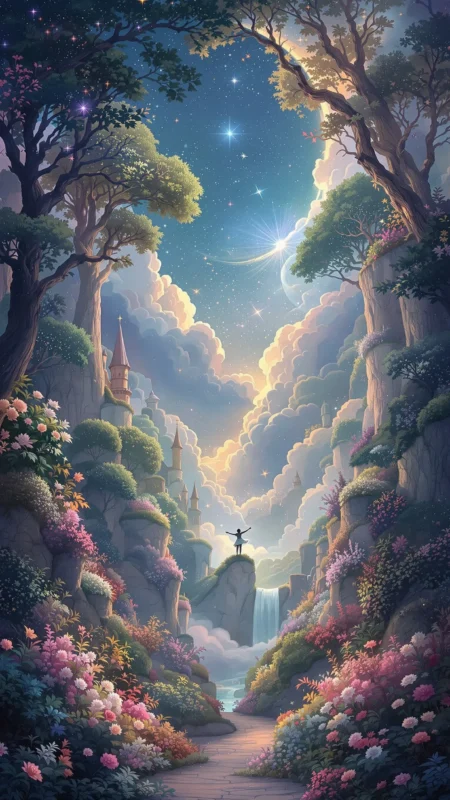
Neverland

Archetype Meaning & Symbolism

Timeless, Wild, Escapist, Imaginative, Dangerous, Idyllic, Lawless, Playful, Unchanging, Isolated

  • The clocks are wrong. The real time is measured in adventures, not seconds.

If Neverland is part of your personal mythology, you may...

Believe

  • Growing up is a choice, not an inevitability.
  • The most serious work is done through play.
  • Rules are merely suggestions for the unimaginative.

Fear

  • The ticking of a clock, symbolizing the inescapable march of time and responsibility.
  • Becoming ordinary, losing the spark of wonder that makes you unique.
  • Finality, the idea that any choice could close the door to infinite other possibilities.

Strength

  • Boundless creativity, the ability to see solutions and possibilities that others miss.
  • Resilience through play, using humor and imagination to bounce back from setbacks.
  • An infectious sense of wonder that can inspire and rejuvenate those around you.

Weakness

  • Aversion to commitment, making it difficult to build lasting structures in life and love.
  • A tendency toward escapism, avoiding difficult problems rather than confronting them.
  • Financial or practical instability, stemming from a disregard for long-term planning.

The Symbolism & Meaning of Neverland

In the modern psyche, Neverland is the cartography of the inner child’s domain. It represents a sovereign territory within the self, a preserve where the imagination remains untamed and the spirit is not yet yoked to the relentless machinery of linear time and productivity. To have Neverland in your personal mythology is to possess a secret country, a mental landscape you can retreat to when the world of deadlines and social contracts becomes a monochrome prison. It is the source code of your creativity, the place where your most original ideas roam free like wild things. This inner realm is not a memory of childhood but an active, living state of being: a place of pure potentiality where you are forever on the cusp of becoming.

The archipelago, however, is shadowed by perilous waters. Neverland also symbolizes the seductive danger of arrested development. It is the siren song of escapism, a beautiful, verdant trap that promises freedom from responsibility but delivers a gilded cage of emotional immaturity. When this landscape dominates the personal mythos, it can foster a refusal to face the necessary deaths and rebirths of a full life. It becomes the place we go not to rejuvenate, but to hide. The refusal to grow up ceases to be a charming quirk and becomes a profound inability to form lasting bonds, to build a meaningful life, or to accept the solemn beauty of mortality.

More recently, Neverland has come to symbolize the act of world-building itself. It is the artist’s studio, the entrepreneur’s garage startup, the dissident’s underground movement: any self-created reality that operates by its own internal logic, defiantly separate from the mainstream. It is a testament to the human capacity to construct meaning and culture on a small scale, to form a tribe of “Lost Boys” united by a shared vision. In this sense, Neverland is not about escaping the world but about creating a new one, a prototype of a different way to live, which may be perilous and isolated but is authentically one’s own.


Neverland Relationships With Other Archetypes

The Captain Hook Archetype

The Captain Hook archetype, or The Tyrant of Time, represents everything Neverland is not: the rigid adherence to social form, the obsession with revenge for past wounds, and a terror of the passage of time, symbolized by the ticking crocodile. In a personal mythos, this is the internal critic, the voice of societal expectation, or the demanding boss who seeks to conquer the wild territory of your imagination. The relationship is one of perpetual conflict. Neverland's very existence is an affront to The Tyrant's control, and The Tyrant's presence threatens to impose order, consequence, and the inescapable reality of the clock onto a world that thrives on their absence.

The Lost Ones Archetype

The Lost Ones, be they boys or girls, are the native inhabitants of Neverland. They embody the part of the self that feels orphaned from the conventional world, a spirit that does not fit neatly into the structures of family, school, or career. Their allegiance is not to a bloodline but to a shared state of being. For the individual, the relationship with this archetype is one of identification and belonging. These are your people. Their presence in your inner Neverland affirms that you are not alone in your refusal to conform. Together, you form a tribe of kindred spirits whose collective identity reinforces the validity of this timeless, playful existence, creating a found family that may feel more real than any family of origin.

The Island Archetype

Neverland is a potent manifestation of The Island archetype. Like all islands, it is a world unto itself: isolated, self-contained, and defined by its separation from the “mainland” of ordinary life. This insularity is both its greatest strength and its most profound weakness. The Island provides sanctuary, a place where a unique ecosystem of rules and beliefs can flourish without outside interference. However, it can also be a prison. The waters that protect can also prevent escape, leading to stagnation, tribalism, and a distorted view of reality. The relationship is symbiotic: Neverland needs its island status to exist, but its inhabitants must always contend with the psychological reality of being surrounded by an impassable sea.

Using Neverland in Every Day Life

Navigating Creative Blocks

When confronted with a barren imagination, one might retreat to their internal Neverland. This is not about forcing a solution but about changing the landscape entirely. You could consciously decide to spend an hour in a state of pure, purposeless play, building something with your hands or following a trail of thought without a destination. In this territory, the rules of logic and commerce dissolve, allowing for the kind of absurd connections and happy accidents from which true originality is born. The goal is not to find the answer, but to remember how to play the game where answers are irrelevant.

Addressing Professional Burnout

For the individual whose mythos is colored by Neverland, burnout may feel like being captured by pirates: trapped by rigid schedules and the tyranny of the clock. The archetype offers an antidote not in a vacation, but in an ontological shift. It is the practice of carving out small, lawless territories within the day. This could be a walk without a route, listening to a piece of music so intensely it dissolves the room around you, or engaging in a hobby with the fierce, unproductive passion of a child. It is a reminder that your core self is not a worker drone but a wild thing that requires unmanaged spaces to thrive.

Overcoming Decision Paralysis

Faced with a life-altering choice, the weight of “growing up” and making the “right” decision can be paralyzing. The Neverland archetype reframes this. Instead of a crossroads with one right path and many wrong ones, the choice becomes a map with multiple tantalizing trails leading to different adventures. One path may lead to the Mermaid’s Lagoon, another to the Indian Camp. Neither is inherently better, just different. This perspective lowers the stakes, transforming a terrifying moment of adult responsibility into an invitation to explore, trusting that you are clever enough to handle whatever dangers you meet along the way.

Neverland is Known For

Suspended Time

Neverland is most famous for its temporal anomaly

time is fluid, nonlinear, or perhaps altogether absent. Within this realm, characters do not age, and the past does not fade but coexists with the present. It represents a psychological state where the burdens of history and the anxieties of the future hold no power.

Untamed Imagination

This is a landscape where thought and reality are porous. Belief alone can give the power of flight; imaginary feasts can feel nourishing. It is populated by figures from myth and nightmare—fairies, mermaids, crocodiles with clocks in their bellies—making it the ultimate canvas for the creative and paranoid mind.

Perilous Play

The games in Neverland are not safe. Sword fights are with sharp blades, and the consequences of adventure are real and sometimes final. This fusion of play and genuine danger symbolizes the idea that a life lived with true passion and imagination is inherently risky, and that to be truly alive is to be vulnerable.

How Neverland Might Affect Your Personal Mythology

How Neverland Might Affect Your Mythos

When Neverland is a key location in your personal mythos, your life story may be framed as a continuous struggle against the forces of mundane adulthood. Major life events are not seen as steps on a ladder of progress but as episodes in an ongoing adventure, judged by their capacity for novelty and wonder. Your narrative might be centered around a “golden age” of youthful freedom, a paradise lost that you are either trying to reclaim or protect from the encroachment of the ticking crocodile of time and responsibility. You may see yourself as a custodian of something precious and wild, a keeper of a flame that the gray, unimaginative world constantly tries to extinguish. Your mythos is not about becoming, but about remaining.

The central conflict in your story is often internal: the battle between the part of you that wants to fly and the part that knows it has to come down to earth. This can create a narrative arc of a “reluctant hero” or a “charming rogue,” someone who navigates the adult world with a sense of ironic detachment, as if playing a role. Your greatest triumphs might be moments of creative breakthrough or defiant acts of non-conformity, while your tragedies could be moments where you were forced to compromise your spirit, to “grow up” in a way that felt like a betrayal. Your life story becomes a testament to the idea that the soul has an age independent of the body.

How Neverland Might Affect Your Sense of Self

Your sense of self may be anchored in a profound identification with youthfulness. This is not about vanity, but about a core belief that your truest self is spontaneous, curious, and playful. You might feel a fundamental disconnect from your chronological age, viewing it as an arbitrary number imposed by an outside world that doesn't understand you. Your identity is fluid and performative, resistant to the fixed labels that society offers: career, spouse, parent. Instead, you may define yourself by your passions, your imagination, and your capacity for wonder. There could be a deep pride in being different, in being the person who still knows how to play.

This can, however, lead to a fragmented or unstable sense of self. You may feel as though you are two different people: the free-spirited inhabitant of your inner Neverland and the persona you must adopt to pay the bills and navigate social expectations. This creates a persistent tension, a feeling of being an imposter in the adult world. This internal division can make it difficult to integrate the various parts of your life into a cohesive whole, leaving you with a feeling that your “real life” is the one lived in moments of escapist fantasy, and the rest is just a tedious performance.

How Neverland Might Affect Your Beliefs About The World

The world may appear to be sharply divided into two distinct realms: the grim, rule-bound “mainland” of adult life and the vibrant, magical archipelago of what is truly real. You might view societal structures—corporations, governments, traditional institutions—with a deep and abiding suspicion, seeing them as pirate ships crewed by unimaginative tyrants obsessed with clocks and treasure. The conventional markers of success, like wealth and status, may seem like hollow trophies in a game you have no interest in playing. Truth, for you, is not found in facts and figures, but in metaphor, in art, in the flash of insight that comes from a moment of unstructured play.

This perspective could foster a worldview that is fundamentally hopeful and generative, a belief that reality is malleable and can be reshaped by a potent act of imagination. But it may also cultivate a kind of cynical idealism. You may feel that the world is irrevocably broken, a paradise paved over by the forces of conformity. This can lead to a posture of detached rebellion, a refusal to engage with the world’s problems on its own terms. Why bother trying to fix a broken clock when you believe that time itself is an illusion? This can create a profound sense of political or social alienation, a feeling that you are an exile in your own time.

How Neverland Might Affect Your Relationships

In relationships, you may seek a fellow adventurer, a partner in crime, another Lost One who understands the secret language of play. The goal is not stability but shared experience. Love and friendship are measured in quality of adventures, not duration. You might resist conventional relationship trajectories, viewing things like marriage or cohabitation as potential traps that could domesticate your wild spirit. The ideal connection is one that feels like a perpetual game of tag, a dance of freedom and connection where neither partner ever feels caged. You may value spontaneity and surprise above all else, seeing them as proof that the relationship is still alive and magical.

This aversion to convention can make deep, lasting intimacy a challenge. The Neverland archetype may foster a fear of the less glamorous aspects of love: the hard work, the compromises, the quiet moments of shared vulnerability that build a mature bond. There could be a tendency to flee when a relationship moves from the exciting “adventure” phase into a more stable, committed one. You might unconsciously cast your partner in the role of Wendy, the sensible one who wants you to come back to the mainland and grow up, creating a self-fulfilling prophecy of abandonment. The fear is that true intimacy requires giving up a piece of your timeless freedom, a sacrifice you may be unwilling to make.

How Neverland Might Affect Your Role in Life

Your perceived role in the world may be that of the “Keeper of Wonder.” You might see it as your duty to be a disruptive force of creativity and playfulness in a world that is starving for both. Whether you are an artist, an innovator, a teacher, or simply an eccentric friend, you may feel your purpose is to remind people of their own forgotten Neverlands. You provide a necessary chaos, challenging stale conventions and introducing an element of the unexpected. Your role is not to lead or to follow, but to dance to a rhythm that only you can hear, inspiring others to find their own.

Alternatively, you may feel perpetually miscast, a permanent adolescent in a world that demands adulthood. You might struggle to find a niche where your unique gifts are valued, bouncing from job to job or role to role, feeling like you are always wearing a costume that doesn't quite fit. This can lead to a sense of being fundamentally out of sync with your peers, watching them achieve milestones that feel both alien and unattainable to you. The role you play might feel like one of a court jester: entertaining and beloved, perhaps, but never truly taken seriously or given real responsibility.

Dream Interpretation of Neverland

To dream of a vibrant, welcoming Neverland—flying over lush jungles, swimming in a luminous lagoon, or sharing a joke with mischievous fairies—could be a potent affirmation from your psyche. It may suggest a healthy and integrated connection to your creative source, your intuition, and your capacity for joy. Such a dream might arrive as a reminder to lighten up, to release your grip on control, and to make more space in your waking life for unstructured, purposeless play. It is a communication from your inner child, confirming that it feels seen, safe, and free to explore.

A dream of a menacing or decaying Neverland, however, serves as a stark warning. If the jungle is suffocating, the pirates are winning, or you find you can no longer fly, it may symbolize that your escapist tendencies have become a prison. This nightmarish landscape could reflect a deep fear that you are evading a necessary life challenge or that your refusal to mature is causing your inner world to stagnate and turn toxic. It may be a call to action from your subconscious, urging you to face the very responsibilities you have been flying away from before your inner sanctuary becomes an inescapable trap.

How Neverland Archetype Might Affect Your Needs

How Neverland Might Affect Your Physiological Needs

When Neverland is part of your mythos, basic physiological needs may be reframed through a lens of adventure and play. Hunger is not a deficit to be managed but an opportunity for an 'imaginary feast' or a spontaneous picnic on the floor. Sleep is not a surrender to exhaustion but a conscious 'trip to the second star to the right,' a journey into the realm of dreams where the spirit is untethered. The body itself might be viewed as a wondrous vehicle for exploration and expression, its aches and energies the signals of a grand game. You may find more nourishment in the experience surrounding food than in the food itself, and more rest in active, joyful solitude than in passive slumber.

This romantic view of the body, however, could foster a dangerous neglect of its fundamental requirements. In the throes of a creative project or an exciting experience, the body's cries for food, water, or sleep might be dismissed as tedious interruptions from the mainland of reality. The Neverland spirit chafes at the body’s limitations, seeing them as a kind of clock, ticking away the precious moments of timeless play. This can lead to a pattern of burnout and adrenal fatigue, a physical manifestation of the spirit's refusal to accept that even the most magical of creatures must eventually come down to earth and rest.

How Neverland Might Affect Your Ideas of Belonging

A sense of belonging, for you, is forged in a tribe of kindred spirits, a found family of fellow 'Lost Ones.' It is not based on blood, geography, or social convention, but on a shared imaginative frequency and a mutual rejection of the mundane. You belong with those who understand your secret language of play and who see the world with the same mixture of wonder and suspicion. Love, in this context, is about finding a playmate. Intimacy is built through shared adventures, inside jokes, and a pact to protect one another’s inner wildness from the homogenizing forces of the world. This can create intensely loyal and magical bonds, a chosen family that feels more real than any other.

The shadow of this is a profound and often painful alienation from the rest of society. The criteria for entry into your tribe can be so specific that it leaves you feeling perpetually on the outside, misunderstood by the majority of people you meet. This can create a defensive posture, a kind of 'us against the world' mentality that, while bonding for the group, is isolating in the long run. There may also be a fear that any attempt to integrate with the 'grown-up' world is a betrayal of your tribe, making it difficult to form meaningful connections with those who don't share your unique worldview.

How Neverland Might Affect Your Feelings of Safety

For you, safety may not be found in stability, but in agility. The world is a thrillingly dangerous place, full of pirates and crocodiles, and security lies not in building higher walls but in knowing how to fly. Safety is the freedom to escape, the belief in your own cleverness to improvise your way out of any trap. A steady job, a mortgage, and a retirement plan might feel like the ultimate cages, binding your wings and leaving you vulnerable. True security is a state of perpetual readiness for adventure, a psychological lightness that allows you to change course at a moment's notice. You feel safest when you are untethered.

This translates into a life that can be deeply precarious. The rejection of conventional safety nets may be liberating, but it leaves one exposed to the very real dangers of the modern world. The aversion to long-term planning can create chronic financial instability, housing insecurity, and a lack of resources when genuine crisis strikes. The belief that you can always 'fly away' from problems can become a pattern of avoidance that prevents you from building anything of lasting material value or security. The thrill of living on the edge can easily curdle into the constant, low-grade terror of having no ground beneath your feet.

How Neverland Might Affect Your Views of Esteem

Self-esteem is likely derived not from external achievements but from internal qualities: your creativity, your wit, your rebellious spirit, your refusal to be boring. You may take immense pride in your originality and your ability to see the magic that others miss. Your sense of self-worth is nourished by moments of imaginative flight, clever solutions to problems, and the admiration of those who 'get' you. The disapproval of authority figures or the mainstream may even bolster your esteem, confirming your status as a free-thinking individual. You value yourself for the part of you that has remained untamed and uncorrupted by the world.

This foundation for self-worth can be fragile. If your value is tied to being perpetually clever, youthful, and original, the natural processes of aging, slowing down, or having an uninspired day can feel like a catastrophic failure of identity. There may be a deep, gnawing fear of becoming ordinary, which can fuel a frantic and exhausting performance of whimsicality. This can also lead to a rejection of earned wisdom, as the experience that comes with age is seen as a form of calcification rather than a source of strength. Your esteem may be constantly chasing the fleeting high of the next new idea or adventure, leaving you feeling empty in the quiet moments in between.

Shadow of Neverland

When the shadow of Neverland falls, the charming eternal youth curdles into the Puer Aeternus, the divine child who has become a tyrant. This is not a joyful embrace of the inner child but a parasitic refusal to shoulder the weight of a human life. It manifests as a profound and charming narcissism where other people become props in one’s personal adventure story, their feelings and needs rendered invisible. Promises are forgotten as easily as last season's games, and responsibilities are shed like a heavy coat on a sunny day. This shadow realm is sterile; nothing can grow there because the soil is too shallow. It is a life of endless beginnings and no satisfying conclusions, a shimmering mirage of potential that never solidifies into reality, leaving a trail of disappointed people and abandoned projects in its wake.

This shadow also transforms the landscape of play into a domain of cruelty. The games are no longer innocent; they become instruments of psychological control and subtle sadism. The leader of this shadow Neverland rules by whim, demanding constant entertainment and admiration, and punishing anything that smells of boredom or dissent with emotional exile. It is the territory of the perpetual adolescent who, terrified of being seen as ordinary, elevates their own whims to the status of sacred law. In this world, vulnerability is weakness, commitment is a cage, and the tender, complex emotions of others are merely amusing distractions in a game only they can win.

Pros & Cons of Neverland in Your Mythology

Pros

  • A vibrant, imaginative inner life that serves as a constant source of creativity and joy.
  • The ability to remain flexible and adaptive in the face of change, viewing challenges as new games.
  • A youthful energy and perspective that can defy the cynicism that often comes with age.

Cons

  • A persistent struggle with the practical demands of adult life, from finances to long-term commitments.
  • A potential for emotional immaturity that can hinder the formation of deep, lasting relationships.
  • A chronic sense of alienation from mainstream society and its milestones.