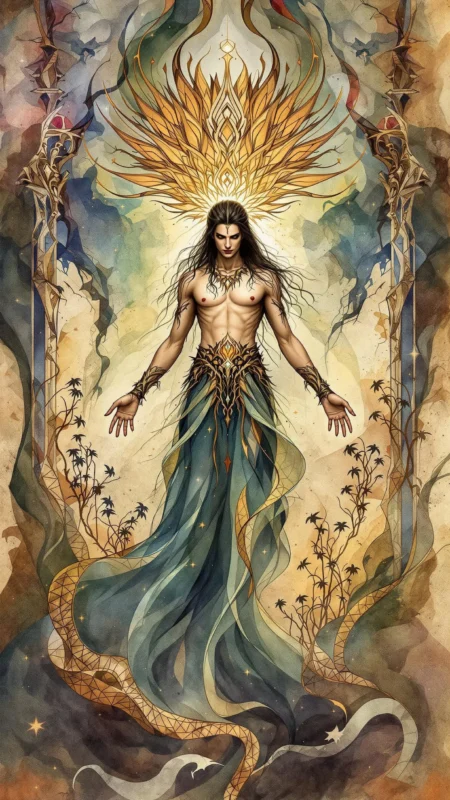
Nephthys

Archetype Meaning & Symbolism

Guardian, loyal, mysterious, liminal, shadowy, compassionate, nocturnal, protective, patient, melancholic, resourceful

  • Do not mistake my silence for absence. The most vital currents flow beneath the surface, and the deepest comfort is found in the dark, where new life quietly gathers its strength.

If Nephthys is part of your personal mythology, you may...

Believe

  • That endings are not failures, but sacred transitions that must be honored with ritual and grief.
  • That the most profound power is quiet, supportive, and works behind the scenes.
  • That true loyalty is shown not in words, but in unwavering presence during the darkest nights.

Fear

  • Being eternally overlooked, your contributions rendered invisible and unappreciated.
  • That your own needs will be completely subsumed by the needs of those you support.
  • Getting lost in the darkness you navigate for others, unable to find your way back to the light.

Strength

  • An immense capacity for empathy and compassion, allowing you to hold space for the deepest forms of suffering.
  • Unwavering loyalty and reliability: you are the person who stays when everyone else leaves.
  • A deep intuition and comfort with the unknown, the mysterious, and the transitional phases of life.

Weakness

  • A tendency towards self-neglect, prioritizing the needs of others to the point of depleting your own resources.
  • Difficulty with self-promotion and asserting your own needs, leading to feelings of resentment or invisibility.
  • A predisposition to melancholy or becoming absorbed in the sorrow of others.

The Symbolism & Meaning of Nephthys

In the modern psyche, Nephthys represents the archetype of the essential shadow, the necessary darkness that gives shape to light. She is the patron saint of the B-side, the understudy, the chief of staff: the role whose power is invisible but utterly indispensable. To have Nephthys in your personal mythology is to understand that not all strength is declarative. Some strength is absorptive, a quiet capacity to hold grief, to keep secrets, to midwife transitions without needing applause. She is the sacred dignity of the supportive role, the recognition that the person holding the ladder is just as vital as the one reaching for the star.

She is also the goddess of the liminal. Nephthys resides at the threshold between worlds: life and death, night and day, conscious and subconscious. Her presence in one’s life may signal a deep comfort with ambiguity and a knack for navigating periods of intense change. She is the one who knows the way through the twilight, when the path is no longer clear. This archetype bestows a kind of psychic resourcefulness, an ability to find meaning not in the destination but in the murky, uncertain, and ultimately fertile process of the journey itself. She is the ferrywoman for the soul’s most difficult crossings.

Furthermore, Nephthys embodies a form of compassionate mourning that is active, not passive. Her grief is not despair: it is a potent magical act, a lament that is also a spell of regeneration. She teaches that honoring an ending fully is what allows a new beginning to take root. For the individual, this may manifest as an ability to process loss without becoming lost, to see sorrow as a sacred rite of passage. She is the part of the self that knows how to properly say goodbye, creating the clean, hollow space into which new life, a new idea, or a new self can eventually be born.


Nephthys Relationships With Other Archetypes

The Lighthouse

The relationship between Nephthys and the Lighthouse is perhaps one of a necessary and silent dialogue between shadow and signal. Nephthys may be the velvet, ambiguous darkness of the unseen coast, the hidden reef, the deep water that holds its breath. The Lighthouse, in turn, is the stark, cycling truth, the piercing beam that attempts to map and warn against this very mystery. Yet, its light does not vanquish her domain; it merely gives it contour and consequence. The Lighthouse’s message could only have meaning against the canvas she provides. She, in turn, may offer a form of protection the light cannot: the wisdom of the depths, the compassionate embrace of what must remain unseen. One might say they are two halves of a single vigilance, guarding the threshold where the known world surrenders to the immeasurable.

The Secret

Nephthys and the Secret may exist in a state of profound symbiosis, like a pearl within the quiet, nacreous dark of its shell. If a Secret is a truth too fragile or too potent for the open air, then Nephthys is the chamber in which it is allowed to rest. She is the clasped hand, the sealed urn, the solemn vow of silence. Her power does not come from wielding the Secret, but from providing it a sanctuary, from understanding its weight without needing to expose it to the harsh light of explanation. In her care, a secret is not merely a piece of withheld information; it could be a sacred text, a seed of future potential, or a wound that is allowed to heal in darkness rather than fester under scrutiny. She is the guardian who ensures its integrity, the keeper of the space between the spoken and the known.

The Bridge

One could see in Nephthys the living architecture of the Bridge, an archetype that exists only to connect two separate shores. She is not the land of the living nor the realm of the dead, but perhaps the very passage that spans the chasm between them. A bridge has no purpose of its own; it is defined by the void it conquers and the journey it allows. Similarly, Nephthys may facilitate the most difficult of human transitions—grief into acceptance, love into memory, life into its next ineffable state. She is the silent, sturdy witness to the crossing, absorbing the tremor of footfalls between what was and what will be. She is not the destination, but the harrowing and holy means of passage, the steadfast presence that makes it possible to leave one bank for the other.

Using Nephthys in Every Day Life

Navigating Grief

When loss hollows out the landscape of a life, the Nephthys archetype provides a map for sacred mourning. It is the practice of sitting with sorrow without demanding it depart, of lighting a candle not to banish the darkness but to honor it. You may embody this by creating a small ritual to mark an ending, by listening to a grieving friend without offering solutions, or by allowing your own tears to flow as a form of purification, like a river washing the silt of what was to make way for what might be.

Supporting a Visionary Project

Not every role is that of the sun-drenched architect: some must be the foundation, hidden in the earth. When a partner, a team, or a cause has a brilliant vision, the Nephthys archetype informs the essential, behind-the-scenes support. This could mean managing the unglamorous logistics that allow creativity to flourish, offering quiet encouragement when morale falters, or safeguarding the project's integrity when the visionary is distracted by the spotlight. You become the keeper of the container, ensuring the precious contents are held safely.

Exploring the Subconscious

Nephthys is a guide to the territory of the night, the realm of dreams and the subconscious. To use this archetype is to become a gentle psychonaut in your own inner world. This might manifest as dedicated dream journaling, paying attention not just to the narrative but to the feeling-tone of your nocturnal travels. It is the courage to meditate on your own shadow, to ask what secrets you keep from yourself, and to trust that even in the most hidden corners of your psyche, there is a protective presence holding a lamp.

Nephthys is Known For

Guardian of the Dead

Alongside her sister Isis, Nephthys is a primary mourner and protector of the slain Osiris. She is one of the two kites who cry out in lamentation, a sacred act of grieving that is also an invocation of rebirth. This establishes her as a psychopomp, a guide for souls in transition.

The Hidden One

Her name, Nebet-Het, translates to "Lady of the House," which could refer to the temple enclosure or, more esoterically, the hidden framework of the cosmos. She represents the unseen, the mysterious, and the inner dimensions of sacred space and the soul.

Loyal Sister

Despite being married to the chaotic deity Set, who murdered her brother Osiris, Nephthys's ultimate loyalty is to her sister, Isis, and the cause of cosmic order. She aids Isis in the search for and reconstitution of Osiris's body, a testament to a fidelity that transcends conventional bonds.

How Nephthys Might Affect Your Personal Mythology

How Nephthys Might Affect Your Mythos

When Nephthys contours your personal mythos, your life story may not read as a hero’s epic but as a sacred text of quiet influence. You may find your narrative purpose not in the grand, public gesture, but in the countless unseen moments of loyalty and support that make others’ heroic journeys possible. Your myth is written in the margins, the acknowledgments, the quiet spaces between the celebrated events. You are the steadfast companion, the keeper of the watch fire while the warrior sleeps, the silent partner whose wisdom shapes the final outcome. Your story's climax might be a moment of profound, private understanding rather than a public victory.

Your personal narrative could become a journey through the dusk-lands of experience. The major plot points might be encounters with endings, losses, and transformations. Rather than a story about climbing the mountain, yours could be a story about learning the secret language of the river that flows at its base. It's a mythos that finds power in shadow, wisdom in melancholy, and magic in the mundane act of showing up. Your life story champions the idea that one's greatest contribution might be to serve as the stable, hidden root system from which another's magnificent tree can grow.

How Nephthys Might Affect Your Sense of Self

With Nephthys as a core archetype, your sense of self may be intricately woven with your capacity to hold space for what is hidden. You might see your identity less as a solid, defined object and more as a sacred vessel: a container for the grief of others, the nascent potential in a project, the silent wisdom of the night. Your self-concept could be fluid, defined not by personal accolades but by your function as a protector and guardian of transitional states. You are the calm eye of the hurricane, the quiet room in a bustling house.

This may cultivate a profound and resilient inner sense of worth, one that is not dependent on external validation. You may know your value is intrinsic, rooted in your integrity, your loyalty, and your courage to face the dark. However, this could also lead to a perpetually veiled sense of self, a struggle to articulate your own needs and desires. You may feel most yourself when in service to another, which can be a source of both deep fulfillment and the risk of personal erasure. You are the keeper of the temple, but you must remember you also live inside it.

How Nephthys Might Affect Your Beliefs About The World

Your worldview, seen through the lens of Nephthys, may value the subtle and the supportive over the overt and the dominant. You might perceive the world not as a stage for charismatic actors, but as a complex ecosystem where the unseen organisms, the mycelial networks, are what truly sustain the whole. You could find more truth in a hushed conversation than in a thunderous speech, more power in a quiet act of loyalty than in a public declaration of war. History, for you, is not just the story of kings, but the story of their counselors, their wives, their loyal guards.

This perspective could foster a deep reverence for mystery and a distrust of simple answers. You may see reality as a layered phenomenon, where the most potent forces operate just beneath the surface of the visible. The cycles of death and rebirth, decay and regeneration, are not unfortunate necessities but the fundamental rhythm of the cosmos. Your philosophy might be one of patience and observation, a belief that the most important changes are slow, silent, and happen in the dark, long before they ever break into the light of day.

How Nephthys Might Affect Your Relationships

In relationships, you may instinctively assume the role of the steadfast confidante, the anchor in the storm. Your love and friendship are expressed not through grand romantic gestures, but through unwavering presence. You are the one who answers the phone at 3 a.m., who sits with a friend in silence after a loss, who remembers the small, important details that others forget. Your connection is built on a foundation of absolute trust, a sacred pact of mutual support through the darkest of passages.

This can forge bonds of incredible depth and resilience. People feel profoundly safe with you, knowing their vulnerability will be held with reverence. The challenge, however, is that this role can become a trap. You may attract people who are in a perpetual state of crisis, who see you as a source of endless comfort without offering reciprocity. You might struggle to feel seen for who you are beyond your supportive function, your own needs remaining in the shadows, unspoken and unmet.

How Nephthys Might Affect Your Role in Life

Your perceived role in any collective, from a family to a workplace, may be that of the essential yet invisible support structure. You might not be the charismatic leader or the star innovator, but you are the project manager who ensures the vision becomes reality, the sibling who mediates family disputes, the friend who organizes the care rota for another in need. You are the guardian of the group's emotional and practical well-being, the one who does the unglamorous work that allows the whole to thrive.

You could feel a sense of sacred duty in this role, a calling to be the priestess of life's liminal spaces. This might mean you are the one who helps a colleague gracefully exit a company, who midwifes a friend through the painful rebirth of a divorce, or who acts as the quiet archivist of a family’s history and rituals. Your role is to tend to the endings and beginnings, ensuring that nothing important is lost in the transition, and that every passage is treated with dignity.

Dream Interpretation of Nephthys

In a positive context, an appearance by Nephthys in a dream, or by her symbols like a kite, a dark river, or a temple at dusk, suggests you are being guided through a difficult passage. It is a sign of hidden support, an assurance that even if you feel alone in your struggle, there are unseen forces protecting you. Her presence may be a call to trust your intuition, to honor a period of grief as sacred, or to acknowledge your own strength in navigating the unknown. She signifies a safe journey through the underworld of your own psyche, promising that you will not be abandoned in the dark.

In a negative context, dreaming of Nephthys may highlight a fear of being invisible or your contributions being perpetually overlooked. It could point to an unresolved sorrow that has become stagnant, or a feeling of being trapped in a supportive role at your own expense. A dream of being lost in a dark temple or being unable to hear her voice might symbolize a disconnect from your own intuition or a fear that your loyalty is being exploited. It could be a warning from your subconscious that you are giving away too much of your light while tending to other people's shadows.

How Nephthys Archetype Might Affect Your Needs

How Nephthys Might Affect Your Physiological Needs

Your physiological needs, through the Nephthys archetype, might be deeply connected to cycles of rest and activity, darkness and light. True restoration may come not just from sleep, but from deliberate retreat into quiet, low-stimulus environments. You might feel a physical need for solitude to recharge your batteries, finding the constant demands of the social 'day world' to be uniquely draining. Your body may crave a gentle, river-like rhythm, one of ebb and flow, rather than the relentless, linear push of modern productivity.

There could be a heightened sensitivity to your body's subtle communications: the first whispers of fatigue, the low hum of anxiety, the quiet ache of unshed tears. For you, attending to these signals is not hypochondria but a sacred duty. Tending to your physical vessel, your 'house,' becomes a primary spiritual practice. Providing it with nourishment, rest, and safety is how you honor the indwelling spirit, ensuring the temple is a worthy and resilient home for the soul.

How Nephthys Might Affect Your Ideas of Belonging

A sense of belonging, for you, is likely found not in the cheerful din of a large party, but in the resonant silence of a small, trusted circle. You belong with the other guardians, the keepers of secrets, the souls who have weathered storms. Your connections are forged in the crucible of shared vulnerability and tested by loyalty through hardship. You belong where your quiet nature is understood not as aloofness, but as depth, and where your supportive presence is cherished as the gift it is.

You may feel like an outsider in groups that value surface-level charisma, competition, or loud self-promotion. Your tribe is the one that speaks the language of nuance, that values listening over speaking, and that understands love is a verb, most often expressed through quiet acts of service. You find your place beside those who, like you, know that the most profound bonds are not declared publicly but are proven in the unseen moments of need.

How Nephthys Might Affect Your Feelings of Safety

Your sense of safety may not be derived from external fortifications like wealth or status, but from an inner knowledge of how to navigate darkness. Security is rooted in your emotional and psychological resourcefulness, your proven ability to weather storms, and your deep trust in the cyclical nature of life. You feel safe not because you can prevent crises, but because you know you can survive them. Safety, for you, is a form of esoteric wisdom: the knowledge that every night eventually gives way to dawn.

This archetype could drive a profound need for a private sanctuary, a physical or metaphorical 'hidden chamber' where you can retreat from the world. This space is essential for your well-being. Furthermore, your safety is deeply intertwined with your alliances. You feel most secure when you know who makes up your inner circle, the few trusted souls who would keep vigil with you through the longest night, just as you would for them. Safety is not a wall: it is a hand to hold in the dark.

How Nephthys Might Affect Your Views of Esteem

Your self-esteem may be built upon a foundation of integrity, compassion, and reliability. You derive a deep sense of worth from your ability to be a steadfast presence in the lives of others. Your esteem swells when your quiet counsel proves wise, when your support helps someone navigate a crisis, or when your loyalty is recognized and reciprocated. Your pride is not in being the star, but in being the indispensable, unwavering bedrock upon which great things can be built.

The primary challenge to your esteem is the frequent disconnect between your inner sense of worth and the external world's validation. Our culture rarely gives awards for 'Best Supporting Role in a Life.' You must therefore consciously cultivate self-worth independent of public recognition. True esteem, for the Nephthys archetype, is a quiet, internal knowing: the deep satisfaction of fulfilling a sacred, protective duty, whether anyone else sees it or not.

Shadow of Nephthys

The shadow of Nephthys arises when the sacred duty of support sours into martyrdom. It is the quiet, simmering resentment of the eternal giver, the unspoken bitterness of the perpetually unrecognized. In this state, your compassion can become a tool for control, your support a method for creating dependency in others. You may become a gatekeeper of grief, unconsciously holding others in their sorrow because it gives your role purpose. The shadow fosters a corrosive passive-aggression, a hidden poison that erodes the very relationships you claim to protect, turning the temple of your care into a prison.

Conversely, a deficit of the Nephthys archetype manifests as a profound inability to face endings or sit with any form of discomfort, in yourself or others. This is the frantic flight from all things dark or difficult, a desperate chase after perpetual light that results in a shallow, brittle existence. This shadow aspect fears loyalty as a trap, flees from responsibility, and can only offer hollow platitudes in the face of real suffering. It abandons others in their moments of greatest need, for it has no map of the underworld, no patience for the slow, sacred, and essential work of mourning and renewal.

Pros & Cons of Nephthys in Your Mythology

Pros

  • You are an incredibly trustworthy and loyal friend, partner, and ally, capable of forging profound, lasting bonds.
  • You possess a rare emotional depth and resilience, able to navigate life's greatest challenges with grace and wisdom.
  • Your intuition is a powerful guide, allowing you to perceive the hidden truths and dynamics in any situation.

Cons

  • You are vulnerable to being exploited or taken for granted by those who see your supportive nature as a resource to be mined.
  • You may struggle with establishing healthy boundaries, leading to emotional burnout and a loss of personal identity.
  • Your comfort with shadow and sorrow can sometimes tip into a state of chronic melancholy or difficulty embracing joy.