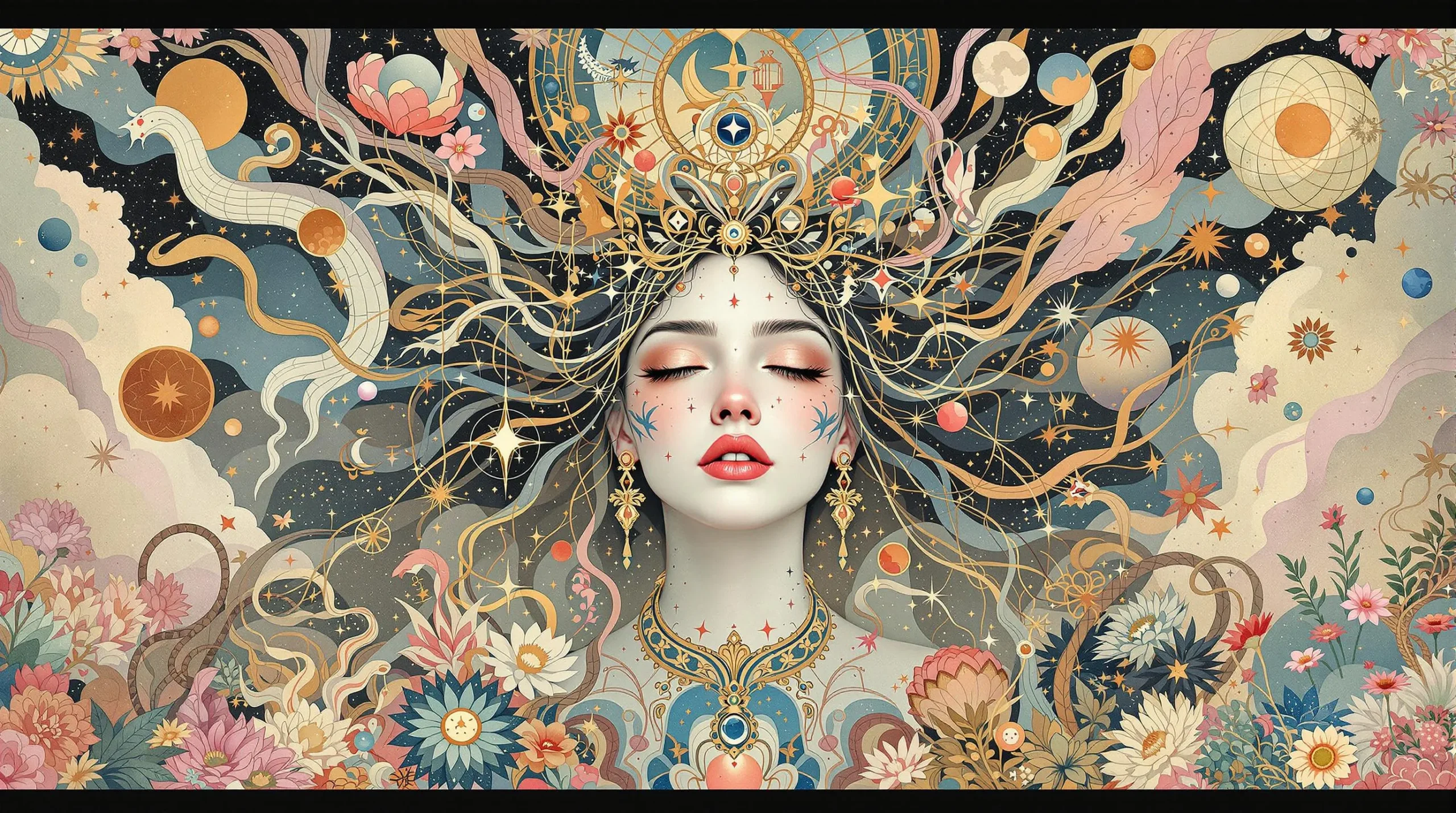


Nanna

Archetype Meaning & Symbolism

Cyclical, luminous, measured, placid, distant, wise, orderly, fertile, solitary, ancient

  • In the heavens, I am the only one who is august.

If Nanna is part of your personal mythology, you may...

Believe

  • You may believe that every ending is also a beginning, that life moves in spirals, not straight lines.
  • You may believe that the most profound truths are found in silence and that wisdom’s native tongue is stillness.
  • You may believe that there is a hidden order, a beautiful and complex mathematical logic, underlying the apparent chaos of the universe.

Fear

  • You may fear being consumed by chaos, a state where patterns dissolve and prediction becomes impossible.
  • You may fear that your quiet nature will be perpetually misunderstood as indifference or weakness, causing you to be overlooked.
  • You may fear losing connection with your own intuition, to be left adrift in a darkness that is no longer illuminated.

Strength

  • Your strength is a profound and unshakable inner calm that can soothe and stabilize those around you.
  • You possess a unique ability to perceive patterns and see the long-term trajectory of events that others miss.
  • Your intuition is a finely tuned instrument, a reliable guide through the ambiguities of life.

Weakness

  • Your contemplative nature may lead to a slowness to act, a tendency toward analysis paralysis while you wait for the 'perfect' phase.
  • You may have a propensity for emotional detachment, creating a distance in relationships that can be perceived as coldness or aloofness.
  • Your sensitivity to your environment can make you fragile, struggling to function effectively in the loud, bright, fast-paced world that is the domain of the sun.

The Symbolism & Meaning of Nanna

To have the moon god Nanna as a current in your personal mythology is to understand that not all light shouts. Some light whispers, revealing texture and shadow where the sun’s glare flattens everything into uniform brightness. Nanna represents the wisdom found in quietude, the clarity that emerges not from action but from observation. He is the patron of the cycle, the cosmic metronome reminding you that everything waxes and wanes: fortune, energy, inspiration, sorrow. Your story may not be one of linear conquest, but of a spiral, revisiting core themes with ever-deepening insight. Nanna is the god of the fixed constant and the visible change, the silver anchor in the shifting tides of the psyche.

The archetype speaks to a knowledge that is cool, mathematical, and rhythmic. Nanna was believed to hold the fates on a string of lapis lazuli, measuring the destinies of gods and mortals alike. In a personal mythos, this translates to a trust in underlying patterns, an ability to see the long arc of a situation. It is the wisdom of the astronomer, not the warrior. You might find meaning in data, in calendars, in the subtle shifts of atmosphere that precede a storm or a breakthrough. This is not cold, unfeeling logic, but the profound beauty of a system in perfect, cyclical motion: the secret clockwork of the world revealed to those patient enough to watch the sky.

Furthermore, Nanna symbolizes a kind of fecundity that is placid and bovine, as he was also associated with cattle. This is not the explosive fertility of a spring storm, but the slow, steady, quiet wealth of a well-tended herd. It points to a creative process that is generative and calm, building value over time through consistent, gentle effort. For you, growth may not be a violent eruption but a slow accumulation, like a pearl forming in darkness. It is the power that resides in stillness, the generative potential of the night when the day’s work is done and the soul’s real accounting begins.


Nanna Relationships With Other Archetypes

The Unruly Garden

The Nanna's soul may find its truest reflection not in a mirror, but in the chaos of an unruly garden. She is its tender, not its architect. Where others might see weeds, she could perhaps recognize the stubborn resilience of a bloodline, the untamable spirit of youth. Each tangled vine of honeysuckle might be a grandchild's complicated story she patiently follows; each surprising volunteer tomato, a flash of unexpected grace. Her relationship with this space is not one of dominion, but of quiet conversation. She doesn't seek to impose perfect, geometric beds upon the land, but rather to cultivate its own wild logic, knowing that the most beautiful blossoms, and the most vibrant lives, often emerge from the spots we neglect to tame.

The Lost Mitten

There exists a quiet, profound kinship between the Nanna and the archetype of the Lost Mitten. The mitten is a small, forgotten grief, a symbol of childhood's tiny, acute sorrows—a moment of carelessness on the playground that feels, to a small heart, like a permanent loss. The Nanna is the keeper of these minor tragedies. Her purpose is not merely to find what is lost, but to restore its comfort. She may not always locate the original, but she can, with a patient rhythm of her hands, knit a new one. This act is a metaphor for her specific genius: a love that doesn't just patch holes, but weaves entirely new warmth, stitch by stitch, to guard against a cold that others might have deemed too insignificant to notice.

The Storm

With the Storm, the Nanna shares no camaraderie, but rather a relationship of profound, quiet opposition. The Storm is the world's chaos—the wailing wind of family crisis, the driving rain of external judgment, the rattling of a house by forces beyond its control. The Nanna does not venture out to battle it. Her power, perhaps, lies in her stillness. She is the lit candle in the window that refuses to be snuffed out. She is the simmering pot on the stove whose aroma is a small, warm defiance of the gale. The Storm may rage, but inside the sphere of her influence, its power could be felt as a distant drumming, a backdrop to the more immediate and important rhythm of a rocking chair or a softly hummed tune. She offers not a shield, but a sanctuary; a reminder that even the most terrifying tempests must eventually pass.

Using Nanna in Every Day Life

Navigating Ambiguity

When faced with a decision clouded by incomplete information, invoking the Nanna archetype encourages a strategic pause. Instead of forcing a conclusion in the glare of insufficient facts, one might choose to wait for the 'moonlight': for the subtle, peripheral data to emerge. It is the practice of trusting that clarity is not always a sudden dawn but a slow, silvery revealing of the landscape of a problem, phase by phase.

Soothing Creative Turbulence

For the artist or writer stuck in a frenzy of self-doubt or a cacophony of external opinions, Nanna offers the solace of the solitary studio at midnight. This archetype sanctions the act of closing the door, of muting the world's noise to hear the quiet rhythm of an idea. It is a permission slip to work by one's own clock, to trust the ebb and flow of inspiration rather than the nine-to-five mandate of productivity, finding genius not in the shout but in the whisper.

Cultivating Inner Authority

In situations demanding a response from a place of deep integrity, Nanna models a form of power that is self-contained and self-aware. It is the quiet confidence of the expert who does not need to raise their voice. When you feel pressured to perform a version of yourself that is louder or more aggressive, this archetype could guide you to hold your ground with placid certainty, letting the substance of your knowledge be its own argument, a silent gravity that pulls others into its orbit.

Nanna is Known For

Lord of the Moon

As the primary lunar deity of the Mesopotamian pantheon, Nanna, later known as Sin, governed the night sky. His journey across the heavens in a barge of lapis lazuli was thought to set the calendar, measure time, and illuminate the darkness, a counterpart to the daily blaze of his son, the sun god Utu/Shamash.

Patron of Ur

Nanna was the tutelary god of the great Sumerian city-state of Ur, where his magnificent ziggurat stood as the sacred and administrative heart of the metropolis. His presence signified divine order, civic prosperity, and the wisdom needed to govern a complex society, linking celestial cycles to earthly stability.

Father of Gods

He is the father of two of the most significant deities

Utu, the god of the sun and justice, and Inanna, the goddess of love, war, and the morning star (Venus). This familial triad represents a complete celestial and psychological cosmology: the quiet wisdom of the moon begetting the brilliant clarity of the sun and the passionate complexities of the human heart.

How Nanna Might Affect Your Personal Mythology

How Nanna Might Affect Your Mythos

When Nanna is a feature of your personal mythos, your life story may resist the simple, sunlit arc of the traditional hero's journey. Instead of a narrative of constant forward momentum, yours could be a story of phases and returns. The plot might circle back on itself, allowing you to re-engage with old challenges from a new vantage point, with the wisdom of a completed cycle. Your defining moments may not be battles won in the daylight, but profound realizations that arrive in the dead of night, moments of quiet, luminous clarity that reframe your entire past and future. The central conflict of your myth is perhaps not Man versus Monster, but Perception versus Obscurity.

You are the protagonist who navigates by a different light. While others are guided by bold ambitions and external markers of success, your quest is for a deeper, internal orientation. Your legend is written in the language of intuition, of pattern recognition, of a profound and steady patience. The great treasures you seek are not golden fleeces but silvered truths. Your allies are those who understand the value of silence, and your great power is the ability to illuminate the hidden paths, for yourself and for others, making you the indispensable guide through the dark forests of uncertainty.

How Nanna Might Affect Your Sense of Self

Your sense of self, under Nanna's influence, may be built around a core of deep inner knowing that requires little external validation. You could perceive your identity not as a fixed, static object, but as a cyclical entity, with its own tides of introversion and extroversion, energy and rest. This view fosters a powerful self-acceptance, a comfort with moods and phases that others might pathologize as inconsistent. You might see your quietness not as a lack, but as a presence: a space where wisdom can cultivate. You are who you are most profoundly when you are alone with your thoughts.

This archetype could also instill a sense of being an observer of your own life, capable of a certain cool detachment that allows for remarkable insight. You may be able to look at your own emotions and experiences with the perspective of a scientist watching a celestial event, noting their trajectory, their intensity, their inevitable passing. This doesn't necessarily mean you are unfeeling, but rather that your feelings don't entirely define you. You are the sky, not the weather. This can grant a foundational stability, a sense that your true self is the calm, witnessing consciousness behind the ever-changing phases of your personal world.

How Nanna Might Affect Your Beliefs About The World

To see the world through Nanna's eyes is to perceive a cosmos governed by rhythm and pattern, not by chaos and force. You may suspect that beneath the noisy surface of daily events, a silent, mathematical order prevails. Your worldview could be one that values subtlety over spectacle, seeing more truth in a whisper than in a speech. You might believe that reality has a dark mode, a whole other dimension of understanding that only becomes visible when the primary lights are turned off and our eyes have time to adjust. This fosters a deep patience and a skepticism of easy answers.

This perspective may also lead to a belief that everything is interconnected in a vast, cyclical dance. The stock market, political tides, personal relationships: all may seem to you to follow predictable, if complex, orbits. This can be deeply comforting, suggesting a universe that is ultimately intelligible, if not always simple. It is a worldview that finds divinity in the intricate clockwork of existence, seeing the hand of the sacred not in the grand miracle, but in the perfect, repeating elegance of the phase, the season, the tide.

How Nanna Might Affect Your Relationships

In relationships, you may be the calm anchor in a storm. You provide a quiet, steady presence that can be profoundly reassuring to more volatile partners. Your way of showing love might be less about grand romantic gestures and more about consistent, reliable presence: being the one who remembers the important dates, who notices the subtle shift in a loved one's mood, who can offer counsel that is both wise and dispassionate. You create a space of quiet stability where others feel seen in a deep and unobtrusive way.

However, this lunar quality might also necessitate a degree of distance. You may require significant solitude to recharge, and you may struggle with relationships that demand constant, high-energy engagement. Your placid nature could be misinterpreted as aloofness or a lack of passion. The ideal relationship for you is one that honors the need for both connection and separateness, a partnership that feels like two celestial bodies in a stable orbit, each with their own gravity and light, but bound by a shared, silent understanding. Intimacy is a quiet room, not a crowded party.

How Nanna Might Affect Your Role in Life

Your role in any group, family, or organization may crystallize into that of the counselor, the strategist, the keeper of the institutional memory. You may not be the one at the front of the stage, but the one in the wings, holding the script and watching the intricate play of light and shadow. You are the one people seek out when the path is lost, because they trust your ability to see in the dark. Your authority is not based on command, but on clarity. You bring order not by imposing rules, but by revealing the inherent order that already exists.

This archetype could cast you as the navigator. In projects or life plans, you are the one who consults the charts, who understands the long game, who advises when to set sail and when to stay in port. This role is vital, yet often invisible to those who only notice the journey's dramatic moments. You may feel a quiet satisfaction in being the hidden mechanism that makes everything run smoothly, the silent, silvered gear in the great machine of collective endeavor.

Dream Interpretation of Nanna

When Nanna appears in your dreams, perhaps as a crescent, a full moon, or a journey on a silver boat, it often points to the state of your intuition and your relationship with the subconscious. In a positive context, a bright, clear moon can signify a moment of profound clarity is approaching. It may suggest that a hidden truth or a solution to a vexing problem will soon be illuminated. Dreaming of following the moonlight could be your subconscious telling you to trust your gut feelings and to proceed on a path that is not yet fully clear but feels deeply right. It is an affirmation of your inner wisdom.

Conversely, a disturbing dream of the moon—perhaps it is eclipsed, bleeding, or falling from the sky—could signal a disconnection from your own inner guidance system. It may reflect a fear of the unknown, or a feeling that your intuition is leading you astray. An eclipsed moon might represent a truth about yourself or a situation that you are actively refusing to see. It can be a warning from the shadow self that a period of confusion, emotional darkness, or painful revelation is at hand, urging you to pay closer attention to the subtle warnings you have been ignoring in your waking life.

How Nanna Archetype Might Affect Your Needs

How Nanna Might Affect Your Physiological Needs

The Nanna archetype may forge a profound link between your personal mythos and your physiological rhythms. You may experience your body less as a machine for performance and more as a natural calendar, deeply attuned to its own cycles. Sleep is not a mere utility but a sacred rite, a journey into the lunar realm of processing and restoration. You might feel a distinct waxing and waning of physical energy that correlates with monthly or even seasonal cycles, teaching you to work in harmony with your body’s tides rather than fighting against them.

This attunement could also manifest as a heightened sensitivity to your environment. You might find chronically bright, loud, or chaotic spaces to be physically draining, creating a physiological need for quiet, dimly lit environments to feel regulated and whole. Your body’s well-being is directly tied to the presence of calm and order. Sustenance might be viewed through a similar lens: not as fuel for a fire, but as a source of steady, generative energy, favoring consistency over dietary extremes.

How Nanna Might Affect Your Ideas of Belonging

With Nanna as a guide, your need for belonging is met not by immersion in a crowd but by a deep, resonant connection with a select few. Belonging is not loud. It is the silent understanding shared with another person who also appreciates the space between words. You may cultivate small, intimate circles where loyalty is unspoken but absolute, and where communication happens on a level of shared intuition. You create belonging by being a source of unwavering, calm support.

You might feel like an outsider in groups that prize performative enthusiasm and constant social interaction. Your sense of connection is easily severed by noise and superficiality. True belonging, for you, is to be with people with whom you do not need to perform. It is the feeling of being in a quiet orbit with other souls, each respecting the other's solitude while being held together by a powerful, invisible gravity of mutual understanding and acceptance.

How Nanna Might Affect Your Feelings of Safety

For you, safety is synonymous with predictability and understanding. The Nanna archetype within your mythos establishes security not through physical walls or weapons, but through knowledge of the patterns that govern your world. You feel safest when you can see the arc of what's coming, whether in a career trajectory, a relationship dynamic, or a social change. The unknown does not feel like an adventure; it feels like a threat to the deep, psychic order upon which your stability rests. Chaos and impulsivity are the true monsters in your story.

Security is therefore an intellectual and intuitive state. It is achieved by observation from a safe distance, by gathering information, and by mapping the territory before you enter it. You might create safety for yourself by building routines and systems that are reliable and rhythmic. Your home may be a sanctuary of quiet and order, a physical manifestation of the internal calm you require. Safety is the quiet confidence that comes from knowing the phases of the moon and trusting that the sun will, eventually, rise again.

How Nanna Might Affect Your Views of Esteem

Esteem, in the mythology of Nanna, is a quality that is self-generated and self-contained. It is the quiet dignity of the moon, which is august in the heavens whether anyone is watching or not. Your self-worth is likely tied to your wisdom, your integrity, and your ability to remain centered amidst turmoil. It does not depend on applause, accolades, or public recognition. In fact, you may be deeply distrustful of such things, viewing them as fleeting and superficial.

Your esteem is built during quiet hours of reflection, study, and mastery of your inner world. It is the confidence that comes from knowing your own 'deep heart,' as the hymns say of Nanna. This can create a formidable, unshakable sense of self, but it can also be a burden. Because your esteem is not fed by external sources, you may struggle to feel your own value if you become disconnected from your inner, contemplative life. Your worth is measured by a standard only you can see.

Shadow of Nanna

The shadow of Nanna manifests as a profound and chilling detachment. It is the wisdom of the moon curdled into a cold, intellectual superiority. In this state, the observer becomes a judge, looking down on the messy, emotional 'daylight' world with disdain. The need for quiet becomes a fortress of isolation, a refusal to engage with the beautiful, necessary chaos of human connection. Relationships are held at an analytical distance, and people become data points in a pattern, not living, breathing souls. It is the lonely tyranny of the silver tower.

Another facet of the shadow is a crippling passivity. The trust in cycles becomes an excuse for inaction. Why strive, why fight, why engage, when this too shall pass? The individual waits for the perfect phase, the ideal alignment of stars, the flawless moment of clarity that never arrives. This leads to a life unlived, a landscape of potential perpetually viewed from a distance but never walked upon. It is the wisdom of patience turned into the paralysis of fear, a slow fading into the background, becoming a ghost in one's own mythos.

Pros & Cons of Nanna in Your Mythology

Pros

  • You possess a rich inner life and a powerful capacity for self-reflection and wisdom.
  • You are often a calming, stabilizing force in your relationships and communities, offering a unique and valuable perspective.
  • Your ability to see long-term patterns makes you a natural strategist and a visionary thinker.

Cons

  • You are susceptible to periods of profound loneliness and may struggle to form connections in a world that values extroversion.
  • Your reserved nature can be easily misinterpreted, leading others to see you as aloof, uninterested, or unemotional.
  • Your deep need for order and predictability can make you rigid and slow to adapt to sudden, unexpected change.