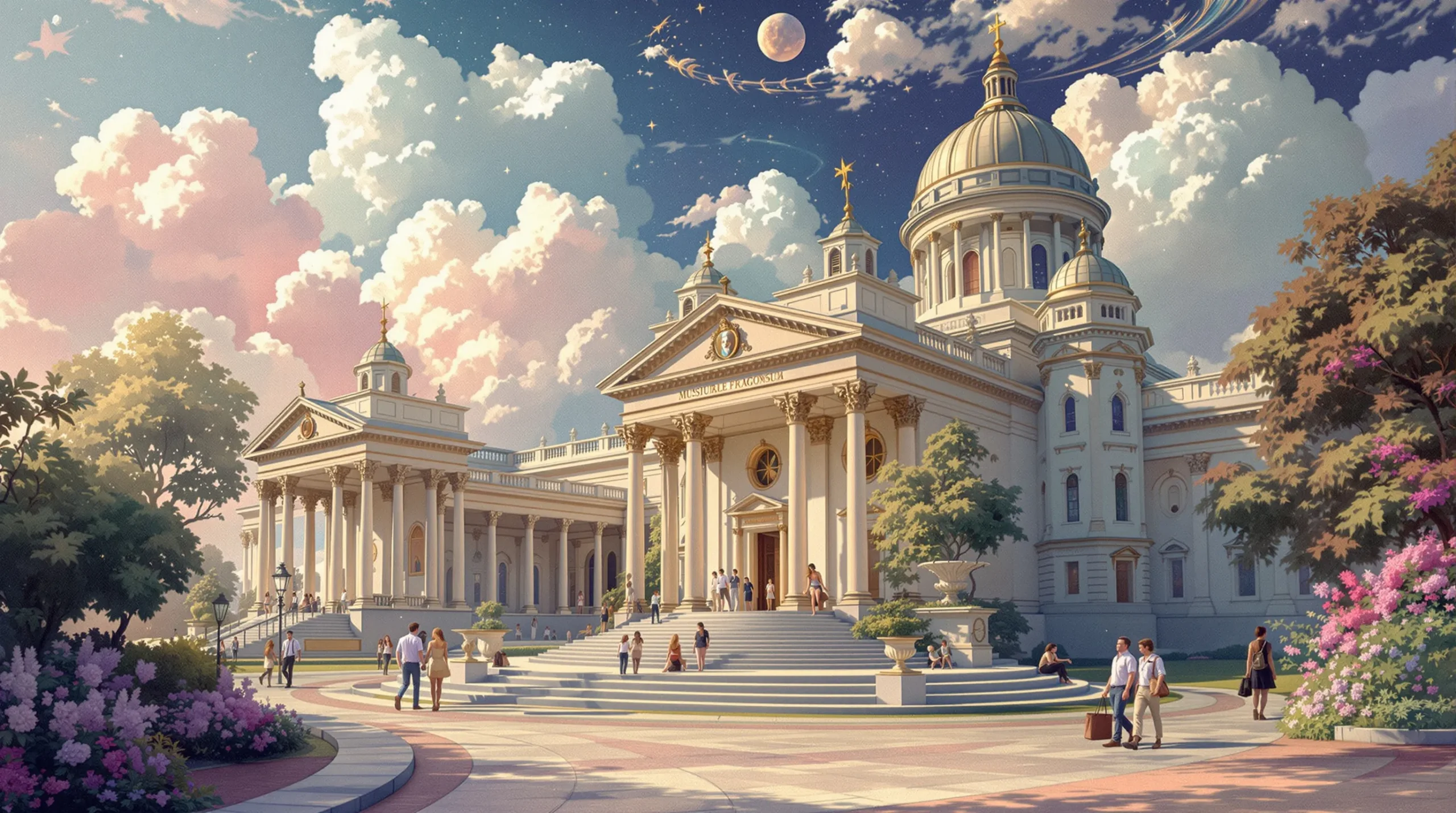


Museum

Archetype Meaning & Symbolism

Curated, historical, preserved, ordered, quiet, narrative, selective, educational, monumental, fragile, reverent, static

  • Do not live here among the relics. Visit, learn, and then return to the world to create the next exhibit.

If Museum is part of your personal mythology, you may...

Believe

  • You may believe that everything, and everyone, has a story that deserves to be understood in its full context.
  • You may believe that the past is not something to be escaped, but a resource to be studied for wisdom and guidance.
  • You may believe that meaning is not found, but carefully constructed through the selective curation of one's own experiences.

Fear

  • You may fear the new and unpredictable, as it threatens the order of your carefully curated world and has no place yet in your established narrative.
  • You may fear being forgotten, or that your life's story and the collections you've built will be lost to time.
  • You may fear that if you stop preserving and archiving, your identity itself will decay and collapse.

Strength

  • Your ability to see patterns across time gives you a rare and valuable perspective that others often miss.
  • You possess a deep capacity for appreciation and reverence, able to find profound meaning in objects and memories that others might overlook.
  • You provide a sense of stability and continuity for others, acting as the keeper of shared histories and traditions.

Weakness

  • You may have a tendency to live in the past, re-visiting old exhibits so often that you neglect to create new ones in the present.
  • You might intellectualize your emotions, treating them as artifacts to be analyzed rather than feelings to be experienced, which can create emotional distance.
  • Your resistance to change can become rigidity, making it difficult to adapt to new situations or to let go of things that no longer serve you.

The Symbolism & Meaning of Museum

The Museum in your personal mythology may symbolize the structured memory, the part of you that collects, categorizes, and displays the past. It is your inner gallery of triumphs and heartbreaks, each housed in a climate-controlled vitrine of the mind. This archetype speaks to a need for narrative, for making sense of the chaotic sequence of life by arranging it into coherent exhibits. One wing might hold the artifacts of childhood: a polished stone, the scent of a specific soap, a feeling of afternoon light. Another might be a stark, minimalist exhibit on a period of loss. To have a strong Museum archetype is to believe that the past is not a ghost that haunts, but a collection that informs. It is a place of profound stillness, where you are both the curator and the sole visitor.

Furthermore, the Museum archetype could represent your relationship with culture, history, and legacy. It suggests a consciousness that sees itself as part of a longer story, a link in a chain of human experience. Your personal identity may be a collection of influences: the art you love, the history that shaped your ancestors, the ideas that form your worldview. These are not just interests; they are artifacts you have chosen to acquire and display in the grand museum of the self. This perspective imbues life with a sense of permanence and significance. The small moments are not fleeting; they are potential acquisitions, moments that might one day be deemed worthy of a place in the permanent collection.

This archetype also speaks to the power of perspective. Just as a simple object is transformed when placed on a pedestal with a descriptive plaque, your experiences gain new meaning when you frame them within your inner Museum. A mistake is no longer just a failure; it becomes an exhibit on resilience. A joyful memory is not just a pleasant thought; it is a masterpiece of your personal collection, to be visited for solace and inspiration. The Museum provides the distance and the context necessary to see your own life with the awe and scholarly appreciation of a visitor, transforming personal history into a work of art.


Museum Relationships With Other Archetypes

The Library:

The Library is the Museum's intellectual sibling, a repository of knowledge and text. While the Museum displays the tangible object, the artifact, the thing-in-itself, the Library holds the written record, the abstract thought. In a personal mythos, your Museum might hold the actual teacup your grandmother used, while your Library holds her transcribed recipes and journals. They could be allies in the quest for understanding the past, though they may argue over primacy: is truth best found in the silent presence of an object or in the articulate voice of a text? A healthy psyche perhaps needs both wings, the gallery and the reading room.

The Wilderness:

The Wilderness is the antithesis of the Museum. It is untamed, chaotic, and governed by the cycles of growth and decay, not preservation. The Museum is civilization's attempt to halt this process, to select and protect. A person with a dominant Museum archetype might view their inner Wilderness with suspicion, a place of messy, unpredictable emotions and instincts. Conversely, a journey into the Wilderness might feel like a necessary act of rebellion, a way to collect new, raw experiences before they are tamed and cataloged. The relationship is one of tension: order versus chaos, curation versus raw creation.

The Collector:

The Collector is the active agent who serves the Museum. While the Museum is the structure, the state of being, the Collector is the one who ventures out, acquiring new pieces for the exhibits. The Collector archetype drives the impulse to gather experiences, memories, and knowledge. However, an unhealthy relationship may emerge. The Collector, driven by passion, might overwhelm the Museum, cluttering its halls with acquisitions that have not been properly processed or curated, turning the sacred space into a hoarder's den. A balanced dynamic sees the Collector’s passion tempered by the Museum’s discerning, curatorial wisdom.

Using Museum in Every Day Life

Processing Grief:

After a significant loss, you might mentally construct a wing of your inner Museum dedicated to the person or experience. Here, you can carefully select the objects of memory: a photograph, the echo of a laugh, a specific piece of advice. This act of curation allows you to honor the past and contain the pain, visiting the exhibit when you need to remember, rather than carrying the entire weight of the loss with you at all times. It transforms raw grief into a narrative of love and legacy.

Career Navigation:

When feeling lost in your professional life, the Museum archetype could serve as your personal portfolio of skills and accomplishments. Each project, success, or even failure is an artifact in a collection. By walking through these exhibits, you may discern a pattern, a theme, a story of your professional evolution. This retrospective viewing can reveal your core talents and passions, guiding you not toward the next logical step, but toward the one that best completes the collection of who you are becoming.

Understanding Family Dynamics:

You may use the Museum archetype to map the complex history of your family. Each relative becomes a portrait in a gallery, each family story a diorama. By observing these exhibits with a curator’s detachment, you could begin to see the generational patterns, the inherited gifts and burdens, not as inescapable fates but as historical context. It allows you to appreciate the artistry and tragedy of your lineage without being trapped within its frame.

Museum is Known For

Preservation

The Museum is known for its ability to hold moments, objects, and ideas still against the tide of time, protecting them from decay and forgetfulness.

Curation

It is defined by its selective process: choosing what is worthy of display, what story to tell, and how to arrange the pieces to create a specific narrative and meaning.

Quiet Contemplation

The atmosphere of the Museum invites a state of silent reflection, a space set apart from the noise of daily life where one can observe and connect with the past in a structured way.

How Museum Might Affect Your Personal Mythology

How Museum Might Affect Your Mythos

When the Museum is a central feature of your personal mythos, your life story may be perceived not as a linear adventure but as a series of curated galleries. Each chapter of your life—childhood, education, career, relationships—is a distinct wing with its own theme and collection of artifacts. Your narrative might be less about what happens next and more about how the current moment will one day be framed and understood. You may find yourself acting as the historian of your own life, carefully documenting events, saving mementos, and mentally writing the plaques that will explain their significance. This creates a mythos rich with context, legacy, and a deep appreciation for the unfolding story, as if you are living a life already worthy of a retrospective.

This archetype could also shape your mythos around the theme of meaning-making. The central conflict of your story might not be an external battle, but the internal, curatorial struggle of what to preserve and what to place in storage. The heroic journey could be the process of building a new exhibit from the ashes of a painful past, or rediscovering a forgotten wing of your own history. Your personal legend becomes a testament to the power of perspective, demonstrating that the meaning of an event is not inherent in the event itself, but in how it is displayed, lit, and contextualized within the greater collection of your life.

How Museum Might Affect Your Sense of Self

Your sense of self may be deeply intertwined with your past, viewed as a collection of experiences that define you. Identity is not a fluid state of becoming but a carefully assembled exhibition of who you have been. This can provide a powerful sense of stability and rootedness; you know who you are because you have the evidence, carefully cataloged in the halls of your mind. You might see your personality traits, skills, and beliefs as artifacts acquired over time, each with a known provenance. This creates a self-concept that is coherent and narrative-driven, but it could also feel static, making it difficult to embrace change or imagine a future self that is not simply a continuation of the existing collection.

This can also foster a self that is highly reflective and introspective. You may spend considerable time 'walking the halls' of your own mind, examining past decisions, re-interpreting old memories, and seeking patterns. This can lead to profound self-awareness and wisdom. However, it may also lead to a sense of detachment, as if you are observing your life from behind glass. You might relate to your own emotions as interesting but historical phenomena rather than as immediate, lived experiences. The self becomes a fascinating object of study, a permanent collection to be maintained, rather than a living organism in constant flux.

How Museum Might Affect Your Beliefs About The World

Your worldview might be that of a historian or an anthropologist, seeing the present as a thin layer deposited upon millennia of human experience. You may view cultures, political systems, and social trends not as new phenomena, but as echoes and reinterpretations of past exhibits. This can instill a sense of calm and perspective amidst contemporary chaos; you've seen variations of this exhibition before. It fosters an appreciation for tradition, legacy, and the slow, deep currents of history, rather than the fleeting froth of the present moment. The world is a grand, living museum, and every person, every event, is a potential artifact with a story to tell.

This perspective could also lead to a worldview that prioritizes preservation and understanding over progress and innovation for their own sake. You may believe that the answers to today's problems are housed in the archives of the past, if only we would take the time to study them. You might be skeptical of movements that seek to erase or rewrite history, viewing them as a kind of vandalism. Your lens on the world is one of careful observation and contextualization, believing that nothing truly happens in a vacuum and that every object, person, and idea is part of a much larger, older collection.

How Museum Might Affect Your Relationships

In relationships, you may take on the role of the archivist, lovingly documenting the history of the connection. You might be the one who saves ticket stubs, remembers anniversaries with specific details, and tells the 'origin story' of your friendships and romances. This can make your partners and friends feel cherished and seen, their importance memorialized in the gallery of your heart. You offer the gift of a shared history, a curated collection of moments that solidifies the bond and gives it a sense of permanence and significance. Your relationships are not disposable; they are long-term exhibits to be tended to.

However, this curatorial approach could sometimes create distance. You might have a tendency to place a relationship 'under glass,' analyzing it and preserving it rather than fully living in its messy, unpredictable present. When conflict arises, your instinct may be to retreat and file the event away as another artifact, rather than engaging with the raw emotion of the moment. There's a risk of turning loved ones into beautiful portraits in your gallery rather than dynamic, living partners. Others may feel that they are being studied rather than simply loved, their actions constantly being assessed for their historical significance within the narrative you are building about the relationship.

How Museum Might Affect Your Role in Life

You may see your role in life as that of a curator, a guardian of stories, memories, and traditions. Whether in your family, your community, or your profession, you might be the one who preserves what is valuable from the past and presents it in a way that is meaningful for the future. This could manifest as being the family historian, the mentor in the office who shares institutional knowledge, or the artist whose work re-contextualizes historical themes. Your purpose is not necessarily to invent something new, but to make sense of what already exists, to connect the dots and reveal the hidden narrative. You provide context, depth, and a sense of continuity in a world that often prizes novelty above all.

This perceived role can also be one of a guide or docent for others. You help people understand their own history and its place in a larger context. You have a knack for framing experiences in a way that reveals their significance, helping a friend see a painful breakup not as a failure but as a pivotal acquisition for their 'Resilience' wing. Your contribution to the world is one of perspective. You slow people down, inviting them out of the rush of the present and into the quiet, contemplative halls of meaning, showing them that their lives are also museums worthy of careful, reverent attention.

Dream Interpretation of Museum

In a positive context, dreaming of a Museum may signify a period of successful integration and self-understanding. You are walking through well-lit, beautifully arranged halls, looking at exhibits from your own life with a sense of peace and appreciation. This could indicate that you have made sense of a difficult past experience, transforming it from a source of pain into a source of wisdom. The dream might highlight a specific exhibit, drawing your attention to a part of your past that now holds a key to a present challenge. It is a dream of clarity, perspective, and the quiet satisfaction that comes from having a coherent, meaningful life story.

Conversely, a negative dream about a Museum could be deeply unsettling. You might find yourself lost in endless, dusty corridors, with exhibits that are broken, covered in sheets, or depicting disturbing scenes. This could symbolize a feeling of being trapped by your past, unable to escape old patterns or traumas. Perhaps you are the only exhibit, trapped behind glass for others to stare at, suggesting feelings of objectification or a loss of agency. A dream of a burning or crumbling museum might represent a fear of losing your identity or your memories, a crisis in your personal mythos where the very structure of your story feels threatened.

How Museum Archetype Might Affect Your Needs

How Museum Might Affect Your Physiological Needs

The Museum archetype may influence your physiological needs by promoting a highly structured and controlled approach to the body. You might see your body as a complex system to be maintained with the precision of a museum conservator. This could manifest as meticulous diet plans, regimented exercise schedules, and a data-driven approach to health, tracking sleep, nutrition, and other metrics like an archivist. The goal is preservation: to keep the body functioning optimally and to slow the inevitable process of decay. This creates a physical life that is ordered and predictable, where the body's needs are cataloged and met with deliberate care.

This can also foster a certain detachment from the body's more chaotic signals. The raw, instinctual demands of hunger, fatigue, or desire may be viewed as problems to be managed or data points to be analyzed, rather than as experiences to be inhabited. There might be a preference for controlled environments—the climate-controlled gym over a wild outdoor trail, the carefully planned meal over a spontaneous feast. The body is less a source of wild, immediate sensation and more a precious, ancient artifact that must be carefully handled to ensure its longevity.

How Museum Might Affect Your Ideas of Belonging

A sense of belongingness and love may be deeply connected to shared history. You might feel closest to people with whom you have a rich, well-documented past. Love is built, in your view, through the accumulation of shared memories, like creating a special exhibit together. You may express affection by recalling specific past moments, creating photo albums, or establishing meaningful traditions. To be loved is to be given a permanent, prominent place in someone's personal museum. You offer a love that is steadfast, loyal, and appreciative of the entire history of a person, not just who they are today.

However, this can create challenges in forming new connections, which lack the requisite history. You might feel a subtle distrust or distance from new people until a sufficient number of 'memory artifacts' have been collected. There could also be a tendency to idealize past relationships, whose exhibits are complete and perfectly preserved, making it difficult for new, imperfect, living relationships to compete. The need for a shared narrative can sometimes overshadow the need for present-moment connection, as you may be more focused on how a moment will be remembered than on simply experiencing it with another person.

How Museum Might Affect Your Feelings of Safety

For one with the Museum in their mythos, safety is found in the predictable and the known. The past, having already happened, is the ultimate safe space. Security needs may be met by building a life that is a fortress of routine and curated experience, minimizing exposure to the unpredictable chaos of the world. Safety is a well-ordered floor plan, where there are no surprises around the corner. You may find comfort in history and data, believing that by studying the patterns of what has been, you can effectively anticipate and neutralize future threats. Financial security might involve meticulous archiving of records, and emotional security might come from replaying known, happy memories.

This quest for safety through order can, however, become a gilded cage. The world outside the museum walls—the world of spontaneity, risk, and uncontrolled variables—can appear overwhelmingly threatening. A deep-seated fear of the new and unknown may develop, as new experiences are un-cataloged and their potential for disruption is high. True safety might be elusive, as the effort to control every variable and preserve a static state of being is ultimately at odds with the dynamic, ever-changing nature of life itself. The walls built to keep danger out may also prevent new life from getting in.

How Museum Might Affect Your Views of Esteem

Esteem may be built upon a curated collection of past achievements. Your self-worth could be grounded in a mental 'Hall of Accomplishments' where you can visit your past successes—diplomas, awards, successfully completed projects, moments you were proud of. This provides a solid, evidence-based foundation for self-respect. When faced with a crisis of confidence, you can walk through these halls and remind yourself of your capabilities. Your esteem is not based on fleeting external validation but on the permanent record of your own history.

This foundation can also be brittle. If your sense of esteem is tied exclusively to past glories, you may feel immense pressure to constantly add new, impressive artifacts to the collection. A period of failure or stagnation can feel catastrophic, as if your museum is falling into ruin. There's also a risk of becoming defined by your past achievements, unable to see your worth beyond them. You might resist trying new things where you might fail, as failure would mar the pristine record of the collection. True esteem may require not just preserving past successes, but also making peace with the exhibits on failure and learning.

Shadow of Museum

The shadow of the Museum emerges when curation becomes petrification. Life ceases to be a dynamic process and becomes a static collection of memories. In this shadow state, you are no longer a visitor to your past but a permanent, ghostly inhabitant, endlessly polishing old trophies while the world moves on outside. New experiences are rejected because they are messy and don't fit the existing narrative. Relationships wither because people cannot be pinned down like butterflies in a display case. The shadow Museum is a mausoleum, a tomb of your own making, where the desire to preserve has killed the very life it sought to honor. It is the sterile silence not of contemplation, but of death.

Another facet of the shadow is hoarding. The discerning eye of the curator is lost, replaced by an anxious inability to let anything go. Every memory, every object, every grudge is kept, regardless of its value or toxicity. The clean, well-lit halls of the psyche become a cluttered, impassable maze of psychic junk. There is no narrative, only chaos. The story is lost beneath the sheer volume of uncurated material. This shadow turns the act of remembering from a source of wisdom into a crushing burden, a heavy, disorganized archive that makes clear thought and forward movement impossible.

Pros & Cons of Museum in Your Mythology

Pros

  • You have a strong, coherent sense of self, rooted in a well-understood personal history.
  • You are able to learn from your experiences, as you consciously reflect on and integrate the lessons of the past.
  • You can bring a sense of meaning, context, and reverence to everyday life, elevating the mundane to the significant.

Cons

  • You may be resistant to change and prone to nostalgia, finding it difficult to embrace the present and future.
  • You can seem emotionally detached, observing life from a distance rather than participating in it fully.
  • You risk becoming defined by your past, unable to reinvent yourself or move on from old identities and failures.