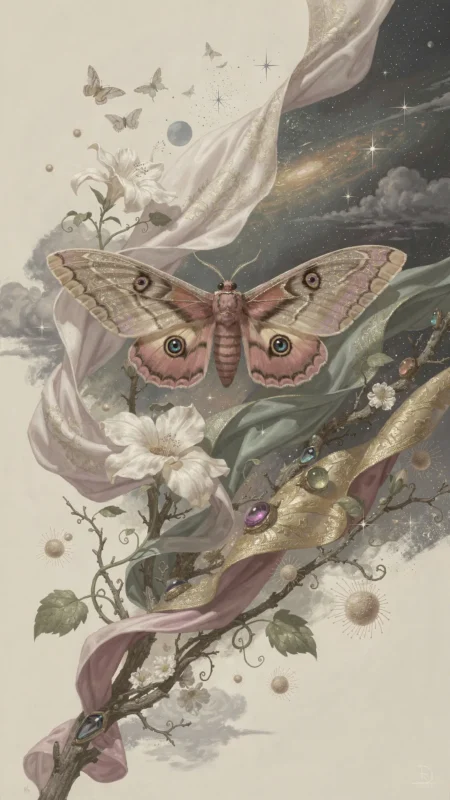
The Flame
The relationship between the Moth and the Flame is perhaps the central, defining myth of this archetype—a sacred transaction disguised as a fatal attraction. The Flame is not merely an object of desire; it is a terrible and beautiful god, a siren's song cast in light. The Moth’s journey toward it could be seen as a pilgrimage toward a truth so absolute it must consume the seeker. In this dance, the Moth may not fear its own immolation but rather sees it as the final, necessary act of union, a shedding of the mundane self to merge with the blinding, divine essence it has always sought. It is a love story about the soul’s unbearable longing for a purity that can only be found in its own undoing, a testament to the idea that the most profound illumination might demand the price of existence itself.
The Moon
If the Flame is a feverish, immediate passion, the Moon is a cool and ancient compass, the original love the Moth has perhaps forsaken. The Moon’s light offers no heat, no promise of ecstatic transformation, only a silvered, silent guidance. This relationship might speak to a schism within the archetype's soul: the instinctual, inherited wisdom of the lunar pull versus the incandescent, modern lure of the artificial fire. The Moth, fluttering erratically in the night, could be a creature caught between two devotions—one to the vast, serene, and predictable cosmos, and the other to the chaotic, brilliant, and ultimately annihilating spectacle of the immediate. The Moon’s gentle light may represent a path of survival and quiet contemplation, a path that has become almost invisible in the shadow of the Flame’s shout.
The Dusty Windowpane
The Dusty Windowpane may be the most tragic of the Moth’s partners, for it is a relationship defined by a cruel, transparent law. It is the invisible barrier, the limit of perception that becomes a physical prison. The Moth’s frantic, percussive prayer against the glass is a ballet of thwarted ambition, a perfect metaphor for the struggle against limitations one cannot fully comprehend. The pane separates the world of instinct from the world of the ideal—the lamp-lit room of warmth and knowledge. The dust itself, accumulated over time, could symbolize the layers of disillusionment and failed attempts that obscure the very light being sought. Here, the Moth is not a willing martyr but a frustrated philosopher, endlessly testing the nature of a reality that allows it to see salvation but never to touch it.

 Believe
 Fear
Fear Strength
 Weakness