Believe
 Fear
Fear Strength
 Weakness
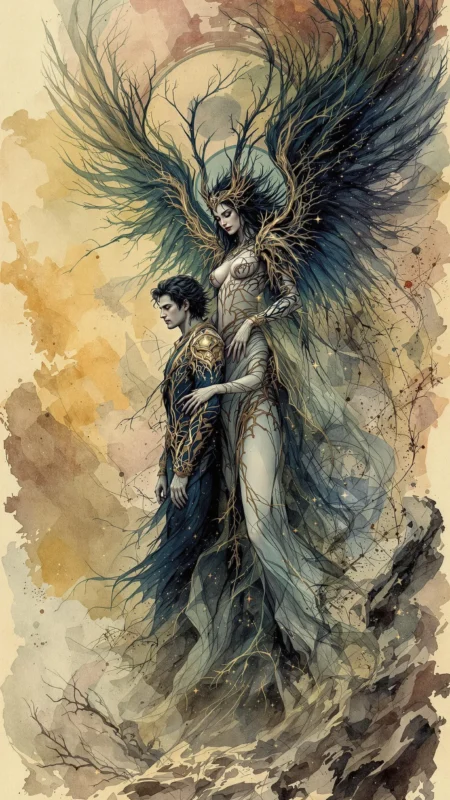
The Morrigan lands in the modern psyche not merely as a goddess of war, but as the patroness of radical, necessary transformation. She is the churning chaos that precedes a new order, the storm that scours the landscape clean. In a personal mythology, her presence suggests that your life is defined by its turning points, its instigated endings. She is the force you might call upon when a part of your life—a job, a belief, an identity—has become a stagnant peace, a pretty prison. She symbolizes the terrifying, yet vital, truth that destruction is a fundamental component of creation. The battlefield is not just a place of death: it is a tilled field, violently turned over to make way for a new crop.
Her essence is liminality. The Morrigan stands at the threshold, the river ford where soldiers must cross and where their fate is revealed. To have her in your mythos is to feel at home in the in-between. You may find yourself perpetually at a crossroads, not out of indecision, but because that is your native territory. This could manifest as a career that blends disparate fields, an identity that resists easy labels, or a spiritual path that walks the unsettling border between shadow and light. She represents the power that is found not in stable certainties, but in the dynamic tension of the threshold itself, the place where all possibilities, beautiful and terrible, coexist.
Above all, she is the embodiment of sovereignty. This is not the simple dominance of a king, but the unassailable self-possession of a queen whose kingdom is her own soul. Her power is chthonic, rising from the earth of her own being, and it answers to no higher authority. For the individual, this could be the central quest of your life's story: the journey to claim this internal throne. It is the process of untangling your worth from the opinions of others, of learning to trust the prophecies of your own intuition, and of wielding your own power with the fierce responsibility of a monarch guarding her only true territory: the self.