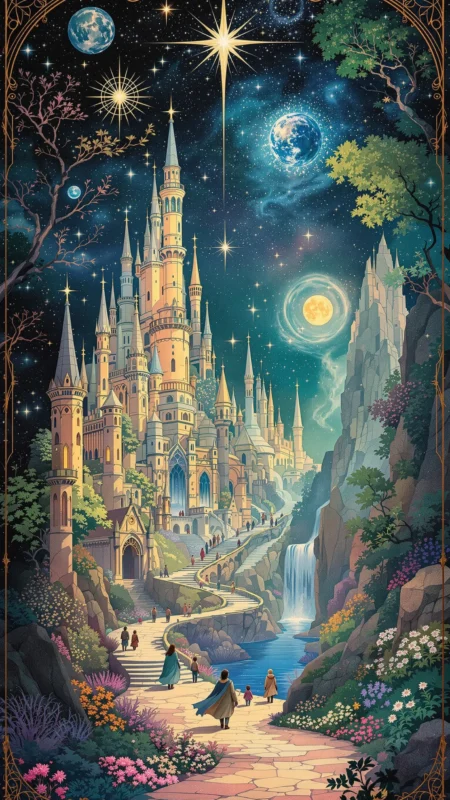


Middle-earth

Archetype Meaning & Symbolism

Ancient, cyclical, mundane, epic, sorrowful, hopeful, provincial, vast, decaying, enduring

  • The path you walk was trod by a thousand others, yet your footprints are your own. Do not mistake the map for the journey.

If Middle-earth is part of your personal mythology, you may...

Believe

  • You may believe that history is not over, and that the choices of ordinary people are the hinges upon which the future of the world turns.

    You may believe that there is a good in this world, and it's worth fighting for, even when all other hope is gone.

    You may believe that true home is not just a place you live, but a state of being you carry within you and fight to protect in the world.

Fear

  • You may fear the seductive whisper of power, the 'One Ring' in your own life that promises control but demands the price of your soul.

    You may fear that the world is irredeemably in decline, that the age of magic and heroes is over, and all that is left is to manage the inevitable decay.

    You may fear that after a great trial, you will be unable to return to a simple life, that the wounds you carry will forever set you apart from those who stayed behind.

Strength

  • You may possess an extraordinary resilience, an ability to keep putting one foot in front of the other long after others would have given up hope.

    You may have a profound capacity for loyalty, forging friendships that can withstand the greatest of trials and temptations.

    You may have a deep appreciation for the simple, beautiful things in life: a good meal, a warm fire, a story well told, which can sustain you through dark times.

Weakness

  • You may have a tendency toward melancholy and a sense of world-weariness, a feeling that you've seen too much of the world's sorrow.

    You may be overly suspicious of novelty and progress, viewing the outside world with a provincial distrust and clinging to the past.

    You may sometimes feel a sense of fatalism, that your choices are small and insignificant in the face of vast, ancient forces beyond your control.

The Symbolism & Meaning of Middle-earth

To adopt Middle-earth as a personal mythological landscape is to internalize a map of immense psychological depth. The soul becomes a realm with its own geography: there are safe, sunlit shires of comfort and simple joy, deep and perilous mines of Moria where one might delve too greedily into the subconscious, and serene elven valleys like Rivendell, representing moments of profound clarity, art, and healing. Mordor is not merely an external threat but the landscape of one's own desolation, the psychic territory of obsession, addiction, or despair. Navigating one's life, then, becomes a form of cartography, understanding which regions of the self are fertile, which are barren, and which hold sleeping dragons.

This archetype also infuses the personal narrative with a sense of profound history, a lineage of being. You are not an isolated individual but the current link in a long chain, the heir to the strengths and sorrows of those who came before. Your personal 'lore' and 'annals'—family stories, past traumas, inherited talents—become as significant as the histories of the elves and the kings of old. This perspective could suggest that your struggles are not unique but part of an ancient, recurring pattern, and that wisdom lies in consulting the 'lore' of your own past to understand the present. It turns memory into a living library, a source of guidance and warning.

Furthermore, the Middle-earth archetype champions a radical synthesis of the epic and the mundane. It suggests that the most significant quests are born in the most unassuming places, over a shared meal or a walk along a country lane. This framework allows an individual to see the heroic in the everyday: the loyalty between friends becomes a fellowship, the struggle to maintain a home becomes the defense of the Shire, and the resistance to cynicism becomes the fight against the Long Defeat. It sanctifies the small, quiet virtues, proposing that the courage to plant a garden in dark times is as profound as the courage to wield a sword.


Middle-earth Relationships With Other Archetypes

The Hero's Journey

Middle-earth is the grand, breathing stage upon which The Hero's Journey unfolds, but it is a stage that actively shapes the play. The landscape is not a passive backdrop; it is a character. The perilous pass of Caradhras is the mountain’s own will pushing back, the Golden Wood of Lothlórien is a test of perception and purity. Unlike a generic setting, Middle-earth infuses the Hero’s Journey with a sense of deep time and consequence. The hero isn't just changing himself; he is a participant in an ages-old struggle, and the land itself will bear the scars or the healing of his passage.

The Ruin

The Ruin is a constant presence in Middle-earth, from the lonely watchtower of Weathertop to the skeletal remains of Osgiliath. This archetype's relationship with the land is one of memory and warning. The Ruin signifies that nothing, not even the greatest kingdoms or the most powerful magic, is permanent. For a person whose mythos includes Middle-earth, this may foster a poignant awareness of impermanence. Their personal failures or past 'ages' are not things to be erased but are ruins in their own soul-scape, places of sorrow that also hold wisdom and a strange, mournful beauty, reminding them that even in decay, a story remains.

The Garden

The Shire is a specific and powerful iteration of The Garden archetype. It is not an untouched Eden but a cultivated, lived-in paradise of simple, earthy pleasures. Its relationship with the wider archetype of Middle-earth is one of codependence and contrast. The Garden's existence is what makes the journey worth taking; it is the heart that the rest of the body politic must protect. Yet, it is also fragile and provincial, its innocence predicated on ignorance of the world outside. For the individual, this may symbolize the core of their being—their innocence, their capacity for simple joy—which must be both cherished as a source of strength and protected from the corrupting forces of their own 'Mordor'.

Using Middle-earth in Every Day Life

Navigating a Period of Depression

When one feels lost in a Mirkwood of the soul, a place of tangled thoughts and unseen dread, the archetype offers a map. It suggests that such forests have paths, however hidden, and that even if you cannot see the sun, it is still there. Your journey through this darkness is not a sign of failure but a necessary passage, one that requires the companionship of a steadfast Samwise or the unexpected light of a Phial of Galadriel: a small, preserved memory of goodness.

Facing an Overwhelming Project

Confronted with a task that feels like a quest to Mordor, a long, arduous slog with no certain end, this archetype reframes the challenge. It is not about a single heroic leap but about putting one foot in front of the other. The focus shifts from the terrifying scale of Mount Doom to the immediate need: taking the next step, sharing the burden with a companion, and remembering the Shire you are fighting to protect, whether that be a peaceful home life, a creative vision, or a sense of personal integrity.

Finding Meaning in a Quiet Life

The archetype of the Shire provides a powerful counter-narrative to the relentless cultural demand for ambition and adventure. It sacralizes the small, the local, and the domestic. Tending a garden, sharing a meal with friends, perfecting a small craft: these are not distractions from a grand purpose but are the purpose itself. It allows one to feel that a life lived in quiet dignity and simple pleasure is as valid and essential to the world as that of any wandering king.

Middle-earth is Known For

The Struggle Between Shadow and Light

Middle-earth is known for its stark, yet deeply nuanced, portrayal of good versus evil. It is not a simple battle of armies but an internal, creeping corruption that can tempt anyone, a shadow that is the absence of light and a twisting of what is good. This struggle is personal before it is global.

The Importance of the Small Folk

A central tenet of the world is that history is turned not by the great and powerful, but by the small, the overlooked, and the humble. Hobbits, with their love of comfort and peace, are the unlikely saviors, suggesting that true strength lies in simple decency and resilience, not in power or might.

A Sense of Deep Time

The landscape is haunted by a profound sense of history and loss. Every ruin, barrow, and ancient road tells a story of what has passed. It is a world in a state of beautiful, sorrowful decline, a 'long defeat' where victory is temporary and hope is found not in final triumph, but in the courage to continue the fight.

How Middle-earth Might Affect Your Personal Mythology

How Middle-earth Might Affect Your Mythos

When Middle-earth shapes a personal mythos, one’s life story may cease to be a linear progression and become an epic, told in Ages. There was the First Age of youthful innocence in a sheltered Shire, followed by the Second Age of forging alliances and rings of commitment, and perhaps now a Third Age of fighting a long, wearying battle against a creeping shadow. This reframes personal history as a saga, lending weight and significance to its chapters. Failures become fallen kingdoms, past relationships are ancient alliances now broken, and personal values are the 'lore' passed down through the generations of the self. The narrative is no longer just 'what happened' but becomes a mythology of one’s own becoming, imbued with a sense of destiny and a deep, resonant past.

The concept of the 'long defeat' may become central to this mythos. Life is not seen as a series of escalating victories culminating in a final 'happily ever after'. Instead, it is a noble struggle against entropy, decay, and darkness, where the true victory lies not in winning, but in the courage and loyalty shown along the way. This perspective allows for immense resilience. A lost job, a painful breakup, a chronic illness—these are not endpoints but battles in a longer war. The mythos is not about achieving a perfect, restored kingdom, but about finding the strength to light the beacons of hope, even when the shadow seems to be falling everywhere.

How Middle-earth Might Affect Your Sense of Self

The Middle-earth archetype may foster a sense of the self as ancient and multi-layered. One might feel a deep connection to their own history, seeing their present personality as just the latest chapter in a long book. There could be an 'inner hobbit' who craves comfort, food, and peace, coexisting with an 'inner ranger' who is world-weary, watchful, and drawn to the wild. This dualism allows for a complex self-image, one that honors both the need for domestic tranquility and the call to a greater purpose. It suggests the self is not a static entity but a fellowship of different beings, each with their own strengths and desires.

This archetype may also instill a profound sense of humility. To see oneself as a single hobbit or one man in the vast sweep of an Age is to recognize one's own smallness. Yet, this is not a diminishing perspective; it is a liberating one. It removes the narcissistic pressure to be the sole, all-powerful hero of the story. Instead, one's value is determined by their role within the fellowship and their willingness to play their small, crucial part. Self-worth is tied not to being the center of the universe, but to being a reliable and courageous part of a much larger, and much more important, story.

How Middle-earth Might Affect Your Beliefs About The World

A worldview shaped by Middle-earth is one that sees the modern world as a thin veneer over an ancient, slumbering reality. The concrete and steel of a city may seem to rest atop forgotten ruins and hidden streams; a patch of old-growth forest at the edge of a suburb is not just trees but a remnant of a wilder, more magical age. This perspective imbues the world with a sense of enchantment and deep history. It fosters a belief that there is more to reality than what is immediately apparent and that echoes of the past resonate in the present moment, for those with the eyes to see and ears to hear.

This view may also be deeply moral, though not simplistic. Evil is perceived as a real, tangible force: a corruption, a shadow, a will to dominate that twists good things to its own purpose. It is Sauron, who was once a gifted pupil of a benevolent god. This means that evil is not a separate creation but a choice, a falling away from the light. Consequently, the fight against it is not just for governments or armies, but a daily, personal struggle. The choice to act with kindness, to create beauty, to speak truth to power, is a direct, meaningful blow against the encroaching darkness. It is lighting a small flame in a vast and encroaching night.

How Middle-earth Might Affect Your Relationships

Relationships may be viewed through the lens of the 'fellowship'. The deepest bonds are not formed by convenience or casual acquaintance but are forged in the fires of shared adversity. A 'fellowship' is a small, fiercely loyal group united by a common purpose, who have seen each other at their worst and have chosen to stand together regardless. This elevates friendship to something sacred, a pact of mutual protection and support against a difficult world. One might have many acquaintances, but only a handful of people in their true fellowship, their 'company'.

Furthermore, this archetype places an extraordinary value on steadfast loyalty and service within relationships. The model is not one of passionate, fleeting romance but of the enduring, quiet bond between a Frodo and a Sam. It champions a love that expresses itself through practical care: carrying a friend's burden, offering a simple meal, staying by their side when all hope seems lost. It suggests that the most profound declarations of love are not spoken in grand poetry, but in the simple, repeated promise: 'I’m with you.' This can lead to relationships of incredible depth and resilience, built on a foundation of unwavering, mutual devotion.

How Middle-earth Might Affect Your Role in Life

One’s role in life may be perceived as a matter of destiny, yet a destiny that must be freely chosen. Like Aragorn, one might feel they are born to a certain path or 'heir' to a particular legacy, be it a family business, a creative talent, or a specific responsibility. There could be a long period of wandering in the 'wild' of self-doubt and evasion, a reluctance to claim the mantle. The role is therefore not a comfortable fit but a heavy burden that one must grow into. It is a sense that your life is not entirely your own, but that you are a steward of a particular purpose for a time.

Alternatively, one might identify with the hobbit’s role: the small person unexpectedly swept up in great events. This fosters a sense that one does not need to seek out a grand role; the role will find you when the time is right. The most important task may arrive unbidden, knocking on the door of your comfortable life. This creates a state of passive readiness, a belief that one’s ordinary life is a training ground for an extraordinary moment. The role is not about status or power but about answering the call when it comes, and finding you have the courage and resilience you never knew you possessed.

Dream Interpretation of Middle-earth

In a positive context, dreaming of the landscapes of Middle-earth may symbolize a connection to the deepest, most timeless parts of the psyche. To dream of walking in Lothlórien could represent a period of healing, intuitive insight, and a feeling of being in harmony with one's true self. Finding oneself in Rivendell might suggest the need for counsel, artistic creation, and a safe harbor to recover from a long journey. A dream of the Shire could be the soul’s plea for a return to simplicity, comfort, and the nourishment of community. These dreams are often affirmations that the dreamer possesses an inner sanctuary of peace and wisdom to which they can always return.

In a negative context, these dreamscapes represent spiritual or psychological peril. To be lost in the Mines of Moria might symbolize delving too deeply into one's own past or ambition, awakening a 'Balrog' of repressed trauma or destructive desire. A dream of being pursued across the plains of Mordor could signify a feeling of being trapped in a toxic environment or an obsessive thought pattern, under the watchful 'Eye' of an inner critic or an external authority. Wandering in the Dead Marshes could point to being stuck in the grief of the past, haunted by the faces of old failures and sorrows. These dreams are warnings, maps of the perilous territories within the self that need to be navigated with caution and courage.

How Middle-earth Archetype Might Affect Your Needs

How Middle-earth Might Affect Your Physiological Needs

The Middle-earth archetype may ground one's personal mythology in the satisfaction of the most fundamental physiological needs. It elevates simple sustenance to a ritual of profound importance. The sharing of 'lembas', the bread that can sustain a traveler for a full day, symbolizes how the simplest meal can be imbued with love and hope, becoming the very fuel for an epic journey. This might translate into a person who finds deep, almost spiritual, comfort in the acts of cooking for others, sharing a simple pint with a friend, or feeling the satisfaction of eating food they have grown themselves. These are not mere bodily functions; they are the foundations of fellowship and fortitude.

This perspective also fosters a deep appreciation for rest and refuge, not as luxuries, but as essential components of a life of struggle. A warm bed, a dry shelter, a crackling fire: in Middle-earth, these are moments of grace, hard-won and deeply cherished. The need for sleep is not a weakness but a necessary retreat to mend the body and spirit for the road ahead. This might lead to a person who is adept at creating 'havens' in their own life, small pockets of peace and physical comfort that serve as a bulwark against the weariness of the world. The physiological needs are not just met; they are honored.

How Middle-earth Might Affect Your Ideas of Belonging

Belonging, in the Middle-earth mythos, is primarily found in the small, intensely loyal fellowship. It is a chosen family forged by a shared quest, where bonds are deeper than blood. This may lead a person to eschew large social circles in favor of a few profound, ride-or-die friendships. True belonging is not about being liked by many, but about being deeply known and trusted by a few. The feeling of belonging comes from the quiet nod of understanding from a companion who has walked through the same metaphorical shadows and knows the weight of the burden you carry. It is the love of Sam for Frodo, a bond of service and empathy that transcends all other ties.

This archetype also speaks to a belonging that is tied to a place and a people, a deep-rooted sense of home. The longing for the Shire that haunts the hobbits on their quest is a powerful force. This could manifest as a deep connection to one's hometown, a love for ancestral traditions, or the creation of a home that is a true sanctuary. However, it also contains the sorrow of exile, the feeling of not quite belonging anywhere fully once you have been out into the wider world. After the quest, you can return home, but the home has changed, and so have you. Belonging becomes a memory and a longing, a bittersweet ache for a place that no longer entirely exists.

How Middle-earth Might Affect Your Feelings of Safety

Within this archetype, safety is understood not as a permanent state but as a fragile, protected space: a Shire. It is a place of warmth, community, and predictable rhythms, but its peace is contingent on the vigilance of rangers who patrol its borders, both literally and metaphorically. This can create a personal mythology where one feels the constant need to guard their own sense of safety—be it financial, emotional, or physical. They may become highly attuned to potential threats from the 'outside world' and work diligently to create a 'hedge' of security around their home and family. Safety is not taken for granted; it is an achievement that requires constant effort.

This can also lead to a dual understanding of safety. While the Shire represents physical and emotional security, the ultimate safety is found not in avoiding danger but in facing it with a fellowship. The bond between the company of adventurers provides a different kind of safety: the knowledge that you are not alone in the wilderness. This might mean a person feels safest not when locked away from the world, but when they are with their trusted few, even in a perilous situation. The greatest threat is not the external dragon, but the internal despair that comes from believing you must face the darkness by yourself.

How Middle-earth Might Affect Your Views of Esteem

Esteem needs may be met not through personal aggrandizement but through the quiet fulfillment of one's duty. The highest praise in Middle-earth is often for loyalty, endurance, and courage in the face of despair, rather than for brilliance or power. A person with this mythos might derive their self-worth from being reliable, from being the one others can count on when things get difficult. Their esteem is not built on public accolades but on the private knowledge that they did not break their word, that they carried their burden as far as they could, that they played their small part in a great story to the best of their ability.

Furthermore, self-esteem might be found in the recognition of one's own lineage, in the positive sense. To see oneself as the 'heir of Elendil' is to feel connected to a legacy of nobility and strength that resides within. This is not about arrogant pride in ancestry, but about drawing strength from the knowledge that the courage of those who came before flows in your veins. It allows one to find self-worth even in moments of personal failure, by seeing oneself as part of a longer, more resilient story. The esteem comes from honoring that legacy through one's own actions, however small they may seem.

Shadow of Middle-earth

The shadow of the Middle-earth archetype manifests as a profound retreat from reality. It is the temptation to live entirely within the fantasy, using the clear moral lines of the story to judge the messy, ambiguous modern world and find it wanting. This can lead to a kind of paralysis, a refusal to engage with real-world problems because they lack the epic scope and clarity of the war against Sauron. It becomes a fortress of nostalgia, where one laments the decline of a non-existent golden age instead of working to build a better future. The individual may become a lore-master of a fictional world while remaining a novice in their own life, their deep knowledge of elven lineages a substitute for forming real human connections.

In its more active shadow form, the archetype can breed a subtle arrogance and a rigid worldview. The world is divided into 'orcs' and 'free peoples', with little room for nuance. Those who do not share one's values are not merely disagreed with; they are on the side of darkness. This can lead to a dogmatic and exclusionary mindset, a fellowship that defines itself by who it keeps out. The love for the lore becomes a tool of gatekeeping, and the comfort of the Shire becomes an excuse for a fierce and fearful provincialism, hostile to anything foreign or different. The noble struggle against a great evil curdles into a petty crusade against those who do not fit into one's epic narrative.

Pros & Cons of Middle-earth in Your Mythology

Pros

  • It provides a rich and meaningful framework for understanding personal struggle, imbuing life with a sense of epic purpose and significance.

    It cultivates deep virtues such as loyalty, resilience, courage, and a profound appreciation for simple, everyday beauty.

    It offers a sense of connection to the past and to the natural world, fostering a worldview that is both enchanted and grounded.

Cons

  • It can foster a melancholy or pessimistic worldview, centered on themes of decay, loss, and the inevitability of a 'long defeat'.

    It may encourage an escapist tendency, a retreat into a nostalgic and morally simplistic fantasy world to avoid the complexities of modern life.

    Its stark moral dualism can make it difficult to navigate the ethical ambiguities and nuances of real-world relationships and problems.