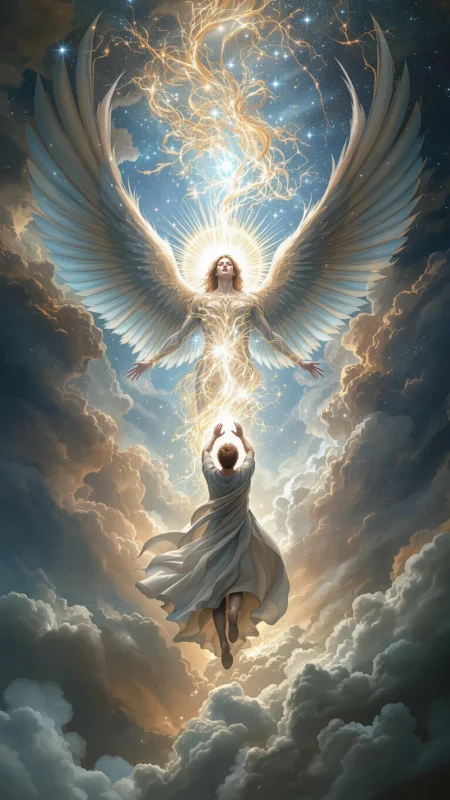
Michael

Archetype Meaning & Symbolism

Valiant, Protector, Just, Incorruptible, Severe, Luminescent, Decisive, Unwavering, Messenger, Guardian

  • Who is like God?

If Michael is part of your personal mythology, you may...

Believe

  • That moral clarity is not only possible, but is a fundamental responsibility.
  • That the ultimate battle is waged within the soul, against one's own fear and compromises.
  • That true authority comes not from power, but from incorruptible integrity.

Fear

  • Being found wanting on the day of judgment, whether by a divine force or by your own conscience.
  • Inaction or cowardice in a moment that demands courage.
  • The corruption of your own principles, the slow, insidious rot of compromise.

Strength

  • An unwavering moral compass that provides clarity in confusing situations.
  • Profound courage to face down external threats and internal demons alike.
  • A deep, abiding sense of purpose and personal responsibility.

Weakness

  • A tendency toward rigidity and black-and-white thinking, a difficulty with nuance and moral ambiguity.
  • A potential for self-righteousness and a judgmental attitude toward those who do not share your conviction.
  • An emotional austerity that can make it difficult to express vulnerability or connect with the 'softer' aspects of the human experience.

The Symbolism & Meaning of Michael

To find Michael in one's personal mythology is to discover a principle of divine order within the chaos of the self. He is not a comforting, gentle guide: he is the celestial surgeon, his sword a scalpel for excising the gangrenous parts of the soul—the cowardice, the self-deceit, the comforting lies. He represents the terrifying, exhilarating moment of absolute clarity when you can no longer pretend you do not know the right thing to do. His presence suggests a life organized not around happiness, but around truth; not around comfort, but around courage. He is the patron saint of the difficult conversation, the lonely stand, the necessary battle.

His symbolism is forged in fire and light, a stark contrast to the murky grays of moral relativism. To walk with Michael is to accept that some things are not negotiable. Justice, integrity, and the protection of the vulnerable become foundational pillars of your reality. He holds the golden scales, a reminder that every action carries weight, every choice tips the balance. This archetype does not ask you to be perfect, but it demands that you be accountable. It is the internal compass that points not to true north, but to true vertical: the alignment of your actions with your highest principles, no matter the cost.

The Michael archetype could also be understood as the psyche’s own immune system. He is the warrior who guards the gates of the mind against invading ideologies of despair or nihilism. When you are tempted by the abyss, by the seductive whisper that nothing matters, Michael is the answering cry: a defiant assertion of meaning. He embodies the will to impose a moral and spiritual order upon the raw, untamed wilderness of experience. He is the golden armor of conviction, the winged faculty of the soul that allows it to rise above its own base instincts and fight for something luminous.


Michael Relationships With Other Archetypes

The Doorway

The Michael may find a curious reflection in the Doorway, for both are defined by the comings and goings of others. He is the sturdy, unassuming jamb against which lives pivot, the threshold over which new beginnings are carried and goodbyes are tearfully made. A Michael could be seen not as the destination, but as the essential, load-bearing frame that makes the journey possible. His own story, perhaps, is not the passage itself but the quiet accumulation of scuffs and fingerprints left by those in transit, a silent witness to the traffic of more urgent narratives.

The Middle Child

In the Middle Child, The Michael might recognize a fellow traveler in the liminal spaces of the family, or indeed, of any social structure. Both are often tasked with the unglamorous work of translation and mediation, existing as the buffer state between more vivid poles. The Michael, too, can be the quiet fulcrum upon which more volatile personalities balance, the hyphen connecting two more dynamic words. Theirs is a shared condition of being functionally essential but emotionally overlooked, a kind of constitutional monarch whose power lies not in decree but in a steadying, often thankless, presence.

The Lighthouse

The Michael’s relationship with the Lighthouse could be one of solitary kinship, a shared watch in the dark. Like that stoic coastal tower, his purpose is often external—a fixed point of light for ships he may never know, navigating storms he only observes. There is a profound loneliness in this brand of steadfastness. The rhythm of his life, it seems, is not the chaotic crash of the waves but the patient, lonely sweep of the beam, a duty performed in isolation for the benefit of a world that sleeps, or sails on, unworried, under the assumption that the light will simply always be there.

Using Michael in Every Day Life

Confronting a Difficult Truth

When you must deliver a message that will cause pain but is necessary for long-term healing, you may invoke the Michael archetype. It is not about aggression, but about the surgical precision of truth: a clean cut, made with the conviction that clarity is its own form of compassion. You become the messenger who does not flinch from the weight of the message.

Making a Moral Stand

In a professional or social setting where a silent consensus supports an injustice, the Michael within you provides the backbone to stand and speak. It is the energy that straightens your spine and clarifies your voice, not for personal gain, but because a line has been crossed. This is the archetype of the righteous dissenter, the guardian of the group's soul against its own compromises.

Battling Internal Paralysis

When facing overwhelming fear, addiction, or self-doubt—your personal legion of demons—the Michael archetype is the declaration of war. It is the act of naming the enemy within and resolving to engage. It is not a promise of an easy victory, but the commitment to the fight itself, drawing a line in the landscape of your own mind and choosing which side you will defend.

Michael is Known For

Leader of the Celestial Armies

His role as the supreme commander of heaven's forces against the legions of shadow, establishing him as the ultimate symbol of spiritual warfare and divine order.

Defeater of the Adversary

His legendary casting of Lucifer from heaven, an act that represents the primary mythological victory of light over darkness, of fidelity over cosmic pride.

Weigher of Souls

His depiction in eschatology holding the scales of justice on Judgment Day, where he weighs the souls of the dead, symbolizing his role as an agent of incorruptible truth and divine consequence.

How Michael Might Affect Your Personal Mythology

How Michael Might Affect Your Mythos

When Michael becomes a central figure in your personal mythos, your life story may cease to be a meandering journey and become, instead, a crusade. Events are no longer random occurrences; they are tests of valor, challenges to your integrity, skirmishes in a larger cosmic war between meaning and chaos. Your narrative arc bends toward confrontation. You may see your past not as a series of mistakes, but as a training ground where you forged the sword of your will. The central conflict of your mythos is likely the battle against a specific 'dragon': perhaps an external injustice like systemic corruption, or an internal one like inherited trauma or addiction.

Your personal legend is thus written in the language of battles, vows, and vigils. Your role shifts from protagonist to champion. You are not simply living a life; you are defending a position, guarding a treasure, or fighting for a cause. This can imbue your story with a profound sense of purpose and urgency. The stakes feel higher. The choices feel more significant. Your mythos becomes a testament to the belief that one person, armed with conviction and courage, can stand against the encroaching darkness and hold the line. It is a story not of finding peace, but of earning it through righteous struggle.

How Michael Might Affect Your Sense of Self

To see yourself through the lens of the Michael archetype is to see a guardian in the mirror. You may perceive a deep, almost sacred responsibility that others might not sense. Your self-worth could be inextricably linked to your integrity and your courage to act upon your convictions. This is not the quiet self-acceptance of a sage, but the earned self-respect of a warrior who has faced their fear and not faltered. You might identify strongly with your will, your capacity to make a decisive choice and stand by it, viewing it as the most divine part of yourself.

This self-concept can also be a heavy burden. You may feel a relentless pressure to be strong, to be the incorruptible one, leaving little room for vulnerability, doubt, or simple human weariness. The identity of the 'protector' can become a suit of armor that is difficult to remove, isolating you from the very people you wish to defend. Your sense of self may be defined by the battles you fight, leaving you feeling lost or without purpose in times of peace. You are the sword: essential in war, but sometimes awkward and out of place at the harvest festival.

How Michael Might Affect Your Beliefs About The World

With Michael as a guide, the world may appear as a magnificent, albeit dangerous, moral gymnasium. It is not a meaningless void, but an arena where virtues are tested and souls are forged. You might see the hand of a higher order in the unfolding of history, perceiving conflicts not merely as political or economic disputes, but as manifestations of a deeper spiritual struggle. This worldview possesses a stark, beautiful clarity. There is good, there is evil; there is truth, there is falsehood; there is the light to be defended and the darkness to be opposed. The world is charged with significance.

This perspective could make it difficult to tolerate ambiguity. The gray areas where most of humanity resides might seem like a moral fog, a breeding ground for compromise and decay. You may view systems, institutions, and even people through a binary lens: are they aligned with justice, or are they an obstacle to it? This can foster a profound sense of mission, a belief that one's actions contribute to the cosmic tipping of the scales. However, it may also lead to a grim and serious outlook, where the world is seen as a place of constant, unceasing vigilance against the forces of entropy and corruption.

How Michael Might Affect Your Relationships

In relationships, the Michael archetype might compel you to act as a fierce and unwavering protector. Your love is a shield. You will be the first to defend your loved ones from harm, whether it be a physical threat, a social slight, or their own self-destructive impulses. Loyalty is paramount, a sacred bond. You may demand a high degree of moral integrity from your partners and friends, believing that true intimacy is built on a shared commitment to truth. Your relationships are not for idle leisure; they are alliances forged in the spirit of a common purpose.

However, this protective instinct can curdle into control. The sword that defends can also be the sword that judges. You may have little patience for the perceived moral failings or weaknesses of others, creating relationships that feel more like a tribunal than a safe harbor. The need for absolute truth can make you a difficult partner, one who is unwilling to let small falsehoods or gentle evasions slide. Intimacy may be challenged by a kind of righteous severity, where the scales of justice are brought into spaces that call for unconditional mercy and grace.

How Michael Might Affect Your Role in Life

Your role in any group—family, company, or community—may crystallize into that of the Guardian or the Enforcer of Principles. You are the one who speaks up when a line is crossed, who volunteers for the difficult task, who holds the center when chaos threatens to overwhelm. You may not be the most liked person, but you are often the most respected, the one others turn to when a crisis demands not diplomacy, but a decision. Your perceived role is to be the strong spine, the moral compass, the one who remembers the mission statement when everyone else is distracted by petty conflicts.

This can be an isolating position. While others bond over shared vulnerabilities, you may be bonding with your own sense of duty. You are the sentinel at the gate, which means you are often standing alone. You may be perceived as rigid, humorless, or overly intense. The role of the champion can preclude the role of the confidant or the jester. There is a risk of becoming a symbol rather than a person within your own community, shouldering the burden of their collective conscience while being held at a reverent, but lonely, distance.

Dream Interpretation of Michael

To dream of Michael in a positive context is to receive a profound affirmation of your own inner strength. His appearance may signal that you have the internal resources to face a looming threat, be it a difficult decision, a confrontation, or a battle with a personal demon. His sword may represent a newfound clarity, the ability to cut through confusion and see a situation for what it truly is. His scales could symbolize a coming into balance, an integration of your actions with your values. Such a dream is a potent symbol of empowerment: a message from your deep psyche that you are ready for the fight and aligned with your own highest truth.

In a negative context, a dream of Michael could manifest as a terrifying, implacable judge. He might represent a tyrannical superego, an inner critic that has become merciless and absolute. His sword could be the threat of self-punishment, while his scales weigh your every failing with no room for grace. This dream may arise when you are paralyzed by guilt or a fear of judgment, either from an external authority or from yourself. It could signify that your own moral code has become so rigid it has turned against you, a righteous warrior transformed into a cold executioner of your own humanity and spontaneity.

How Michael Archetype Might Affect Your Needs

How Michael Might Affect Your Physiological Needs

The Michael mythos may not directly provide for physiological needs like food and shelter, but it cultivates the internal state required to secure them under duress. It is about fostering a body that is a ready instrument for the will. This could manifest as a commitment to physical discipline, not for vanity, but for readiness. The body is the armor and the weapon; it must be maintained. There might be a heightened state of physiological arousal in the face of perceived injustice, a literal quickening of the pulse and sharpening of the senses, as the body prepares itself for righteous action.

This constant state of readiness, however, can be physiologically taxing. Living as the sentinel on the wall means the nervous system may rarely stand down from high alert. This could lead to burnout, chronic stress, and the physical ailments that accompany them. The archetype prioritizes will over the body's gentle signals for rest and recovery. Sleep might be seen as a necessary but unproductive state, food as mere fuel. The danger is in treating the body as a machine for enacting justice, forgetting that it is also the fragile, living thing that justice is meant to protect.

How Michael Might Affect Your Ideas of Belonging

Belonging, for one with Michael in their mythos, is found in a cohort, a legion, a fellowship of the committed. It is not the easy comfort of a neighborhood barbecue, but the profound, unspoken bond between soldiers who have weathered the same storm. You may seek out communities bound by a strong moral code, a shared mission, or a common enemy. Love and friendship are expressions of unwavering loyalty and mutual defense. To belong is to be entrusted with the well-being of the tribe, and to trust them with yours. It is a belonging forged in the crucible of shared principle.

This high standard for connection can lead to a profound sense of isolation. You may struggle to find others who meet your exacting criteria for loyalty and integrity. Casual friendships might feel meaningless, and the moral compromises inherent in any human group can feel like a betrayal. The love you offer, while fiercely protective, may also feel conditional upon the other person living up to your standards. You might stand with your comrades, yet feel fundamentally alone in your absolute commitment, a general whose heart is unknown to his troops.

How Michael Might Affect Your Feelings of Safety

Embodying the Michael archetype fundamentally reframes the concept of safety. Safety is not a passive state of being protected by external walls; it is an active state created by one's own courage and conviction. Your sense of security may come from the knowledge that you have the strength to face down any threat, rather than the hope that no threat will ever appear. You build your sanctuary not with bricks and mortar, but with the force of your own integrity. This is the safety of the sword, not the shield. It is a proactive, dynamic sense of security rooted in self-reliance and readiness.

This can also cultivate a worldview where threats are perceived everywhere, demanding constant vigilance. The warrior who is always ready for battle may never know peace. True safety, which includes psychological relaxation and trust, might be elusive. You may feel safe in a fight, but profoundly unsafe in moments of vulnerability or stillness. The need to be the source of your own safety can make it difficult to trust others to protect you, leading to hyper-independence and an inability to truly rest in the care of another. The guardian must always stay awake, and eternal vigilance is a form of exile from tranquility.

How Michael Might Affect Your Views of Esteem

Esteem is built not on praise or external validation, but on the bedrock of self-respect earned through action. Your esteem rises when you act in alignment with your deepest values, especially when it is difficult. It is the feeling that follows confronting a bully, speaking truth to power, or choosing the harder right over the easier wrong. This is esteem as a consequence of integrity. You feel worthy not because you are loved, but because you are honorable. Respect from others is valued, but only if it is respect for your character, not your charm.

This can create a fragile and demanding system for self-worth. Esteem must be perpetually re-earned through new trials of courage and integrity. A single moral failure, a moment of cowardice, can shatter your self-concept. There is little room for grace or the forgiveness of your own human limitations. Your esteem is contingent on your performance as a moral warrior, leading to immense pressure and a harsh inner critic. The need to be worthy can eclipse the simple, unconditional worth of being human.

Shadow of Michael

The shadow of Michael is the righteous fire turned into a conflagration. It is the Grand Inquisitor, the fanatic, the tyrant who justifies atrocity in the name of a higher good. When the archetype’s energy is untempered by mercy, its sword of clarity becomes a guillotine for all dissent, nuance, and complexity. The shadow believes its truth is the only truth, and therefore any action taken in its service is sanctified. It is the protector who becomes the paranoid jailer, the champion of justice who becomes the merciless executioner. This shadow sees dragons and demons everywhere, and in its zeal to slay them, it tramples the very innocents it originally swore to defend.

In this state, the inner life becomes a courtroom of perpetual judgment. The self becomes its own harshest critic, a cold and unforgiving god. There is no room for mistakes, no possibility of grace. The drive for purity leads to a sterile and brittle existence, cut off from the messy, vibrant, and contradictory stuff of life. The shadow of Michael isolates a person in a fortress of their own rightness, where they are safe from corruption but starved of human warmth. It is the tragic arc of the hero who fights the monster for so long that they become one, their golden armor now a cage.

Pros & Cons of Michael in Your Mythology

Pros

  • You may possess a rare and powerful clarity of purpose, a guiding star in a chaotic world.
  • You may be a source of immense courage and inspiration for others, a rock of integrity in your community.
  • You will likely live a life of deep meaning, feeling that your choices have weight and consequence.

Cons

  • You may struggle with relationships, as your high standards can alienate others and make intimacy difficult.
  • You are at risk of burnout, as the life of a constant warrior is emotionally and physically exhausting.
  • You may be perceived as rigid, judgmental, or self-righteous, isolating yourself even from those who admire you.