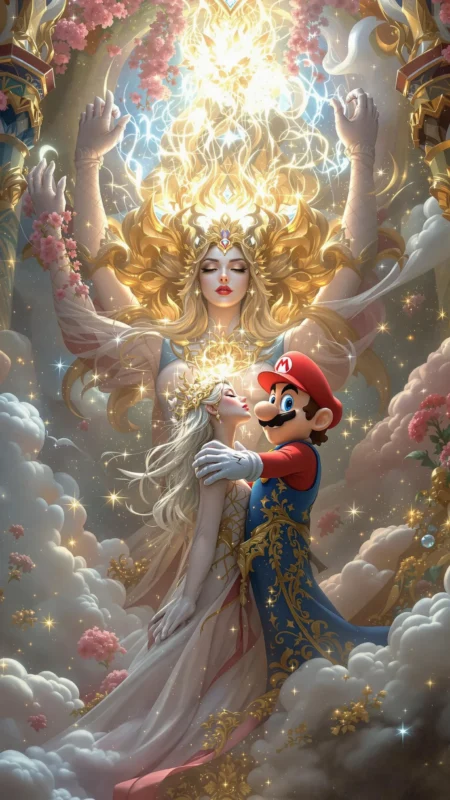
Mario

Archetype Meaning & Symbolism

persistent, optimistic, brave, simple, dedicated, athletic, working-class, heroic, loyal, cheerful

  • It's-a me, Mario!

If Mario is part of your personal mythology, you may...

Believe

  • That every problem has a solution, and that the solution can be found through persistent, direct action.
  • That a simple, clear purpose is the highest good, and that life is best when you know exactly who you are fighting for.
  • That your capabilities can always be expanded, that there is always another power-up to be found that will help you meet the next challenge.

Fear

  • Ambiguity. A situation with no clear enemy, no clear goal, and no clear victory condition is a special kind of hell.
  • Futility. The deep, existential dread that your quest is a cosmic joke, and that the princess will, eternally, be in another castle.
  • Stillness. The quiet moments when there are no platforms to jump to, no puzzles to solve, forcing an encounter with the self, an internal world you may have neglected.

Strength

  • Unflinching resilience. You see failure as a temporary setback, a chance to learn the pattern and try again, making you nearly impossible to discourage.
  • A powerful, focused drive. When you have a clear goal, you can pursue it with a singular energy that is both impressive and highly effective.
  • Infectious optimism. Your belief that problems are solvable can inspire hope and action in those around you, turning a daunting challenge into a winnable game.

Weakness

  • A tendency toward oversimplification. You may apply a 'jump on it' mentality to nuanced emotional or interpersonal problems, causing collateral damage.
  • Purpose-based identity. Your sense of self may be so tied to having a quest that you feel empty and aimless in times of peace or after a major achievement.
  • Difficulty with vulnerability. The role of the hero can make it difficult to ask for help or to admit to struggles that cannot be solved by sheer heroic effort.

The Symbolism & Meaning of Mario

To have Mario in your personal pantheon is to champion the working-class hero, the everyman plumber unexpectedly summoned to an epic stage. He is a testament to the idea that you do not need a grand lineage or a complex destiny to have a profound purpose. His heroism is tactile, grounded in running and jumping, a physical manifestation of will. The mythos suggests that the most extraordinary journeys are undertaken with the simplest of tools: your own two feet, a clear sense of direction, and the courage to take the first leap. It is a mythology of competence earned through action, not bestowed by fate.

The archetype is a powerful symbol of persistence. Mario’s world operates on the logic of the retry. Failure is not a final judgment but a data point. A fall into a chasm is merely a lesson in the physics of his world, a prelude to a more educated next attempt. This could instill a personal belief system where life's obstacles are not tragic dead ends but solvable puzzles. Every challenge has a pattern, every boss a weak point. The universe, in this view, is not a chaotic mystery but a well-designed, if difficult, game that rewards patience and pattern recognition.

His meaning is also tied to the purity of the quest. There is little room for moral ambiguity in the Mushroom Kingdom. The goal is clear, the villain is identifiable, and the mission is righteous. For someone whose personal mythos includes Mario, life’s purpose may feel most potent when it is distilled into a straightforward crusade. It is the search for a form of grace found in uncomplicated devotion: to a person, to a cause, to a single, consuming goal. It is the relief of knowing exactly what must be done, and that doing it is, unequivocally, good.


Mario Relationships With Other Archetypes

The Princess

The Mario’s relationship with The Princess may be less a romance and more a form of celestial navigation. She is the distant, unwavering lighthouse, and he the small, determined vessel tossed on a sea of bewildering threats. Her predicament is not a tragedy to be mourned but a vector to be followed; it provides a singular, clarifying purpose that cuts through the chaos of his world. He moves toward her not with the complexity of courtly love, but with the beautiful, unthinking tropism of a plant turning toward the sun. She is, perhaps, the abstract concept of “There” in a world composed entirely of “Here,” the fixed point around which his kinetic universe is allowed to spin.

The Obstacle

The Obstacle and The Mario could be seen as partners in a percussive dance. Each pitfall is not an end, but an invitation to leap; each marching goomba is not an enemy, but a rhythmic beat upon which to land. The Obstacles provide the very texture of The Mario’s reality, transforming a flat expanse into a landscape of challenges that give his movement meaning. Without them, his signature jump would be an absurdity, a twitch without context. The Obstacle, then, may be the anvil against which The Mario’s resilient spirit is perpetually forged, each successful stomp a small, resonant chime of victory in a world that demands constant, active participation.

The Labyrinth

The Mario exists within The Labyrinth not as its prisoner, but as its most unpredictable element. If his world is a vast, incomprehensible machine of pipes and platforms, he is not its operator but a kind of kinetic energy that flows through it, finding pathways and exploits the original architect never intended. The Labyrinth could be the baffling architecture of bureaucracy, the inscrutable code of a digital world. The Mario does not seek to understand the grand schematic; rather, he engages with it on a purely tactile level, his progress a testament to a kind of blue-collar intuition. He is a whisper of improvisation in a world of rigid, repeating code, a joyful glitch that proves the system is, on some fundamental level, playable.

Using Mario in Every Day Life

Facing Creative Block

When the canvas is blank or the page resists your words, the Mario archetype suggests a change in mechanics. If one approach fails, try another. The goal isn't to force the lock, but to find a different key, perhaps a Tanooki Suit of a new medium or a Fire Flower of a different perspective. It reframes the block not as a wall, but as a puzzle-platforming challenge, one that requires a change in your own form to solve.

Navigating Bureaucracy

An encounter with endless paperwork or institutional red tape can feel like a fortress. The Mario mythos offers a strategy: treat it like a castle level. Identify the patterns, the gatekeepers, the key documents. Each form filed is a Goomba stomped, each successful phone call a coin collected. The quest is to find the final boss, the person with the authority to say yes, and defeat them with a well-timed presentation of your completed quest log.

Learning a New Skill

Mastering an instrument, a language, or a piece of software can feel like an insurmountable world map. To embody Mario is to focus on one level at a time. Today, the goal is not fluency, but learning three chords. It is not building the whole application, but making one button work. This approach turns a daunting journey into a series of small, satisfying victories, each one ending with a little flourish of its own flagpole music.

Mario is Known For

Jumping

His primary mode of interaction with the world. A jump is an answer, a weapon, and a tool for discovery, symbolizing a leap of faith and direct, physical problem-solving.

Rescuing Princess Peach:

The central, recurring quest that drives his narrative. It represents a simple, unwavering devotion to a goal and the archetype of the hero on a mission of reclamation.

Power-Ups:

His ability to transform through external items like the Super Mushroom or Fire Flower. This signifies a capacity for radical adaptation and the belief that help can be found in the world to augment one's innate abilities.

How Mario Might Affect Your Personal Mythology

How Mario Might Affect Your Mythos

When Mario is a guiding figure, your personal mythos may transform from a sprawling, novelistic epic into a series of distinct, self-contained adventures. Life is not a single, unbroken narrative but a world map you traverse, choosing your next level. Each phase of life, a job, a relationship, a personal project, could be viewed as a unique stage with its own aesthetic, challenges, and 'boss' at the end. Your story becomes less about the slow, ambiguous unfolding of character and more about a collection of heroic episodes, of castles conquered and princesses saved.

Furthermore, your life's story might be defined by its external plot points rather than its internal monologues. The central conflict of your myth is not a war within the self but a campaign waged in the world. The narrative drive comes from a tangible, external goal: achieving the promotion, finishing the marathon, building the house. Self-discovery, in this framework, is not the point of the journey, but a happy accident that occurs while you are busy jumping on turtles and climbing vines. Your legend is written in your deeds, not your diary.

How Mario Might Affect Your Sense of Self

You may perceive yourself as fundamentally resilient and capable. Failure is stripped of its sting, re-categorized as a necessary part of the learning process. This could foster a powerful sense of agency, a belief that you are the player, not the piece being played. Your identity might become deeply entwined with your ability to *do*, to act, to overcome. You are what you accomplish. This can be a source of immense strength and self-reliance, a conviction that no fortress is impregnable, no chasm too wide.

This perspective could also cultivate a certain psychological distance from your own experiences. To see yourself as an avatar, a Mario on a screen, might insulate you from the deeper emotional currents of life. Setbacks become mere game overs, frustrating but not soul-crushing. While this detachment can be a useful coping mechanism, it may also risk flattening your inner landscape, keeping you a stranger to the more complex, vulnerable parts of your own heart. You might find it difficult to simply *be*, feeling a constant, low-level pressure to perform, to move forward, to get to the next level.

How Mario Might Affect Your Beliefs About The World

The world, seen through a Mario-tinted lens, may appear as a vibrant and interactive obstacle course. Every challenge is a platform, every problem a puzzle box waiting to be struck. This worldview is inherently optimistic: it assumes that the universe is fundamentally knowable and conquerable. There are secret paths behind waterfalls and extra lives hidden in plain sight for those with the curiosity to look. It is a perspective that encourages exploration and proactive engagement, a belief that the world yields its treasures to the bold.

This can, however, foster a kind of simplifying binary vision. The world may be neatly divided into helpful resources (mushrooms, flowers) and clear antagonists (turtles, monsters). Moral and ethical complexity may be flattened. Situations that require nuanced diplomacy, that feature no clear villain, or that have no 'winning' outcome could seem baffling, like a glitch in the game's code. It is a worldview that thrives on clarity and action, and it may struggle to find its footing in the grey fog of ambiguity that colors so much of human experience.

How Mario Might Affect Your Relationships

In relationships, you might unconsciously cast yourself and others into archetypal roles from the game. You are the hero, the one who does the rescuing. Your partner, friend, or family member may become the 'princess,' a cherished person who needs your protection and for whom your quest is undertaken. This can create powerful bonds of loyalty and devotion, a sense of shared adventure. You express love through heroic acts, through solving problems and vanquishing the 'Bowser' of the moment, be it a leaky faucet or a difficult boss.

However, this framework may leave little room for the complexities of partnership between equals. The dynamic of rescuer and rescued can become constricting, preventing the kind of mutual vulnerability that fosters deep intimacy. A partner who wishes not to be saved, but to be met in a space of shared uncertainty, might find your heroic advances perplexing or even patronizing. The Mario mythos prepares you for a quest for someone, but it may leave you ill-equipped for the much subtler journey *with* someone.

How Mario Might Affect Your Role in Life

You may feel your role in life, your fundamental purpose, is to be the protagonist. You are the mover, the actor, the one who initiates the quest and sees it through. This is not necessarily born of ego, but from a deep-seated belief that progress requires a clear hero. You might feel a responsibility to take the lead, to be the one who jumps first while others hesitate. Your role is defined by forward momentum, by being the engine of the narrative for yourself and those around you.

This can also manifest as a role of grand service. You are the one people call when a definitive, external problem needs solving. Your purpose is not quiet counsel or gentle support: it is direct intervention. You are the plumber called for a crisis, the hero arriving when the castle is under siege. This role can be incredibly valuable and fulfilling, yet it may become a trap if it is the only one you know how to play, leaving you feeling adrift during times of peace or in situations that call for stillness instead of action.

Dream Interpretation of Mario

To dream of being Mario, or of successfully navigating one of his vibrant, kinetic worlds, may be a potent symbol from your subconscious that you feel a sense of agency and optimistic capability. The dream suggests you are in touch with your own resilience. You may feel equipped to handle the challenges of your waking life, viewing them as conquerable puzzles rather than insurmountable threats. Collecting coins could symbolize a recognition of your own value and resources, while reaching the flagpole signifies a feeling of impending success or the satisfying closure of a recent accomplishment.

In a more troubling context, a Mario dream can be a landscape of deep anxiety. To be stuck in a loop, perpetually mistiming a jump and falling into a pit, could represent a waking situation where you feel your efforts are futile. Facing a Bowser you cannot defeat might reflect a problem that feels too large or a foe that seems invincible. A dream where the princess is always in another castle could be the most profound of all: a manifestation of a deep fear that your ultimate goal, your life's quest, is a meaningless chase leading to perpetual disappointment.

How Mario Archetype Might Affect Your Needs

How Mario Might Affect Your Physiological Needs

The Mario archetype can tie your sense of physiological well-being directly to action and accumulation. Just as Mario gathers coins and mushrooms to sustain his journey and grow stronger, you may feel that your basic needs for food, shelter, and vitality are resources to be actively won. This can foster a proactive approach to health and survival, a belief that one's physical state is a direct result of one's efforts and successful navigation of the environment. There is no passivity; well-being must be earned, collected, and consumed.

There might also be a deeply ingrained physiological need for kinetic expression. The body, in the Mario mythos, is a tool for running and jumping, a vessel of perpetual motion. A sense of physical wellness may be contingent on constant activity. Stillness could feel unnatural, even unhealthy. This may translate into a lifestyle built around exercise and goal-oriented movement, but also a restlessness that makes relaxation difficult, as if the body's baseline state is a forward-moving animation cycle, not a state of rest.

How Mario Might Affect Your Ideas of Belonging

A sense of belonging, within the Mario mythos, is often forged in the crucible of a shared mission. You belong with your fellow adventurers: the Player 2 Luigi, the helpful Toad, the loyal Yoshi. Love and connection are functions of the quest, built on foundations of loyalty, utility, and a common goal. To love someone is to put them at the center of your quest, as Mario does the princess. To be a friend is to offer a helpful power-up or a boost to a higher platform. Belonging is the camaraderie of the campaign.

This can also engender a strange form of heroic isolation. Ultimately, Mario's journey is a solitary one. He is the singular hero who must enter the final castle alone. You may feel that while you have allies and people you are fighting for, the core of your struggle is yours and yours alone. This can create a feeling that true belonging is the prize at the end of the game, the celebration after the princess is saved, rather than something deeply experienced and woven into the fabric of the journey itself.

How Mario Might Affect Your Feelings of Safety

Your need for safety may be fulfilled not by building walls, but by mastering the environment. Safety is not a static condition but a dynamic skill. You feel secure because you are agile, because you have learned the patterns of the threats around you, and because you trust your ability to react. It is the security of the athlete, not the fortress-dweller. This can lead to a courageous and engaged way of being in the world, a willingness to venture into 'dangerous' territories because you have faith in your own competence.

This perspective may also frame the world as being filled with predictable, almost charmingly non-threatening dangers. The threats are ever-present—the Goombas marching, the fireballs spinning—but they operate on simple, learnable loops. The core anxiety is not of chaos or the malevolent unknown, but of personal error: a mistimed jump, a moment of inattention. The burden of safety rests squarely on your own shoulders and your capacity for flawless execution, which can be both empowering and exhausting.

How Mario Might Affect Your Views of Esteem

Esteem needs, under the influence of this archetype, are met through tangible, quantifiable achievement. Self-worth is built like a high score. Every level cleared, every obstacle overcome, every coin collected adds to a visible tally of your value. This provides a very clear and direct path to feeling good about yourself: accomplish a goal. The feedback loop is immediate and satisfying, building a robust sense of competence and pride in your own effectiveness.

This foundation for esteem can also be incredibly precarious. Because it is tied to external performance, self-worth can plummet during periods of failure, stagnation, or rest. If you are not actively conquering something, you may feel worthless. There is little room for the kind of self-esteem that comes from simply being, from one's intrinsic character rather than one's list of accomplishments. An identity built on being the hero is a fragile one when there are, for the moment, no dragons to slay.

Shadow of Mario

The shadow of the Mario archetype emerges when the rescuer cannot stop rescuing. It is the hero who, in the absence of a clear villain, begins to cast others in that role to perpetuate his own heroic narrative. This shadow aspect is not content with peace; it subtly creates or inflates crises to maintain its sense of purpose. It is the partner who 'solves' problems that were not problems until they arrived, trampling over the nuances of a situation with the blunt force of their simple, heroic solutions. They may offer help that is not wanted and save people who did not need saving, all to keep the game going and to avoid the terrifying silence of the 'game over' screen, where they might have to confront themselves.

A deeper, more tragic shadow is the hero who has become hollow. This is the Mario who has performed the same jumps and fought the same battles so many times that the actions have been severed from all meaning. He is an avatar without a player, a body going through the motions of a quest with no internal emotional life. This manifests as a profound disconnect from oneself and others, an inability to access any feeling beyond the fleeting, superficial thrill of stomping a Goomba. It is the terror of introspection masked by frantic, endless activity, a man running perpetually to the right to outpace the emptiness chasing him from the left.

Pros & Cons of Mario in Your Mythology

Pros

  • You possess a powerful and resilient spirit, able to bounce back from setbacks with renewed vigor.
  • You are an effective agent of change in the world, capable of identifying and executing solutions to tangible problems.
  • Your straightforward, optimistic approach can cut through confusion and inspire group action.

Cons

  • You may struggle to navigate the grey areas of life, finding complex emotional situations deeply frustrating.
  • You might inadvertently diminish the people around you by casting them as supporting characters in your personal quest.
  • Your self-worth can be dangerously dependent on constant achievement, leading to burnout or a crisis of identity during fallow periods.