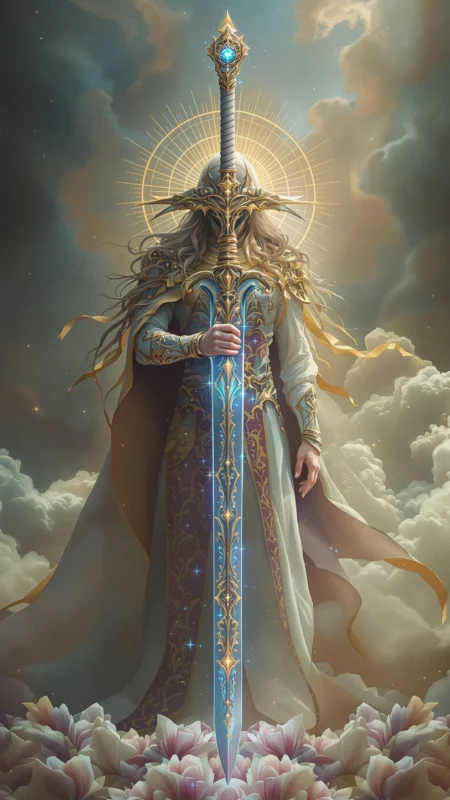
Magic Sword

Archetype Meaning & Symbolism

Decisive, Potent, Unifying, Dividing, Legacy, Truthful, Dangerous, Precise, Sovereign, Inflexible

  • My edge is not for cleaving flesh, but for severing the lies you tell yourself.

If Magic Sword is part of your personal mythology, you may…

Believe

  • You may believe that clarity is the highest virtue, and that ambiguity is a form of weakness to be cut through.
  • You may believe that you are defined not by your thoughts or feelings, but by your decisive actions and unwavering commitments.
  • You may believe that some things are worth fighting for, and that true neutrality is an illusion.

Fear

  • You may fear becoming dull or ‘unsharpened,’ losing your intellectual edge, your moral clarity, or your will to act.
  • You may fear wielding your power unjustly, that your sword of truth could become a blade of tyranny or cruelty.
  • You may fear that your sword is, in the end, too heavy a burden to carry, and that its responsibility will isolate you completely.

Strength

  • Your strength is your decisiveness, your ability to make a choice and commit to it fully, freeing yourself and others from the paralysis of indecision.
  • Your strength is your moral clarity, a powerful inner compass that allows you to navigate complex situations with a strong sense of purpose.
  • Your strength is your capacity to create and defend boundaries, protecting your own integrity and the well-being of those you care for.

Weakness

  • Your weakness may be a profound inflexibility, an inability to bend or adapt when a situation calls for nuance rather than a clean cut.
  • Your weakness may be a tendency toward binary, black-and-white thinking, which blinds you to the valid, complex truths that live in the gray areas.
  • Your weakness may be a potential for ruthlessness, of cutting people or possibilities out of your life too quickly, without allowing for redemption or change.

The Symbolism & Meaning of Magic Sword

The Magic Sword, as it lives within a personal mythology, is rarely about literal battle. It is an artifact of the mind, a symbol of the discerning intellect and the resolute will. Its primary function is to draw a line: between right and wrong, between the essential and the superfluous, between the self and the other. To have this sword in your mythos is to possess an internal compass of conviction. It may represent a core principle so fundamental to your being that it dictates all your significant choices. This is not a tool for every task. You cannot use a sword to mend a garment or till a field. Its purpose is specific, potent, and sometimes terrible. It is the power of the final word, the irreversible decision, the stand from which you will not be moved.

This archetype is also a symbol of legacy and earned power. A sword may be inherited, representing a lineage of values or a burden of responsibility you must carry. Or perhaps your sword is one you forged yourself in the fires of experience, its metal tempered by your own hardships, its edge honed by your own mistakes. It becomes an extension of your very being, a physical metaphor for your capacity to impact the world. Its weight in your hand is the weight of your own history and the potential of your future. It is cold, it is hard, it is uncompromising: because it represents a truth you have decided to live by, no matter the cost.

Ultimately, the Magic Sword symbolizes the lonely courage of conviction. A sword is wielded by one. While you may fight alongside others, the decision to draw, to strike, or to sheathe is yours alone. Its presence in your story suggests a path defined by profound, and perhaps isolating, moments of choice. It is the tool that carves your identity out of the raw material of the world. It may grant you power, authority, and clarity, but it also demands a terrible integrity. Every cut you make defines not only the world around you, but the shape of your own soul.


Magic Sword Relationships With Other Archetypes

The Scabbard

The Scabbard is the sword’s necessary counterpart, its conscience and its place of rest. While the sword represents the power to act, the scabbard represents the wisdom of restraint. If the sword in your mythos is your capacity for decisive judgment, the scabbard is your capacity for patience, diplomacy, and peace. To draw the sword is to commit to a path of conflict and consequence. To keep it sheathed is a conscious choice, an act of power in itself. An individual whose mythology lacks a Scabbard may be rash, needlessly destructive, and quick to sever ties, their blade always bare and threatening. The interplay between the two asks a constant question: is this a moment for the clean cut, or a moment for the quiet wait?

The Anvil

The Anvil is the place of the sword’s creation. It is the unmovable object upon which the raw, hot metal of potential is beaten into shape. In a personal mythology, the Anvil represents the brutal, formative experiences of life: the hardships, the heartbreaks, the failures. It is the unyielding reality against which your character is forged. The Magic Sword, in this context, cannot exist without the Anvil. Its strength, its sharpness, its very identity are products of the suffering and pressure it endured. A person who honors both archetypes understands that their current strength, their clarity of purpose, was born from past trials. They do not resent the Anvil, for they know it is the reason the sword exists at all.

The Crown

The Crown symbolizes the right to rule, the legitimacy of authority, while the Magic Sword symbolizes the power to enforce that rule. One is title, the other is might. In a healthy personal mythos, they are aligned: the one who wears the Crown rightfully wields the sword. This signifies a person whose actions (the sword) are in perfect harmony with their principles and identity (the Crown). When they are in conflict, it creates a crisis of self. One might have the power to act but feel they lack the right, leading to paralysis. Or one might claim a title or identity but lack the strength or will to defend it, becoming a hollow monarch. The relationship is a constant negotiation between one’s perceived role and one’s actual ability to fulfill it.

Using Magic Sword in Every Day Life

Navigating a Career Crossroads

When you stand before two paths, one offering security and the other a volatile, soul-stirring passion, the Magic Sword archetype is what you draw upon to make the cut. It is not a pro-and-con list. It is the sudden, gut-level recognition of the one truth that matters. The sword is the decision itself, the swift, clean severance from the future you will not live, allowing you to walk forward without the ghost of a second guess clinging to your heel. It is the tool that carves your singular path from the marble of infinite possibility.

Establishing Personal Boundaries

In relationships that drain or diminish, the sword is not an instrument of anger but of definition. It is the articulation of a boundary, spoken with calm finality. It represents the line drawn not to wound the other, but to protect the sovereignty of your own inner kingdom. Wielding it may mean ending a conversation, refusing a request, or, in the gravest cases, severing a tie. The act is not about malice: it is about the preservation of self, a declaration that your peace is not a territory open for colonization.

Overcoming Creative Paralysis

Before the blank page or the empty canvas, the Magic Sword archetype is the force that cuts through the thousand-headed hydra of self-doubt. It is the first, bold stroke of the brush, the decisive first sentence written. It doesn’t negotiate with the inner critic; it simply acts, separating the pure impulse to create from the fear of imperfection. This sword is the commitment to a single idea, slicing it free from the nebulous cloud of ‘what ifs’ and giving it form, however flawed, in the material world.

Magic Sword is Known For

Severing Ties

The sword is known for its definitive ability to end things

a bad habit, a toxic relationship, a period of indecision. Its power lies in making separations clean and final, preventing the lingering decay of ambiguity.

Bestowing Sovereignty

To be given a sword, or to forge one’s own, is to be granted agency and authority. It is the symbol of the right to rule one’s own life, to make one’s own laws, and to defend one’s own principles. It transforms one from a subject to a sovereign.

Revealing Truth

Like a flash of steel in the sun, the sword represents a moment of piercing clarity. It cuts through deception, illusion, and confusion to reveal the unadorned truth of a situation, a person, or oneself. This truth is often hard and uncomfortable, but it is the solid ground upon which one can build.

How Magic Sword Might Affect Your Personal Mythology

How Magic Sword Might Affect Your Mythos

When the Magic Sword is central to your personal mythos, your life story is likely not a meandering river but a path carved with intention. Your narrative arc may be structured around a series of definitive cuts: the severing of a past self, the commitment to a singular quest, the defense of a sacred principle. Life is not something that merely happens to you; it is a territory you claim and define. Your personal history might be punctuated by moments of conflict, not necessarily with others, but with profound, life-altering choices. These are the moments you drew your blade.

Your mythos may also be one of inheritance or invention. Perhaps you are the guardian of a family sword, a set of values passed down through generations that you are now tasked to uphold. Your story is about living up to this legacy. Conversely, your mythos could be about forging your own blade in the fires of adversity, crafting your own code from scratch. In either case, the sword becomes the central artifact of your story, the symbol of your purpose, and the measure of your journey’s success. It is the object around which the entire narrative revolves.

How Magic Sword Might Affect Your Sense of Self

Your self-concept may be built upon a foundation of integrity and resolve. You might perceive yourself as an agent of clarity in a world of confusion, someone who is willing to make the hard choices that others avoid. This can foster a powerful sense of self-reliance and inner authority. You trust your own judgment because you have honed it, like a blade, against the whetstone of experience. You may not see yourself as flexible or accommodating, but rather as principled and constant. Your identity is not a fluid thing but a well-defined form, with sharp edges.

However, this may also lead to a self-view that is rigid and unforgiving. You might judge your own perceived weaknesses with the same incisive criticism you apply to the external world. A failure to live up to your own code could feel like a catastrophic blow to your identity, as if your sword has been broken or tarnished. There might be a loneliness to this self-concept, a sense of being a solitary warrior on a path no one else can truly understand. You are your sword, and you may sometimes forget that you are also the hand that wields it, capable of softness and change.

How Magic Sword Might Affect Your Beliefs About The World

The world, seen through the lens of this archetype, may appear as a place of stark contrasts and moral imperatives. It is a realm that calls for action, not passive contemplation. Problems are not meant to be endlessly analyzed but to be solved with a decisive stroke. You might view society as a constant struggle between order and chaos, truth and deception, justice and tyranny. There is little room for moral relativism or shades of gray in this worldview; things are, for the most part, right or wrong, and it is your responsibility to align with the right.

This perspective can be immensely empowering, providing the clarity needed to navigate a complex world and fight for what you believe in. Yet, it can also be dangerously simplistic. The sword’s worldview risks missing the intricate nuances of human situations, the hidden contexts, and the validity of opposing viewpoints. It may lead to a kind of righteous impatience with the messiness of life, a desire to ‘cut the Gordian knot’ when patient untangling is what is truly required. The world becomes a battlefield of principles, and you may fail to see the quiet gardens that grow in between.

How Magic Sword Might Affect Your Relationships

In relationships, the Magic Sword archetype could manifest as a profound sense of loyalty and protectiveness. You defend your loved ones with the same fierce resolve you apply to your principles. Your commitments are not made lightly, but once given, they are absolute. Boundaries are clear and well-maintained, not out of coldness, but from a belief that healthy relationships require well-defined spaces. You are the person one can count on in a crisis, the one who will bring clarity and action when others are paralyzed by emotion.

Conversely, the sword’s influence can be destructive to intimacy. A tendency to see things in black and white may make it difficult to navigate the subtle compromises and ambiguities inherent in any close bond. An argument could be treated as a battle to be won rather than a misunderstanding to be resolved. You may be too quick to ‘cut ties’ at the first sign of what you perceive as a betrayal of principles, leaving a trail of severed connections in your wake. The challenge is to learn when to wield the sword of truth and when to offer the open hand of grace.

How Magic Sword Might Affect Your Role in Life

Your perceived role in life might be that of the Pioneer, the Judge, or the Guardian. You are not here to simply exist but to enact, to define, to defend. As the Pioneer, you use your sword to carve a path through the wilderness of the unknown, creating something new where nothing existed before. As the Judge, you use it to separate truth from falsehood, to uphold a standard of justice and order. As the Guardian, you stand watch over something precious: a community, an ideal, a person, a tradition.

This sense of purpose can be a powerful motivator, providing a clear answer to the question, ‘Why am I here?’ However, it can also become a heavy burden. The sword demands to be used, and you may feel a constant pressure to be acting in your role, unable to rest or simply be. There is a risk of conflating your identity entirely with your function, believing that your worth comes only from your effectiveness as a path-carver or a guardian. You may forget that a sword must sometimes be returned to its scabbard, and a warrior must be allowed to sit by the fire.

Dream Interpretation of Magic Sword

To dream of being given or finding a Magic Sword in a positive context often symbolizes a moment of empowerment and newfound clarity. It may suggest that you are finally accessing the resolve to confront a long-standing problem in your waking life. Wielding the sword with ease and confidence could point to a growing sense of your own authority and competence. Using it to cut through vines or darkness might represent your ability to clear away confusion and see a path forward. The dream is an affirmation from your subconscious: you have the tool you need. The decision is now yours to make.

In a negative context, a dream of a Magic Sword can be unsettling. If the sword is too heavy to lift, broken, or rusted, it may reflect feelings of powerlessness, inadequacy, or a compromised sense of integrity. Your core principles may feel useless in a current situation. Being threatened or pursued by someone with a sword could symbolize a harsh inner critic, an external authority you feel oppressed by, or the consequences of a past ‘cut’ you made. Dropping the sword or losing it might point to a fear of responsibility or a crisis of faith in your own beliefs.

How Magic Sword Archetype Might Affect Your Needs

How Magic Sword Might Affect Your Physiological Needs

The Magic Sword, in the realm of personal mythology, extends its influence to the physical self, representing the mind’s sovereign rule over the body. Its presence may manifest as a powerful drive toward discipline and physical regimen. Your body is not seen as a source of messy, unpredictable desires, but as an instrument to be honed and perfected for a purpose. This could translate to rigorous exercise, strict dietary control, or an almost ascetic denial of physical comforts that are deemed ‘weaknesses.’ The goal is to make the flesh as sharp, reliable, and resilient as the blade itself.

This connection between will and body can forge incredible physical resilience and focus. However, it also creates a potential for dissociation or harshness toward one’s own physical being. The sword’s logic may struggle with the body’s need for rest, softness, and unstructured pleasure. Illness or physical limitation might be perceived as a personal failure, a frustrating flaw in the instrument rather than a natural part of the human condition. The challenge is to command the body without tyrannizing it, to use the sword’s discipline not to punish the flesh, but to honor it as the living vessel of your will.

How Magic Sword Might Affect Your Ideas of Belonging

Belonging, for one with a Magic Sword in their mythos, is forged in the fire of shared principles. You find your tribe not among those with whom you share casual interests, but among those with whom you share a code. It is an alliance of fellow soldiers, guardians of the same flame. These bonds are often few but intensely loyal, built on a foundation of mutual respect for each other’s strength and integrity. Love and friendship are commitments, pacts to be honored and defended. You belong where your sword is valued and your purpose is understood.

This search for an allegiance of honor can also lead to profound isolation. Your standards for yourself and others may be so high that few can meet them. You might stand apart, a solitary figure whose principles are too rigid to allow for the messy compromises of community. The sword that defines your identity may also become the blade that cuts you off from the warmth of easy companionship. You may struggle to connect with those who do not share your intensity, mistaking their different worldview for a lack of substance. Belonging becomes a fortress with very few inhabitants.

How Magic Sword Might Affect Your Feelings of Safety

For a mythos containing the Magic Sword, safety is not found in passivity or fortification. It is not about building higher walls but about possessing the means to eliminate a threat. Security is a function of readiness and capability. You may feel safest when you have a clear plan of action, when you understand the risks, and when you trust in your own ability to respond decisively. The sword offers psychological security through a sense of agency. It is the belief that no matter what challenge appears, you have the tool to meet it, to cut it down to size, to carve out a space of safety for yourself and those you protect.

This reliance on proactive defense can, however, create a state of hyper-vigilance. The hand is always resting on the hilt. When your primary tool for safety is a weapon, you may be more inclined to perceive the world in terms of threats. Instead of fostering peace, the constant readiness for conflict can subtly invite it. True safety may be elusive, as the sword’s very nature is to engage with danger, not to transcend it. It offers safety in the battle, but not necessarily from the battle itself.

How Magic Sword Might Affect Your Views of Esteem

Esteem, in the context of the Magic Sword, is inextricably linked to integrity and effectiveness. Your self-worth is not derived from external praise but from the internal knowledge that you have acted in accordance with your code. Esteem is the clean, satisfying hum of a blade that has been used rightly. It is earned by making the difficult but necessary choice, by defending a value when it was costly to do so, by speaking a hard truth, and by maintaining your resolve under pressure. You respect yourself when your actions are as sharp and true as the sword you carry.

Consequently, a perceived failure of will or a compromise of principle can be devastating to your self-esteem. A moment of indecision, a choice made from fear rather than conviction, or an act of hypocrisy can feel like a deep, shameful stain upon your blade. This can lead to a cycle of relentless self-criticism, where any deviation from an impossibly high standard is seen as a total failure. Your esteem is conditional, dependent on a flawless performance as the wielder of truth, leaving little room for the grace of human imperfection.

Shadow of Magic Sword

The shadow of the Magic Sword emerges when the wielder forgets that its purpose is to serve a principle greater than their own ego. In the shadow, the sword of justice becomes the blade of the zealot. It no longer separates truth from falsehood but cleaves the world into ‘us’ and ‘them.’ Every disagreement becomes a battle, every differing viewpoint an enemy to be vanquished. It is the razor edge of the relentless critic who tears down all creative efforts, including their own, in the name of an impossible perfection. It is the cold, cruel logic that justifies any action in the name of its righteous cause, severing bonds of love and compassion without a second thought because they are deemed ‘weak’ or ‘sentimental.’

Another shadow manifests in the absence of the sword’s power: a deep-seated fear of its use. This is the individual who is perpetually paralyzed by indecision, who yearns for clarity but is terrified of the finality of making a cut. They see the sword, they know it is theirs to wield, but they fear the responsibility, the potential for making a mistake, the irreversible consequences. Their life becomes a swamp of ambiguity and resentment. The sword, meant to be an instrument of freedom, becomes a source of torment, a constant reminder of the power they are too afraid to claim. It lies rusting in its scabbard, a symbol not of integrity, but of cowardice.

Pros & Cons of Magic Sword in Your Mythology

Pros

  • Having this archetype in your mythos grants you a rare clarity of purpose, a guiding star in a confusing world.
  • You possess the agency to enact meaningful change, to cut through obstacles, and to shape your own destiny rather than being shaped by it.
  • You cultivate a strong sense of personal integrity and self-respect, built on a foundation of living by your convictions.

Cons

  • You may carry the heavy burden of responsibility, feeling that the moral weight of every situation rests on your shoulders.
  • Your uncompromising principles and sharp edges can lead to isolation, making it difficult to form connections with those who operate in the gray areas of life.
  • There is a constant danger of becoming rigid, dogmatic, and destructive, mistaking your personal truths for universal law.