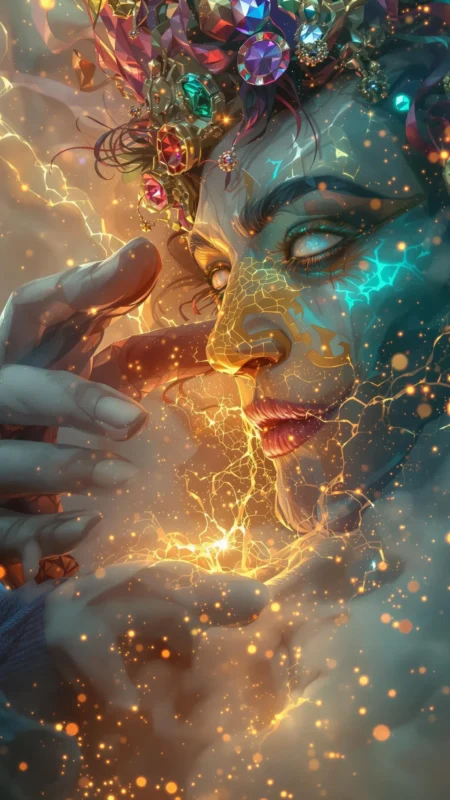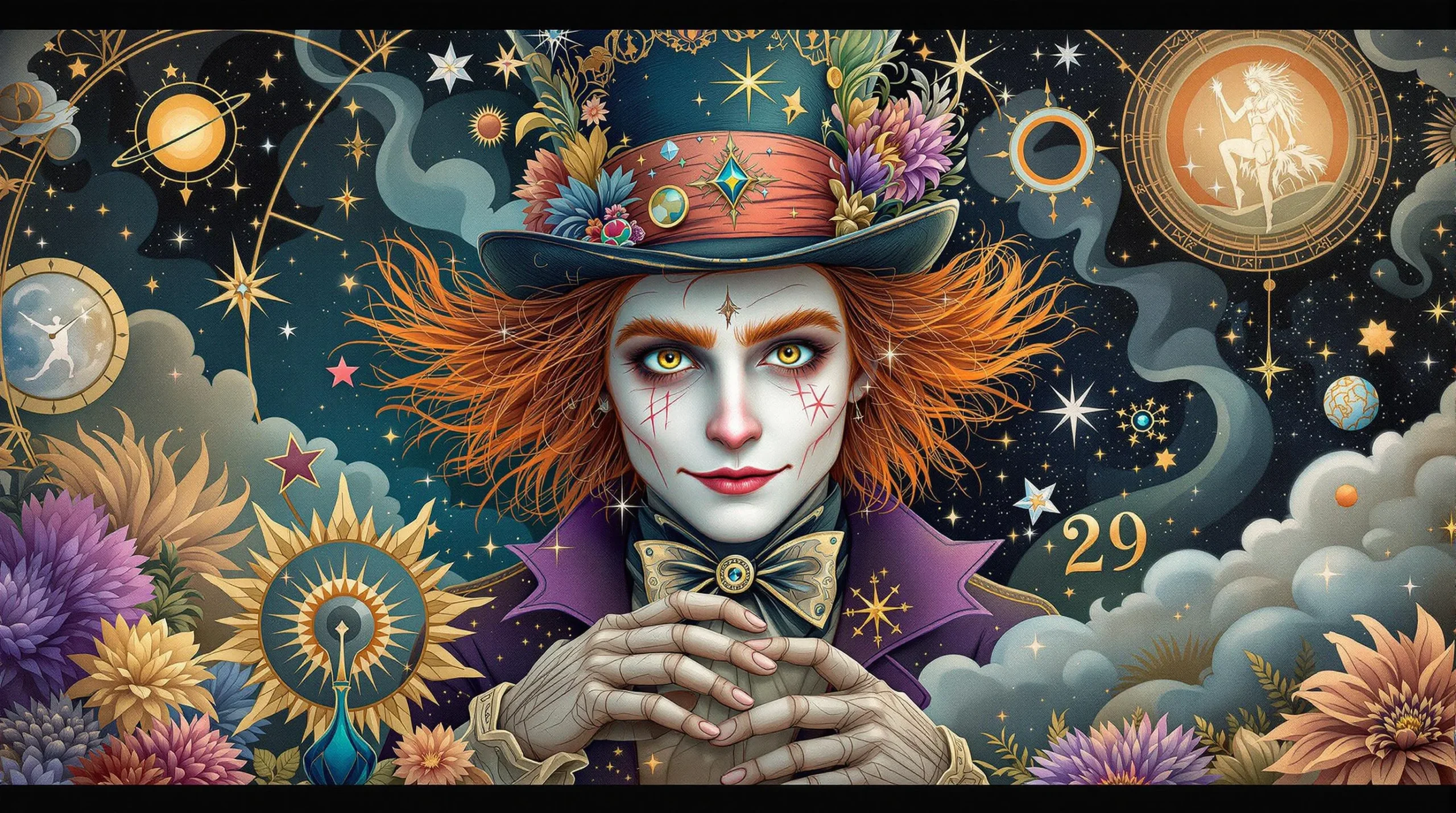


Mad Hatter

Archetype Meaning & Symbolism

Nonsensical, eccentric, creative, chaotic, loyal, melancholic, frantic, theatrical, hospitable, unpredictable

  • Have I gone mad? I'm afraid so. You're entirely bonkers. But I'll tell you a secret. All the best people are.

If Mad Hatter is part of your personal mythology, you may...

Believe

  • You may believe that logic is a suggestion, not a commandment, and that the most profound truths are often spoken in the language of paradox and play.
  • You may believe that time is not a straight line to be conquered but a circular room to be decorated, and that the present moment is the only one worthy of a party.
  • You may believe that the purpose of conversation is not always to exchange information, but to weave a shared moment of delightful confusion.

Fear

  • You may fear that your madness is not a charming choice but an inescapable condition, and that one day you will look for the path back to sanity and find it gone.
  • You may fear being utterly alone in your Wonderland, hosting a tea party for one and realizing that no one else is coming to play.
  • You may fear the mundane, the predictable, and the quiet death of the spirit that comes from a life of 'sensible' choices and gray conformity.

Strength

  • Your mind may be a fountain of startling creativity, able to generate novel ideas and solutions by gleefully disregarding the rules that constrain others.
  • You might possess a deep, joyful resilience, able to weather life's absurdities by treating them as just another feature of the cosmic tea party.
  • You have the rare gift of creating magic and celebration from thin air, reminding others and yourself of the joy that is available in any given moment, no matter the circumstances.

Weakness

  • You may struggle to function in environments that demand punctuality, consistency, and adherence to linear processes, making conventional success a difficult pursuit.
  • Your whimsical nature could be perceived as flippancy or unreliability, potentially alienating those who operate on a more grounded, practical wavelength.
  • You might use your eccentric persona as a defense mechanism, a colorful shield to keep others at a distance and avoid deep emotional vulnerability or accountability.

The Symbolism & Meaning of Mad Hatter

The Mad Hatter is the patron saint of beautiful nonsense, a figure who stands in gentle, chaotic opposition to a world obsessed with utility and linear reason. He represents the sanity of madness, the profound wisdom that can only be found by abandoning the well-trodden path of logic. In a personal mythology, he is the keeper of the unanswerable riddle, reminding us that some of life's greatest mysteries are not problems to be solved but landscapes to be inhabited. His perpetual tea party is not a sign of stagnation but a radical act of presence: a declaration that this moment, right now, with its particular blend of strange company and warm tea, is worthy of eternal celebration. He is the divine fool, whose nonsensical pronouncements may hold more truth than a philosopher's treatise.

His existence whispers a profound permission slip to the soul. Permission to be inconsistent, to be theatrical, to find joy in rituals of one's own making. The Hatter’s own potential origin story, rooted in the mercury poisoning of his trade, adds a layer of poignant tragedy to the archetype. He is perhaps not mad by choice, but by craft. This suggests a connection between creativity and suffering, that the artist’s greatest gift may also be their heaviest burden. He symbolizes the individual whose very mind has been altered by their dedication to their art, making their life a performance they cannot leave. He embodies the beauty that can grow from a wounded mind, a vibrant, chaotic garden flourishing in poisoned soil.

Ultimately, the Hatter is a symbol of chosen reality. He does not fight the absurdity of his world; he curates it. He presides over it. He decides it is perpetually time for tea, and so it is. For someone who holds this archetype within their mythos, this is a powerful lesson in personal sovereignty. It is the understanding that while one cannot always control the rules of the game, one can invent an entirely new game to play alongside it. The Hatter’s world is not an escape from reality, but an insistence on a different, more vibrant, and infinitely more interesting version of it.


Mad Hatter Relationships With Other Archetypes

The Clock

The Mad Hatter’s relationship with The Clock may be the central tragedy of his archetype, a lover’s quarrel that has escalated into a metaphysical cold war. Having supposedly “murdered” Time, the Hatter is not its master but its eternal prisoner, locked in the amber of a single, looping moment. The motionless hands of the clock are not a trophy of liberation but perhaps the bars of a psychic cage, confining him to the stale air of six o’clock. This stasis could be seen as a kind of inverted nirvana, a release from the tyranny of past and future that has curdled into a frantic, meaningless present. The Hatter’s frantic energy, then, might be the ghost of all the moments that can no longer be born, a desperate dance on the pinhead of a second that will never, ever pass.

The Teapot

In the Hatter’s world, The Teapot is less a vessel of comfort and more a hollow icon, a chalice for a sacrament that has long since lost its grace. It promises the warmth of community and the civility of ritual, yet it delivers only a lukewarm and circular conversation. The steam that rises from its spout may not be an invitation but a vaporous exhalation of forgotten thoughts, a fog of unresolved riddles. It is, perhaps, the very crucible of the Hatter’s condition: a constant pouring that never fills, a gesture of hospitality that has become a mechanism of alienation. The Teapot could be a monument to a broken promise, its comforting shape a cruel reminder of a social connection that is perpetually just out of reach.

The Child

The Child arrives at the tea party as a surveyor in a landscape without dimensions, a cartographer of chaos. This archetype, with its clean, linear logic, acts as the shoreline against which the Hatter’s sea of non-sequiturs endlessly crashes. Their dynamic seems to be one of mutual, profound bewilderment. The Hatter may see in The Child a phantom limb—a sense of orderly reason he once possessed but has long since had amputated by whim or by trauma. The Child, in turn, could view the Hatter not merely as an adult absurdity, but as a terrifying glimpse into a kind of freedom where the soul is untethered from sense itself. The Hatter’s nonsensical riddles are not just games; they may be attempts to shatter the crystalline, and perhaps fragile, certitude of the young mind before the world does it first.

Using Mad Hatter in Every Day Life

Navigating Creative Blocks

When faced with a sterile problem that logic cannot solve, embodying the Hatter means throwing a tea party for your ideas. You might deliberately introduce a random, nonsensical element: writing with your opposite hand, consulting a deck of cards for your next step, or working only for ten-minute intervals because the Dormouse is asleep in the teapot again. It is a ritual of surrendering to creative chaos, trusting that the answer lies not in linear thought, but in the happy accident that occurs when you stop trying to force a solution.

Challenging Social Norms

To find the Hatter in your mythos is to challenge the unspoken rules of social engagement. This could manifest as asking beautifully absurd questions at a formal dinner, celebrating a half-birthday with more pomp than a real one, or simply refusing to engage in conversations that feel like pre-written scripts. It is the practice of creating your own social gravity, a pocket of Wonderland where interactions are governed by whimsy and genuine curiosity rather than staid expectations, inviting others to leave their own scripts at the door.

Coping with Timeless Grief

The Hatter is perpetually trapped at six o'clock, a moment of arrested time that may mirror the experience of profound grief or trauma. To use this archetype is not to escape the feeling, but to furnish it. You host a tea party within the frozen moment. It is an acknowledgment that some sorrows are unending, yet one can still find company, ritual, and a slice of absurd joy within that stasis. It is the radical act of pouring tea for your ghosts and declaring the sad, strange moment to be a celebration of what was, and what stubbornly remains.

Mad Hatter is Known For

The Unending Tea Party

A perpetual celebration stuck at six o'clock, symbolizing both a joyous commitment to the present moment and a tragic inability to escape the past. It is a loop of ritual hospitality, where the rules of time and reason are suspended in favor of company and a clean cup.

Riddles Without Answers

Most famously, "Why is a raven like a writing-desk?" This act epitomizes a love for the query over the conclusion. It suggests that the value lies in the process of wondering, in the shared, playful confusion, rather than in the sterile satisfaction of a correct answer.

Eccentric Millinery

The Hatter's identity is inseparable from his craft, with the top hat being his crown of chaos. This is rooted in the historical reality of mercury poisoning among 19th-century hatters ("mad as a hatter"), lending a tragic depth to his whimsy. His profession is his art, his identity, and perhaps, the source of his magnificent madness.

How Mad Hatter Might Affect Your Personal Mythology

How Mad Hatter Might Affect Your Mythos

When the Mad Hatter enters your personal mythos, the narrative structure of your life may begin to fray at the edges, beautifully. A life story that was once a straightforward road from A to B could transform into a labyrinthine garden of forking paths, or perhaps a looping, circular track around a tea table. The hero's journey is replaced by the host's vigil. Your myth is no longer about slaying dragons or reaching a final destination, but about keeping the kettle on, ready for whoever or whatever might appear next. Milestones like graduations and promotions may lose their narrative weight, supplanted by moments of sublime absurdity: the day you held a conversation with a squirrel, the afternoon you wrote a poem on a receipt, the decision to change everything for no reason other than the sheer, thrilling possibility of it.

This archetype reframes the protagonist. You are no longer just the hero; you may be the trickster, the sage, and the fool, all at once. Your personal history might be reinterpreted not as a series of causes and effects, but as a collection of compelling, disconnected scenes. A period of unemployment ceases to be a narrative trough and becomes a 'perpetual six o'clock,' a strange, timeless pause ripe for unexpected encounters. A failed romance is not an ending but a riddle posed without an answer, a beautiful question that hangs in the air forever. Your myth becomes less of a novel and more of a collection of surrealist poetry, its meaning found not in the plot, but in the dazzling, disorienting imagery of its verses.

How Mad Hatter Might Affect Your Sense of Self

To see the world through the Hatter's eyes is to grant oneself a radical form of self-acceptance. The parts of you that seem contradictory, illogical, or 'too much' may no longer be viewed as flaws to be corrected but as essential features of your design. The self ceases to be a singular, stable entity and becomes a delightful, ever-shifting ensemble cast. One day you are the frantic host, another the melancholic poet, another the playful riddler. Identity is not a fixed point but a continuous performance, and you are both the lead actor and the gleeful director of your own one-person show. This perspective could dissolve the pressure to be consistent, allowing for a more fluid and authentic expression of your internal multitudes.

This archetypal influence may also cultivate a deep appreciation for your own internal Wonderland. Your mind is not a machine to be optimized but a landscape to be explored, with all its strange flora and fauna. The Hatter's presence encourages a playful curiosity towards your own thoughts and emotions. Instead of judging a 'mad' thought, you might invite it for tea, ask it a riddle, and see what it has to say. This internal hospitality can foster a profound sense of self-compassion, a recognition that even the most chaotic corners of your psyche have a place at the table. You may find your self-worth untethered from external achievements, rooted instead in the sheer, inimitable fact of your own unique and wonderful bonkers-ness.

How Mad Hatter Might Affect Your Beliefs About The World

With the Hatter as a guide, the world may cease to appear as a rational, ordered system governed by immutable laws. Instead, it might reveal itself as a grand, cosmic tea party, fundamentally absurd and shot through with moments of baffling beauty. The relentless march of time, the bedrock of the conventional worldview, could dissolve into something more pliable and personal. Time is not a resource to be managed, but a medium to be played in. 'Later' and 'sooner' become less important than 'now,' and 'now' is always, miraculously, time for tea. This can lead to a worldview that prioritizes present-moment experience over long-term planning, finding sacredness in the small, inexplicable rituals of daily life.

Furthermore, this archetype challenges the very nature of truth and meaning. The world is not a set of facts to be learned, but a series of riddles to be savored. A worldview informed by the Hatter does not seek definitive answers but delights in the ambiguity of the questions. Meaning is not discovered; it is created, often out of the most nonsensical materials. This perspective fosters a deep skepticism towards dogma, authority, and any system that claims to have it all figured out. It replaces the search for objective truth with a commitment to subjective wonder, suggesting that the most profound way to understand the universe is to dance with its madness rather than attempt to pin it down.

How Mad Hatter Might Affect Your Relationships

In the realm of relationships, the Mad Hatter archetype may shift the focus from compatibility of goals to compatibility of nonsense. You might find yourself drawn to fellow oddballs, the ones whose particular brand of madness harmonizes with your own. The ideal of a perfect partner or friend is replaced by the search for a perfect tea party guest: someone who knows which conversational forks are for salad and which are for combing your hair. Relationships become less about building a future and more about curating a shared, magical present. The strength of a bond is measured not in years of stability, but in the capacity for mutual delight in the absurd.

Friendship and love may take on a fiercely loyal, insular quality. Like the Hatter, March Hare, and Dormouse, you may form a tight-knit circle that operates on its own internal logic, a safe harbor from the 'sane' world outside. Within this circle, communication can become a shorthand of inside jokes, shared symbols, and riddles that need no answers. There is a deep, unspoken understanding that you are all in on the same magnificent joke. However, this can also make it difficult to connect with those outside the circle, who may find the language and rituals of your relationships bewildering or exclusionary. The Hatter's hospitality is infinite, but it is for a very specific kind of guest.

How Mad Hatter Might Affect Your Role in Life

Adopting the Hatter as a personal totem could radically redefine your perceived role in society, in your family, and in your own life. You may shed the skin of more conventional roles—the reliable provider, the dutiful child, the ambitious professional—and slip into the much more comfortable, if less understood, role of the 'divine fool' or the 'creative catalyst.' Your purpose is not to maintain the status quo, but to gently disrupt it with a well-timed, nonsensical question or a sudden burst of celebratory energy. You become the person who reminds everyone that the emperor has no clothes, not through angry protest, but by cheerfully pointing out the absurdity of his invisible finery.

This role is less about what you do and more about how you are. You might be the keeper of whimsy in a corporate office, the host of strange and wonderful gatherings in your community, the one who gives others permission to be a little bit mad. Your function is to puncture pomposity, to celebrate the unbirthday, and to hold space for the parts of life that don't fit neatly into a spreadsheet or a five-year plan. It is a role that carries little formal authority but immense informal power: the power to change the emotional weather of a room, to spark an unexpected idea, to remind others of the joy of pure, unadulterated play.

Dream Interpretation of Mad Hatter

When the Mad Hatter presides over a dream in a positive context, it may be a powerful omen from the subconscious, signaling an invitation to embrace creative chaos and break free from rigid thinking. His appearance could suggest that a solution to a waking-life problem lies not in more effort, but in a complete shift in perspective. To be offered a cup of tea by the Hatter in a dream is to be asked to ingest a dose of healthy madness, to loosen your grip on control and allow for spontaneous, joyful, and illogical possibilities to emerge. The dream may be a communiqué from your inner artist or trickster, urging you to play, to ask silly questions, and to find the profound in the preposterous.

Conversely, a dream featuring the Hatter in a negative light can be deeply unsettling. It may represent a mind caught in a frantic, unproductive loop, a state of anxiety where thoughts spin in circles without resolution. The unending tea party becomes a symbol of being trapped in a situation or a mindset, forced to perform a cheerful ritual that has become meaningless and exhausting. The Hatter's riddles might feel menacing, representing confusing circumstances or conversations in your life that are intentionally obscure and manipulative. Such a dream could be a warning that your embrace of chaos is tipping into a state of genuine mental distress, or that you feel socially trapped by people whose 'playfulness' feels like a form of madness you cannot escape.

How Mad Hatter Archetype Might Affect Your Needs

How Mad Hatter Might Affect Your Physiological Needs

When the Mad Hatter informs one's mythos, the most basic physiological needs—food, water, rest—may be transformed from biological imperatives into theatrical rituals. Sustenance is not merely about calories; it is about the ceremony of the tea party. The presentation, the company, the sheer delightful strangeness of the occasion might take precedence over the nutritional content of the food itself. One might find more nourishment in a beautifully arranged plate of mismatched cakes than in a perfectly balanced, yet soulless, meal. It is a philosophy where the 'how' of consumption becomes as important, if not more so, than the 'what.'

Similarly, the rhythm of sleep and wakefulness could be disrupted. The Hatter’s world operates on a frantic, chaotic energy, punctuated by sudden collapses into slumber, much like the Dormouse napping in the teapot. For an individual living this myth, rest may not follow a prescribed eight-hour schedule but arrive in unpredictable waves. It is a life lived in bursts of intense activity and creativity, followed by periods of deep, necessary withdrawal. This approach challenges the modern cult of productivity and consistent energy, suggesting that the body’s needs are as whimsical and illogical as the mind’s.

How Mad Hatter Might Affect Your Ideas of Belonging

The need for love and belonging, when filtered through the Mad Hatter archetype, becomes a highly specific quest. It is not about fitting in with the crowd, but about finding 'your' crowd, which may consist of only two or three other people at a very small table. Belonging is the profound relief of finding someone else who understands why it's perfectly reasonable to change places at the table for no reason at all. It is the creation of a micro-culture, a chosen family bound by its own secret language and rituals. The tea party is the sacred space of this belonging: a commitment to show up, to share in the madness, and to fiercely protect the circle from the judgment of the sane.

This pursuit can be both deeply rewarding and profoundly isolating. When you find your fellow 'bonkers' people, the connection is electric, a rare and precious thing. It is a belongingness of the soul. However, the specificity of this need can make the search a lonely one. It may involve a feeling of being a perpetual outsider until that specific tribe is found. The Hatter’s mythos suggests that superficial connections are not worth the effort; it is better to be alone with your teapot than to be at a large party where you can’t be your true, gloriously mad self. Love, in this context, is finding the one who will happily celebrate all 364 of your unbirthdays.

How Mad Hatter Might Affect Your Feelings of Safety

Safety, in the world of the Mad Hatter, is a paradox. It is not found in stability, predictability, or the accumulation of resources. In fact, such things might be seen as traps. Instead, safety is discovered in the masterful embrace of chaos. If your internal world is already a swirling vortex of delightful nonsense, the unpredictable calamities of the external world may seem less threatening. The Hatter-minded individual builds their fortress not of bricks, but of adaptability. Their security lies in the certainty that they can find a place for any absurdity within their own personal Wonderland. They are safe because they are unpinnable, a moving target for misfortune.

This redefinition of safety can be both liberating and perilous. It liberates one from the anxiety of trying to control the uncontrollable, fostering a deep resilience and a calm-in-the-storm demeanor. However, it might also lead to a cavalier disregard for genuine, practical dangers. The mythos may encourage one to neglect financial planning, physical health, or emotional boundaries, viewing them as tiresome constraints on one's freedom. True safety for the Hatter archetype lies in a delicate balance: the ability to dance with chaos without letting it sweep you completely off the cliff's edge.

How Mad Hatter Might Affect Your Views of Esteem

Esteem, for one who walks with the Hatter, is not built on a foundation of external achievements or social approval. It is built on the bedrock of radical self-amusement. Self-worth comes from the courage to live by an internal logic that others may not understand, and to do so with flair and theatricality. The Hatter's confidence is unshakable, not because he is 'right' by any objective measure, but because he is fully, unapologetically committed to his own reality. Esteem is found in the masterful curation of one's own life, in treating one's existence as a form of art. It is the quiet pride of wearing a towering, nonsensical hat in a world of sensible fedoras.

This internal validation provides a powerful shield against criticism and failure. If your metrics for success are your own—'Did I delight myself today? Did I ask a beautiful, unanswerable question?'—then the judgment of the outside world loses its sting. However, this can also foster a kind of hermetically sealed arrogance. The esteem of the Hatter can sometimes prevent self-reflection or growth, as any external feedback can be dismissed as simply not understanding the 'game.' The challenge is to cultivate this robust, internal self-worth without becoming deaf to the loving, constructive voices of the few guests who have earned a seat at your table.

Shadow of Mad Hatter

The shadow of the Mad Hatter emerges when the playful chaos curdles into genuine mania, when the whimsy becomes a weapon. In its shadow form, the archetype is not a gentle host of a party but a tyrant of nonsense, trapping others in illogical loops and circular arguments for the sake of control. The riddles are not playful but designed to demean and confuse. The tea party is no longer a sanctuary but a prison, where guests are forced to abide by arbitrary, constantly changing rules. This shadow Hatter is the frantic energy that consumes all oxygen in the room, the instability that is not creative but destructive, leaving a wake of bewildered and emotionally exhausted people. It is the madness that has lost its mirth, leaving only the frantic, hollow performance.

Conversely, a dearth of the Hatter's energy creates its own shadow: a life of rigid conformity and joyless practicality. This is the individual who polices their own thoughts for any sign of whimsy, who fears any deviation from the schedule, and who sees a riddle not as a game but as an error in communication. Life becomes a sterile, gray affair, a series of tasks to be completed rather than moments to be lived. This profound lack of Hatter energy leads to a spiritual desiccation, an inability to play, wonder, or connect with the absurd beauty of existence. The world becomes a problem to be solved rather than a mystery to be loved, and the soul slowly starves in a prison of its own sensible, logical making.

Pros & Cons of Mad Hatter in Your Mythology

Pros

  • You may possess a unique and refreshing perspective that challenges groupthink and inspires creativity in others.
  • You might live a life that is a rich tapestry of surprising moments, genuine joy, and deep connections with fellow non-conformists.
  • You are likely uniquely equipped to handle life's absurdities and existential crises with a sense of play and profound wonder.

Cons

  • You may struggle to maintain stable employment, long-term plans, or relationships with people who require predictability and logical consistency.
  • Your behavior might be frequently misinterpreted as flippant, unreliable, or even cruel by those who don't understand your internal logic or sense of play.
  • There is a constant tightrope walk between charming eccentricity and a mental state that is genuinely harmful to yourself or isolating from the support of others.