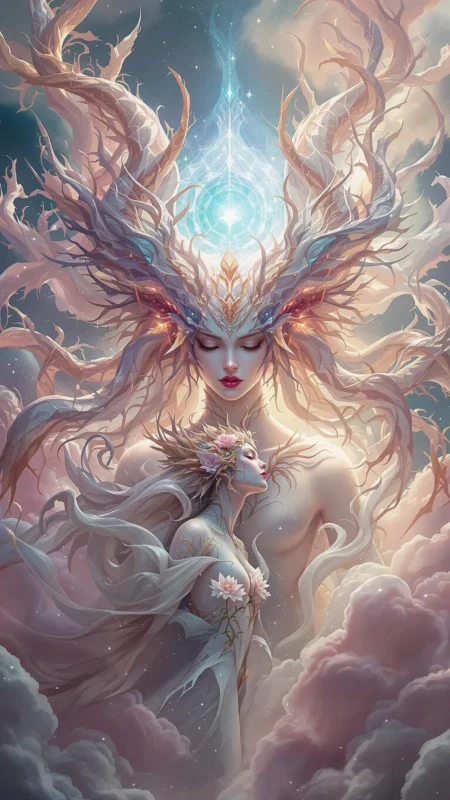
Lofn

Archetype Meaning & Symbolism

Gentle, Permissive, Kind, Arranger, Matchmaker, Sanctioner, Compassionate, Unconventional, Diplomat, Intercessor

  • Let no law of man or god stand between two hearts that have found their true north. I grant the permit. I witness the bond. The rest is but noise.

If Lofn is part of your personal mythology, you may...

Believe

  • That the highest law in the cosmos is the law of love, and all other rules are merely commentary.
  • That the most courageous act is not to fight, but to gently and persistently create connection where there is division.
  • That every genuine bond between people is sacred and deserves to be praised, regardless of its form.

Fear

  • That in the end, love is not actually enough to overcome real-world obstacles and societal hatred.
  • The collateral damage of your choices: that in pursuing a forbidden union, you will cause irreparable pain to people you also love, like your parents or children.
  • Being completely ostracized, left with only your sanctioned love in a cold and hostile world.

Strength

  • A profound, non-judgmental empathy that allows you to be a safe confidant for people from all walks of life.
  • A quiet but tenacious courage that allows you to follow the guidance of your own heart against immense pressure.
  • Diplomatic grace: an innate ability to mediate disputes by finding the common ground of affection or shared humanity between opposing parties.

Weakness

  • A certain naivete regarding the very real dangers of defying powerful social norms and taboos.
  • A tendency to prioritize relational harmony above all else, sometimes at the cost of ignoring difficult truths or enabling unhealthy behavior.
  • You may be drawn to meddle in the relationships of others, becoming a self-appointed “fixer” where your intervention is neither wanted nor helpful.

The Symbolism & Meaning of Lofn

In a personal mythology, Lofn represents the sacred permission slip. She is the patron goddess of the loves we are told we cannot have: the love for a person deemed unsuitable by our tribe, the love for a way of life that our family rejects, or the love for a part of ourselves we have been taught to hide. She does not smash the gates of convention like a berserker; she finds the key, unlocks the door with a gentle click, and holds it open with a reassuring smile. Her presence in one’s life may signal a quiet revolution, a turn toward a love that feels more authentic than obedient. She symbolizes the truth that some bonds are their own justification, existing above the laws of man or the judgment of the crowd.

The archetype of Lofn is also one of divine diplomacy. She is an intercessor, a being who moves between the rigid structures of power and the chaotic, heartfelt needs of individuals. Her symbolism is not in breaking the rules, but in understanding them so deeply that she finds the compassionate loophole. In a modern context, she is the energy that allows a conservative father to dance at his son’s same-sex wedding, or the grace that helps a family welcome a member back from addiction. She embodies the profound idea that love is not the enemy of order but is, perhaps, a higher, more complex order of its own.

Her name, meaning “praise,” points to her role as an affirmer. To have Lofn in your personal pantheon is to have a source of validation for the tender, unconventional, or fragile connections in your life. She is the whisper that says “this is good” when the world is shouting “this is wrong.” She sanctifies the secret, praises the timid, and blesses the bond that has no other blessing. She is the patron of the starting point, of the first tentative step toward a union that will redefine the map of your world, granting you the courage not of a warrior, but of the devoted heart.


Lofn Relationships With Other Archetypes

The Locksmith

The Lofn’s relationship with The Locksmith may be one of silent, mutual recognition, a shared understanding of how the world is sectioned off by gates and doors, both visible and not. Where the Locksmith deals in the cold, intricate realities of brass and steel, the Lofn works with the equally complex tumblers of social code and forbidden longing. The Locksmith could be seen as the Lofn's hands in the material world, the one who physically springs the latch for which the Lofn has already secured a spiritual or social pardon. It is a partnership, perhaps, between the metaphysical pick and the physical one, a quiet pact to believe that no barrier, whether of iron or of institution, should be absolute when a fundamental connection is at stake.

The Border Collie

One could also see The Border Collie as the Lofn’s instinctual, four-legged counterpart, a living embodiment of the art of gentle gathering. The Collie does not command the flock with brute force but with an intelligent, intuitive pressure, a low and patient circling that makes unity seem like the sheeps’ own idea. So too does the Lofn operate. This archetype does not kick down the door but rather herds possibilities, nudging circumstances and whispering encouragement until two disparate souls find themselves moving along the same path, drawn together by what feels like serendipity but might be the result of a quiet, persistent, and loving will. It is the art of creating a whole from scattered parts, not by edict, but by an unerring sense of the path of least resistance toward union.

The Diplomat

With The Diplomat, the Lofn perhaps shares a common soul, if not a common office. Both are masters of the sanctioned exception, experts in navigating the treacherous corridors of power to argue for a reality that is not yet recognized. While the Diplomat brokers a treaty between warring nations, the Lofn brokers a kind of treaty between the heart's sovereign territory and the state's decree. The work is one of immense subtlety, requiring a deep understanding of the established rules in order to carve out a space for what they neglect. The Lofn, in this light, is a diplomat for the heart, securing a passport for a love that was, until then, stateless, and proving that the most profound negotiations are often those that win permission for two people to simply be together.

Using Lofn in Every Day Life

Navigating Family Disapproval

When a chosen partner does not meet the family's expectations, be it for reasons of class, religion, or background, the Lofn archetype provides the internal fortitude to sanctify your own choice. It is not about angry rebellion but about a quiet, firm belief in the validity of the connection. You might use this energy to calmly explain your position, not seeking approval but stating a truth, creating a sacred space for your relationship to exist even amidst disapproval.

Embracing an Unconventional Identity

The Lofn archetype extends beyond romantic love to self-love. For individuals struggling to accept an aspect of their identity that defies social norms, such as their sexuality, gender identity, or even an unusual career path, Lofn offers the permission slip. She is the inner voice that says this, too, is a valid union: the union of the self you are with the self you present to the world. She praises this integration, giving you the grace to live your truth without demanding the world's applause.

Mediating Fierce Disagreements

In a situation of intractable conflict, perhaps between family members or within a community, the Lofn archetype can be invoked to act as a gentle mediator. Instead of focusing on who is right, you would focus on the forgotten threads of affection that still exist between the parties. Like Lofn arranging a strategic marriage to create peace, you would seek to find a common project, a shared memory, or a future goal that can serve as a bridge, allowing a new, perhaps fragile, union to form over the ashes of the old argument.

Lofn is Known For

Gaining Permission for Unions

Her primary and most celebrated role is to gain permission from Odin and Frigg to arrange unions, particularly those considered illicit or forbidden by societal or familial standards. She is the patron of love against the odds.

A Gentle and Kind Demeanor

Lofn is consistently described as mild-mannered, gentle, and good to call upon. Her power is not one of force but of compassion and gentle persuasion, making her an approachable and comforting figure.

Handmaiden of Frigg

As one of the Asynjur (goddesses) who serve Frigg, queen of the Æsir, Lofn operates under the highest authority. This connection gives her the legitimacy to bend rules, as her actions are sanctioned by the very powers that create those rules.

How Lofn Might Affect Your Personal Mythology

How Lofn Might Affect Your Mythos

When Lofn becomes a figure in one's personal mythos, the life story itself may transform from a tale of epic battles to one of quiet, revolutionary unions. The central conflicts of the narrative may no longer be about conquering external foes, but about bridging internal divides and forging difficult connections. Your personal epic becomes a story of mediation: arranging a peace treaty between your career ambitions and your creative passions, sanctioning a marriage between your past self and your future potential, or uniting your spirituality with your daily, mundane life. The climax of such a mythos might not be a victory on a battlefield, but a moment of profound, peaceful integration, a quiet wedding of two formerly warring aspects of the self or the community.

The character arc in a Lofn-infused mythos is one of developing a specific kind of strength: the power of gentle persuasion. The protagonist learns that true influence lies not in dominance but in compassion, not in loud proclamations but in quiet understanding. The story may be plotted with moments where forbidden doors are opened not with a battering ram but with the right key, offered at the right time. Your personal legend becomes less about what you have conquered and more about what you have connected, what you have healed, and what you have permitted to flourish against the odds. It is the story of becoming a safe harbor, a sanctuary where the most unlikely and tender things are allowed to grow.

How Lofn Might Affect Your Sense of Self

To see oneself through the lens of the Lofn archetype is to view one's capacity for gentleness as a form of power. You may perceive your core identity as that of a facilitator, a bridge-builder, a quiet councilor. Your self-worth might be deeply tied to your ability to create harmony and to sanction authenticity in yourself and others. This can foster a profound sense of inner authority, a feeling that you do not need external validation for your choices in love and life because you have access to a higher, more compassionate court of appeal. You are the one who gives out the permission slips, starting with your own.

This self-perception could also foster a deep and abiding patience. Understanding that your role is not to force but to gently arrange, you may cultivate a slower, more observant approach to life's challenges. You may see your empathy not as a vulnerability but as your most finely tuned instrument, allowing you to navigate complex emotional landscapes with grace. The self that emerges is not fragile, but flexible; not weak, but yielding in a way that allows you to absorb conflict and transform it into connection. You may come to see your quiet nature not as a lack of forcefulness, but as the very source of your unique and potent influence.

How Lofn Might Affect Your Beliefs About The World

A worldview shaped by Lofn is one where rules, laws, and social conventions are seen as provisional, secondary to the higher, unwritten law of love and compassionate connection. You may look at the world’s rigid categories and intractable conflicts with a sense of hopeful sorrow, believing that a bridge could be built across any divide if only the right approach were found. Institutions, traditions, and dogmas may seem like flimsy structures next to the bedrock reality of an individual heart seeking a home in another.

This perspective fosters a deep faith in the power of the individual bond to create change. You might believe that the most significant political acts are not marches or protests, but small, personal acts of forbidden connection: a friendship across party lines, a marriage across cultural divides, a conversation that breaches a long-held taboo. The world, for you, is not a battlefield of ideologies but a tangled web of relationships waiting to be mended, and your purpose is to find a loose thread and begin, gently, to pull things back together.

How Lofn Might Affect Your Relationships

In relationships, you may unconsciously adopt the role of the sanctioning agent, the one who makes others feel safe and accepted in their authenticity. You might find yourself drawn to unconventional partnerships, or to people who feel like outsiders, feeling a deep, almost spiritual calling to provide them with a space of belonging. Your presence can be a balm in friendships and romantic partnerships, as you prioritize the health and harmony of the bond above ego or being right. You create the kind of relationship where difficult truths can be spoken because they are cushioned with unwavering gentleness.

However, this approach carries a risk. Your deep desire for harmony might lead you to smooth over necessary conflicts or enable unhealthy dynamics in the name of unconditional acceptance. You might become the keeper of secrets, the silent witness to dysfunction, because your primary drive is to preserve the union at all costs. The challenge of the Lofn archetype in relationships is to learn the difference between granting permission for authentic love and providing a sanctuary for patterns that ultimately harm the very people you wish to protect.

How Lofn Might Affect Your Role in Life

If Lofn is part of your inner pantheon, you may feel that your role in life is not to be the star of the show, but the one who ensures the show can go on. You are not the monarch, but the trusted diplomat who arranges the peace. You are not the fiery prophet, but the quiet mystic who tends the sacred flame of connection in the temple. Your purpose may feel less like a grand destiny and more like a quiet, vital function: to be a facilitator of love, a mediator of conflict, and a creator of safe spaces. This role can be profoundly fulfilling but is often invisible, its successes measured in conflicts that don't happen and relationships that quietly thrive.

This sense of purpose could guide you toward professions like therapy, diplomacy, human resources, or community organizing, roles that are explicitly about bridging gaps between people. Even in other fields, you might find yourself becoming the unofficial office counselor or the family peacemaker. Your greatest contribution is not a tangible product but an atmosphere of trust and acceptance you cultivate around you. Your role is to be the gentle force that reminds everyone of their shared humanity, sanctioning the small, daily acts of love that hold the world together.

Dream Interpretation of Lofn

To dream of a Lofn-like figure, or to feel her presence as a sense of gentle permission, may be a profound message from the subconscious. In a positive context, such a dream is a green light. It may signify that a path you feared was forbidden—be it a new relationship, a creative project, or a radical change in identity—is now sanctioned by your deepest self. The dream is an invitation to proceed with courage, not with aggression, but with the quiet confidence that this union is right and good. It could be a call to act as a peacemaker in a waking life conflict, assuring you that you have the internal resources for the task.

Conversely, to dream of a Lofn who is weeping, silent, or who turns her back on you could represent a deep internal schism. It may indicate that a desire or relationship you are pursuing is in fundamental conflict with your own core values, and your subconscious cannot grant permission. This negative dream is not a condemnation but a warning light, suggesting that the “forbidden” nature of the situation is not merely societal but is rooted in a genuine threat to your well-being or integrity. It could also symbolize a feeling of powerlessness, a fear that the external barriers to a cherished connection are truly insurmountable, leaving you with a sense of divinely unsanctioned heartbreak.

How Lofn Archetype Might Affect Your Needs

How Lofn Might Affect Your Physiological Needs

From a mythological perspective, the Lofn archetype speaks directly to the body’s need for gentle touch, intimacy, and the calm that comes from secure attachment. While she doesn't provide food or shelter, she sanctions the relationships that regulate our nervous systems. Her presence in one's mythos could correlate to a life where these needs are met, where the body feels safe enough to rest, digest, and heal in the presence of a trusted other. The permission to love freely is also the permission for the body to exit a state of hyper-vigilance, allowing for deeper sleep and a more resilient physical state.

The absence or blockage of the Lofn energy might manifest in the body as the somatic cost of a forbidden love. The stress of hiding a relationship, the constant fear of disapproval, can create chronic physiological tension. This may result in insomnia, digestive issues, a weakened immune system, or a perpetually racing heart. The body itself longs for the sanction that Lofn provides, for the physical release that comes when a bond is allowed to exist openly and peacefully, without the corrosive effect of shame or fear.

How Lofn Might Affect Your Ideas of Belonging

Lofn’s entire domain is belongingness and love. Her influence in one's personal mythos is a radical assertion that everyone has a right to love and be loved, and that a sacred space of belonging can be forged by any two souls who choose it. She specializes in creating belonging for the outcasts. If you love someone your family rejects, Lofn sanctions a new family, a tribe of two. If you feel exiled from your community, she reminds you that your most profound belonging is with your own heart and those you choose to cherish. She is the ultimate antidote to the loneliness that comes from being different, promising that a true union is its own world and its own home.

Ironically, this intense focus on a specific, perhaps unconventional, bond can threaten one's sense of belonging to the wider group. The price of admission to the sacred space of the sanctioned relationship may be exile from one's family of origin, religious community, or hometown. The Lofn archetype forces a difficult choice: is it better to belong superficially to the many, or to belong profoundly to the few, or even to the one? Her path suggests the latter, but it does not erase the pain of what must be left behind. It is a path of choosing a deeper, more authentic belonging, even if it means standing outside the circle of the wider tribe.

How Lofn Might Affect Your Feelings of Safety

Lofn provides a unique form of safety: the emotional and spiritual safety of the sanctioned space. When she is an active archetype in your life, you may feel a sense of being protected from the harsh judgments of the world. Your primary relationships become a fortress, a sacred enclosure where you are safe to be your most authentic self. This safety is not about locks on the doors but about the unshakeable inner knowledge that your bond is valid and blessed. It is the security that comes from knowing that, even if the world rejects you, you have a place where you are fully seen and accepted.

However, this archetype presents a profound paradox regarding safety. In granting you permission to pursue a love that is forbidden, Lofn may simultaneously guide you into situations of real-world danger. Defying strong social, familial, or religious taboos can lead to ostracization, financial ruin, emotional abuse from the community, or even physical violence. The inner safety she provides is not a guarantee of external security. The personal mythos then becomes about navigating this dangerous gap, learning to protect the sacred bond while realistically assessing and defending against the very real threats that its existence might attract.

How Lofn Might Affect Your Views of Esteem

Esteem, through the lens of Lofn, is the self-respect earned by living in alignment with one's heart. It is not the boisterous pride of accomplishment but the quiet, unshakable confidence that comes from refusing to betray your own affections for the sake of approval. Lofn's name means “praise,” and the esteem she grants is a form of internal praise for your courage to love authentically. It is the dignity of the person who can look the world in the eye and, without anger, state their truth. This fosters a powerful, self-referential sense of worth, independent of social accolades or acceptance.

When this archetype is underdeveloped, low esteem can manifest as a desperate need for external validation for one’s relationships. One might feel a deep sense of shame about their attractions or hide their partnerships, believing they are fundamentally unworthy of a love that doesn't fit a narrow, conventional template. They are perpetually seeking permission from others because they cannot grant it to themselves. To cultivate the Lofn archetype is to embark on the journey of becoming your own highest source of praise, learning to trust the wisdom of your own gentle heart and finding deep self-esteem in that trust.

Shadow of Lofn

The shadow of Lofn emerges when gentle permission curdles into toxic enabling. This is the archetype in its excess, where the drive to sanction all love becomes a refusal to exercise discernment. The shadow Lofn blesses codependency, calling it devotion. She puts a sacred veil over abusive dynamics, praising the victim’s “unconditional love” for their abuser. She is the friend who encourages you to go back to a harmful partner because “you love each other,” ignoring all the evidence of destruction. In this form, she is not a healer but a purveyor of sweet-sounding poison, using the language of compassion and acceptance to sanctify unions that are fundamentally unhealthy, obsessive, or dangerous.

Conversely, the shadow can appear as a distorted lack of Lofn's energy, transforming the gentle permitter into a self-righteous gatekeeper. This shadow figure hoards permission, granting it only to those who meet a narrow, personally defined set of criteria. Instead of defying societal judgment, this figure becomes a new source of it, looking down upon others' relationships as not “conscious” or “evolved” enough. This is the spiritual snobbery that uses the vocabulary of love to create new hierarchies of exclusion. The shadow Lofn, in this guise, becomes the very thing she was meant to overcome: a force that judges, divides, and withholds the blessing of acceptance from those deemed unworthy.

Pros & Cons of Lofn in Your Mythology

Pros

  • You possess a deep well of empathy that allows you to form profound and meaningful connections with a wide variety of people.
  • Living by the law of your own heart frees you from the psychological burden of convention, allowing you to build a life of genuine authenticity.
  • You can be a powerful force for healing and reconciliation in your family and community, capable of building bridges where others see only walls.

Cons

  • You may find yourself in a state of quiet but perpetual conflict with mainstream society, which can be exhausting and isolating.
  • Your compassionate desire to see the best in every relationship can make you tragically blind to manipulation and toxic dynamics.
  • Those who value order, tradition, and clear boundaries may perceive you as a subversive, disruptive, or meddling influence.