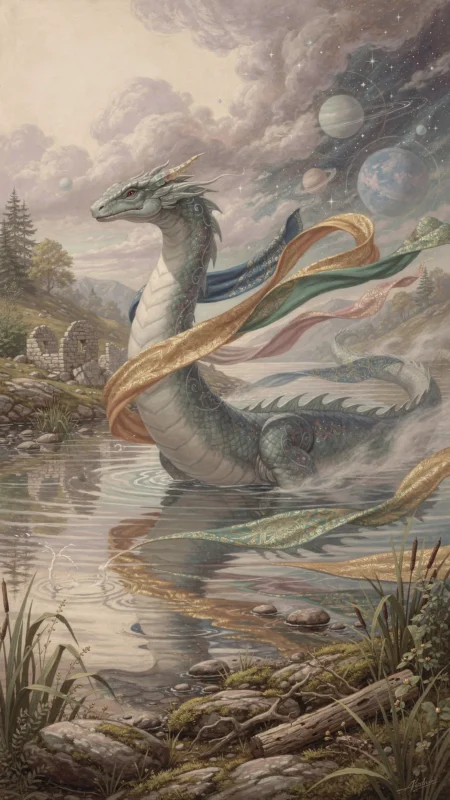
Loch Ness Monster

Archetype Meaning & Symbolism

Mysterious, elusive, deep, ancient, solitary, misunderstood, legendary, shy, gentle, resilient

  • The world mistakes the surface for the whole sea: find your truth in the currents far below, where their sight cannot follow.

If Loch Ness Monster is part of your personal mythology, you may...

Believe

  • The greatest truths are felt, not proven.
  • There is a profound dignity in being misunderstood.
  • The world is far more magical and mysterious than it appears on the surface.

Fear

  • Being fully seen, exposed, and explained away.
  • Discovering that your inner mystery is actually just emptiness.
  • Living in a world with no secrets left to discover.

Strength

  • A profound self-reliance and an exceptionally rich inner life.
  • A calming, steady, and enigmatic presence that often reassures others.
  • The ability to see beyond the obvious and perceive deeper patterns and truths.

Weakness

  • A tendency toward self-imposed isolation and difficulty forming intimate bonds.
  • You may be perceived by others as aloof, secretive, withholding, or untrustworthy.
  • A potential for stubbornness in refusing to engage with practical, surface-level realities.

The Symbolism & Meaning of Loch Ness Monster

To have the Loch Ness Monster as a feature in your personal mythology is to carry the deep, peaty waters of its home within you. The loch itself is a potent metaphor for the subconscious mind: dark, deep, and holding things of immense age and power. It suggests that the most vital and defining aspects of your being are not on the surface, not easily cataloged or understood. Your essence may be something ancient, something that has survived against all odds, something that defies easy explanation. This archetype represents a profound comfort with one's own inner mystery, a quiet acknowledgment that your depths contain wonders, and perhaps a few terrors, that the conscious mind can only glimpse in fleeting moments of intuition or dream.

Furthermore, the creature exists in the charged space between belief and skepticism. To align with it is to find a home in ambiguity. You may reject a purely materialist worldview, choosing instead to live in a world where wonder is possible, where not every shadow needs to be explained away by the harsh light of proof. The Loch Ness Monster symbolizes the courage to believe in what is felt over what is seen, to trust the personal anecdotal evidence of your own soul. It is the patron saint of 'what if,' the quiet champion of enchantment in a world drowning in the mundane. This allows for a life story rich with potential and open to magic, where the absence of evidence is not the evidence of absence.

Despite its imposing potential, the modern Nessie is rarely a figure of malice. It is the gentle giant, the misunderstood behemoth. This symbolism points to a form of power that is not aggressive or dominating but passive and enduring. It is the strength of resilience, of quiet survival. It suggests that your greatest power may be your ability to withdraw, to become unseen, to protect your core self from a world that may not understand it. Your strength lies not in confrontation but in your profound and unshakable presence, a deep and steady current beneath the choppy surface of everyday life.


Loch Ness Monster Relationships With Other Archetypes

The Hoax

The Hoax may be the Monster’s shadow-self, the cynical twin born from the same flash of light on water. It is a relationship of parasitic codependence, where the crude machinery of fabrication—the toy submarine, the doctored photograph—attempts to supplant a sublime mystery. Yet, perhaps the Hoax does not diminish the Monster but rather deepens it, for in exposing a lie, it forces us to question the very nature of seeing. The confessed counterfeit could be a desperate attempt to give a disappointing form to a formless wonder, a way to hold the ocean in a teacup, and in its failure, it only underscores the vastness of what it sought to capture.

The Fog

The Fog is less a partner to the Monster and more its native element, the very medium in which it breathes. It could be seen as the amniotic fluid of myth, dissolving the hard certainties of the shoreline and the rational sky into a single, pearlescent ambiguity. Under the Fog’s soft erasure, the familiar world recedes, and the water’s surface becomes a membrane between what is known and what is eternally guessed at. The Monster does not simply hide in the Fog; perhaps it is *made* of it, a temporary coalescence of mist and longing, a shape that the mind gives to the lake’s inscrutable exhalations before it dissolves back into suggestion.

The Unseen

The Loch Ness Monster’s most profound kinship is, of course, with The Unseen. It is the grand vessel for that powerful absence which haunts the edges of our perception. The Monster could be the ultimate testament to the fact that a thing’s power is not in its presence, but in its persistent, tantalizing, and unconfirmed possibility. It is the rustle in the cosmic hedgerow, the ripple that proves a stone was thrown, even if we never see the hand. This relationship suggests that what truly captivates us is not the creature itself, but the shape of the void it leaves in our understanding, a space so perfectly contoured that our imagination cannot help but fill it.

Patterns of The Loch Ness Monster Spirit Animal, Totem, or Archetype

Signs that the Loch Ness Monster archetype is connected to you often manifest as a persistent feeling of being out of time, a sense of ancientness in a modern world. You might find yourself drawn to bodies of water, especially deep, dark, or mysterious ones, feeling a sense of homecoming or profound peace near them. Synchronicities could appear as recurring images of serpentine forms, plesiosaurs, or mythological sea creatures in art, media, or conversation. You may have a lifelong fascination with unsolved mysteries, cryptozoology, and folklore, not as a mere hobby, but as a deep, personal resonance with the idea that the world still holds profound secrets. This pull towards the enigmatic, this comfort in the unproven, could be a sign that the Loch Ness Monster spirit animal is surfacing in your consciousness.

Emotionally, you might feel a recurring tension between a desire to be seen for who you truly are and an equally powerful instinct to remain hidden and protected. This isn't simple shyness; it's a deeper, more primal impulse to guard your inner core. You may experience periods of social withdrawal that feel not draining, but deeply necessary and restorative, as if you are diving into your own personal loch to recharge. Events that force you into the spotlight or demand total transparency might feel acutely stressful, almost threatening. If you consistently feel that your truest self is a vast, quiet, deep entity that most people only ever glimpse from the shore, this archetype is likely a central pillar of your personal mythos.

Thoughts and beliefs aligned with this archetype often center on the validity of intuition and the limits of empirical evidence. You may find yourself defending the 'magic' in the world, arguing for the possibility of the unknown against cynical or purely rational viewpoints. A significant life event, perhaps a moment of profound intuition that defied logic or a mysterious experience that could not be explained away, may have cemented this worldview. If you find yourself consistently playing the role of the gentle skeptic of skepticism, the one who reminds others of the vastness of what we don't know, you are embodying the creature's spirit. This quiet insistence on a deeper, more mysterious reality is the clearest sign of a connection to the Loch Ness Monster spirit animal as a guide.

Using Loch Ness Monster in Every Day Life

Navigating Social Pressure

When you feel the overwhelming need to perform or reveal the entirety of your being for social acceptance, you may channel the wisdom of the monster. To offer a glimpse, a shadow, a subtle ripple on the surface is enough. Your inner world is a vast, deep loch, not a shallow, well-lit pond for public recreation. You do not owe the world a full sighting on demand.

Embracing Your Unique Path

If your life choices, your passions, or your very essence seem unbelievable or strange to others, like a plesiosaur thriving in a modern Scottish lake, so be it. The creature does not surface to seek validation from the tourist-laden boats. It follows its own ancient, submerged currents. Your journey is valid on its own terms, its truth not subject to a popular vote or the consensus of onlookers.

Cultivating Inner Richness

When confronted with periods of loneliness or a sense of being profoundly misunderstood, you might reframe the experience through the lens of the archetype. Loneliness becomes a dignified solitude. It is a sacred space for cultivating an inner life so rich and complex it does not require constant external reflection. The most profound discoveries are made in the quiet, murky, and solitary depths of the self.

Loch Ness Monster is Known For

Elusiveness

Its legendary ability to evade capture and definitive proof, existing primarily in fleeting, ambiguous glimpses and eyewitness accounts.

The Surgeon's Photograph

The iconic 1934 image, though long since debunked as a hoax, which seared its long-necked, humped form into the global consciousness.

Enduring Mystery

Its persistence as a cultural phenomenon and a symbol of the unknown, fueling belief and scientific curiosity for generations despite a lack of concrete evidence.

How Loch Ness Monster Might Affect Your Personal Mythology

How Loch Ness Monster Might Affect Your Mythos

When the Loch Ness Monster swims into one's personal mythos, the life story ceases to be a straightforward narrative of external achievement. It transforms into a quest for a glimpse of something hidden deep within. Your personal history may be marked not by conquests but by 'sightings': fleeting moments of profound self-understanding, eerie synchronicities, or encounters with the sublime that hint at a deeper, unseen reality. The central tension of your story might be the dance between the part of you that lives on the surface, engaging with the world, and the vast, ancient creature of your inner self that resides below. Your life's purpose may be redefined as the patient, lifelong vigil by the shores of your own soul, waiting for that magnificent head to break the surface.

The narrative of your life may also shed a linear structure in favor of one defined by depths and surfaces. Periods of social withdrawal, creative fallowness, or quiet introspection are no longer framed as failures or setbacks. Instead, they become necessary dives into the loch, times of submergence essential for restoration and the gathering of hidden wisdom. The plot of your life is driven by these cycles of disappearance and reappearance. The most pivotal moments in your mythos might be the ones that happened in secret, in the solitary darkness, with only your inner creature as a witness. Your story's value is measured not by what the world sees, but by the richness of the world it cannot see.

How Loch Ness Monster Might Affect Your Sense of Self

To see oneself through the lens of the Loch Ness Monster archetype is to accept a fundamental and perhaps permanent state of being misunderstood. You may perceive yourself as possessing a profound inner complexity, a depth that is both a gift and a burden. This can foster a quiet sense of being special, not with arrogance, but with the simple acknowledgment of your own unique ecology. There is a safety in this self-concept: your truest self is protected by fathoms of water, shielded from the casual judgments and facile interpretations of others. You learn to be a self-contained universe, your own best-kept secret.

This perspective naturally cultivates a powerful self-reliance. When your essential truth is an elusive creature, you cease depending on others to validate its existence. You become your own primary witness, your own believer. This fosters a quiet confidence that is not performative or loud but is as steady and deep as the loch itself. Your self-worth is not tied to how many 'likes' or 'shares' your surface-level persona receives. It is anchored in the deep, unwavering knowledge of the magnificent, mysterious being that you are sheltering within, a truth understood by you and you alone.

How Loch Ness Monster Might Affect Your Beliefs About The World

An affinity for the Loch Ness Monster may shape a worldview that is perpetually enchanted. The world is not a finished, fully mapped territory but a place of endless mystery and hidden wonders. Every forest, every ocean, every old city street could hold its own Nessie. This perspective is an antidote to the cynicism of the modern age, a commitment to seeing the magic simmering just beneath the veneer of the mundane. It is a worldview that finds more truth in folklore than in headlines, more substance in a strange feeling than in a statistic. Reality is not a fixed object but a deep body of water, and what we see is only the thinnest of surfaces.

This naturally leads to a healthy skepticism of official narratives and the tyranny of 'proven facts.' If the established order can be so wrong about what lurks in a single Scottish loch, what other grand certainties might be equally fragile? This fosters an open and deeply curious mind, one that values intuition, personal experience, and ancestral stories as legitimate ways of knowing. The world becomes a text to be interpreted, not a problem to be solved. You may find yourself trusting the subtle currents of your Loch Ness Monster spirit animal over the loud pronouncements of experts, believing that the most profound truths are always the ones that slip through the nets of conventional understanding.

How Loch Ness Monster Might Affect Your Relationships

In relationships, the Nessie archetype compels a search for depth and a high tolerance for mystery. Superficial connections, small talk, and relationships based on social convenience may feel unbearable. You seek partners, friends, and kin who are not afraid of the dark water, who are willing to sit in quiet patience by the shore of your being without demanding a constant performance. True intimacy is found with those who love you for the depths they sense, not merely the personality you present. The ideal connection is a silent, shared vigil, an unspoken pact to honor the unseen in each other.

This same quality, however, can be the primary obstacle to connection. The powerful instinct to remain submerged, to guard your inner world, can easily be mistaken for aloofness, disinterest, or secrecy. Vulnerability may feel like a dangerous surfacing, risking capture or, worse, demystification. There can be a tendency to test potential partners: to flash a fin, to show a hint of the strange creature below, and to watch if they flee in terror or disbelief. The challenge is learning to build a dock, to allow a trusted few to get a closer look without feeling that the sanctity of the entire loch has been compromised.

How Loch Ness Monster Might Affect Your Role in Life

Your perceived role in life, or in any group, may be that of the Keeper of the Mystery. You are not the charismatic leader who charges ahead, nor the diligent worker bee who maintains the hive. You are the still, quiet presence that gives the collective its soul, its depth. In meetings, in families, in friendships, you may be the one who listens intently, speaking rarely, but when you do, your words seem to rise from a place of ancient wisdom, changing the temperature of the room. Your role is to be a living reminder that not everything can be known, quantified, or solved, and that there is a profound power in that fact.

Professionally, this archetype often guides individuals toward roles that involve peering beneath the surface. You may be drawn to psychology, research, investigative work, archaeology, or any artistic medium that explores the vast realms of the subconscious. The calling is not to provide the world with easy answers but to formulate deeper, more resonant questions. You are the one who points to the inexplicable ripple on the water, the anomaly in the data, the ghost in the machine, and invites the world to wonder, to look closer, and to abandon the comfort of its certainty.

Dream Interpretation of Loch Ness Monster

In a positive context, dreaming of the Loch Ness Monster gliding peacefully through the water or even allowing you a clear, gentle sighting can be a powerful symbol of integration. It may suggest that you are becoming comfortable with the vast, unknown territories of your own psyche. The dream is an affirmation that you are successfully befriending your own depths. The 'monster' of your subconscious is revealing itself not as a threat, but as a source of serene, ancient power and wisdom. It signifies a harmonious relationship between your conscious self and your hidden potential.

Conversely, a nightmare involving Nessie can be deeply unsettling. Dreaming that the creature is thrashing violently, chasing you, or pulling you down into the murky blackness may indicate a profound fear of your own inner world. It could represent repressed emotions, traumas, or shadow aspects that have become turbulent and are threatening to overwhelm your conscious control. The dream acts as an urgent warning from your subconscious: there is something in the deep that you have ignored for too long, and it is now demanding your attention before it capsizes the boat of your waking life.

How Loch Ness Monster Archetype Might Affect Your Needs

How Loch Ness Monster Might Affect Your Physiological Needs

From a mythological perspective, having the Nessie archetype in your life may create a distinct physiological need for quiet, calm, and sensory stillness. The constant noise, bright lights, and relentless pace of modern life may register not just as an annoyance but as a genuine, somatic threat. Your body might crave periods of sensory deprivation—dark rooms, silence, flotation tanks—as a biological necessity. This is not a mere preference for tranquility; it can feel like a deep, instinctual drive to return your nervous system to the baseline state of the deep, undisturbed waters.

There may also be a powerful, almost cellular, affinity for water. Being near, in, or even just listening to the sound of water could feel profoundly regulating and restorative. A simple bath or shower might transform from a hygienic routine into a sacred ritual of return. Physiologically, you might feel most 'at home' in cool, dark, and quiet environments that mimic the creature's habitat. Stress could manifest as a physical sensation of being beached, overexposed, or trapped in the harsh, dry air, creating a visceral longing to submerge once more into a protective, fluid element.

How Loch Ness Monster Might Affect Your Ideas of Belonging

Belongingness is a deep and often challenging current for the Nessie archetype. True belonging is rarely found in large, boisterous communities. It is discovered, instead, in a small, select group of fellow 'deep-divers'—souls who understand the language of silence and respect the sanctity of another's inner world. It is a bond forged in mutual patience, an unspoken agreement not to demand proof of what is felt. You seek a family, biological or chosen, that believes in your depths without needing you to dredge them up for inspection.

The search for this profound connection can, however, lead to long periods of intense isolation. The world can feel populated entirely by shallow-water swimmers, and you may feel like a species of one. This creates a deep ache of loneliness, a feeling of being a mythological creature in a world that only values the common and the cataloged. The central challenge of belonging becomes learning how to connect deeply with the few who understand, without sacrificing the sacred solitude that is so essential to your nature. It is the search for a fellow monster, or at least a patient, loving cryptozoologist of the heart.

How Loch Ness Monster Might Affect Your Feelings of Safety

For this archetype, safety is synonymous with obscurity. The ultimate protection is not found in walls, alarms, or weapons, but in being unseen and unknowable. This can translate into a life strategy of maintaining a deliberately low profile, sharing personal information sparingly, and avoiding any kind of spotlight. True security is an internal state, a deep inner sanctum that external chaos cannot breach. You feel safest when you are a mystery, when the world knows of you but does not truly know you. The power lies in the fact that no one is quite sure what you are capable of.

Conversely, the greatest threats to your sense of safety are exposure and explanation. Being put on the spot, forced to reveal your hand, or having your privacy violated can trigger a primal fight-or-flight response. The fear is not necessarily of physical harm, but of being psychically captured, pinned down, and labeled like a specimen. This is a core anxiety for one with a Loch Ness Monster spirit animal. To be fully seen and understood by the wrong person feels like a kind of death, the end of the magic and the beginning of a dreadful vulnerability.

How Loch Ness Monster Might Affect Your Views of Esteem

Self-esteem, for the Nessie archetype, is not built upon external accolades or social approval. It is drawn from a deep, internal wellspring of self-knowledge. It is the quiet pride of the ancient survivor, the dignified self-regard of a being that has persisted against all odds and outlasted its doubters. Esteem is rooted in the knowledge of your own complexity, resilience, and the successful navigation of your own turbulent inner waters. You feel good about yourself not when the world applauds, but when you have been true to the mysterious creature within.

This foundation for esteem, however, can be surprisingly fragile. If self-worth becomes too entangled with the idea of 'being mysterious,' it can be threatened by the demands of genuine intimacy. The act of letting someone in, of becoming vulnerable and known, can trigger a crisis of identity. A deep fear may surface: what if, when they finally see what's in the depths, they find nothing special at all? Just a lonely creature in the dark. The powerful Loch Ness Monster spirit animal must guard against this insecurity, learning that being truly seen by the right person does not diminish the mystery, but completes it.

Shadow of Loch Ness Monster

The shadow of the Loch Ness Monster archetype manifests as a crushing, pathological withdrawal from life. The healthy need for solitude sours into a fearful and resentful isolation. Here, the mystery is no longer a protective veil but a weaponized shroud, used to keep everyone, even potential allies, at a hostile distance. The individual may cultivate a sense of superiority based on being 'unknowable,' looking down on the 'shallow' people who live their lives in the open. The inner loch ceases to be a place of wisdom and becomes a stagnant, lightless bog of resentment and secrets kept even from the self. This is the Nessie who never surfaces, who would rather rot in the depths than risk the light.

In its other shadow form, the archetype becomes a caricature of itself: a desperate performance of mystery. This is the individual who is not truly elusive but is constantly staging 'sightings.' They manufacture drama, post cryptic hints of inner turmoil, and create elaborate emotional puzzles, all designed to make others obsess over their 'depth.' They do not want to be understood; they want to be hunted. The elusiveness is not a genuine need for privacy but a calculated ploy for attention. The loch becomes a stage, the depths a mere backdrop, and the creature within is starving for an audience, its mystery a hollow and exhausting performance.

Pros & Cons of Loch Ness Monster in Your Mythology

Pros

  • You possess a unique, intriguing, and memorable presence that naturally draws others to you.
  • You are deeply comfortable with ambiguity and the unknown, making you resilient and calm in times of uncertainty.
  • You cultivate a rich inner world that serves as a constant source of solace, creativity, and self-fascination.

Cons

  • You may struggle with profound loneliness and find it difficult to build close, vulnerable relationships.
  • Your natural elusiveness and privacy can be easily misinterpreted by others as arrogance, untrustworthiness, or coldness.
  • You might dismiss practical, surface-level solutions to problems, overly complicating matters by seeking a deeper, hidden meaning that isn't there.