
Lamb
Symbolism, Meaning & Spirit Animal
A lamb is a young sheep, less than a year old, and the word also names the meat from such an animal. Lamb symbolizes innocence, gentleness, vulnerability, and the quiet courage of remaining open.
The Symbolism & Meaning of Lamb
Lamb symbolism begins with a creature that enters the world dependent on warmth, milk, and the nearness of a flock. A newborn lamb may stand shortly after birth and search for its mother's teat, but that quickness does not make it self-sufficient. It survives through attachment. Its bleat calls and answers across pasture. Its body grows on grass it cannot yet digest at first, then joins the adult rhythm of grazing, resting, and moving together. Innocence here is not an idea floating above nature. It is a young animal still learning which sounds mean food, which mean danger, and which mean home.
That dependence gives Lamb its gentleness. A lamb grazes rather than hunts. It does not meet the world with claws or a beak designed to tear. It lowers its head, crops what grows, and remains alert to the flock's motion. This makes peace feel practical rather than decorative. Lamb carries the meaning of a life that takes in more than it conquers, a life whose first response is often trust. The symbol suits people who notice a room's emotional weather, who make space before claiming it, and who would rather mend a bond than win an argument.
Though shadows fall, let kindness be your compass, for even in darkness, the heart's gentle light may find its way.
But the same behavior creates the archetype's vulnerability. A lamb can be led. Its safety depends partly on a boundary it did not build and a protector it cannot always choose. In religious traditions, this vulnerability becomes sacrifice. The Passover lamb stands inside a household before its death; the Agnus Dei bears the sins of the world; the animal offered in Eid al-Adha joins obedience with generosity and shared food. These traditions do not all say the same thing. Some make the lamb a willing sign of redemption, while others leave the harder question exposed: why does purity so often become available for someone else's purpose?
Lamb therefore symbolizes innocence, but not merely childish ignorance. It represents the condition of meeting life without a private arsenal. Its hope is physical and seasonal. Lambing follows gestation, birth, milk, and the return of 

As an archetype, Lamb asks what kind of gentleness can remain alive. Pure kindness is not the same as automatic compliance. Meekness can keep a conflict from becoming a wound, but it can also make a convenient offering. The healthy Lamb keeps its capacity for trust while learning the shape of the fence, the route back to the flock, and the difference between a hand that feeds and a hand that grips. Its meaning is not to disappear into 
Lamb as a Spirit Animal, Totem & Power Animal
When Lamb is your spirit animal, totem, or power animal, it often arrives through a season when your gentleness has become impossible to dismiss. You may notice lambs in dreams, religious art, family stories, spring fields, or an unexpected encounter that leaves you moved rather than impressed. The image may come after a 
Carrying Lamb means you are sensitive to the conditions that let life remain tender. You may feed people before they ask, notice who has gone quiet, or understand that a frightened person will not become braver because someone shouts. Your power is not force. It is the ability to keep contact with warmth, trust, and simple needs when other people have made everything complicated. Like a lamb finding its mother by scent and voice, you may navigate relationships through small signs that others overlook.
This archetype asks you to practice receptive strength. You can accept care without apologizing for needing it. You can enter a new place before you know every rule. You can let hope be modest, more like a body standing after birth than a speech about the future. The flock matters here. Lamb is not a solitary mountain animal pretending not to need anyone. It asks you to choose company carefully, to recognize the voices that return your call, and to leave groups that treat belonging as a reason to control you.
Lamb also asks for a boundary around sacrifice. A person carrying this archetype may be praised for being easy, forgiving, pure, or endlessly available. Those compliments can become a halter. The power animal is not the lamb dragged wherever a stronger hand prefers. It is the lamb that knows its mother, hears the flock, spots the gap in the fence, and moves when the pasture has turned dangerous. Gentleness becomes power when it remains connected to perception.
In practice, Lamb may guide you toward care work, reconciliation, art, spiritual devotion, animal keeping, early parenthood, or any role requiring patience with what cannot be rushed. It may also appear when you need to begin again without pretending to be experienced. Its presence says that vulnerability is not a finished identity. It is a living condition requiring nourishment, company, and discernment.
The totem's deepest gift is a clean response to what is in front of you. Hunger wants food. Fear wants shelter. A lonely voice wants an answer. Lamb strips away the pride of making every need symbolic. Yet the archetype must mature. A pure heart still needs a gate. A peaceful person still needs an exit. A sacrificial life is not automatically a meaningful one. Lamb asks you to keep the open face and retire the habit of offering yourself to every blade of grass that calls itself a 
Which of these is also you?
Collect 8 to make a mythos.
0 of 8
These archetypes were chosen because you are reading about Lamb.
Lamb in Mythology & Folklore: Where the Symbolism Comes From
In the Hebrew Bible, the lamb appears where household life, worship, danger, and deliverance meet. At Passover, the Israelites mark their doors with the blood of a lamb and eat the animal in haste before leaving Egypt. The lamb is not presented as a pet or an abstract emblem. It is a costly meal, prepared by families who may have kept it close for days. In Leviticus, lambs are among the animals brought for sacrifice, and the unblemished animal carries the language of fitness and offering. Isaiah's suffering servant is compared to a lamb led to slaughter, making quiet endurance a troubling image as well as a tender one.
Christian tradition develops that image through John the Baptist's phrase "Lamb of God" and the Latin Agnus Dei. Christ becomes the lamb whose death removes sin, while the lamb also remains an image of resurrection, communion, and the innocent life placed in the hands of violence. Medieval European art often gives the lamb a cross or banner, turning a farm animal into a sign of Christ's victory. The same body can therefore mean both victim and conqueror. Its gentleness does not erase the knife; it makes the knife visible.
In Islamic practice, sheep and lambs belong to the story of Ibrahim's willingness to obey God's command and the substitution of an animal at the moment of sacrifice. During Eid al-Adha, families who are able may sacrifice a sheep, goat, cow, or camel and distribute the meat among household, friends, and people in need. The animal is not a decorative symbol of 
Ancient Greek stories more often give the 

Folk belief has never agreed on whether the lamb's helplessness should be admired or escaped. A white lamb may suggest purity, blessing, and a clean beginning; a lamb led quietly away may suggest submission, exploitation, or a person trained not to resist. The old stories keep both readings alive. Lamb lore is gentle only from a distance. Up close, it asks who is feeding whom, who owns the gate, and whether the creature's peacefulness is chosen.




Lamb and Its Relationships With Other Archetypes

Wolf
“Isaiah promised Wolf would one day live beside me, and Aesop knew how it usually goes.”
Isaiah 11 imagines a peaceable kingdom where the wolf dwells with the lamb, while Aesop's fable has a wolf inventing excuses to eat a lamb that has done nothing wrong. Between them sits the whole question of innocence, whether gentleness can survive in the world as it is or only in the world to come.
Visit Wolf
Tiger
“Blake wrote me in his songs of innocence and Tiger in his songs of experience.”
William Blake's poem about the lamb appears in Songs of Innocence and his poem about the tyger in Songs of Experience, where the speaker asks whether the same maker made both. The pairing holds Lamb's gentleness against its fiercest opposite, and suggests a whole person needs both poems.
Visit Tiger
Sacrifice
“On the first Passover my blood marked the doorposts, and the death that came passed by.”
In Exodus 12 each Israelite household killed a lamb and painted its blood on the doorframe so the plague on Egypt's firstborn would pass over them, and Christianity later called Jesus the Lamb of God. Sacrifice is the heaviest meaning Lamb carries, the innocent one whose loss protects others.
Visit Sacrifice
School
“I followed Mary to school one day, against the rule, and the children laughed and played.”
The rhyme 'Mary Had a Little Lamb,' published by Sarah Josepha Hale in 1830, is said to be based on Mary Sawyer of Massachusetts, whose pet lamb followed her to class. School is where innocence first meets the rules, and the pairing remembers a lamb that trusted its person enough to walk in anyway.
Visit School
Innocent
“Innocent and I both walk into rooms without armor, and both get mistaken for weak.”
Innocent is the role of someone who has not yet learned to expect harm, and Lamb is its oldest picture in Western religion and poetry. The difference worth noticing is that innocence happens to a person, while staying open after experience is a choice, and that choice is the courage Lamb really stands for.
Visit Innocent
Lamb also keeps company with the Jewish tradition: Bat Mitzvah, Fig, Mandrake, Prophecy, Sheol and Willow, among sixty-three others of the Jewish tradition.

Lamb in Dreams: Meaning & Interpretation
Dreaming of a lamb often brings attention to the part of life that is soft, new, trusting, or easily injured. The dream may concern a 
The dream is often doing a quiet inventory of safety. It shows what you protect, what you hand over too quickly, and whether peace in your life comes from genuine gentleness or from fear of making a disturbance. A contented lamb may let you recognize tenderness as a living strength. A frightened or isolated one may bring the cost of being agreeable into view. The image does not demand that you become tougher. It asks whether your softness has a fence, a keeper, and a way out.
A lamb sleeping beside you may point to a welcome beginning, a relationship that feels unguarded, or a part of yourself finally resting in safe company. A lamb nursing from its mother can mark nourishment that is simple and timely, especially after a season of emotional thrift. A flock moving together across open grass may reflect belonging without performance. A white lamb in spring often carries the pleasure of a clean start, though the dreamer's own associations decide whether that cleanliness feels comforting or sterile.
A lamb caught in a fence may begin with the dream itself: a small life kept safe by the structure that also restricts it. A lamb separated from the flock can warn of loneliness, exile, or misplaced trust. A lamb being carried toward a slaughterhouse may bring an unavoidable question about sacrifice and who benefits from your compliance. A snarling dog near the flock may represent a real threat, but it may also show the dreamer's alarm at having to defend something gentle. The warning is not that innocence must vanish. It is that innocence without attention becomes easy to lead.
Lamb: Positive & Negative Meanings
Positive Meanings
- Offers warmth without demanding repayment.
- Notices fragile needs before they become emergencies.
- Builds trust through consistency and presence.
- Keeps hope alive during uncertain beginnings.
- Makes reconciliation feel possible.
- Protects gentleness from needless hardness.
Negative Meanings
- Can mistake compliance for goodness.
- May follow familiar voices into harmful places.
- Risks becoming useful through self-sacrifice.
- Can avoid necessary conflict until resentment grows.
- May romanticize innocence and distrust experience.
- Needs stronger boundaries around trust.

The Shadow of Lamb
The shadow of Lamb begins when innocence becomes an arrangement other people can use. A person carrying this shadow may turn vulnerability into a permanent role, waiting to be protected while quietly resenting the protector. They may confuse meekness with goodness and resistance with cruelty. Because the lamb is so easy to pity, this shadow can attract admiration. Being the injured, forgiving, or harmless one may keep attention fixed on suffering while avoiding the harder work of choice.
Sacrifice is the darkest pasture in this archetype. Lamb may stay in a harmful family, group, or relationship because leaving would disappoint the flock. It may call self-erasure compassion and interpret every boundary as betrayal. A person can become skilled at looking peaceful while their body records fear. The old religious image of the lamb led to slaughter is useful here because it refuses to make passivity automatically holy. Someone else may be benefiting from the quiet.
There is also a shadow of naivety. Lamb can trust the familiar voice even after the gate has changed. It can follow warmth without asking who owns the field. It may prefer a comforting explanation to an accurate one, especially when accuracy would require conflict. The answer is not to become suspicious of every hand. It is to let innocence grow teeth in the form of observation, memory, and a practiced no.
The integrated Lamb remains gentle but stops volunteering as proof of someone else's virtue. It accepts shelter and checks the door. It forgives without returning to the same danger. It can grieve the loss of innocence without treating experience as corruption. Its peace has a spine.
How Did You End Up at Lamb?
Who benefited when you stayed close to the flock, kept your voice gentle, and let someone else decide where the safest patch of grass was?
What did you give up to remain the harmless one, and when did you first notice that your wool had become a uniform?
Where are you still standing quietly behind a familiar fence, even though nothing is reaching through it now?
What were you keeping safe by being meek enough not to draw the predator's eye, and is that predator still anywhere near you?
The Lamb Hearth
Find Your Lamb People
If Lamb has ever turned up in your life, in a dream, a moment, a person, you are not the only one. Its people are gathering, and the first stories haven’t been told yet.
Joining is free: put Lamb on your page, then press Join.

Talk to Warren about Lamb
I have known a good many people who were followed by Lamb. Tell me how it came into your life, and I will ask the question that takes you one step further back.

 Written by Warren,
for you alone
A reading by Warren
What Lamb means for you
This page says what Lamb means. Warren can tell you why it is showing up for you, now.
Lamb: Frequently Asked Questions
- What does Lamb symbolize?
- Lamb symbolism begins with a creature that enters the world dependent on warmth, milk, and the nearness of a flock. A newborn lamb may stand shortly after birth and search for its mother's teat, but that quickness does not make it self-sufficient.
- What is the spiritual meaning of Lamb?
- When Lamb is your spirit animal, totem, or power animal, it often arrives through a season when your gentleness has become impossible to dismiss. You may notice lambs in dreams, religious art, family stories, spring fields, or an unexpected encounter that leaves you moved rather than impressed.
- What does Lamb represent?
- In the Hebrew Bible, the lamb appears where household life, worship, danger, and deliverance meet. At Passover, the Israelites mark their doors with the blood of a lamb and eat the animal in haste before leaving Egypt.
- What does it mean to dream about Lamb?
- Dreaming of a lamb often brings attention to the part of life that is soft, new, trusting, or easily injured. The dream may concern a child, a fresh relationship, a beginning that has not yet learned defensiveness, or your own wish to move through a difficult place without becoming hard.
- What is the shadow side of Lamb?
- The shadow of Lamb begins when innocence becomes an arrangement other people can use. A person carrying this shadow may turn vulnerability into a permanent role, waiting to be protected while quietly resenting the protector.
- What are the positive and negative meanings of Lamb?
- Offers warmth without demanding repayment. Can mistake compliance for goodness.
- What does a Lamb tattoo mean?
- Often, a Lamb tattoo marks a cherished beginning, a child, or a commitment to tenderness after hardship. Some wear it to honor faith, sacrifice, or a beloved pastoral memory. Others choose it as a reminder that vulnerability can remain deliberate rather than accidental.
Characteristics of Lamb
- Color:
- white
- Covering:
- furry
- Form:
- four-legged
- Size:
- small
- Kind:
- mammal
- Diet:
- herbivore
- Active when:
- diurnal
- Habitat:
- grassland
- Element:
- earth
- Tradition:
- Christian, Jewish
Lambs are built for close social living and rapid early growth, with mothers and young recognizing one another through calls and scent. Their digestive system turns fibrous pasture into usable energy through fermentation, while their narrow field of attention can shift quickly toward flock movement, a useful response to danger. A newborn may stand and nurse within minutes, an astonishingly practical answer to life in an exposed grassland.
Get the next one
Essays on personal mythology, archetypes, and the stories we tell ourselves.
Take Lamb home
Printed to order and shipped to you. Please allow a few extra days for production.
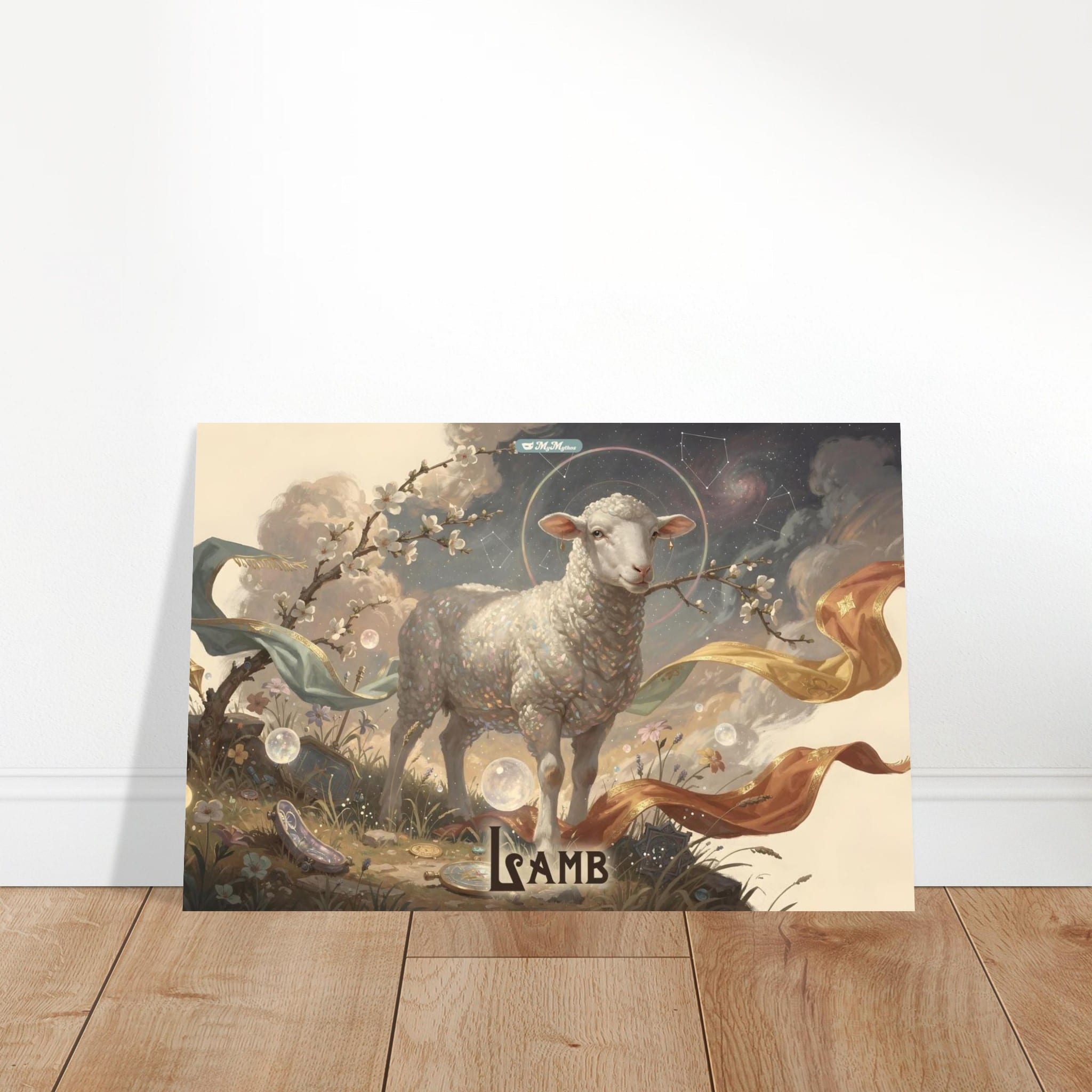
On your wall
Material
$19.00
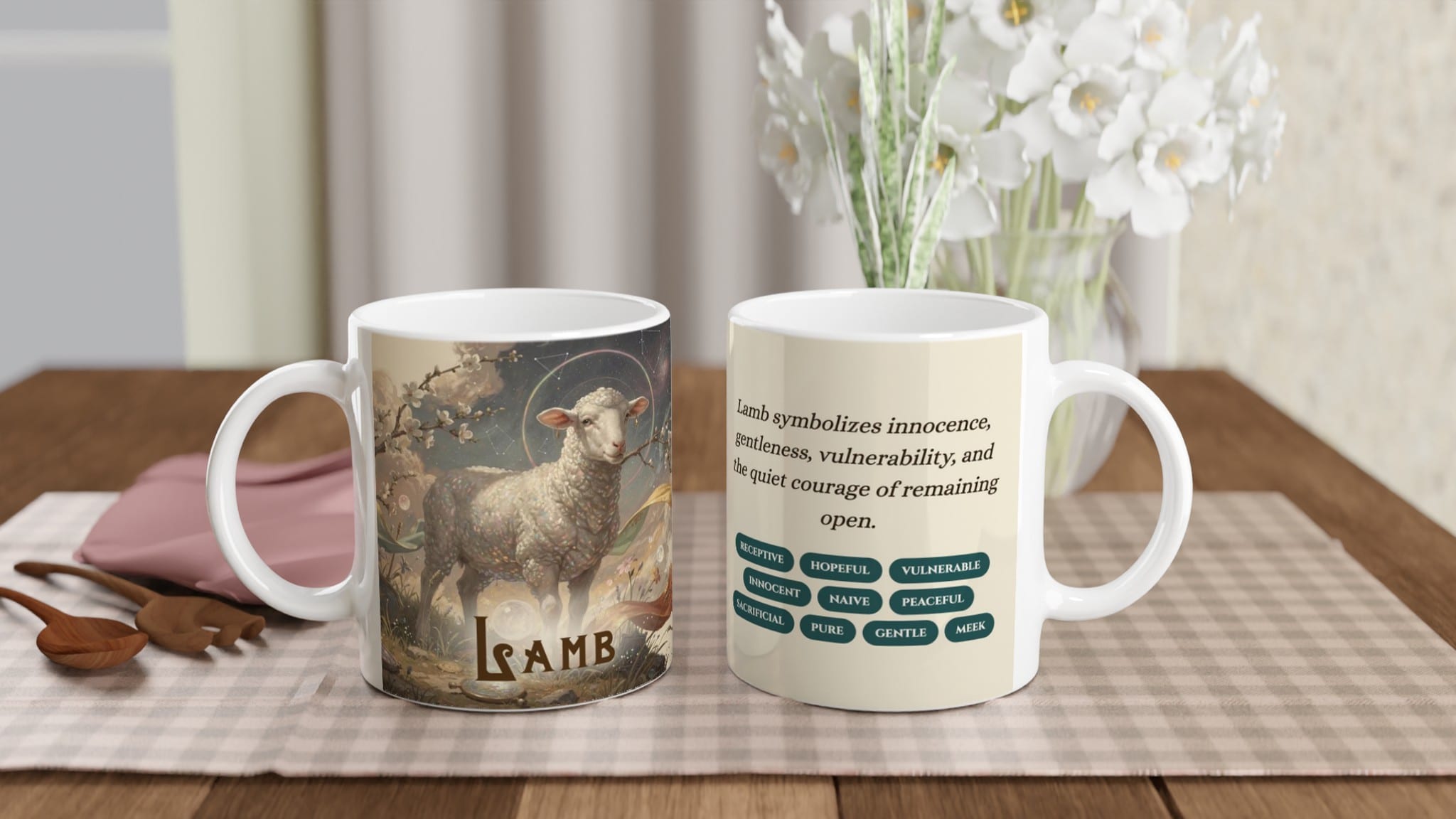
In your hands
Size
Color: White
$18.00
From elsewhere
Paid links: if you buy through these, MyMythos earns a small commission at no cost to you.