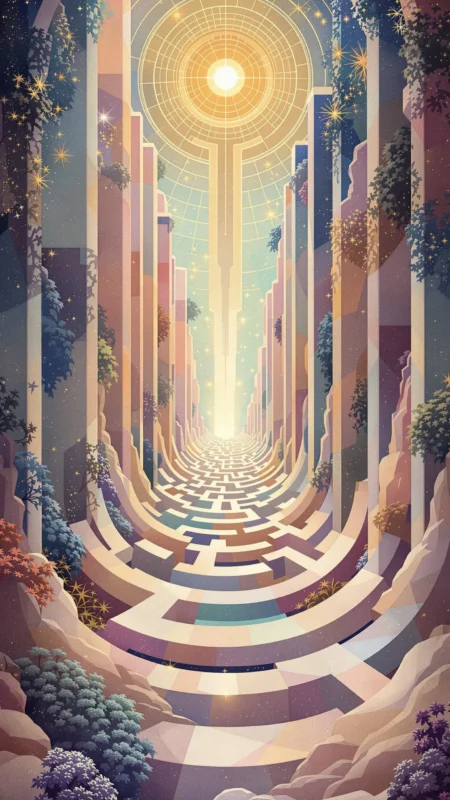
Labyrinth

Archetype Meaning & Symbolism

Intricate, meditative, cyclical, confusing, revealing, solitary, ancient, structural, inescapable, profound

  • Do not seek a map. The destination is discovering you are the cartographer.

If Labyrinth is part of your personal mythology, you may...

Believe

  • The only way out is through.
  • Getting lost is not a mistake; it is a method of discovery.
  • Every path, even one that seems to go backward, is part of the journey forward.

Fear

  • That the Labyrinth has no center and no exit, that the journey is truly endless and meaningless.
  • That you are, in fact, the monster at the heart of your own maze.
  • That you will forget the way back, losing yourself so completely in the inner world that you can never return to the outer one.

Strength

  • A profound patience and the ability to trust a process even when it is not logical or linear.
  • A deep capacity for introspection and self-analysis that leads to genuine wisdom.
  • The resilience to navigate immense complexity and ambiguity without becoming overwhelmed.

Weakness

  • A tendency to overcomplicate things that could be simple, creating labyrinths where none exist.
  • An inclination toward isolation, feeling that your inner journey is so unique it cannot be shared.
  • Analysis paralysis: becoming so engrossed in the meaning of the path's twists and turns that you stop walking altogether.

The Symbolism & Meaning of Labyrinth

The Labyrinth is perhaps the definitive map of the inner world, a blueprint for the journey one must take to meet the core of the self. In your personal mythos, it may represent those periods of life that are confusing, nonlinear, yet utterly necessary. It is the structure that contains the chaos: the grief that must be walked through, not around; the complex project that demands total immersion; the search for an identity that cannot be found through direct inquiry but only through a winding exploration of all that you are not. The path is predetermined, yet the experience of walking it is unique and transformative. It symbolizes a trust in the process, a faith that even when you seem to be moving away from the goal, you are still on the one true path.

Furthermore, the Labyrinth is a paradox: a space of confinement that offers liberation. Its walls, whether of stone or hedge or lines drawn in the sand, provide a container for a deep dive into the psyche. You are free from the infinite, paralyzing choices of the open world, given a single, sacred task: to walk. This could symbolize your need for structure in order to achieve creative or spiritual freedom. The Labyrinth in your mythos suggests that your greatest breakthroughs may come not from boundless possibility, but from a profound engagement with a set of limitations, a single path walked with devotion and attention.

At its heart, the Labyrinth holds a secret, a challenge, or a revelation. This is the Minotaur, the treasure, the sacred spring. For you, this central point could symbolize a core wound, a deep-seated fear, a profound truth, or your own untamed nature. The journey into the Labyrinth is the process of gathering the strength and wisdom to face this center. The journey out is the process of integrating that encounter into your life. It is not about slaying the beast and escaping; it is about meeting it, understanding it, and carrying its wisdom back out into the light.


Labyrinth Relationships With Other Archetypes

The Minotaur:

The Minotaur is not merely a monster trapped within the Labyrinth; it is the Labyrinth’s heart, its animating principle. In your mythos, this archetype may represent the feared, rejected, or powerful part of yourself that you have built intricate mental or emotional structures to contain. The Labyrinth, then, is the complex defense mechanism, the intellectual maze, the convoluted narrative you construct to avoid facing this raw, instinctual power. The relationship is symbiotic: without the Minotaur, the Labyrinth is just an empty path; without the Labyrinth, the Minotaur might be integrated or it might run rampant. The journey is a quest to meet, not necessarily to slay, this powerful, misunderstood core of the self.

The Thread (Ariadne):

The Thread is the principle of intuition, of memory, of loving guidance that makes the Labyrinth navigable. It is the quiet inner voice, the recurring dream, the uncanny synchronicity that assures you you are still on the path. For a person whose mythos is shaped by the Labyrinth, The Thread archetype could represent a profound trust in something beyond the rational mind. It is the belief that even in the most disorienting passages of life, there is an unbroken connection to the entrance, to the world, to a core sense of purpose. It symbolizes the faith that you are never truly lost, only unspooling the story of your return, even as you venture deeper in.

The Cartographer:

While the Labyrinth presents a pre-existing path, your interaction with it may invoke The Cartographer archetype. This is not the creator of the maze, but the one who maps it through experience. You may feel a drive to understand the patterns of your own life, to chart the recurring cycles of joy and sorrow, confusion and clarity. The Cartographer does not seek to escape the Labyrinth but to know its every turn, to document the journey as a way of mastering it. This relationship suggests a mythos built around meaning-making, where the purpose is not just to endure the confusing journey of life but to render it into a map for oneself and, perhaps, for others who follow.

Using Labyrinth in Every Day Life

Navigating a Career Change:

When your professional life feels like a series of wrong turns, the Labyrinth archetype suggests this is not failure but a necessary journey. Instead of forcing a direct path to a new job, you may engage with the winding process: taking a seemingly unrelated course, talking to people in adjacent fields, exploring a forgotten hobby. The Labyrinth teaches that the 'detour' might be the very path leading to the center, where your true vocation awaits, a discovery made not by efficiency but by exhaustive, mindful exploration.

Deepening a Spiritual Practice:

For one whose spiritual life feels stagnant or riddled with doubt, the Labyrinth offers a model for contemplation. It is a walking meditation. You may physically or mentally trace its path, not to receive a sudden answer from a deity, but to engage with the question itself. Each turn could represent a letting go of a certainty, each straightaway a moment of clarity, the center a place of quiet communion with the self before the equally important journey back out into the world, transformed by the pilgrimage.

Overcoming Creative Block:

A creative project that has stalled is a kind of labyrinth. The artist, writer, or musician may feel lost, facing the Minotaur of self-doubt in its center. The Labyrinth archetype reframes this block not as an ending but as a crucial part of the structure. It encourages a deliberate engagement with the confusion: to write the 'wrong' chapter, to paint over a section, to follow a dissonant chord. It is in the willingness to walk the confusing passages that a new, unexpected corridor of inspiration may be revealed.

Labyrinth is Known For

The Center

Not an exit, but a destination for reflection and confrontation. It may hold a treasure, a monster, or simply a mirror. Reaching it is only half the journey; one must also find their way back out, changed.

The Journey Inward:

The Labyrinth is primarily a symbol of pilgrimage to the core of one's own being. It is a structured, protected space for introspection, a path that coils in on itself to lead you deeper into your own psyche.

The Disorienting Path:

Unlike a maze, a unicursal labyrinth has only one path. The feeling of being lost comes not from wrong turns, but from the disorientation of the journey itself, where proximity to the center is not linear and forward progress can feel like a retreat.

How Labyrinth Might Affect Your Personal Mythology

How Labyrinth Might Affect Your Mythos

When the Labyrinth is a feature of your personal landscape, your life story may not read as a linear epic of conquest and progress. Instead, it might be a spiraling narrative, a tale of descents and emergences. Your mythos could be defined by periods of deliberate withdrawal from the world, of walking a winding, internal path to confront a central truth about yourself before returning to the world with newfound wisdom. Major life events may be seen not as beginnings and endings, but as turns on the same continuous path, bringing you closer to and then further from a central mystery that defines your existence. The defining feature of your story is not the dragons slain, but the complexity navigated.

Your personal mythos may also be one that honors the process over the prize. The great heroic act, in your story, is the willingness to undertake the journey itself, to stay on the path even when it is confusing and seems to lead nowhere. You might see your life as a series of intricate puzzles or sacred pilgrimages. The narrative arc is not about achieving a final victory but about the transformation that occurs during the walk. Your story teaches that wisdom is not a destination to be arrived at but a quality of attention to be cultivated along the way.

How Labyrinth Might Affect Your Sense of Self

Your sense of self may be intricately tied to the journey rather than a fixed identity. You might not see yourself as a static being, but as a pilgrim perpetually walking the path of your own becoming. This could cultivate a deep resilience and patience with your own unfolding. You may be comfortable with not having all the answers, viewing your own confusion or uncertainty as a sacred part of your inner landscape. Self-knowledge is not a treasure to be unearthed once, but a center that must be journeyed to and from, again and again, throughout your life, with each pilgrimage revealing a new facet.

This archetype could also foster a self-concept that is highly introspective and self-contained. You may feel that the most significant events of your life happen internally. Your self-worth might be derived from your ability to navigate your own complexity, to sit with paradox, and to face the 'Minotaur' within. This can lead to a powerful sense of self-reliance, a feeling that you contain within you the entire landscape necessary for your own growth. You are the walker, the path, and the destination all at once.

How Labyrinth Might Affect Your Beliefs About The World

You may perceive the world not as a battlefield or a marketplace, but as a vast, intricate, and ultimately meaningful pattern. From this perspective, global events, social shifts, and even historical movements might not seem like chaotic, random occurrences, but as part of a larger, winding path toward some unknown center. This worldview could foster a deep sense of wonder and a contemplative approach to life, where the goal is not to conquer or control the world but to understand its mysterious, labyrinthine logic and find one's own path within it.

Problems, both personal and collective, may not appear as obstacles to be demolished but as paths to be walked. A societal crisis, in this view, is a labyrinth that the collective must navigate to reach a new level of understanding. This perspective resists simple, direct solutions, favoring instead a patient and thorough exploration of the issue's complexity. It is a worldview that values questions over answers and sees wisdom in the journey through a problem rather than its swift eradication.

How Labyrinth Might Affect Your Relationships

In relationships, you may be drawn to depth and complexity over simplicity and ease. A connection with another person could be seen as its own labyrinth, a shared path to be walked with its own turns, dead ends, and central mysteries. You might value the process of getting to know someone in a slow, spiraling way, understanding that true intimacy is not a direct conquest but a patient pilgrimage. You may have a high tolerance for the confusing, nonlinear phases of a relationship, seeing them as part of the necessary journey toward a deeper bond.

However, this perspective could also lead to a sense of solitude even within partnership. You might feel that your own inner labyrinth is a place you must ultimately walk alone, and that even the most intimate partner can only wait at the entrance. This can create a profound respect for personal boundaries and the inner lives of others, but it may also create a barrier to complete fusion. Your relationships may be characterized by periods of intense connection followed by necessary withdrawal, as you retreat to walk your own path for a time.

How Labyrinth Might Affect Your Role in Life

Your perceived role in life might be less of a builder, a leader, or a warrior and more of a pilgrim, a mystic, or a guide. You may feel your purpose is not to create new structures in the outer world, but to navigate the intricate structures within yourself and, perhaps, to help others navigate theirs. You are not the one who draws the map from a god's-eye view, but the one who walks the ground and knows the feel of the stones beneath your feet. Your contribution is the wisdom gained from the journey itself.

This could mean you find your calling in roles that require deep listening, patience, and the ability to hold complexity: a therapist, a philosopher, a researcher, a spiritual director, an artist. Your role is to demonstrate that there is value in the slow, indirect path. You may not be the one to charge the hill, but you are the one who knows the ancient, winding path up the other side of the mountain, the one who understands that the longest way round is sometimes the shortest way home.

Dream Interpretation of Labyrinth

In a positive context, dreaming of a labyrinth may signal that you are embarking on or are in the midst of a significant journey of self-discovery. The dream affirms that while your current life path may feel confusing or indirect, you are exactly where you need to be. The clarity of the path, even as it winds, suggests a trust in your unconscious or spiritual process. Reaching the center of the labyrinth in a dream could signify a breakthrough, a moment of profound self-acceptance, or the integration of a vital aspect of your psyche. Walking back out may symbolize your readiness to bring this newfound wisdom into your waking life.

Conversely, a dream of a labyrinth can carry a more challenging message. If you feel trapped, panicked, or pursued within its walls, it might suggest you are feeling lost in a situation in your waking life, overwhelmed by its complexity with no clear way out. The labyrinth may represent a convoluted mental state, a prison of obsessive thoughts, or a relationship that feels inescapable. Encountering a terrifying Minotaur at the center could point to a confrontation with a shadow aspect of yourself that you are not yet prepared to face. A labyrinth with no center or no exit in a dream may reflect a deep-seated fear of meaninglessness or a sense of being trapped in a pointless cycle.

How Labyrinth Archetype Might Affect Your Needs

How Labyrinth Might Affect Your Physiological Needs

The Labyrinth archetype may cause you to experience your own body as an intricate, mysterious system. The winding paths of the circulatory system, the complex network of the nerves, the coiled intestines: you may feel a deep connection to this inner biological maze. Your physiological needs might be viewed as sacred provisions for a long pilgrimage. Food is not just fuel; it is the ritual sustenance that allows you to continue the inner walk. Rest is not idleness; it is the pause at a turn in the path, a moment to gather strength before proceeding deeper into the journey of your own life.

This perspective could also manifest in a heightened sensitivity to your body's subtle cues, treating them as messages from the deep interior. Aches, pains, or feelings of fatigue may not be mere annoyances but signals from the labyrinth of your being, indicating a need to change direction, to slow down, or to pay closer attention to the path you are on. Your physical well-being might be seen as inseparable from your spiritual journey; to care for the body is to maintain the very vessel that walks the path.

How Labyrinth Might Affect Your Ideas of Belonging

Your need for belonging may be satisfied in a solitary way. The primary connection you seek could be with the deepest part of yourself, found at the center of your own inner labyrinth. The feeling of belonging, for you, might be the profound resonance of your feet on the path, the sense of rightness in the solitary pilgrimage. You may feel you belong to your own journey more than you belong to any group or tribe. This can lead to a powerful self-possession, a feeling of being at home within your own skin, regardless of external circumstances.

Alternatively, you may find a unique form of community with fellow pilgrims. Belonging is not about conforming to a group identity, but about sharing the path with others who are also on their own winding journeys. You might connect deeply with people who understand the necessity of the inner walk, who respect the need for both solitude and shared witness. This is a community of mutual respect for each other’s labyrinths, where intimacy comes from understanding that everyone must walk their own path to their own center, but that they can, for a time, walk side-by-side.

How Labyrinth Might Affect Your Feelings of Safety

For you, a sense of safety may not come from fortification against the world, but from a profound trust in the path. The Labyrinth’s walls are not for keeping danger out, but for keeping the pilgrim in, focused on the journey. Your security could be rooted in the belief that as long as you stay on the path, however winding, you are held and protected by a larger structure and purpose. Safety is the knowledge that you cannot truly get lost, even when you feel disoriented. The real danger is not the twists and turns, but the temptation to try and climb the walls, to abandon the prescribed journey in favor of a chaotic and pathless wilderness.

This may also mean that you find safety in complexity itself. A simple, straightforward situation might feel more threatening and vulnerable than a complex one. The intricate walls of the Labyrinth, for you, could represent the nuanced, detailed, and well-considered structures you build in your life: your philosophies, your routines, your carefully chosen relationships. These are not walls of fear, but of sacred containment. The threat to your safety is oversimplification, the brute force that would knock down the walls and destroy the integrity of the path.

How Labyrinth Might Affect Your Views of Esteem

Self-esteem may not be built on external achievements or the accolades of others. Instead, it could be forged in the quiet crucible of your own inner journey. Your esteem might come from the courage it takes to enter the labyrinth, to face the confusion and uncertainty without giving up. Each turn navigated, each moment of despair overcome, adds to a deep and abiding sense of self-respect. You value yourself not for the flags you have captured, but for the territory within yourself that you have been brave enough to explore.

Esteem is also found in the confrontation at the center. By facing the Minotaur—your deepest fear, your greatest flaw, your raw power—and surviving, you gain a unique kind of confidence. It is the quiet assurance of one who has met their own shadow and has not been destroyed by it. This is not the loud pride of the conqueror, but the serene integrity of the pilgrim who has completed a sacred circuit. You know what you are made of because you have walked the full measure of yourself and have returned.

Shadow of Labyrinth

The shadow of the Labyrinth emerges when the pilgrim becomes the jailer. You may use your understanding of complexity not for illumination but for obfuscation, constructing intricate intellectual or emotional mazes to trap others. This could manifest as being deliberately confusing in arguments, creating unnecessary bureaucracy, or playing manipulative emotional games. You become Daedalus, the brilliant architect who builds a prison for the monstrous, forgetting that he, too, can become trapped by his own cleverness. The goal is no longer to guide but to confound, to maintain power by being the only one who understands the layout of the prison.

Another shadow aspect arises when the Labyrinth ceases to be a place of temporary pilgrimage and becomes a permanent residence. You might fall in love with the winding path so much that you refuse to ever leave. You may reject simple truths, direct answers, and straightforward joys in favor of perpetual complexity. This is a self-imposed exile from the sunlit world, a refusal to integrate the wisdom of the center and complete the journey. The Labyrinth transforms from a tool for growth into a gilded cage, a beautiful and intricate defense against the risk and simplicity of lived experience.

Pros & Cons of Labyrinth in Your Mythology

Pros

  • You develop a profound and resilient sense of self, forged through deep introspection.
  • You are unafraid of life's necessary complexities, and can navigate ambiguity with grace.
  • You find deep meaning and beauty in the process and the journey, not just the final outcome.

Cons

  • You may feel perpetually unsettled, as if your journey has no final destination or resting place.
  • Others may find you indirect, slow, or frustratingly complex, making simple connection difficult.
  • There is a persistent danger of becoming lost in your own inner world, mistaking introspection for life itself.