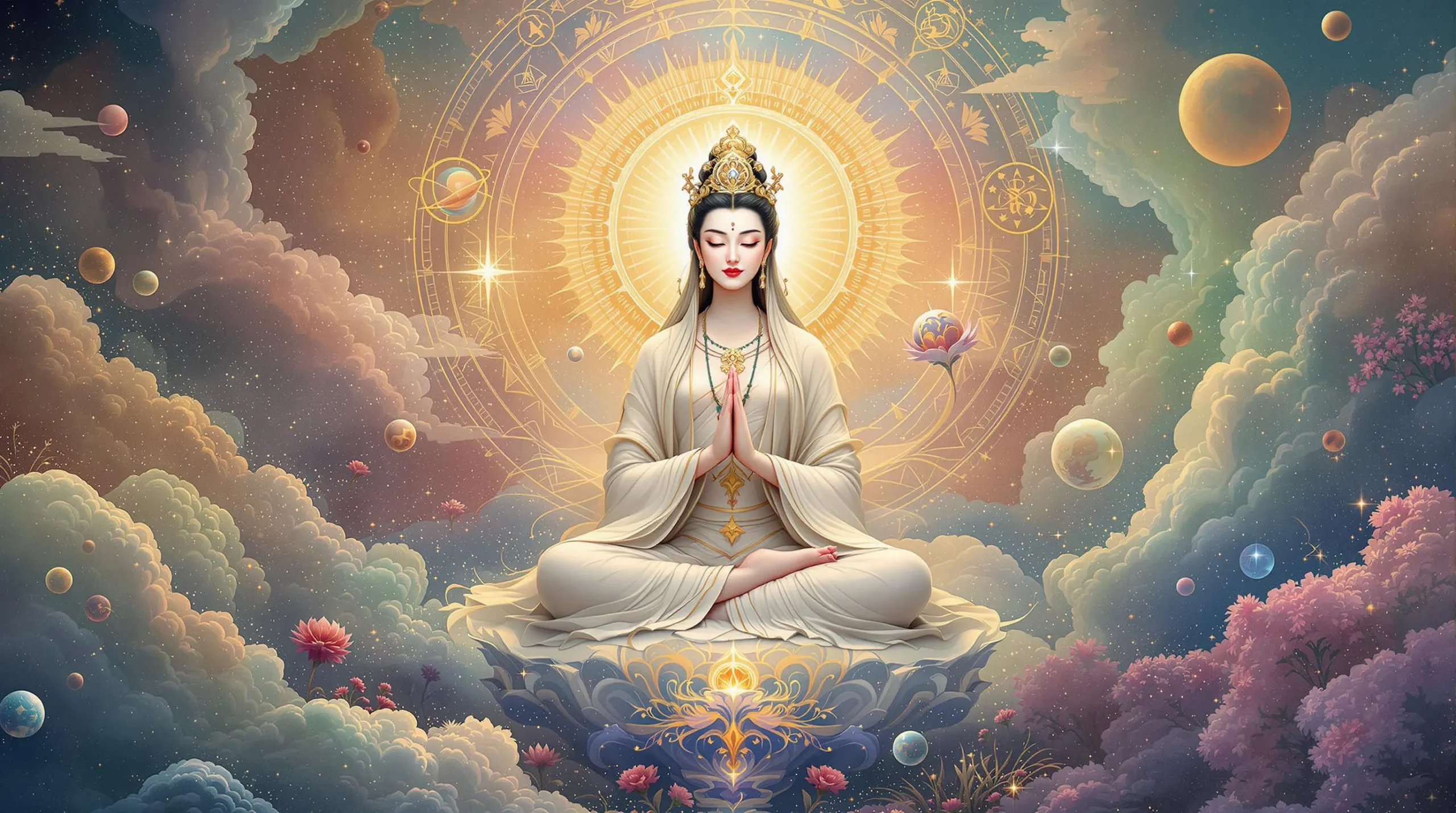


Kuan Yin

Archetype Meaning & Symbolism

Compassionate, receptive, enduring, patient, androgynous, observant, boundless, merciful, yielding, silent

  • The universe does not require you to fix its pain. It asks only that you be a worthy vessel to hold it, for in the holding, the pain remembers its own way home.

If Kuan Yin is part of your personal mythology, you may...

Believe

  • You may believe that true healing, for an individual or the world, begins not with a plan of action, but with a moment of pure, uninterrupted witness.

  • You may believe that vulnerability is not a weakness to be overcome, but the very portal through which grace and connection enter your life.

  • You may believe that every being, no matter how troubled or destructive, possesses a fundamental core of goodness that is crying out to be seen.

Fear

  • You may fear that the sheer volume of suffering in the world is an infinite ocean and that your compassion is a tiny cup, doomed to be overwhelmed.

  • You may fear that in your commitment to non-resistance and acceptance, you will become passive and complicit in the face of injustice.

  • You may fear that if you open your heart completely, you will eventually dissolve, losing any sense of a core self to navigate your own life.

Strength

  • You possess an almost supernatural ability to remain centered and calm in the midst of emotional chaos, acting as a grounding force for those around you.

  • Your empathy is not just a feeling but a form of profound intelligence, allowing you to perceive the subtle, unspoken needs and motivations of others.

  • You are able to create spaces of deep psychological safety, allowing others to share their most vulnerable truths without fear of judgment.

Weakness

  • You may have extremely porous personal boundaries, making you susceptible to absorbing the negative emotional states of others as if they were your own.

  • You may have a tendency toward indecisiveness, especially in situations that require assertive action that could potentially cause conflict or distress to someone.

  • You may be vulnerable to a specific kind of melancholy or despair that comes from being too attuned to the pain of the world.

The Symbolism & Meaning of Kuan Yin

The Kuan Yin archetype is the embodiment of radical receptivity. In a culture that worships action, force, and the projection of will, Kuan Yin represents the counter-intuitive power of stillness, listening, and bearing witness. She is often depicted holding a vase containing the dew of compassion, not a weapon. This suggests that healing comes not from doing battle, but from anointing the world's wounds with attentive grace. To have Kuan Yin as part of your personal mythology is perhaps to understand that your greatest strength lies in your capacity to absorb, to hold, and to soothe. It is the mythology of the listener, the confidant, the quiet presence in the room whose calm is more potent than any argument.

The fluidity of Kuan Yin's gender is central to her meaning. She is depicted as the masculine Avalokiteshvara in India and Tibet, and as the feminine Kuan Yin in East Asia. This is not indecision; it is transcendence. The archetype suggests that ultimate compassion is not bound by gendered expressions, but encompasses the full spectrum of being. The famous depictions with a thousand arms and a thousand eyes are a metaphor for this boundless capacity. The thousand eyes perceive suffering in all its forms and in all corners of the world; the thousand arms possess the skillful means to respond to each cry in its own unique language. This isn't about multitasking, but about a state of awareness so profound it can hold the particular and the universal at once.

In our contemporary world, saturated with noise and performative outrage, the Kuan Yin mythos offers a revolutionary path. It suggests a different way of engaging with overwhelming global crises: not by adding more noise, but by cultivating a deep, resonant silence that allows for clarity. It is the archetype for the therapist who holds the client's trauma, the artist who channels the zeitgeist, the parent who absorbs a child's tantrum and responds with a hug. It is a belief that presence itself is a powerful agent of change, and that before any effective action can be taken, the situation must first be fully seen, heard, and held with unconditional love.


Kuan Yin Relationships With Other Archetypes

The Lighthouse

In the grand, churning sea of human suffering, The Kuan Yin may be seen as a kind of Lighthouse. Their relationship is not one of direct intervention, for the lighthouse does not sail out to rescue the battered ship. Instead, it holds its station upon the jagged shore, a solitary sentinel whose very existence is an act of profound compassion. It offers a single, unwavering beam—a geometry of hope cast across the chaos—allowing the soul to navigate its own storm. The Lighthouse is perhaps indifferent to being seen, its light a constant, unconditional offering, a silent testament that even in the most profound darkness, a path to safe harbor exists for those with the will to steer toward it.

The Wounded Healer

The Kuan Yin could be said to share a soul-kinship with the Wounded Healer, for her boundless compassion seems not to be a grace bestowed from an untouchable height, but rather a wisdom earned in the valleys of shared experience. Theirs is a relationship of mirrored understanding, where the capacity to mend is born from a deep familiarity with what it is to be broken. The Kuan Yin’s mercy may not be a pristine, unblemished garment, but rather a kintsugi vessel, whose own ancient fractures are traced in gold, reminding us that it is through our own vulnerabilities—acknowledged and held with tenderness—that the most profound healing light may enter and then pour forth.

The Bell

One might consider the relationship between The Kuan Yin and a temple Bell, suspended in stillness. The Bell does not speak, it resonates. It does not initiate, it responds. The cries of the world, in this metaphor, are the strike of the mallet—the force that awakens the sound. The Kuan Yin, like the Bell, is perhaps the perfect medium for this transformation, turning the sharp, percussive shock of pain into a resonant, enduring tone that travels outward, not as an argument or a solution, but as a vibrational field of pure awareness and empathy. It is a physics of grace, suggesting that true compassion is not an action, but a state of being, perfectly tuned to hear and transmute the frequency of sorrow.

Using Kuan Yin in Every Day Life

Navigating a Heated Argument

Instead of marshalling counter-arguments, one might embody Kuan Yin by becoming a space of profound listening. You could choose not to defend your position but to simply bear witness to the other's anger or hurt, absorbing its energy without judgment. This is not surrender, but a subtle alchemy that allows the conflict's fever to break on its own, often revealing the more vulnerable feelings beneath the rage.

Processing Personal Grief

When confronted with one's own sorrow, the temptation is to fight it, distract from it, or rush through it. The Kuan Yin archetype offers another path: treating your own suffering with the same sacred attention you would offer a loved one. You might create a small ritual, lighting a candle not to banish the sadness, but to sit with it, to honor its presence, to listen to what it has to say without demanding it leave. This allows grief to move through you, rather than getting stuck within you.

Responding to a Community Crisis

In the face of collective tragedy or injustice, the impulse can be outrage and a call for grand, immediate action. Kuan Yin's wisdom may guide a different response. Perhaps your role is not to lead the protest, but to be the one who brings water to the protestors. It might be to organize a quiet circle where people can simply speak their fear and grief, or to create art that reflects the community's soul back to itself. It is the work of emotional infrastructure, less visible but just as vital.

Kuan Yin is Known For

Unconditional Compassion

The ability to perceive and respond to the cries of all sentient beings without judgment or condition. Kuan Yin hears the sound of suffering and turns towards it, not away.

The Bodhisattva Vow

The profound promise to postpone one's own final enlightenment and remain in the world until every last being has been liberated from suffering. It is an act of ultimate solidarity.

Skillful Means (Upāya)

The capacity to manifest in any form necessary—male, female, deity, human, animal—to reach and aid those in need. This speaks to a radical adaptability and a focus on efficacy over rigid identity.

How Kuan Yin Might Affect Your Personal Mythology

How Kuan Yin Might Affect Your Mythos

When Kuan Yin enters your personal mythology, the very structure of your life's story may shift. The narrative arc may bend away from the linear progression of the hero's journey—the call to adventure, the slaying of the dragon, the triumphant return. Instead, your mythos could become cyclical, tidal. Its key moments are not defined by what you achieved, but by what you received; not by the battles you won, a but by the suffering you were able to witness without turning away. Your life story ceases to be a chronicle of personal conquest and becomes a tapestry woven from the threads of shared human experience, a map of sorrows and joys that are not just your own.

Your personal myth might also be one of quiet, almost invisible, influence. You are not the king, but the king's trusted advisor whose wisdom is whispered, not proclaimed. You are not the warrior, but the medic who tends to the wounds on both sides of the battlefield. The climax of your story may not be a single, dramatic event, but a slow, gradual transformation of your own heart. Your legend is written in water, not stone: a legacy of eased pains, quieted fears, and moments of grace that ripple outwards in ways you may never fully know. The central antagonist in your mythos is not an external villain, but the temptation to close your heart.

How Kuan Yin Might Affect Your Sense of Self

To integrate the Kuan Yin archetype is to fundamentally alter your concept of self. You may begin to experience your identity less as a fortress to be defended and more as a vessel to be filled. The boundaries of the ego could become more porous, making you acutely sensitive to the emotional weather patterns of those around you. This is not necessarily a loss of self, but could be felt as an expansion of self, a dissolving of the illusion of separation. You might understand that 'you' are not just the contents of your own mind, but are also a reflection of, and a repository for, the collective consciousness.

Self-worth, in this context, may become untethered from external validation, achievement, or status. Its source could shift to your capacity for presence and empathy. You may measure the success of your day not by the tasks you completed, but by the quality of attention you offered to a stressed colleague, a crying child, or even your own aching heart. This can be liberating, freeing you from the relentless pursuit of approval. However, it can also be disorienting, as the self becomes defined by its receptivity rather than its assertions, a quiet harbor in a world that celebrates naval fleets.

How Kuan Yin Might Affect Your Beliefs About The World

With Kuan Yin as a guiding principle, your worldview may undergo a profound softening. The world may cease to appear as a mechanistic system to be controlled or a battlefield of competing ideologies. Instead, you might perceive it as a single, interconnected organism, and its various crises—political, environmental, social—as the cries of this organism in pain. Problems are not there to be 'solved' with brute force or clever engineering, but to be 'heard' into resolution. You could begin to see suffering not as a cosmic error to be eradicated, but as the very texture of mortal existence, the necessary grit that polishes the soul into a pearl of compassion.

This perspective fosters a deep, almost irrational trust in the healing process. You may believe that even in the face of unspeakable tragedy, the act of bearing witness creates the conditions for grace to enter. The universe is not seen as cold and indifferent, but as fundamentally responsive. Your compassionate attention is not a passive act; it is a form of active prayer, a coherent signal sent into the quantum field, inviting a reciprocal response. This view doesn't ignore the darkness in the world; it insists on meeting that darkness with a lantern rather than a sword.

How Kuan Yin Might Affect Your Relationships

In the realm of relationships, the Kuan Yin archetype might move you from a transactional model to a devotional one. The driving question in your interactions shifts from 'What can I get?' to 'How can I serve?' You may find yourself drawn to people who are in pain or turmoil, not as a project to be fixed, but as a soul to be accompanied. Your primary love language could become deep listening, creating relationships where others feel profoundly seen, perhaps for the first time. The foundation of your bonds is not shared interests or mutual benefit, but a shared vulnerability and a mutual commitment to holding space for each other's humanity.

This can create an almost unbearable intimacy, a sense of connection that transcends the ordinary. However, it also carries the risk of dissolving healthy boundaries. You might find it difficult to distinguish your own emotional needs from the needs of your partner, friends, or family, becoming an emotional dumping ground. The unconditional nature of your compassion can be confusing for others, who may be accustomed to more defined, reciprocal arrangements. You may give a love so vast and formless that it can, paradoxically, leave your own specific, human needs for recognition and reciprocity unmet.

How Kuan Yin Might Affect Your Role in Life

Your perceived role in the world, in your family, and in your work may shift from an active, projective one to a receptive, containing one. You might not see yourself as the innovator, the leader, or the trailblazer. Instead, you could identify as the anchor, the witness, the quiet center that allows others to do their work. You may be the person in a meeting who doesn't speak often, but when they do, their words bring a sense of calm and clarity. You are the keeper of the emotional commons, the individual who maintains the invisible web of relationships that allows a group to function.

This role is often essential but frequently undervalued in a society that fetishizes visibility and quantifiable results. You might be the emotional bedrock of your family or the unofficial therapist for your entire office, yet this immense labor may go completely unacknowledged. Your life's work is the subtle art of creating space, a contribution that is as vital and as invisible as the air we breathe. There is a quiet dignity in this, but also a potential for feeling unseen and unappreciated, a sense that your greatest contributions leave no monuments.

Dream Interpretation of Kuan Yin

To dream of Kuan Yin in a positive light—perhaps seeing her serene face, being offered water from her vase, or resting under the shade of her willow branch—may be a profound message of grace from the subconscious. It could signify that a period of personal suffering is being met with divine compassion, either from an external source or, more importantly, from within yourself. The dream might be an invitation to soften, to cease striving, and to trust that you are being held. It affirms that your sensitivity and empathy, which may feel like burdens in the waking world, are in fact sacred gifts. It is a symbol of profound self-acceptance and the presence of a powerful, benevolent force in your inner world.

A dream where Kuan Yin appears in a distressing context—weeping uncontrollably, her thousand arms flailing in chaos, or turning her back on you—could serve as a potent warning. It might symbolize a state of severe empathic burnout, where you have taken on the 'cries of the world' to a degree that has overwhelmed your own psychic structure. This shadow Kuan Yin represents compassion that has become toxic, a martyrdom that is destroying the martyr. The dream could be urgently asking you to establish boundaries, to attend to your own unmet needs, and to ask the critical question: who is holding space for the holder of space?

How Kuan Yin Archetype Might Affect Your Needs

How Kuan Yin Might Affect Your Physiological Needs

When the Kuan Yin archetype shapes your personal mythos, your relationship with your body's most basic needs—for sustenance, hydration, rest, and breath—may be transformed into a spiritual practice. The simple act of drinking a glass of water could become a meditation on the dew of compassion, a conscious act of filling your own vessel so you may have something to offer. You might develop a preference for simple, pure foods, seeing nourishment not just as fuel, but as a way of honoring the physical temple that houses your compassionate spirit. Breathwork could become a central practice, each inhale a drawing in of the world's pain, each exhale a release of loving-kindness.

Conversely, a deep immersion in this mythos could lead to a dangerous neglect of these very needs. In the urgent mission to attend to the suffering of others, you may consistently ignore your own body's signals of hunger, thirst, or exhaustion. Sleep might be seen as a selfish indulgence when there is so much pain in the world. This can create a paradoxical situation where the 'bodhisattva' is running on empty, their physical vessel breaking down due to a spiritualized self-neglect. The body's cries for basic care become the one cry that Kuan Yin, tragically, cannot hear.

How Kuan Yin Might Affect Your Ideas of Belonging

The need for love and belonging, when filtered through the Kuan Yin archetype, may expand beyond the conventional confines of family, partnership, and tribe. You might find your sense of belonging not in fitting in with a specific group, but in a feeling of universal kinship with all of existence. Love is not an exclusive emotion reserved for a chosen few, but a diffuse, ambient state of being—a gentle radiance offered equally to a dear friend, a struggling stranger, or a wilting plant. True belonging is the recognition of a shared consciousness in all things.

This universal connection, however, can paradoxically foster a profound and unique form of loneliness. While feeling a sense of oneness with everything, you may struggle to form the specific, reciprocal, and sometimes messy bonds that constitute human intimacy. The unconditional, all-encompassing love you offer might be difficult for others to receive or reciprocate in a way that nourishes your individual human heart. You may belong to everyone, and therefore, to no one in particular, floating in a sea of cosmic love while yearning for the simple anchor of a hand to hold that is yours alone.

How Kuan Yin Might Affect Your Feelings of Safety

From the perspective of a Kuan Yin mythos, the need for safety might be reinterpreted entirely. Security may not be sought from external sources like financial wealth, physical fortifications, or social status. Instead, a profound sense of safety could arise from an internal state of radical acceptance and non-resistance. The belief is that true security lies in the ability to meet any circumstance, even a threatening one, with an open and compassionate heart. Kuan Yin faces the world unarmed, her protection being her very vulnerability, which can disarm aggression. Your safety, therefore, is located in your unshakeable inner peace, a sanctuary that no external event can truly breach.

However, this worldview can create a perilous disregard for practical self-preservation. You might consciously or unconsciously place yourself in emotionally, psychologically, or even physically dangerous situations, guided by the belief that your compassionate presence is a sufficient shield. This can lead to being exploited, abused, or harmed. The shadow side of this approach is a form of naivete that struggles to reconcile the ideal of universal compassion with the reality that some situations and people are genuinely unsafe and require firm boundaries, distance, or assertive defense, not just an open heart.

How Kuan Yin Might Affect Your Views of Esteem

Within the Kuan Yin mythos, the entire economy of esteem is reconfigured. Respect and self-worth are no longer currencies earned through competition, dominance, or the accumulation of accolades. Instead, esteem may be derived from a quiet, internal sense of alignment with your compassionate purpose. The moments that build your self-worth are not public victories, but private instances of successful service: the time you listened to a friend without interrupting, the moment you soothed a child's fear, the day you met your own anger with curiosity instead of judgment. It is an egoless esteem, rooted in your function as a clear vessel, not in the celebration of your personal attributes.

This can create a significant friction with the values of the external world. You may feel alienated by environments that reward aggressive self-promotion and individual achievement. Your quiet, often invisible, contributions may go unrecognized, leading to periods of doubt where you mistake this lack of external validation for a lack of intrinsic value. You might struggle to articulate your own worth in conventional terms, like on a resume or in a job interview, because your greatest strengths are relational, subtle, and profoundly difficult to quantify. Your challenge is to trust in your own significance, even when the world fails to mirror it back to you.

Shadow of Kuan Yin

When the Kuan Yin archetype falls into shadow, it curdles into a manipulative martyrdom. This is the compassion that is not freely given but is used as a currency for control, a form of passive-aggression that creates dependency in others. The shadow Kuan Yin keeps a meticulous, unspoken tally of their sacrifices, their silent suffering becoming a tool to induce guilt and obligation in those around them. They are the 'helper' who fosters helplessness, the 'selfless' friend whose selflessness is a performance designed to elicit praise and confirm their identity as a saint. The vase of compassion becomes a cup of poison, and the thousand arms that are meant to help become chains that bind others to them in a web of emotional debt.

A more subtle shadow is that of spiritual bypassing. In this manifestation, the archetype's enlightened equanimity is used as a shield to avoid messy, difficult, but necessary human emotions. It is the refusal to engage with righteous anger, the inability to set a firm boundary, the glossing over of genuine harm with platitudes about forgiveness and universal love. This can lead to a state of profound emotional dishonesty and stagnation. By being perpetually 'above it all,' this shadow archetype becomes detached and ineffective, unable to participate authentically in the grit of human relationships. The hearer of the world's cries becomes deaf to the legitimate cries of their own soul for justice, for boundaries, and for a self that is allowed to be imperfectly, complexly human.

Pros & Cons of Kuan Yin in Your Mythology

Pros

  • You cultivate exceptionally deep and authentic relationships, as people feel safe and truly seen in your presence.

  • You develop a profound inner peace and resilience, able to navigate life's inevitable suffering without being shattered by it.

  • Your life is imbued with a powerful and enduring sense of purpose, rooted in the meaningful act of easing the burdens of others.

Cons

  • You are at a high risk for compassion fatigue and emotional burnout, as you may absorb more suffering than your system can process.

  • You may struggle to advocate for your own needs, leading to situations where you are overlooked, undervalued, or taken advantage of.

  • The constant, heightened awareness of the pain in the world can lead to a persistent undercurrent of sadness or a sense of helplessness.