Believe
 Fear
Fear Strength
 Weakness
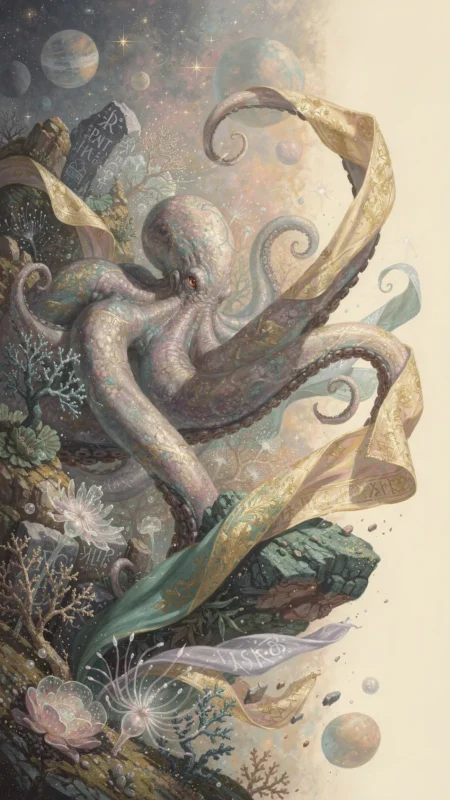
The Kraken is the cartography of the personal abyss. In modern mythology, it has sloughed off its simplistic monster skin to become the embodiment of the subconscious: vast, dark, and filled with both treasure and terror. It symbolizes the enormous creative and destructive power that lies dormant within us, the unexpressed emotions, the forgotten traumas, and the untapped genius that churns miles below the placid surface of our daily consciousness. To have the Kraken as part of your mythos is to acknowledge that the most significant parts of you may be the parts you cannot easily see or explain, the things that stir in the quiet moments, the intuitions that rise like colossal, silent forms from the deep.
Its symbolism is also deeply tied to the concept of pressure. The Kraken exists, and perhaps thrives, under conditions that would annihilate anything else. It suggests a profound resilience, an ability to not just survive but to find a strange sovereignty in overwhelming circumstances. It is the patron saint of the artist wrestling with a magnum opus, the scholar lost in a complex theory, the soul navigating the crushing weight of grief. The Kraken spirit animal, in this light, is not a monster to be slain but a cartographer of the soul's uncharted oceans, offering a map written in bioluminescent ink.
Furthermore, the Kraken speaks to the nature of mystery itself. It represents the generative power of the unknown. In a world obsessed with data, with illumination and explanation, the Kraken is a sanctuary for what must remain obscure. It posits that some things are powerful precisely because they are not fully brought into the light, that their potential is tied to their mystery. It is the story that is more potent for being untold, the power that is greater for being held in reserve, the part of the self that is sacred because it is yours alone, dwelling in a darkness of your own making.