Believe
 Fear
Fear Strength
 Weakness
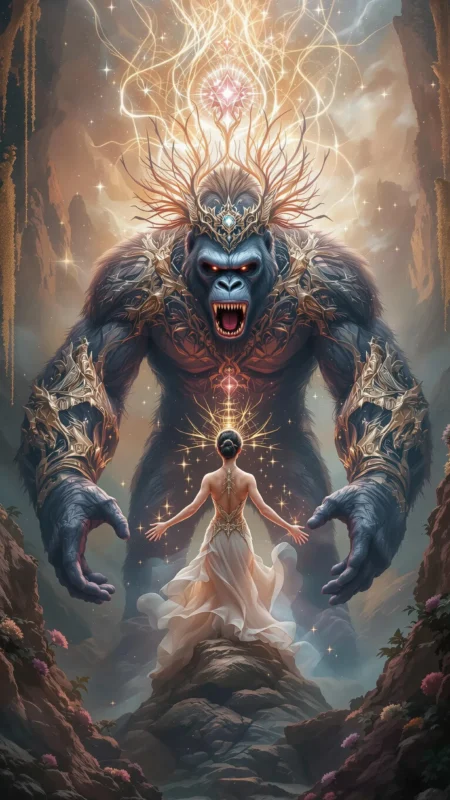
The King Kong archetype is a vessel for the profound tragedy of the untamable spirit in a tamed world. He is the last vestige of a primal, sacred power that industrial society seeks to first conquer, then chain, and finally, sell tickets to. To have Kong in your personal mythology is perhaps to feel like a creature of a different, older world, navigating a landscape of concrete and steel that has no room for your scale. He is the ultimate misunderstood outcast, whose roars of pain are interpreted as threats of violence, whose acts of protection are seen as savage possessiveness. He is a potent symbol for the parts of our own psyche that are raw, immense, and inconvenient to the polite fictions of civilized life.
His story is a cautionary tale about the gaze of the other. Kong is sovereign and complete on his island, a god in his own domain. It is only when he is seen, captured, and transported that he becomes a monster and a tragedy. This may resonate with a personal feeling that your authenticity is only safe when unobserved, that to be truly seen by the world is to be misunderstood and ultimately destroyed. Kong symbolizes the devastating price of being extraordinary, the loneliness that accompanies a power that others cannot comprehend and therefore must cage. He is not merely a beast; he is a fallen king.
Furthermore, Kong represents a paradox of strength. His physical power is nearly absolute, yet he is undone by something as fragile as an airplane, as ephemeral as his affection for one small woman. This could reflect a personal truth: that your greatest vulnerabilities lie not in your weaknesses, but adjacent to your greatest strengths. He is the raw force of nature, but also the capacity for a love so profound it makes him careless. He is the titan felled by his own heart, a story that warns how the very thing that makes you more than a monster—your capacity to love—is also the chink in your armor.