Believe
 Fear
Fear Strength
 Weakness
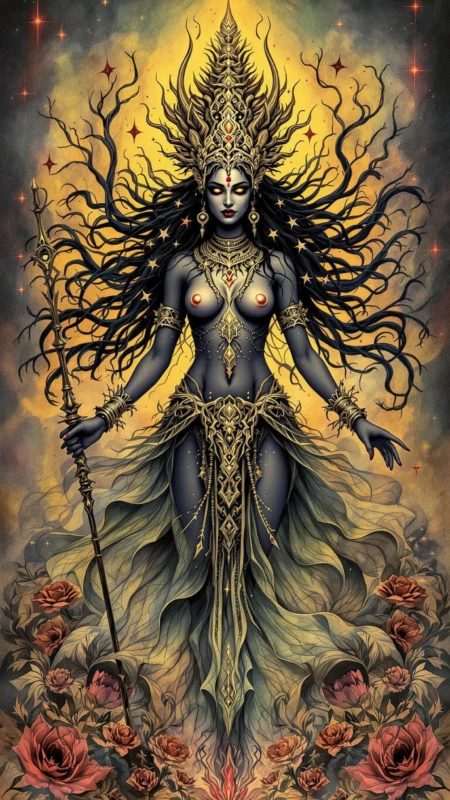
In the modern psyche, Kali may represent radical, uncompromising truth. She is the part of us that refuses to pretend, the voice that names the sickness in a system, the courage to face the abyss. To have her in one's personal mythology is to befriend the process of dissolution. The end of a job, a relationship, or an identity is not a failure but a sacred clearing. Her symbolism suggests that illusions, no matter how comforting, are cages. Her sword is not for cruelty but for liberation, cutting the cords of attachment that bind one to a smaller, more constricted life. She is the patron saint of the necessary ending, the fierce grace that arrives when a thing is well and truly over.
Her connection to time, or Kala, positions her as the embodiment of change. She is the chaotic, unpredictable, and often violent nature of reality itself. Her dance is the relentless unfolding of the universe, a process that inherently involves destruction. The skyscraper will one day be dust; our bodies will fail; empires will fall. A personal mythology informed by Kali does not see this as nihilistic but as a fundamental truth. It fosters a deep respect for cycles. This understanding could lead one to live more fully in the present, knowing that this moment, this form, is temporary and therefore infinitely precious. She is the reminder that only by embracing impermanence can one truly live.
Perhaps her most misunderstood aspect is her maternal nature. This is not the gentle, nurturing mother, but the she-bear who would tear apart a threat to her cubs. Her children are our souls, our truest selves, and the threat is the ego, with its vanities, fears, and delusions. Her love is a purifying fire. It may feel terrifying because it demands we surrender what we think we are in order to become what we are meant to be. She holds a severed head, a symbol of the slain ego, yet her hand is raised in a gesture of blessing: fear not. This death is a gift.