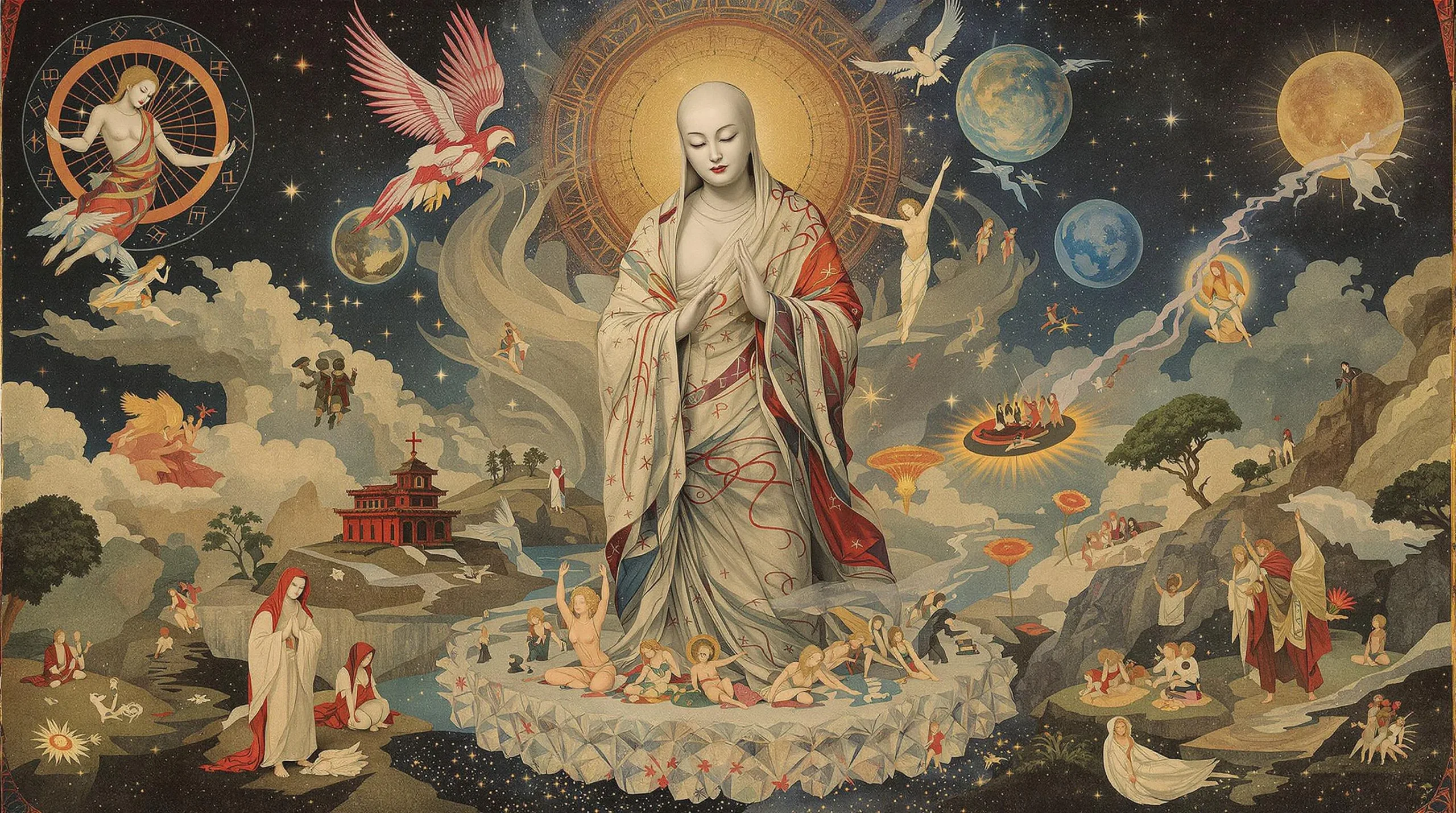


Jizo

Archetype Meaning & Symbolism

Compassionate, patient, protective, liminal, steadfast, gentle, enduring, mournful, hopeful, quiet, unassuming, solid

  • The smallest stone can hold the heaviest grief. Rest it here. I will not move.

If Jizo is part of your personal mythology, you may...

Believe

  • That the greatest strength is found in quiet endurance, not loud victory.
  • That no grief is too small to be honored, and no person is too lost to be witnessed.
  • That your presence, offered without agenda, is the most powerful and sacred gift you can give.

Fear

  • That your stillness will be mistaken for indifference or passivity.
  • Becoming so overwhelmed by the sorrows of the world that your stone-like form finally cracks under the weight.
  • That your quiet acts of care will go completely unseen and, ultimately, make no difference at all.

Strength

  • An immense capacity for empathy and holding space for the pain of others without judgment or the need to fix it.
  • Unwavering patience and the ability to remain steadfast through long periods of difficulty, uncertainty, or grief.
  • Finding profound meaning and a sense of sacred purpose in small, often overlooked acts of kindness and protection.

Weakness

  • A tendency toward passivity or inaction, sometimes waiting patiently for a storm to pass when decisive action is needed.
  • Difficulty setting and maintaining emotional boundaries, which can lead to absorbing the grief of others to a detrimental degree.
  • A deep reluctance to express your own needs or pain, maintaining a stoic, protective exterior even when you are crumbling inside.

The Symbolism & Meaning of Jizo

In the personal mythology of a modern life, Jizo may represent a radical form of compassionate endurance. He is not a warrior god promising victory, but a quiet stone figure promising presence. His meaning unfurls in the spaces others hurry past: the bus stop where a stranger weeps quietly, the hospital waiting room thick with unspoken fear, the silent aftermath of a difficult conversation. Jizo symbolizes the profound power of simply staying. He is the courage to witness suffering, your own or another’s, without the frantic need to fix it, to analyze it, or to run from it. He is the patron saint of the small, the overlooked, and the unfinished, suggesting that wholeness can be found not in perfection, but in the patient mending of what is broken.

This archetype could also be the keeper of unsanctioned griefs. The sorrow for a life not lived, the quiet mourning for a friendship that has faded, the ache of ecological loss. These are the pebbles Jizo holds, the griefs for which society offers few rituals. To have Jizo in your mythos is to have a framework for these ambiguous losses, to grant them weight and dignity. His statues, often adorned with bibs and toys by grieving parents, are a testament to this: love and loss made tangible, a small, steadfast landmark in the vast landscape of sorrow. He gives permission to feel deeply about the things that are easy to dismiss.

Ultimately, Jizo’s symbolism might point toward a different kind of strength, one found not in action but in being. He is the stillness at the heart of the storm, the unshakable calm of the earth itself. His smile, so often gentle and serene even as he stands in places of sorrow, is not one of ignorance but of deep knowing. It suggests that hope is not the absence of pain, but the ability to hold it with love. He is a metaphor for the resilient, quiet core within us that can bear witness to the world’s impermanence and still offer a blessing.


Jizo Relationships With Other Archetypes

The Crossroads

The Jizo does not stand at The Crossroads as a signpost, offering clear direction toward some sunlit destination. Its relationship with this nexus of possibility is perhaps more profound. It is a companionship with uncertainty itself. The Jizo’s granite stillness may suggest that the critical moment is not the choice of a path, but the silent, contemplative pause before the step is taken. It could be a guardian of the threshold, sanctifying the liminal space where all futures remain equally real. In its presence, The Crossroads is transformed from a site of anxious paralysis into a sacred ground of potential, a quiet stage where one’s own inner compass might finally be heard over the din of competing destinations.

The Small Stone

One might observe that the relationship between The Jizo and The Small Stone is a silent dialogue between the eternal and the ephemeral. The stone, chosen from the dust and placed with a moment of intention, is a prayer made tangible, a single, humble grief given weight and form. As these small offerings accumulate, they build a fragile cairn, a collective sigh of hope or memory. The Jizo, in its patient, unjudging acceptance of these tiny burdens, seems to suggest that divinity is not a distant, monolithic force, but something that communes with our smallest, most sincere gestures. The stone does not adorn the Jizo so much as it completes it, embodying the human need to leave a mark, however fleeting, upon the face of compassion.

The Lost Child

The Jizo’s bond with The Lost Child archetype may be its most tender and enigmatic. This is not merely a guardian for a physical child who has strayed, but perhaps for that part of every soul that remains unmoored, innocent, and vulnerable to the world’s sharp edges. The Jizo offers a protection that is not a cage but a quiet clearing in a bewildering wood. It could be seen as a ferryman for the spirit, its gentle presence a lantern in a fog of grief or confusion. The relationship is one of pure witness; the Jizo does not erase the sorrow of being lost, but instead validates it with an unwavering gaze, promising that even in the loneliest passage, a steady, unconditional love holds vigil.

Using Jizo in Every Day Life

Navigating Grief

When confronted with a loss, whether the seismic departure of a loved one or the quiet sorrow of a forgotten dream, your inner Jizo offers a place to set the burden down. You might perform a small ritual: lighting a candle, placing a flower in a vase, or simply breathing with the weight of it. This is not about forgetting, but about honoring the pain by giving it a place to rest, allowing you to continue your journey without being entirely consumed by what you carry.

Guiding Transitions

During life’s precarious crossroads: a career change, the end of a relationship, a move to a new city, the Jizo archetype could be your guide. It reminds you to be a patient guardian of your own becoming. Instead of rushing to a conclusion, you might find strength in the uncertainty itself, standing firm in the liminal space between what was and what will be. You become a protector of your own potential, nurturing the fragile self that is in the process of emerging.

Finding Everyday Purpose

Your mythology may not call for grand quests. Instead, you could embody Jizo by finding purpose in nearly invisible acts of care. This might be tending to a neglected office plant, offering a moment of silent, undivided attention to a stressed colleague, or leaving a thoughtful note for a family member. These small gestures become your sacred practice, creating pockets of grace and safety in the world, proving that profound change can begin with the smallest act of protection.

Jizo is Known For

Guardian of Children

Jizo is most famously the protector of the souls of children who have died, especially those who died before their parents. He is said to guide them through the liminal realm of the underworld, comforting them, and even hiding them in his sleeves to protect them from demons.

Protector of Travelers

Statues of Jizo often appear at crossroads, along mountain paths, and at the edges of villages. They are silent sentinels offering a blessing of safe passage to all who journey, whether on a physical road or a metaphorical path of spiritual inquiry or personal transformation.

Dweller in Liminal Spaces

This bodhisattva is a master of the in-between. Jizo resides at the threshold of life and death, suffering and salvation, the sacred and the profane. He offers solace to those who are lost, caught between worlds, or navigating the ambiguous and uncertain territories of life.

How Jizo Might Affect Your Personal Mythology

How Jizo Might Affect Your Mythos

When Jizo becomes a central figure in your personal mythos, your life story may shift from a hero's journey to a guardian's vigil. The narrative is no longer defined by mountains conquered or dragons slain, but by the quiet thresholds you have kept, the sorrows you have sheltered, and the journeys you have blessed with your steady presence. Your great accomplishment may not be a singular, dramatic event, but the cumulative weight of countless small acts of compassion. You are the wayside shrine, not the fabled destination city. Your story is written in the moments you chose to stay when others left, to listen when others spoke, and to protect when others attacked.

Your personal mythos might also become a story of liminality, a life lived comfortably in the in-between. You are the character who guides others across the bridge but does not cross it yourself, finding your purpose in the transition. Your tale may be one of slow, patient transformation, like a stone being shaped by millennia of wind and rain. The plot is not driven by conflict and resolution, but by endurance and acceptance. The central theme of your life could be the profound discovery that one’s greatest power lies not in changing the world, but in offering it a single, unwavering point of solace.

How Jizo Might Affect Your Sense of Self

To see yourself through the lens of Jizo is perhaps to find worth in your stillness. You may not identify with the dynamic, ambitious archetypes of the innovator or the leader. Instead, your self-concept could be rooted in a deep, quiet reservoir of strength. You might perceive yourself as a container, capable of holding the most difficult emotions, your own and others', without shattering. There could be a core of calm within you that feels ancient and unshakeable, an identity built not on what you do, but on what you are: a place of refuge.

This perspective might also foster a radical self-compassion. You may learn to treat your own suffering with the same gentle, non-judgmental presence you offer to others. The inner critic might be quieted by a gentle, smiling guardian who simply witnesses your flaws and struggles without demanding immediate improvement. You may come to see your own vulnerabilities not as weaknesses to be eradicated, but as the very source of your empathy, the cracks in the stone where the moss of wisdom begins to grow.

How Jizo Might Affect Your Beliefs About The World

A worldview shaped by the Jizo archetype is one that finds the sacred in the mundane. The world is not a battlefield of competing ideologies or a marketplace of finite resources. It is, perhaps, a network of crossroads, a vast landscape dotted with small, significant points of connection and rest. You may find more meaning in a shared, quiet smile with a stranger than in a headline-grabbing achievement. This perspective values patience over speed, and depth over breadth. The grand narratives of history and progress might seem less important than the individual, often silent, stories of human endurance and kindness.

Furthermore, this view of the world could be fundamentally hopeful, but not in a naive way. It does not ignore suffering, injustice, or pain. On the contrary, it looks directly at them. The hope comes from the belief in the resilience of the human spirit to offer comfort even in the darkest of times. The world is seen as a place where, at any given moment, someone is metaphorically placing a small, red bib on a cold stone, a tiny, defiant act of love against the vastness of loss. It is a belief that grace persists, especially in the broken places.

How Jizo Might Affect Your Relationships

In relationships, you may embody the role of the steadfast witness. People might be drawn to you in their moments of crisis or confusion, not because you offer brilliant solutions, but because you offer the rare gift of your unwavering, non-judgmental presence. You are the friend who can sit in silence with someone who is grieving, allowing their sorrow to exist without trying to fix or diminish it. Your love may be expressed less through passionate declarations and more through consistent, reliable acts of care and a deep, intuitive listening.

This can create bonds of extraordinary depth and trust. However, it may also mean that your relationships are sometimes asymmetrical. You might be the constant gardener of your connections, the one who tends and protects while others are more transient. The challenge in your mythos is to cultivate relationships where your stillness is not taken for granted, and where others are also willing to stand watch with you, offering you the same quiet shelter you so freely give.

How Jizo Might Affect Your Role in Life

Your perceived role in life, in your family, community, or career, may be that of the quiet guardian. You are not necessarily the person in charge, nor the one with the most innovative ideas, but you are the stable center around which things revolve. In a chaotic project at work, you might be the one who maintains morale, the calm anchor in a storm of deadlines and stress. In your family, you could be the keeper of memories, the holder of stories, the one who ensures that no one’s struggles are forgotten.

This role is one of immense importance, though it often lacks public recognition. You are the protector of thresholds: the mentor who guides a novice through their first vulnerable steps, the parent who creates a safe space for a child to fail, the friend who stands by as another makes a life-altering decision. Your purpose is not to direct the outcome but to ensure safe passage. It is a role defined by humility and a profound understanding that some of the most important work in the world happens quietly, in the background.

Dream Interpretation of Jizo

In a positive context, dreaming of a Jizo statue, perhaps encountered on a peaceful path or in a quiet garden, may signify a deep-seated sense of security and inner peace. It could suggest that you are successfully integrating a capacity for self-compassion, learning to be a guardian to your own vulnerable parts. The dream might be an affirmation from your subconscious that you are protected, especially during a period of transition or uncertainty. Seeing moss on the statue could symbolize the wisdom gained through patient endurance, while a child's offering at its feet might represent an innocent, renewed sense of hope.

Conversely, a dream featuring a Jizo that is crumbling, defaced, or menacing could point to a neglected aspect of your own psyche. It may symbolize a profound compassion fatigue, a feeling that your capacity to care for yourself and others has been exhausted and is now turning to stone-cold resentment. Such a dream could be a warning that you are carrying too much sorrow, either your own or others', and that your stoic exterior is beginning to crack under the pressure. It might be a call to set boundaries or to finally attend to a long-held grief that you have refused to acknowledge.

How Jizo Archetype Might Affect Your Needs

How Jizo Might Affect Your Physiological Needs

The Jizo archetype, when integrated into your mythos, could translate physiologically into a fundamental need for quiet and stillness. Your nervous system may not be wired for constant stimulation; instead, it might thrive on grounding, rhythmic activities. The simple act of walking barefoot on grass, the slow, methodical process of tending to a garden, or the deep, even cadence of your own breath could feel more restorative than any high-intensity activity. Your body’s baseline is one of calm endurance, and you might feel physically unwell in environments that are chaotic, loud, or rushed.

When faced with stress, your physiological response may not be the classic 'fight or flight' but a kind of 'weathering.' You might feel a deep weariness in your bones, a sense of being worn down like a stone in a river. This isn't a dramatic collapse but a slow erosion of energy. To feel physically safe and whole, you may require regular periods of profound sensory quiet, retreating into your own inner sanctuary to rebuild your reserves. Your body doesn't just need rest; it needs a sacred pause, a moment to be as still and solid as the earth.

How Jizo Might Affect Your Ideas of Belonging

Belongingness, within a Jizo-informed mythos, is found not in the boisterous center of a large group, but in the quiet, profound connection with a few kindred souls. You may feel a deep sense of kinship not with a tribe defined by success or shared interests, but with the fellow travelers, the grieving, the lost, and the overlooked. Your sense of 'we' is forged in shared vulnerability and the mutual recognition of life's fragility. Love and belonging are expressed through the language of small, consistent acts of devotion: the shared cup of tea, the remembered anniversary of a loss, the silent offering of a hand to hold.

This archetype can also foster a profound sense of belonging to a place, or even to the earth itself. You might feel more at home in a quiet forest, beside a slow-moving river, or in a weathered old building than in any bustling social scene. Love, for you, is about guardianship. You belong to what you protect, whether that is a person, a principle, or a small patch of green in the city. Connection is less an emotional firework display and more the slow, deep growth of roots, anchoring you securely to what you hold dear.

How Jizo Might Affect Your Feelings of Safety

From a mythological perspective, safety for you is not about building fortresses but about cultivating an unshakeable inner sanctum. The Jizo archetype suggests that true security comes from the internal capacity to withstand life’s inevitable storms, not from the external ability to avoid them. You may create safety for yourself by developing profound emotional resilience, knowing that you can hold your ground no matter what passes. Your home might feel like a temple, a quiet, orderly space designed to soothe the soul rather than to impress others.

This sense of safety is one you naturally extend to others. You become a 'safe harbor' in your relationships and communities. People feel secure in your presence because they sense your reliability and your non-judgmental acceptance. Your steadiness is a landmark in their often-chaotic lives. Security, for you, is deeply tied to presence and predictability. It's the knowledge that, like a wayside statue, you will be there, a quiet and constant point of reference in an ever-changing world.

How Jizo Might Affect Your Views of Esteem

Esteem, for one with Jizo in their mythos, is rarely derived from external accolades, promotions, or public praise. In fact, you may feel a quiet discomfort with being the center of attention. Instead, your self-worth is cultivated from the deep, internal knowledge of your own resilience and your capacity to offer solace. You respect yourself for your ability to remain standing, to be a source of calm in a crisis, and to witness pain without flinching. Your esteem is built on the foundation of your integrity and your unwavering compassion.

This means the respect you crave is of a very specific kind. It is not the admiration of the crowd but the quiet, earned trust of those you hold dear. You feel seen and valued when someone chooses you as their confidante, when they entrust you with their vulnerability, or when they acknowledge the strength in your stillness. Your self-esteem is solidified each time you successfully protect something fragile, whether it's another person's feelings, a budding idea, or your own inner peace. It is the quiet pride of the guardian.

Shadow of Jizo

The shadow of Jizo emerges when compassion curdles into a form of self-annihilation. In this distortion, the guardian becomes a martyr, compulsively absorbing the pain of everyone around them. You may feel a perverse pride in your ability to suffer, believing your worth is directly proportional to the amount of grief you can hold. This isn't compassion; it is a slow erasure of the self, where your own needs are so profoundly neglected that you become a hollow stone, a monument to the suffering of others but empty of any life of your own. Boundaries dissolve entirely, and you may unknowingly enable unhealthy dynamics by shielding others from the natural consequences of their actions.

Conversely, the shadow can manifest as a cold, stony detachment. The stillness of Jizo, which should be a source of comfort, becomes a fortress. You might use your serene exterior as a shield against the messy, unpredictable nature of human connection, judging others for their emotional displays from a place of feigned enlightenment. The protector becomes a prison warden, locking away your own heart. In this shadow form, you offer not presence but absence, a polite but impenetrable wall that keeps everyone, including yourself, at a safe, sterile distance from the beautiful, heartbreaking work of being truly alive and connected.

Pros & Cons of Jizo in Your Mythology

Pros

  • You are a source of profound comfort and stability for those in your life, a true safe harbor in a storm.
  • You possess a deep well of resilience and can weather personal hardships and long periods of uncertainty with exceptional grace.
  • You cultivate a rich inner life and are able to find sacred meaning and purpose in the quiet, often overlooked corners of existence.

Cons

  • You may be frequently overlooked or underestimated in personal and professional settings because your strength is quiet and not performative.
  • You are highly vulnerable to emotional burnout and compassion fatigue if you fail to maintain strong personal boundaries.
  • You might struggle to advocate for your own needs, to celebrate your own successes, or to ask for the same support you so freely give to others.