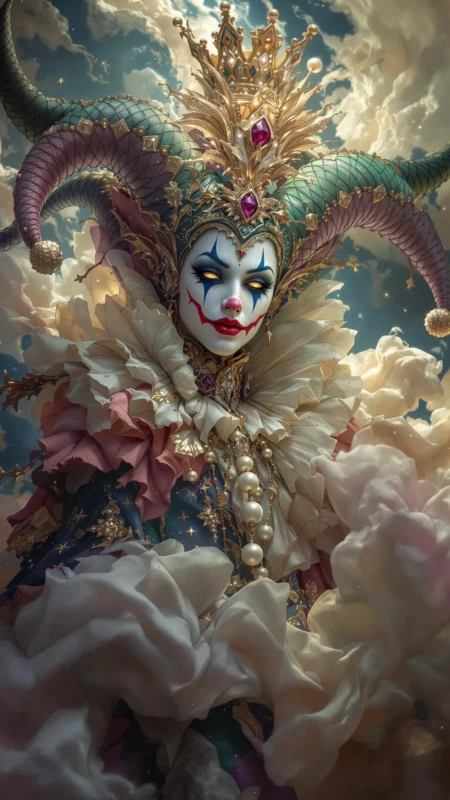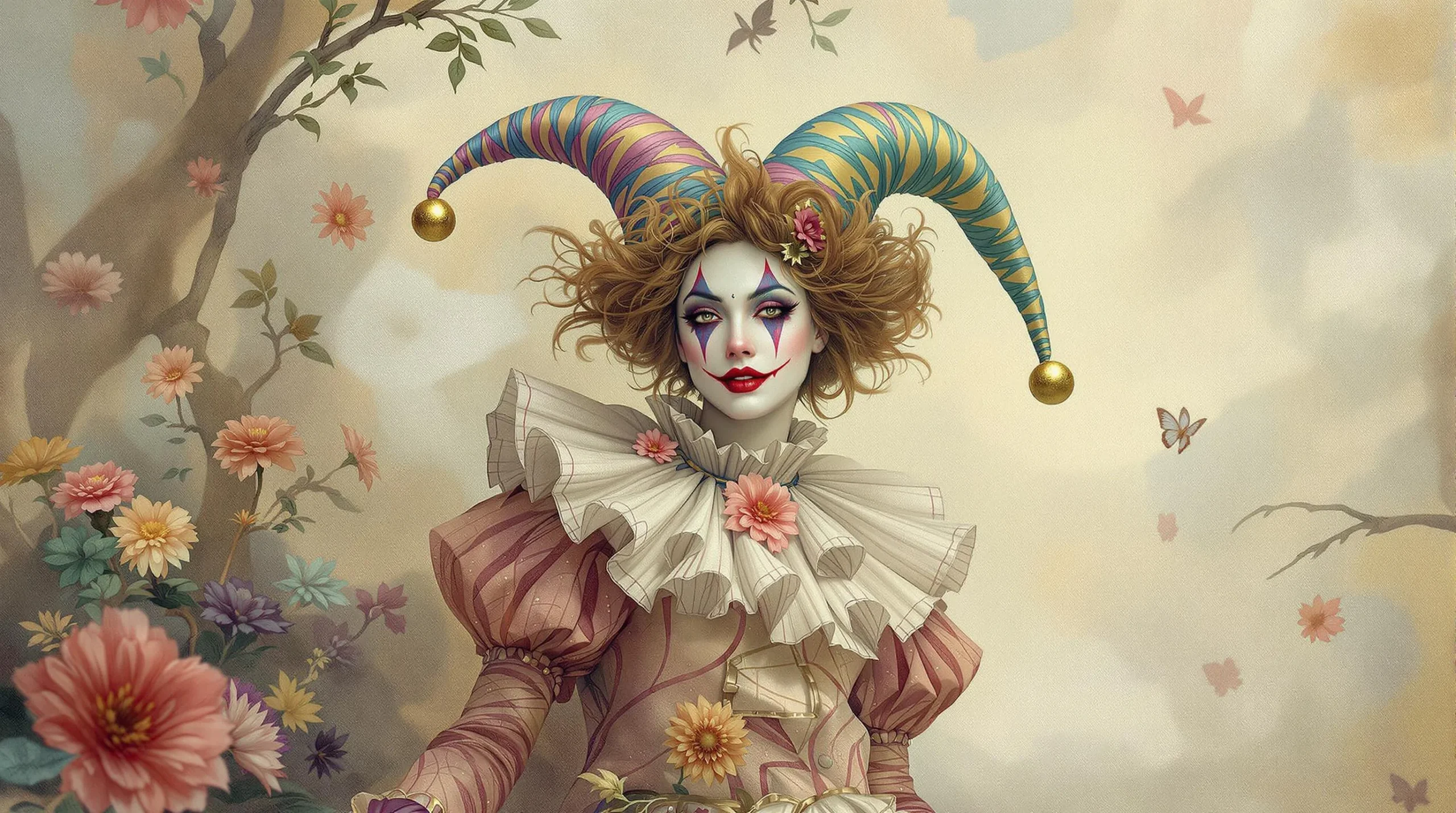


Jester

Archetype Meaning & Symbolism

Irreverent, Witty, Provocative, Joyful, Chaotic, Perceptive, Evasive, Resilient, Paradoxical, Unpredictable, Truthful, Playful

  • The world is a magnificent, terrible joke. The secret is not to get the punchline, but to learn to love the telling.

If Jester is part of your personal mythology, you may...

Believe

  • You may believe that solemnity is the most dangerous idol of them all, and that the first duty of an intelligent person is to regularly poke fun at what they hold most sacred.

  • You may believe that laughter is not the opposite of seriousness, but its most effective tool, capable of delivering truths that would otherwise be rejected.

  • You may believe that life has no inherent meaning, which is not a tragedy, but a liberating invitation to create your own meaning through play, joy, and connection.

Fear

  • You may fear silence: the moment after a joke when no one laughs, which can feel like a profound social and personal death.

  • You may fear being trapped, not by physical walls, but by a single identity, a boring routine, or a situation that offers no room for wit or improvisation.

  • You may fear emotional sincerity, believing that vulnerability is a weakness and that if you ever remove the mask of humor, you will be rejected or destroyed.

Strength

  • You likely possess a remarkable resilience, with the ability to reframe setbacks and tragedies as absurdities, allowing you to bounce back from what might crush a more serious spirit.

  • You have the gift of perspective, able to detach from a situation and see its hidden dynamics, hypocrisies, and humorous angles, making you a brilliant strategist and social observer.

  • You are a master of connection, capable of disarming strangers, de-escalating conflicts, and bringing diverse groups of people together through the universal language of laughter.

Weakness

  • You may have a tendency towards frivolity, using humor to evade responsibility, avoid difficult conversations, and keep from committing to any single path or person.

  • Your constant need for an audience and their approval can make you emotionally dependent, with your self-esteem rising and falling on the whims of others' reactions.

  • You may struggle with intimacy, as your well-practiced wit can become a fortress that keeps even your loved ones from getting too close to your authentic, vulnerable self.

The Symbolism & Meaning of Jester

In the modern theatre of the self, the Jester archetype may emerge not in motley and bells, but as a crucial psychological function. It could symbolize the part of you that refuses to be crushed by the solemnity of adult life, the voice that whispers 'what if?' in the face of 'you must.' To have the Jester in your personal mythology is to carry a license for irreverence, a permission slip to puncture pomposity wherever you find it: in your workplace, in your family, and most importantly, within yourself. This figure represents the wisdom of not knowing, the power of play, and the liberating recognition that the universe may operate on principles closer to cosmic comedy than grand tragedy. It’s the capacity to hold two opposing ideas at once and find the humor in their collision, a skill essential for navigating the complex absurdities of contemporary existence.

The Jester's meaning deepens when viewed as a keeper of mental and emotional agility. This archetype is the embodiment of pattern-breaking. When your personal narrative becomes too rigid, too tragic, or too self-important, the Jester appears to trip you up, to make you laugh at your own script. It could be the impulse to take a sudden detour on your commute, to answer a serious question with a playful non-sequitur, or to see a personal failure not as an endpoint but as a spectacular pratfall. The Jester reminds the psyche that identity is fluid, that the self is a performance, and that at any moment, you can change your costume, your tone, and your act. This is not about frivolity, but about a profound form of resilience.

Ultimately, the Jester symbolizes the unkillable spirit of life itself. It is the dandelion growing in the crack of a concrete palace, the laughter that erupts in a quiet library, the sudden flash of insight that arrives not from careful deduction but from a moment of pure, unadulterated silliness. In one's mythos, the Jester is the sacred fool who walks the tightrope between sanity and madness, order and chaos, meaning and meaninglessness, and shows us that the rope itself is the point. The Jester's presence suggests that the goal of the story is not to reach a tidy conclusion, but to dance along the way, fully alive to the beautiful, terrifying, and hilarious balancing act of being human.


Jester Relationships With Other Archetypes

The Sovereign:

The Jester's relationship with the Sovereign is one of symbiotic peril. The Sovereign, representing order, structure, and ultimate authority, requires the Jester to stay humble and connected to the truth. The Jester is the Sovereign's reality check, a living mirror reflecting the monarch's flaws and the absurdity of their absolute power. For an individual, this may play out as a tension between their ambitious, responsible side (the Sovereign who builds a career and a stable life) and their irreverent, freedom-seeking side (the Jester who questions the point of it all). This internal court needs its fool, lest the personal Sovereign becomes a tyrant, enforcing rigid rules upon the self with no room for laughter or deviation from the grand plan.

The Sage:

Where the Sage seeks truth through texts, contemplation, and linear reason, the Jester finds it in pratfalls, paradox, and the chaotic mess of lived experience. They are two paths to the same mountain peak. The Sage might view the Jester as frivolous, while the Jester may see the Sage as ponderously slow and out of touch. In a personal mythos, this relationship could manifest as the conflict between your intellectual, analytical mind and your intuitive, playful gut. An over-reliance on the Sage can lead to analysis paralysis, a life lived in theory. An over-indulgence in the Jester can lead to a life devoid of structure and depth. The mythic task is to foster a dialogue between them: to find the rigorous truth in a good joke, and the playful spirit within a profound philosophy.

The Orphan:

The Jester often shares a profound kinship with the Orphan archetype, the figure defined by a sense of abandonment and a longing for belonging. Both are outsiders. The Orphan is an outsider by circumstance; the Jester is often an outsider by choice, understanding that true perception requires a degree of detachment. In a personal narrative, someone with a strong Orphan background may develop a Jester persona as a survival mechanism. Humor becomes a shield, a way to be accepted by the group without ever being truly vulnerable. The Jester’s wit can keep the raw pain of the Orphan at bay, creating a person who is the life of the party but who goes home to a profound sense of solitude. The challenge is for the Jester to learn to put down the mask and allow the vulnerable Orphan to be seen and cared for.

Using Jester in Every Day Life

Navigating Corporate Absurdity:

When faced with a labyrinthine bureaucracy or a meeting filled with meaningless jargon, you may embody the Jester. This isn't about telling jokes, but about asking the simple, 'foolish' question that exposes the core absurdity. It's a way of using pointed innocence to cut through corporate speak, perhaps by reframing a convoluted business plan into a simple, almost childish analogy that reveals its flaws or its genius. You become the mirror reflecting the ridiculousness of the situation, allowing others to see it too, without overt rebellion.

Healing from Grief:

In moments of profound loss, the Jester archetype may surface not as a denial of pain, but as an embrace of life's inherent paradox. It could be the sudden, unbidden laugh at a funeral remembering a loved one's quirky habit, a moment that doesn't erase sorrow but coexists with it. This is the Jester's wisdom: that joy and grief are not opposites but intimate partners. Using this archetype could mean creating space for macabre humor or celebrating the beautiful absurdity of a life lived, finding a flicker of light not by ignoring the darkness, but by finding its shape amusing.

Sparking Creativity:

When trapped in a creative desert, the Jester archetype offers a path out through deliberate play and the dismantling of self-seriousness. This might mean switching artistic mediums for an hour, writing with the opposite hand, or setting ridiculous, impossible constraints on a project. The Jester understands that innovation rarely comes from linear thought. By inviting chaos, disrupting patterns, and making the goal 'play' rather than 'perfection,' you may trick the rigid, critical parts of the mind into silence, allowing unexpected ideas to emerge from the playground of nonsense.

Jester is Known For

Truth-telling

The Jester is famed for being the sole figure permitted to speak unvarnished, often uncomfortable, truth to power. Their humor is a vessel, a sugar-coating for the bitter pill of reality, allowing them to critique the Sovereign, the system, or the sacred without (usually) losing their head. This makes them a vital agent of clarity and humility in any power structure.

Living in the Moment:

Unburdened by yesterday's regrets or tomorrow's anxieties, the Jester is a master of the present. Their reality is improvisation, reacting to the here-and-now with wit and agility. This capacity for spontaneous joy and engagement with the immediate situation is a core strength, a form of mindfulness in motion.

Wielding Paradox:

The Jester thrives on contradiction. They are both wise and foolish, inside the court but forever an outsider, powerless in title yet powerful in influence. They are known for using satire, irony, and absurdity to expose the hidden paradoxes in our own lives and societies, forcing us to confront a world that is rarely black and white.

How Jester Might Affect Your Personal Mythology

How Jester Might Affect Your Mythos

When the Jester is a central figure in your personal mythos, your life story may resist a simple, heroic arc. Instead of a linear progression of challenges overcome and goals achieved, your narrative might more closely resemble a series of vignettes, a collection of curious paradoxes and surprising turns. The defining moments of your mythos may not be the promotions or the victories, but the times you laughed in the face of disaster, the moments you chose play over productivity, or the instances where a foolish act led to unexpected wisdom. Your story's theme may not be about 'becoming' something, but about creatively and joyfully 'being' in each moment, finding meaning not in the destination but in the delightfully meandering journey.

Furthermore, your personal mythology could be characterized by a recurring theme of inversion: the powerful are shown to be foolish, the serious revealed as absurd, and the failures recast as opportunities for growth and humor. You might see yourself as the character who enters a scene and subtly changes its entire dynamic, not through force, but through a shift in perspective. Your mythos may not have a clear protagonist versus antagonist structure; instead, the primary conflict could be an internal one, a constant dance between the need for societal approval and the irrepressible urge to poke holes in society's sacred cows. Your life story becomes a testament to the idea that the most profound truths are often spoken in jest.

How Jester Might Affect Your Sense of Self

To see yourself through the Jester's eyes is to cultivate a healthy detachment from your own ego. You may be less inclined to build a rigid, heavily defended identity, understanding that the 'self' is a fluid and often comical construction. This perspective allows for a remarkable degree of self-acceptance; failures become funny stories rather than sources of shame, and personal quirks are celebrated as unique features rather than flaws to be fixed. You might perceive your own internal dramas with a sense of theatricality, viewing your anxieties and ambitions as roles you are playing, which gives you the power to step out of character and laugh at the performance.

This self-perception, however, also carries a risk. The Jester's lens could make it difficult to take yourself seriously when necessary. You might use humor as a sophisticated defense mechanism, a way to deflect genuine intimacy or avoid confronting painful emotions. There may be a persistent feeling of being a performer rather than a participant in your own life, watching yourself from the wings with an amused, critical eye. This can lead to a subtle sense of alienation from your own deepest feelings, as the Jester's instinct is to turn everything, even pain, into a punchline before it can be fully felt and integrated.

How Jester Might Affect Your Beliefs About The World

A worldview shaped by the Jester archetype is one that sees the magnificent absurdity in all human endeavors. You may look upon the grand structures of society: politics, religion, finance, and academia, and see not just their stated purpose but their inherent theatricality and self-importance. You might be keenly aware of the vast gap between what people say they believe and how they actually behave. This doesn't necessarily lead to cynicism, but rather to a kind of amused realism. You could see the world as a grand, chaotic, and often hilarious play, and you understand that the scripts we are all handed are largely improvised and open to interpretation.

This perspective could foster a deep appreciation for freedom and a suspicion of all forms of dogmatic belief. You may believe that no system, ideology, or leader is beyond reproach or immune to satire. Your philosophy could be one of radical contingency: the recognition that things could always be otherwise. While this provides a powerful antidote to fanaticism and despair, it might also make it challenging to commit fully to a cause or a community. If everything is a bit of a joke, finding something worth fighting and sacrificing for can become a difficult, almost paradoxical quest for the Jester-minded individual.

How Jester Might Affect Your Relationships

In relationships, the Jester archetype can manifest as a partner who is playful, witty, and adept at diffusing tension with humor. You may be the one who can break a stony silence with a well-timed joke or reframe a major conflict as a minor, manageable absurdity. This can make for a lighthearted and resilient partnership, one that doesn't get bogged down in petty grievances. You likely value laughter and intellectual sparring as core components of intimacy, and you may be drawn to people who don't take themselves too seriously and can appreciate your unique brand of irreverence.

However, the Jester's influence can also create significant challenges in deep connection. Your reliance on humor might be perceived by a partner as a refusal to be vulnerable or to engage with the gravity of their emotions. There may be a tendency to 'joke your way out' of difficult conversations, leaving your partner feeling unheard or dismissed. The Jester's inherent outsider status can persist even in the most intimate relationships, creating a subtle barrier. The fear may be that if the laughter stops, if the mask of wit is removed, what remains will not be loved or accepted. The challenge for the Jester in relationships is to learn that true intimacy requires moments without a punchline.

How Jester Might Affect Your Role in Life

If the Jester informs your perceived role in life, you may feel you are here to be a catalyst, a disruptor of stale equilibrium. You might not see yourself as a leader or a follower, but as the 'trickster' or the 'court fool' of your social or professional circles. This role is often adopted, sometimes unwillingly, because you are the one who naturally sees the emperor has no clothes and cannot resist pointing it out, albeit with a clever quip rather than a direct accusation. You may believe your purpose is to inject levity, perspective, and uncomfortable truth into situations that have become too self-important or stagnant. You provide a necessary service: keeping egos in check and reminding the group of its shared, flawed humanity.

This role, while vital, is often a lonely and precarious one. You might be loved for your humor but rarely trusted with serious responsibility. People may turn to you for a laugh but not for comfort. There's a danger of being permanently typecast, trapped in the role of the entertainer even when you yearn to be seen as something more. Your life's work may be a constant negotiation: how to fulfill your disruptive, truth-telling function without becoming so marginal that your voice loses its impact. You are the necessary outsider, a role that offers a unique form of influence but can also preclude a deeper sense of belonging.

Dream Interpretation of Jester

When the Jester appears in your dreams in a positive context, it may be a message from your subconscious to lighten up and embrace play. A laughing, dancing Jester could signify that you have successfully integrated a difficult truth or found a way to release a heavy emotional burden. This dream figure might be beckoning you towards more creativity, spontaneity, and joy in your waking life. If the Jester offers you a gift or shares a secret, it may represent a flash of profound insight arriving in an unexpected or humorous form. It could be a signal from your psyche that the solution to a problem lies not in more effort, but in a radical shift of perspective, in finding the 'divine comedy' within your personal tragedy.

Conversely, a menacing or unfunny Jester in a dream could represent the archetype's shadow side. A Jester whose jokes are cruel, who mocks you, or whose grin is malevolent may symbolize a fear of being ridiculed or socially shamed. It could also be your own inner critic, twisted into a mocking form, using satire to wound your self-esteem. This figure might represent a part of you that uses humor defensively to an unhealthy degree, keeping others at a distance and avoiding genuine emotional expression. A silent or weeping Jester could be even more potent, symbolizing a loss of joy, a creative block, or the despair that comes when the laughter has died and one is left alone with a truth that is no longer funny.

How Jester Archetype Might Affect Your Needs

How Jester Might Affect Your Physiological Needs

The Jester archetype may influence your physiological needs by prioritizing the feast over the famine, the celebration over the routine. Your body's needs might be met with a spirit of improvisation rather than a strict regimen. You could be someone who eats when joy strikes, not when the clock dictates, finding that a shared meal with laughter is more nourishing than a perfectly balanced one eaten in solitude. There may be a belief that laughter itself is a physiological necessity, a core nutrient like water or air, and you might actively seek it out as a form of medicine, feeling a genuine physical depletion in its absence.

This spontaneity, however, can also lead to a neglect of the body's fundamental requirements. The Jester, caught up in the moment, may easily forget to sleep, to eat properly, or to rest. This can lead to a boom-and-bust cycle of energy, with periods of manic activity followed by crashes of exhaustion. In your personal mythos, this might be framed as 'burning the candle at both ends for a brighter light,' but it can take a physical toll. The body becomes a secondary concern to the pursuit of the moment, and you may have to learn, perhaps the hard way, that even the most brilliant performer needs downtime and basic maintenance to keep the show going.

How Jester Might Affect Your Ideas of Belonging

The Jester can be a master of creating moments of communal belonging. With a shared laugh, you can dissolve tensions and unite a disparate group, making you the heart of many social gatherings. You might feel a sense of purpose in your ability to bring people together, to forge temporary communities through the magic of wit and shared amusement. This can lead to a life rich in friendships and social connections, where you are a welcome and cherished presence. Belonging, for you, may be found in the role of the beloved entertainer, the catalyst for collective joy.

Yet, the Jester is often the ultimate outsider. You may be 'in' the group, but never truly 'of' the group. The role of entertainer can create a subtle distance, a barrier of performance that prevents true, vulnerable intimacy. People may love the persona but not know the person behind it. This can lead to a profound loneliness at the center of the party, a feeling of being a professional guest in your own life. You might fear that if you stopped being funny, you would cease to belong anywhere, making your connections feel conditional and fragile. The search for unconditional love and belonging can be the Jester's most secret and serious quest.

How Jester Might Affect Your Feelings of Safety

The Jester's approach to safety is a paradox. On one hand, you may find safety in being underestimated. By playing the fool, you could be perceived as non-threatening, allowing you to observe and move through dangerous social or political landscapes without attracting negative attention. Humor can be a disarming shield, de-escalating conflict before it begins. Your security may lie not in walls and weapons, but in your mental agility, your ability to talk your way out of trouble, and the protection afforded by making powerful people laugh. There is a strange safety in having nothing to lose.

On the other hand, the Jester's very function is to live on the edge of safety. Speaking truth to power, even when couched in humor, is inherently risky. Your sense of security could be constantly undermined by the fear of having gone too far, of a joke landing badly and resulting in ostracism, punishment, or professional ruin. This could manifest as a life of financial or social precarity, where stability is sacrificed for the freedom to be provocative. You might feel that true safety is an illusion anyway, and that the only honest way to live is to embrace the insecurity of the tightrope walk.

How Jester Might Affect Your Views of Esteem

Esteem for the individual with a strong Jester archetype may be sourced from unconventional wells. Your self-worth might not be tied to titles, wealth, or conventional achievements, but rather to your intellectual quickness and social influence. You could derive immense satisfaction from landing a perfect, truth-telling joke in a tense room, from making a stoic authority figure crack a smile, or from elegantly exposing a hypocrisy that everyone else was afraid to name. Esteem is earned through the successful performance of your function: to be the cleverest, quickest, and most perceptive person in the court.

This source of esteem, however, is precarious and eternally dependent on an audience. Your self-worth can become a rollercoaster, soaring with a wave of laughter and crashing in a silent room. You might become a 'joke addict,' constantly seeking the validation of others' amusement to feel good about yourself. This can lead to a fear of being unfunny, which is tantamount to a fear of being worthless. The deeper challenge for your esteem is to separate your inherent worth from your performance, to learn to value the wise fool within even when there is no one around to applaud.

Shadow of Jester

When the Jester archetype falls into shadow, the joyful sprite of wit curdles into something cruel and nihilistic. The shadow Jester is not the wise fool but the cynical bully. Their humor is no longer a tool for liberation but a weapon for degradation. This is the person who uses 'just kidding' as a shield after launching a precisely aimed barb designed to wound. They mock the vulnerable, punch down instead of up, and use satire not to expose the follies of the powerful but to enforce social hierarchies and torment those who are different. Their playfulness becomes a form of chaos, leaving messes for others to clean up, shirking all responsibility with a flippant laugh. The world is not a grand comedy to them, but a meaningless joke, justifying any selfish or destructive impulse.

Another manifestation of the shadow Jester is the person trapped permanently behind the mask. This is the individual who cannot, under any circumstances, be serious. Every moment of potential sincerity, every bid for emotional connection, is immediately deflected with a joke, a pun, or a sarcastic comment. They become a caricature, a two-dimensional figure incapable of genuine feeling or presence. This isn't joyful play; it's a frantic, desperate dance to keep reality at bay. This shadow prevents authentic relationships, stifles personal growth, and ultimately leads to a profound, echoing loneliness, where the Jester is left performing their act in a hall of mirrors, with no real audience to be found.

Pros & Cons of Jester in Your Mythology

Pros

  • You possess a powerful tool for coping with life's difficulties, allowing you to find light in the darkest of situations and maintain psychological flexibility.

  • You can be a force for positive change, using your unique ability to speak truth to power to expose corruption, challenge dogma, and inspire fresh thinking in stale environments.

  • Your life is likely to be rich with novelty, spontaneity, and joy, as you are instinctively drawn to play, exploration, and the celebration of the present moment.

Cons

  • You may be consistently underestimated or not taken seriously, preventing you from holding positions of leadership or being trusted with important responsibilities.

  • Your relationships can suffer from a lack of emotional depth if you consistently use humor as a shield against vulnerability and true intimacy.

  • You might live with a chronic sense of being an outsider, and your self-esteem may be precariously dependent on the laughter and approval of others.