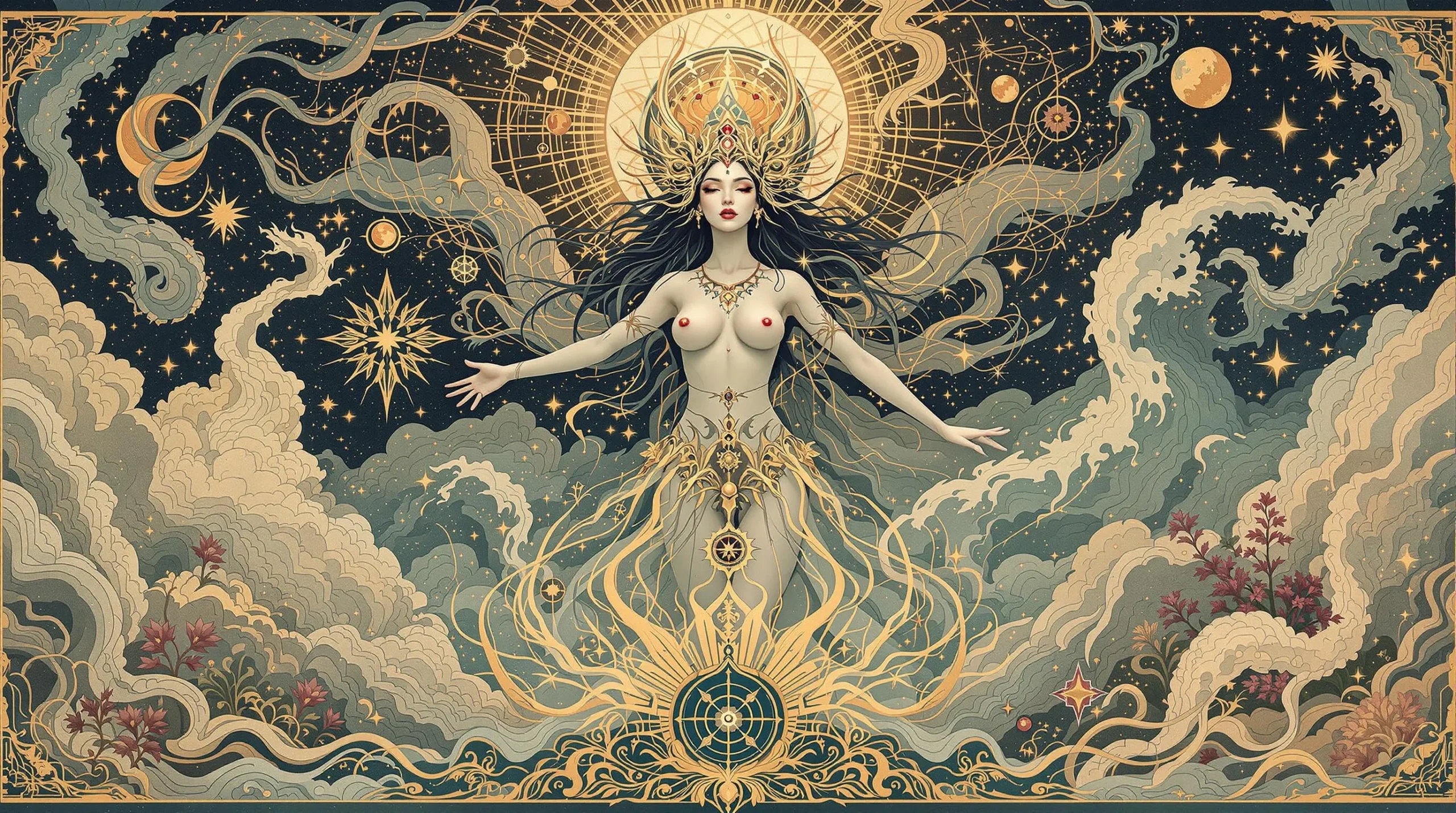


Izanami

Archetype Meaning & Symbolism

Creative, destructive, primordial, abandoned, generative, wrathful, foundational, decaying, protective, absolute

  • Do not look upon me in my becoming. The space between what I was and what I will be is sacred, and your gaze is a violation.

If Izanami is part of your personal mythology, you may...

Believe

  • You may believe that every act of creation plants the seed of its own destruction, and that this is a sacred, unavoidable cycle.

    You may believe that some betrayals are so fundamental that they don't just break a relationship; they rewrite the laws of reality between two people.

    You may believe that true power isn't about avoiding your personal hell, but about learning to rule it.

Fear

  • You may fear being seen in a state of vulnerability or transformation before you are ready, believing that another's gaze will curdle the process into something monstrous.

    You may fear that your capacity for righteous rage, once unleashed, is a world-ending force that you won't be able to control.

    You may fear that by sealing the door to your past, you have also sealed the door to future love and connection, condemning yourself to eternal sovereignty but also eternal loneliness.

Strength

  • You possess an immense, primordial creativity, able to bring entire worlds of ideas, projects, or relationships into being from sheer will and imagination.

    You have an unparalleled resilience, an ability to not only survive catastrophic loss but to metabolize it into a source of profound strength and authority.

    Your ability to set and enforce boundaries is absolute. When you decide something is over, it is over, protecting your energy with unshakeable resolve.

Weakness

  • A tendency toward absolute severance can make it nearly impossible to forgive, causing you to burn bridges that might have been mended, leading to profound isolation.

    Your righteous anger can morph into disproportionate vengeance, where the 'curse' you enact far outweighs the original transgression, harming yourself as much as the other.

    You may become so identified with your 'underworld' self that you refuse to leave it, seeing betrayal and decay everywhere and preemptively destroying potential sources of joy and creation.

The Symbolism & Meaning of Izanami

In the modern psyche, Izanami is the echo of the great creative endeavor that ends in ashes. She is the startup founder whose company crumbles, the artist whose magnum opus is misunderstood, the parent whose child leaves the world they so carefully built. Her story is not a simple tragedy: it is a testament to the fact that creation and destruction are not opposites but partners in a wrenching, intimate dance. To have Izanami in your personal mythology is to understand that every birth contains a death, and every act of making leaves you vulnerable to the horror of its unmaking. She is the patron saint of the project that fails, the love that sours, the body that betrays itself. Her symbolism resides in the sacredness of the process, both the beautiful beginning and the horrifying end.

Her myth is also a profound lesson in boundaries. The act of looking, of Izanagi violating his promise, is the pivotal moment. It suggests that some transformations are so deeply personal they cannot be witnessed by others, even those we love most. Izanami’s rage is the fury of the soul laid bare before it is ready. She represents that part of us that demands the right to our own decay, to our own becoming, in private. She is the locked door, the sealed tomb, the absolute 'no' that protects the nascent, terrifying power growing in the dark. In a world that demands constant transparency, Izanami champions the sovereignty of the shadow, the right to fall apart and reconstitute oneself away from prying eyes.

Ultimately, Izanami symbolizes a terrifying but necessary integration. She does not cease to be the creator goddess when she becomes the goddess of death. The two are one. Her personal meaning for us today is the call to embrace this duality within ourselves. We may contain both the pristine garden and the rotting corpse, the capacity for boundless love and the potential for absolute severance. To walk with Izanami is to accept that our most profound power may be forged in our deepest wound, that our greatest creative potential might only be unlocked after we have descended into our personal underworld and claimed its terrifying throne.


Izanami Relationships With Other Archetypes

The Broken Mirror

The Izanami may find its most faithful, if most agonizing, counterpart in The Broken Mirror. Where a mirror once offered the pristine, whole self—the promise of a shared world reflected in a lover's gaze—its shattering marks the moment of irreversible trauma. The relationship is not one of opposition, but of terrible, clarifying truth. To engage with The Izanami is to be handed a shard of this mirror; it no longer reflects a future but rather the unbearable honesty of a present decay. The mirror, in its fractured state, does not simply show The Izanami's sorrow, it could be said to implicate the viewer, revealing how their own gaze contributed to the breaking. What was once a covenant of wholeness is now a treachery of sharp edges, each piece reflecting a different angle of the same foundational loss.

The Unsent Letter

A more silent, sorrowful dialogue could exist with The Unsent Letter. This archetype represents a communication channel, a promise of connection, that was abruptly severed. The letter itself—full of devotion, of future plans, of a world yet to be built—is a perfect artifact of The Izanami’s initial, creative state. The calamity, the metaphorical death in childbirth, is the moment the ink is dry but the envelope is never sealed, the address never reached. The Izanami’s subsequent rage may be the scream of this unsent message, its love curdling into accusation in the dark of a forgotten drawer. The relationship, then, is one of arrested potential, where the silence between them is not an emptiness, but a space heavy with the ghost of a promise that can never be fulfilled or retracted.

The Ghost Orchard

Perhaps the most haunting relationship is with The Ghost Orchard, a landscape of profound and beautiful decay. In its prime, The Izanami archetype is a generative force, a place of fruitful, life-giving boughs. After the fall, it becomes this orchard: the skeletal branches still trace the patterns of a former abundance, but they bear no fruit. The memory of sweetness may hang in the air like a frost, but any attempt to find sustenance there yields only a profound chill. The Ghost Orchard is what remains of creation when the life-force has fled, leaving behind a perfect, desolate monument to what was. To walk its rows is to understand The Izanami—not as a monster, but as a place of beauty haunted by its own, more vibrant past, a potential now serving only as a testament to an irreversible blight.

Using Izanami in Every Day Life

Navigating a Creative Block:

When a project stalls, the Izanami archetype does not suggest pushing through with brute force. It asks what part of the creation must be allowed to die. Perhaps the initial concept, once beautiful, has begun to rot. Izanami invites you to descend into the project's 'underworld,' to witness its decay without flinching, and from that decomposition, draw the fertile soil for what it truly needs to become. It is a process of letting go of the pristine idea to embrace a more complex, living reality.

Ending a Foundational Relationship:

When a partnership that once created a world with you is over, the mythos of Izanami provides a map for the severance. It acknowledges the shared creation: the islands of memories, the sacred spaces. But upon betrayal or the finality of an ending, it demands a clean break. It is the courage to seal the boulder at the entrance to Yomi, to accept the painful consequences, and to declare a new reality. You do not look back, not out of coldness, but to honor the finality of what has passed and protect the sovereignty of your new, solitary path.

Processing Betrayal:

Izanami's story is a masterclass in the anatomy of betrayal. A sacred promise: 'do not look,' is broken. Her archetype helps you understand that the rage that follows is not petty. It is a primordial force, a reaction to a foundational violation. It gives you permission to feel the full, destructive scope of your anger, not as a flaw, but as the cry of a creator whose sacred workshop has been desecrated. The task then becomes how to wield that terrible power: not for endless vengeance, but to establish an unbreachable boundary for the future.

Izanami is Known For

Creation of the Land

As one of the primordial kami, Izanami, with her consort Izanagi, gave birth to the islands of Japan, creating the physical world from the brine of chaos. She is the archetypal mother of the tangible world.

Descent into Yomi

After dying while giving birth to the fire god, Kagutsuchi, she descended into Yomi-no-kuni, the shadowy land of the dead. This journey marks her transformation from a goddess of life to a deity of death and decay.

The Curse of a Thousand Deaths

When Izanagi broke his promise and saw her decaying form, she became a fearsome goddess of death. In her rage, she vowed to kill one thousand of his people each day, establishing the inescapable cycle of death in the world as a consequence of his transgression.

How Izanami Might Affect Your Personal Mythology

How Izanami Might Affect Your Mythos

When Izanami is a cornerstone of your personal mythos, your life story is likely not a simple hero’s journey but a creator’s tragedy and rebirth. The narrative arc follows a pattern: a period of intense, joyous, and perhaps naive creation, where you and perhaps a partner build a world from scratch. This could be a business, a family, a core identity. This era is your 'giving birth to islands.' Then comes the fall, the descent. It is often triggered by a profound loss or a betrayal that feels like a death, a moment where the creative fire consumes you. This is your journey into Yomi.

The second act of your mythos is defined by this underworld. It is a period of decomposition, of facing the 'maggot-ridden' parts of yourself and your life that you’ve hidden away. The climax is not about being rescued, but about being seen in this state and reacting with formidable power. When someone from your past life 'looks' upon your transformation, you do not seek their approval. You claim your new, darker power. The rest of your story becomes about wielding this integrated power: the knowledge of both creation and destruction. Your myth is one of becoming a gatekeeper, a sovereign of your own experience, whose authority was earned in the dark.

How Izanami Might Affect Your Sense of Self

Your view of self may be fundamentally dualistic, a constant awareness of two distinct versions of you. There is the 'before': the beautiful creator goddess, full of light, potential, and a certain innocence. You may look back on this self with a mix of nostalgia and pity. Then there is the 'after': the self forged in the underworld, the one who has seen the decay, who carries the wound of betrayal, and who wields a power that feels both righteous and terrifying. This self is no longer pristine, and may even feel monstrous at times.

Self-acceptance, in this context, is not about healing the wound to return to the 'before' state. It is about integrating the two selves. It is the understanding that the Queen of the Underworld is still the Mother of Islands. Your strength, your wisdom, your authority, they all stem from this integration. You learn to see the beauty in the decay, the power in the rage, and the necessity of the boulder that seals the tomb of your past. Your self-worth becomes independent of being seen as 'beautiful' or 'good,' and instead is rooted in the formidable resilience of your survival and transformation.

How Izanami Might Affect Your Beliefs About The World

With Izanami as a guide, your worldview may be stripped of romanticism. You might see the world as a place of incessant, cyclical creation and destruction, where life and death are not in opposition but are two hands of the same god, working in tandem. You may perceive the inherent cost in every new beginning, the shadow that trails every bright idea. This is not necessarily a pessimistic view: it is a realistic one, imbued with a deep respect for the power of entropy and the necessity of endings. You see the world not as a stage for progress, but as a cosmic compost heap where rot is the prerequisite for fertility.

This perspective could foster a profound appreciation for transitions. You might find beauty in abandoned buildings, decaying leaves, and the quiet dignity of things ending. You may distrust narratives of perpetual growth and easy solutions. Your understanding of reality is that some doors, once closed, are meant to stay closed. You believe in consequences. The world is not a forgiving, gentle place, but a realm of cause and effect, where a broken promise can and should alter the landscape of reality forever. It is a world that respects the finality of a curse.

How Izanami Might Affect Your Relationships

In relationships, the Izanami archetype fosters a capacity for profound, world-building intimacy. You may seek a partner with whom you can 'give birth to islands,' a co-creator to spin a shared reality from nothing. In this phase, you could be incredibly devoted, generative, and giving. The bond is a creative act, and the shared world you build feels sacred, a testament to your combined power. There is a desire to merge, to create something larger and more lasting than yourselves.

However, this deep creative impulse comes with a perilous condition. The line between creation and destruction is thin, and it is policed by trust. A betrayal, especially one that violates a core promise or exposes a sacred vulnerability ('don't look at me now'), can trigger a complete reality shift. The creative partnership is irrevocably broken. The impulse is not to repair, but to sever. To seal the cave. Relationships may become binary: they are either in the 'creation' phase or they are over. Forgiveness can be exceptionally difficult, as the transgression is not seen as a simple mistake, but as a desecration of the sacred act of creation itself. Boundaries become absolute and the consequences for crossing them, final.

How Izanami Might Affect Your Role in Life

Your perceived role in life might be that of the foundational force, the primordial creator. You may feel a deep-seated impulse to start things: companies, families, movements, artistic projects. You are the one who lays the first stone, who churns the chaotic sea to bring forth land. In groups or families, you may naturally assume the role of the matriarch or patriarch, the source from which the structure and life of the unit originates. There is a sense of responsibility for the very existence and nourishment of your creations.

This role, however, has a shadow aspect that you must also carry. Following a loss, a failure, or a betrayal, your role may transform into that of the gatekeeper of endings. You become the one who presides over the dissolution, the one who understands that some things must be allowed to die. You might be the one who has to make the painful decision to shut down a business, to finalize a divorce, to declare an end. This dual role can be isolating. You are both the source of life and the arbiter of its conclusion, holding the terrible, integrated power of the beginning and the end.

Dream Interpretation of Izanami

To dream of Izanami in her beautiful, creative form, perhaps seeing her alongside Izanagi churning the sea or giving birth to gods and islands, is a potent omen of fertility and creation. This dream may suggest you are entering a period of immense generative power. It could be a sign to begin a new project, to lean into a new relationship, to start a family, or to pour your energy into an artistic endeavor. The dream affirms that you are aligned with the forces of life and becoming, and that the world is receptive to what you have to offer. It is a blessing from the archetypal mother, a green light for your ambitions.

Conversely, to dream of the underworld of Yomi, to see Izanami in her decaying form, or to be the one fleeing from her wrath, is a powerful warning. This dream signifies a confrontation with an ending that has become toxic. It may point to a betrayal you have not fully processed, or a past you are unwisely trying to revisit. Fleeing from her suggests you are trying to escape the necessary consequences of a separation. If you are Izanagi, breaking your promise and looking upon her, the dream may be a caution against violating sacred boundaries in your waking life. It is a call to respect the finality of endings and to let the dead remain buried, lest you unleash a powerful and destructive force upon your own life.

How Izanami Archetype Might Affect Your Needs

How Izanami Might Affect Your Physiological Needs

From a mythological perspective, the Izanami archetype deeply connects your sense of self to the body's raw, cyclical nature. Your physiological needs are not seen as a matter of simple maintenance but as a sacred rhythm of creation and decay. You might feel an intense connection to your body's fertility, its ability to create, whether literally or metaphorically. Health is not a static state of perfection but a dynamic process. You may be more accepting of the body's 'ugly' processes: sickness, aging, scarring, menstruation. These are not failures but the body's own journey into the underworld, its necessary decomposition before regeneration.

This can lead to a state of hyper-awareness of your physical form, a sense that your flesh is a landscape where divine dramas unfold. The birth of the fire god Kagutsuchi, which burns and kills Izanami, can be a potent metaphor for any bodily experience that feels both creative and destructive, such as a difficult childbirth, a chronic illness, or an intense athletic endeavor. You may feel that your body is a sacred text, and its pains and pleasures are messages from a deeper, chthonic wisdom. You honor your need for rest and retreat not as weakness, but as a necessary descent into Yomi to gather strength.

How Izanami Might Affect Your Ideas of Belonging

The need for love and belonging is a central, and perhaps the most painful, axis of the Izanami archetype. There is a profound longing for a creative partnership, a desire to merge with another to build a world. This is the yearning for Izanagi, the divine consort, the one with whom you can churn the chaos into something beautiful and real. Belonging, in this sense, is an act of co-creation, a shared divinity. It's the feeling of finding the one other person who can stand with you at the dawn of a new world.

However, this deep desire is haunted by the terror of the wound. The betrayal by Izanagi creates a core belief that to be truly seen in your moment of transformation, in your 'decay,' is to be abandoned. Therefore, the need for belonging is fraught with peril. You may test potential partners, consciously or unconsciously, to see if they will flee from your darkness. True belonging becomes an almost impossible standard: to find someone who will not just tolerate your underworld self, but who will honor it without flinching and without violating the sanctity of your private becoming. This can lead to profound loneliness or to the creation of exceptionally deep, resilient bonds with the very few who pass the test.

How Izanami Might Affect Your Feelings of Safety

Your need for safety may be less about building walls to keep danger out and more about becoming the master of the dangerous place itself. True security is not found in avoiding the underworld, but in knowing you can survive it. Safety is the confidence that comes from having faced the absolute worst, the deepest loss or betrayal, and having emerged not broken, but transformed into something more formidable. The trauma becomes the source of an unshakeable inner fortress. Your safety is not a comfortable home; it is a throne in the land of the dead.

This translates into a fierce need for psychological and emotional sovereignty. Safety means having boundaries that are not merely suggestions, but absolute laws of physics in your personal reality. The 'boulder' that Izanagi rolls to block the entrance to Yomi is a key symbol. You may create such 'boulders' in your life: cutting off contact with toxic people, leaving environments that threaten your integrity, and refusing to revisit past harms. Safety is the power to declare a space, whether physical or emotional, as your own sacred ground, from which you have the ultimate authority to grant or deny access.

How Izanami Might Affect Your Views of Esteem

Esteem, within the Izanami framework, is not sourced from accolades, social status, or external validation. It is forged in the underworld. Your self-worth is born from the moment you survive what you thought would destroy you. It is the quiet, terrifying pride of the one who has seen the rot at the core of things, including within the self, and has not looked away. It is the esteem that comes from turning the deepest wound into the most formidable weapon, from transforming rage into sovereignty.

This form of self-esteem is resilient but can be isolating. It doesn't need applause. It is the esteem of the gatekeeper, who knows their own power because they set the boundary and enforced the consequence. You may feel a disconnect from conventional measures of success or likeability. Your sense of accomplishment is tied to your creative power and your ability to endure and dictate the terms of endings. It is the profound self-respect that comes from knowing you are the ruler of your own darkness, and that this power, while perhaps fearsome to others, is authentically and irrevocably yours.

Shadow of Izanami

The shadow of Izanami manifests when the sacred cycle of creation and destruction becomes frozen at one pole. When there is too little of her destructive energy, you become pathologically unable to let anything die. You cling to zombie relationships, failing projects, and outdated identities, refusing to admit that decay has set in. Your world becomes a museum of beautifully preserved corpses. You are Izanami refusing to accept her own death, denying the reality of Yomi and thus preventing any possibility of rebirth into a new form of power.

When the shadow takes over with too much destructive force, you become the vengeful Queen of Yomi full-time. Every disagreement is a profound betrayal, every mistake a reason to unleash hell. You salt the earth of your own life, cursing any new thing that tries to grow. The boundary-setting power becomes a weapon of mass destruction, isolating you in a barren underworld of your own making. You are the curse of a thousand deaths a day, enacted upon your own potential for happiness. The shadow forgets the joy of creation and knows only the grim satisfaction of the end, a ruler of a kingdom of dust.

Pros & Cons of Izanami in Your Mythology

Pros

  • You have access to a deep well of creative energy, making you capable of birthing incredible projects, ideas, and relationships.

    You are unafraid of endings and transformations, navigating life's most difficult passages with a strength that others find awesome.

    Your personal sovereignty is paramount, and your ability to defend your boundaries ensures you are rarely taken advantage of.

Cons

  • A rigid, all-or-nothing approach to trust and forgiveness can lead to a life of serial disappointments and profound loneliness.

    Your potent anger, if not consciously wielded, can cause you to inflict deep, lasting wounds on others and yourself, often disproportionate to the offense.

    You risk getting stuck in your own 'underworld,' identifying so strongly with past trauma that you are unable to move forward into a new cycle of creation and joy.