Believe
 Fear
Fear Strength
 Weakness
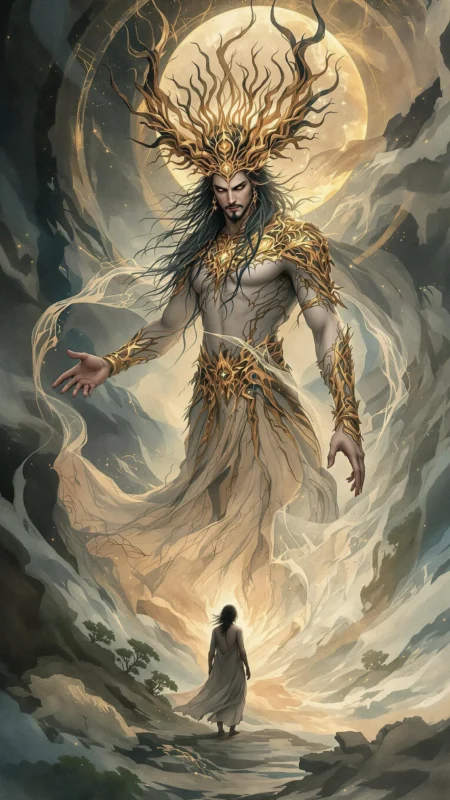
The archetype of Izanagi is not one of a pristine, omnipotent creator, but of the scarred progenitor, the god who learns that creation is an act of messy, often painful, entanglement. To have Izanagi in your personal mythos is to understand that giving form to the formless—be it a family, an artwork, or a life path—will inevitably mark you. It is the acceptance that the act of building a world with another leaves you vulnerable to its collapse. His story suggests that divinity is not about perfection, but about the relentless, generative impulse to create, even knowing the potential for loss. He is the patron of the first draft, the initial plan, the hopeful beginning that holds within it the seed of a possible tragedy.
His journey introduces a crucial second act to the creator's tale: the confrontation with decay and the necessity of purification. The flight from Yomi and the subsequent washing are not mere plot points; they are a profound metaphor for processing trauma. Izanagi does not defeat the underworld; he escapes it and then cleanses himself of its touch. This symbolism suggests a path for survival. It is not about fighting the past, but about separating from it and then, through a conscious ritual, washing away its influence to make way for the new. The birth of the three noble children from this act is the core of his meaning: your most radiant creations, your brightest moments of insight and strength, may be born directly from the cleansing of your deepest wounds.
Ultimately, Izanagi represents a flawed but persistent creative force. He breaks his promise to Izanami, he recoils in horror, he acts out of fear. He is relatable in his imperfections. His mythos suggests that you do not need to be perfect to build a world. You simply need the courage to dip the spear into the chaos, the heart to love what you create, the fortitude to witness its potential decay, and the resilience to wash yourself clean and begin again. He is the god of 'and then,' the patron of the second chance, the embodiment of the truth that life is a series of creations, not one single, perfect act.