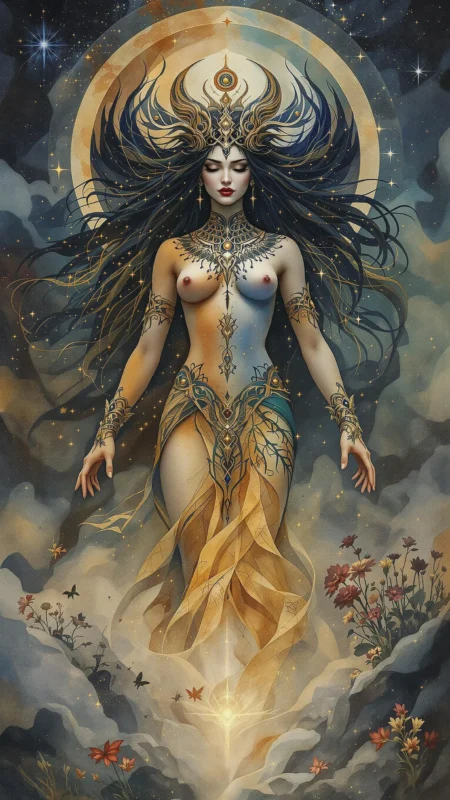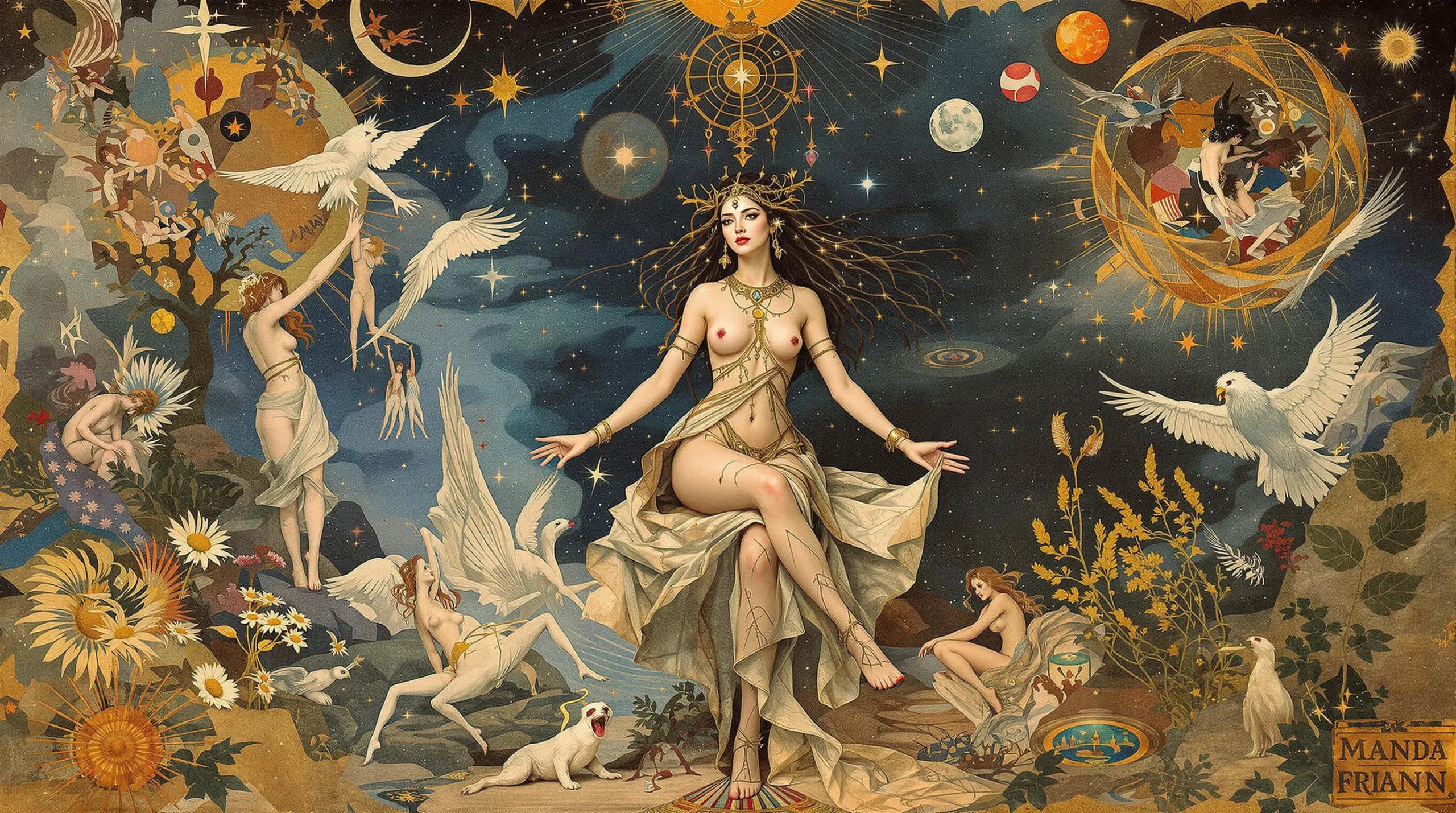


Inanna

Archetype Meaning & Symbolism

Sovereign, ambitious, sensual, strategic, cyclical, vengeful, transformative, calculating, demanding, radiant

  • Do not ask for power to be given. It is a crown you must forge in the dark, a throne you must seize in the light. All of it is yours, if you are willing to pay the price of the journey.

If Inanna is part of your personal mythology, you may...

Believe

  • That power is never freely given; it must be claimed through strategy, courage, and a willingness to descend into difficult truths.

  • That desire is not a weakness but a form of divine guidance, a compass pointing toward your sacred purpose.

  • That life's greatest wisdom is cyclical, and periods of loss and darkness are necessary rites of passage for any true ascent.

Fear

  • The ultimate fear is not death, but insignificance: living a life where your power is never fully claimed or expressed, a queen who never finds her throne.

  • A deep terror of the descent being final, of being stripped bare in the underworld of crisis and not having the strength or support to return.

  • Betrayal by a trusted consort or ally, especially one who fails to honor your sacrifices and your journey, is a particularly potent fear.

Strength

  • Profound resilience. You possess an almost supernatural ability to recover from devastating losses, knowing how to navigate the darkness and emerge not just healed, but more powerful.

  • Strategic ambition. You are not just a dreamer; you are a tactician, capable of seeing the path to your goals and making the shrewd, sometimes difficult, choices required to achieve them.

  • Unapologetic wholeness. You have the capacity to integrate the seemingly contradictory parts of yourself—the loving and the warlike, the spiritual and the sensual—into an authentic and formidable presence.

Weakness

  • A potential for ruthlessness. In the drive to achieve your goals, you may view people as pawns in your strategy, leading to a willingness to sacrifice relationships for the sake of ambition.

  • Hubris. Success can lead to an over-identification with the powerful, celestial aspect of the archetype, causing you to forget the lessons of humility learned in the descent, which often precedes a great fall.

  • Sovereign isolation. The sheer force of your presence and the demands of your 'reign' can be intimidating, making it difficult to find true equals and fostering a deep sense of loneliness on the throne.

The Symbolism & Meaning of Inanna

In the modern psyche, Inanna emerges as the patron saint of radical self-possession. She is not a goddess of gentle, nurturing femininity, but of a holistic and often terrifying sovereignty that integrates light and shadow. Her symbolism speaks to the person who feels a call to leadership, not just in the world, but over the disparate territories of the self. Her journey is a map for alchemy: turning the lead of loss into the gold of wisdom, transmuting ambition into achievement, and sanctifying desire as a compass pointing toward one’s authentic throne. To walk with Inanna in your personal mythology is to accept that your power is directly proportional to your willingness to face what you have disowned within yourself and the world.

Her cyclical nature offers a profound alternative to the linear narratives of progress and success that dominate Western thought. Inanna’s story suggests that life is not a ladder but a spiral. The descent is not a failure; it is a required pilgrimage into darkness to gather the lost parts of the soul. This could manifest as a period of depression, a career setback, or the dissolution of a core relationship. The Inanna mythos reframes these events not as endings, but as the necessary stripping away of ego and attachment, a purification process before a greater, more authentic ascent. It is the recognition that one must periodically die to one’s old life to be reborn into a new one.

Furthermore, Inanna is the archetype of unapologetic, strategic desire. She sees what she wants—the sky, the earth, the underworld—and she goes after it. In a world that often teaches women to be accommodating and to shrink their needs, Inanna provides a model for claiming one's due with divine authority. This is not a brute force, but a strategic power. She is a politician, a lover, and a warrior. Her meaning for a modern individual could be the courage to ask for the raise, to initiate the relationship, to set the boundary, and to understand that the pursuit of one's ambitions can be a sacred and life-giving act.


Inanna Relationships With Other Archetypes

The Underworld

The relationship between Inanna and the Underworld is perhaps less an adversarial one and more a collaboration with a silent, unflinching partner. The Underworld may be seen not as a place of punishment, but as a vast, dark bell that, when struck by her arrival, does not ring but instead absorbs all sound, all light, all identity. It is the divine crucible of subtraction, the stark, unadorned stage upon which the self is unmade so it might be remade. It offers no wisdom, only the experience of wisdom’s stark absence, a profound and necessary emptiness. In this realm, power is not measured by what one possesses, but by what one is willing to lose, and her journey through its gates could be the soul’s slow, deliberate undressing before the void.

The Serpent

The Serpent seems to glide alongside Inanna as the living embodiment of her journey’s perilous wisdom. It is a creature of the threshold, belonging neither to the sunlit world of ambition nor entirely to the chthonic abyss, but moving between them with a cold, primal grace. Its shed skin may be a potent metaphor for the seven gates, for the layers of identity and divine right that Inanna must discard, each one a life lived and then outgrown. The Serpent’s knowledge is not spoken, but enacted; it is the cyclical truth of poison and antidote, of a life that must coil back into the earth to be reborn. To embrace it is to accept a form of knowing that is both dangerous and ultimately regenerative, the secret language of the world beneath the world.

The Mirror

In Inanna’s saga, the Mirror is not polished silver but still, black water, or perhaps the unblinking eyes of her sister, Ereshkigal. It does not return a flattering, sun-drenched image, but rather absorbs the light to reveal the skeletal truth beneath the flesh of ego and empire. This mirror is a merciless object of self-confrontation, showing her not what she is in her glory, but what she is when stripped of it—grieving, naked, and mortal. This encounter with her reflection, her shadow-self, could be the moment the soul recognizes its own ghost, its own capacity for ruin and despair. It is in this terrible recognition, this refusal to look away from the desolation within, that she may find the first glimmer of a more profound and integrated wholeness.

Using Inanna in Every Day Life

Navigating a Career Transition:

When faced with professional crossroads, the Inanna mythos encourages a bold, strategic claiming of what you desire, not merely what is offered. You might map out your ascent like a campaign, identifying key 'gates' or challenges. Instead of fearing a demotion or a lateral move, you could reframe it as a necessary 'descent': a period for gathering new skills or knowledge in the 'underworld' of a less glamorous role, all in preparation for a more powerful return.

Healing from Betrayal:

The story of Inanna's descent, her stripping at each of the seven gates, and her eventual revival offers a potent map for navigating the agony of betrayal or loss. You may find solace in ritualizing this process. Acknowledging each thing you have lost—trust, intimacy, a vision of the future—as a garment removed at a gate. The mythos suggests that this state of being 'naked' and 'slain' is not the end, but a prerequisite for a resurrection into a wiser, more sovereign self, one who now knows the cost of vulnerability.

Embracing Your Full Self:

Inanna's dominion over both love and war, the heavens and the earth, provides a framework for radical self-acceptance. If you feel fragmented, torn between your 'professional' self and your 'sensual' self, or your 'kind' nature and your 'angry' nature, this archetype invites you to build a pantheon within. You could learn to honor your ambition as a sacred drive and your sexuality as a divine power, refusing to apologize for the paradoxical facets of your being. You are the queen of your own inner kingdom, and all aspects have a place at your court.

Inanna is Known For

The Descent to the Underworld

Her signature myth, a journey to the realm of her sister Ereshkigal, where she is systematically stripped of her power and worldly regalia, is slain, and is ultimately resurrected. This narrative provides a timeless metaphor for psychological transformation through crisis.

The Goddess of Paradox

Inanna uniquely presides over seemingly contradictory domains: she is the goddess of tender love and brutal war, of the morning and evening star, of sacred prostitutes and righteous kings. She embodies the integration of opposites.

The Huluppu Tree

An early myth where she claims a tree, nurtures it, and eventually, with help, cleanses it of unwanted inhabitants to build her throne and bed. It is a potent story of claiming one's space, setting boundaries, and creating a sovereign domain.

How Inanna Might Affect Your Personal Mythology

How Inanna Might Affect Your Mythos

When Inanna takes root in your personal mythology, your life story may cease to be a simple tale of good intentions and linear progress. It becomes a saga, an epic punctuated by dramatic descents and glorious returns. Setbacks are no longer read as failures but as chapters titled 'The Stripping at the First Gate' or 'The Sojourn in the Underworld.' Your narrative arc is not about avoiding pain but about metabolizing it into power. The central theme of your mythos could become the reclamation of sovereignty: a lifelong quest to gather the disparate parts of your kingdom—your career, your relationships, your creativity, your shadow—and rule them with a firm and knowing hand.

Your personal myth may also be defined by a series of thrones. There might be the throne of the career you built, the throne of the family you created, or the quiet, internal throne of self-knowledge. Each one required a conquest, a strategic campaign, and perhaps, a sacrifice. The story of your life is not about being liked, but about being effective, about creating a world that reflects your will. This can make for a powerful narrative, but also one that is not without its casualties. The story might include a 'Dumuzi': a person, a dream, or a part of yourself that had to be sacrificed for the sake of your own resurrection and continued reign.

How Inanna Might Affect Your Sense of Self

To see oneself through the lens of Inanna is to embrace a profound and sometimes unsettling complexity. You may stop trying to be one, consistent thing. Instead, you might accept your internal paradoxes as a sign of wholeness: your capacity for fierce ambition exists alongside your capacity for deep love; your strategic mind does not negate your sensual body. This archetype could grant you permission to be the warrior and the lover, the creator and the destroyer, understanding that these are not contradictions but facets of a single, powerful gem. The self is not a static point but a dynamic, cyclical process of becoming.

This perspective could cultivate a formidable sense of self-reliance. Your confidence may not be built on praise or external success, but on the quiet, internal knowledge that you have journeyed to your own dark places and returned. You know what you are made of because you have seen yourself stripped of everything. This creates a core of resilience that is less easily shaken by the world's judgments or life's vicissitudes. You may see your anger not as a flaw but as a tool for boundary-setting, your desires not as selfish but as sacred intel from the divine.

How Inanna Might Affect Your Beliefs About The World

The world, seen through an Inanna-tinted lens, may appear not as a safe harbor, but as a territory to be navigated, claimed, and sometimes conquered. It is a place of power dynamics, where authority is rarely given and must be strategically taken. This is not necessarily a cynical view, but a pragmatic one. It assumes that life is a cycle of creation and destruction, and that to thrive, one must learn to participate skillfully in both. You might see societal structures, rules, and expectations as gates, things to be consciously encountered and passed through, sometimes requiring a toll or sacrifice.

This worldview could also hold a deep appreciation for the sacredness of the material world. Heaven is not some distant, abstract place; it is here, in the body, in pleasure, in the earth, in the city. Divinity is found in the grit of life, not in its denial. You may develop an eye for the beauty in decay, seeing the compost heap as just as holy as the blooming flower. The world is a temple, but a temple with dark, forgotten cellars as well as luminous altars, and wisdom requires visiting both.

How Inanna Might Affect Your Relationships

In relationships, the Inanna archetype could compel you to seek not a savior or a provider, but a consort: an equal who can occupy a neighboring throne and appreciate the weight of a crown. You might value passion, power, and mutual ambition in a partner above all else. Relationships are not just about comfort; they are about alliance. There may be an unconscious assessment of what a partner adds to your 'kingdom.' This can lead to incredibly powerful and dynamic unions, where both parties fuel each other's growth and success.

However, this drive for sovereignty can make relationships complex. The myth's climax—Inanna sacrificing her consort, Dumuzi, to the demons of the underworld because he failed to properly mourn her—is a stark warning. You may have little patience for partners who do not recognize or honor your struggles and triumphs. There could be a subconscious expectation that your loved ones must support your reign, and a ruthless capacity to cut ties with those who undermine your authority or fail to respect your journey. The need for autonomy might sometimes clash with the demands of intimacy, creating a central tension in your relational life.

How Inanna Might Affect Your Role in Life

If Inanna informs your personal myth, you may feel that your role in life is that of the Sovereign. This is not about arrogance, but about a deep, internal sense of responsibility for your own domain, whatever its scale. You are the one who makes the decrees, sets the strategy, and bears the consequences. Whether you are a CEO, an artist, a parent, or a hermit, you may approach your life from a position of ultimate accountability for your own reality. You are here to build your kingdom, not to be a bit player in someone else's.

This role involves a constant, dynamic dance between the celestial and the chthonic. Your duty is not only to rule in the light but also to periodically descend into the darkness to retrieve wisdom and power. This means your role may require you to make difficult, even seemingly cruel, decisions for the greater good of your 'kingdom.' It could feel isolating, as the Sovereign must often stand alone, bearing a weight of vision and responsibility that others cannot fully comprehend. Your purpose is not to be liked, but to be true to the complex, cyclical demands of your own soul's journey.

Dream Interpretation of Inanna

To dream of Inanna, or an Inanna-like figure, in a positive context is often a powerful omen of integration and rising power. The dream may be a signal from your unconscious that you are ready to claim a new level of authority in your life. It might be a call to begin a 'descent'—to consciously face a fear, heal a wound, or explore a hidden aspect of your psyche. Seeing her symbols—the lion, the star, the gate—could suggest that you have the resources needed for this journey. Such a dream may leave you feeling emboldened, validated in your ambition, and ready to take strategic action toward a long-held desire.

In a negative context, an Inanna dream can be a warning against hubris or tyranny. A wrathful or demanding Inanna figure might reflect your own unchecked ambition or the ways you may be sacrificing relationships on the altar of your goals. Dreaming of being stripped at the gates against your will could symbolize a coming crisis or loss of control that you are not prepared for. It may be a cautionary message from your psyche to humble yourself, to pay your dues, and to remember that even the Queen of Heaven and Earth must bow to the laws of the underworld. It could be a sign that a necessary, painful ego-death is imminent.

How Inanna Archetype Might Affect Your Needs

How Inanna Might Affect Your Physiological Needs

When Inanna informs your personal mythology, your physiological needs may become sacred rites rather than mundane requirements. The body is not a machine to be fueled; it is the earthly kingdom in which your spirit reigns, the primary temple for your consciousness. Hunger is not just a signal for calories; it might be felt as a sacred desire, a call to honor the life force by taking in the bounty of the earth. You may find yourself drawn to foods that feel powerful, vibrant, and alive, seeing eating as an act of communion with the cycles of life and death.

The need for rest and sleep could be reframed as a mini-descent into the underworld. It is not wasted time but a necessary journey into the subconscious to process, heal, and gather wisdom. Furthermore, this archetype sanctifies the body's capacity for pleasure. Sensuality and sexuality are not seen as frivolous or sinful, but as core expressions of divine life force, a way of experiencing heaven on earth. There may be a deep attunement to the body's cycles—menstrual, circadian, seasonal—and a desire to align one's life with these natural rhythms, seeing them as a source of immense power.

How Inanna Might Affect Your Ideas of Belonging

The need for belonging, under the influence of Inanna, transforms from a desire to 'fit in' to a drive to 'preside over.' You may not seek a group that will accept you, but rather create a court, a company, a circle of allies who are drawn into your orbit. Belonging becomes an act of curation. You choose your people based on loyalty, shared power, and their ability to honor your sovereign nature. This can foster incredibly deep, powerful, and loyal bonds—a chosen family or an inner circle united by mutual respect and ambition.

However, this approach can make conventional community challenging. You may feel like an outsider in groups that demand conformity or the suppression of individual power for the sake of a placid group harmony. The myth of Inanna and Dumuzi provides a stark template for relational belonging: love is essential, but it is conditional upon respect for the sovereign's journey. Your need for love and connection is immense, but it may be secondary to your need for self-actualization. You may risk profound loneliness to avoid any connection that requires you to shrink, compromise your mission, or abdicate your throne.

How Inanna Might Affect Your Feelings of Safety

From the perspective of an Inanna mythos, safety is not found in building higher walls or avoiding risk. True safety is an internal state, forged in the fires of personal trials. It is the deep, cellular knowledge that you can survive being stripped of everything—your status, your wealth, your relationships—and still find a way back to power. Safety is resilience. It is the confidence in your own strategic mind to navigate threats and your own spirit's capacity to resurrect itself after a fall.

This may lead to a life that appears, from the outside, to be filled with risk. You might quit the secure job, end the comfortable relationship, or move across the world, not out of recklessness, but because your sense of security is not tied to external circumstances. It is located in your sovereign self. The greatest threat is not failure or loss, but stagnation: the refusal to descend when the call comes. The true danger is abdicating your throne for the illusion of a safe, small life in a cage, however gilded.

How Inanna Might Affect Your Views of Esteem

With Inanna as a guide, your esteem is not a fragile thing dependent on external validation. It is a crown you have forged and placed on your own head. Self-worth is derived from conquest—not necessarily over others, but over your own fear, your own limitations, and your own private underworlds. Each challenge overcome, each goal achieved, is another jewel on that crown. Your esteem is built on the bedrock of your proven resilience, on the memory of past returns from darkness.

You may feel a sense of pride that is deeply rooted and internally generated. The opinions of others, while perhaps tactically useful, do not fundamentally define your value. Your worth is measured by your alignment with your own purpose and your ability to wield your power effectively and authentically. This can create a powerful, charismatic presence, but it also means that your esteem is tested not by criticism, but by your own perceived failures to live up to your sovereign potential. The harshest judge is always the one on the internal throne.

Shadow of Inanna

The shadow of Inanna is the sovereign turned tyrant. It is when the righteous fire of ambition curdles into an insatiable, cancerous hunger for power for its own sake. In this dark aspect, the world and its people become mere objects to be manipulated and controlled. The strategic mind becomes a weapon of emotional destruction, and the willingness to sacrifice becomes a casual cruelty. The descent is no longer a journey toward wisdom but an excuse for vengeance, a justification for holding onto grievances and punishing those who are perceived to have failed you. The shadow Inanna builds a kingdom of fear, not respect, and her throne, while seemingly powerful, is built on a foundation of ash and isolated by a moat of her own making.

The other, more passive shadow is the abdicated queen. This is the Inanna who hears the call to descend but refuses, who feels her power but is too afraid to claim it. She lives in a state of quiet, simmering resentment for a life unlived. Her ambition, denied a healthy outlet, becomes envy. Her strategic mind devolves into passive aggression and subtle manipulation. She rules over a dusty, neglected kingdom of the self, projecting her desire for a throne onto others, alternately worshipping and attempting to sabotage the power she sees in them but fears in herself. This shadow is not a dramatic fall, but a slow, tragic fading into powerlessness.

Pros & Cons of Inanna in Your Mythology

Pros

  • Fosters an incredible resilience and the courage to face life's most profound challenges, knowing that transformation is possible.

  • Encourages a healthy and holistic ambition, providing a blueprint for achieving worldly success and spiritual authority without apology.

  • Cultivates a rich, embodied, and sensual life, freeing one to experience desire, pleasure, and the body as sacred domains.

Cons

  • The drive for sovereignty can lead to a sense of isolation and difficulty in forming relationships not based on power dynamics.

  • The mythos necessitates cyclical periods of crisis and destruction (descents), which can be deeply painful and disruptive to a stable life.

  • There is a persistent risk of falling into the shadow of ruthlessness or hubris, where power corrupts and alienates you from your own humanity.