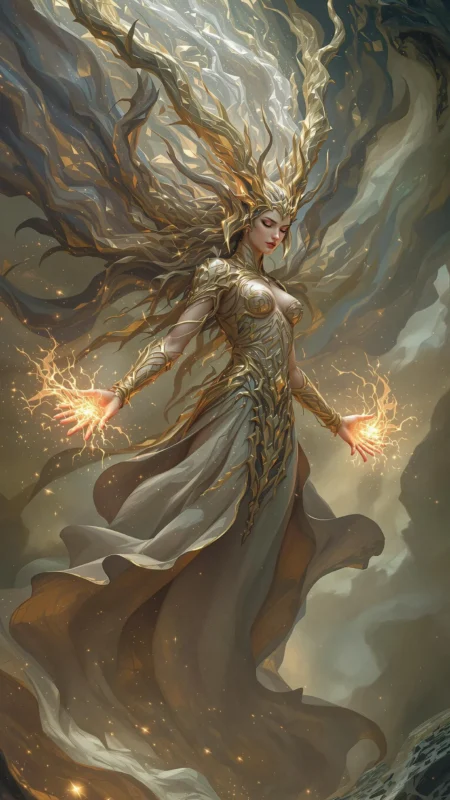
Idunn

Archetype Meaning & Symbolism

Nurturing, Generative, Guarded, Seasonal, Renewing, Youthful, Secretive, Vital, Provisioner, Enduring

  • Do not mistake the stillness of the branch for inaction. All of winter is spent preparing for a single spring.

If Idunn is part of your personal mythology, you may...

Believe

  • True strength lies not in the swing of the axe, but in the patience of the root system.
  • My well-being is a sacred resource, and protecting it is my primary responsibility, from which all other gifts flow.
  • Renewal is not a one-time fix, but a constant, cyclical rhythm that must be honored.

Fear

  • Being completely depleted, my inner orchard barren and unable to recover.
  • That my value to others is solely based on what I can provide, and that I will be abandoned if I can no longer give.
  • Losing my sanctuary, having my inner walls breached and my vitality stolen or corrupted.

Strength

  • An immense capacity for nurturing. You create environments where others can heal and grow.
  • A profound resilience. You understand the seasons of life and know how to store energy for the winter, trusting in the return of spring.
  • A quiet wisdom of discernment. You can intuitively sense what is nourishing and what is depleting, for yourself and for others.

Weakness

  • A tendency towards self-isolation. In protecting your garden, you may build the walls too high, cutting yourself off from needed connection.
  • A vulnerability to exploitation. Your generative nature can attract 'emotional vampires' who see you as a resource to be consumed.
  • A difficulty in asking for help. As the designated nurturer, you may feel it is your job to always be the strong one, unable to admit your own needs.

The Symbolism & Meaning of Idunn

In the modern psyche, Idunn may represent the keeper of our own vital essence, the part of us that cultivates what is life-giving and protects it from the world’s ceaseless demands. She is the quiet, internal gardener who knows precisely which metaphorical foods nourish our spirit and which are poison. To have Idunn in your personal mythology is to possess an internal compass pointing toward rejuvenation. It is the wisdom that recognizes burnout not as a personal failing but as a sign that the orchard has been plundered. Your life becomes less a quest for external treasures and more a process of tending your own secret, golden fruit: the unique talents, passions, and sources of joy that keep your soul from growing old.

Her symbolism is also deeply tied to the concept of cultivated versus wild energy. Unlike the untamed power of a storm god or the raw cunning of a trickster, Idunn’s power is in her stewardship. It is patient, cyclical, and intentional. This could manifest as a profound appreciation for routine, for the small, consistent actions that build lasting strength. She represents the truth that true power doesn’t always roar: sometimes it is the silent, daily act of watering a seed. In a culture that often prizes explosive growth and heroic, singular acts, Idunn champions the quiet, indispensable labor of maintenance.

Furthermore, Idunn speaks to the sacredness of what we keep in reserve. Her apples are not offered freely to all; they are a guarded treasure for the deserving community. This suggests a mythology of discerning generosity. Your energy, your care, your creative output—these are not infinite resources to be scattered to the wind. They are precious, and part of your life's work is to build a worthy container for them, a psychological walled garden. She teaches that saying no, that preserving one’s core, is not selfishness but a prerequisite for having anything of value to offer at all.


Idunn Relationships With Other Archetypes

The Trickster

The relationship between the Idunn and the Trickster is perhaps less one of simple opposition and more of a perilous, cosmic symbiosis. The Trickster may be seen as the cracked mirror held up to the Idunn's perfect garden, a necessary agent of chaos whose schemes reveal the very value of the vitality being guarded. Where the Idunn represents a kind of unthinking, generative innocence, the Trickster is the embodiment of restless, amoral intelligence that must test the boundaries of every sacred grove. It is the serpent whose whisper introduces the concept of loss, and in doing so, paradoxically defines the meaning of paradise. The Trickster’s theft of the Idunn's gift is not merely malicious; it could be the universe’s own mechanism for ensuring that eternal youth is not taken for granted, forcing a confrontation with fragility and a desperate, clarifying quest for its return.

The Ancient Oak

In the Ancient Oak, the Idunn finds not a supplicant but a silent contemporary, a fellow keeper of a different kind of eternity. The Oak does not crave the Idunn’s apples, for its immortality is written in rings of history, in the patient accumulation of seasons. Its strength is a testament to endurance, not to stasis. This archetype, then, could be a philosophical counterpoint: the Idunn offers a life suspended in a perfect, sunlit present, while the Oak embodies a life that has absorbed all of its pasts and wears them as gnarled, honorable bark. Theirs is a relationship of deep, unspoken respect, like two neighboring kingdoms with different customs of time. The Idunn’s garden might be a place of perpetual spring, but it may be the long, deep shadow of the Oak at twilight that gives the landscape its profound and anchoring truth.

The Waning Moon

The Waning Moon and the Idunn may share the most poignant of bonds, one of quiet, reciprocal longing across the chasm of existence. As the Moon relinquishes its light, it could be seen as the embodiment of graceful decline, of the beautiful, hollowing ache that precedes renewal. It does not rage against the dying of the light; it performs it as a slow, silvered ritual. From the Idunn's verdant world, the Waning Moon might appear as a necessary memento mori, a reminder that the apple’s sweetness is defined by the eventual hunger. In turn, the Idunn's perpetual glow could offer the Moon a vision of what it is receding from, not as a source of envy, but as a fixed point of beauty that gives its own diminishment a kind of noble purpose. They are, perhaps, two halves of a single cosmic breath—the full, vibrant inhale of the Idunn, and the long, meditative exhale of the Moon.

Using Idunn in Every Day Life

Navigating Creative Burnout

When the well of inspiration runs dry, the Idunn archetype suggests it is not a time for forcing the work but for tending the orchard. This might manifest as a deliberate withdrawal from the demands of production. You may retreat to your own walled garden: the studio filled only with old sketches, the bookshelf of foundational authors, the quiet walking path. Instead of seeking new stimuli, you are revisiting the roots of your creative life, nourishing them with rest and reflection, trusting that the golden apples of new ideas will grow only from a well-tended tree, not a whipped horse.

Caring for an Ailing Loved One

In the face of prolonged caregiving, the Idunn narrative offers a map for sustainability. It reframes the role from one of endless sacrifice to one of a guarded spring. You may learn to offer care not from your core reserves, but from the surplus you consciously cultivate. This could look like scheduling non-negotiable time for yourself, creating rituals of personal renewal, and understanding that your ability to nourish another is directly proportional to how well you protect your own source. You are the keeper of the apples: if you give them all away, the gods themselves will wither.

Confronting the Fear of Aging

The Idunn archetype confronts aging not as a loss of youth, but as a change in season. Her gift is not eternal youth in the physical sense, but enduring vitality. In your personal myth, this could mean shifting focus from the preservation of a youthful appearance to the cultivation of a vital spirit. It is the understanding that the gnarled bark of an old apple tree holds the same life force that produces the crisp, new fruit. Your value is not in the smooth skin of the apple but in the entire, enduring, life-giving ecosystem of the orchard you have become.

Idunn is Known For

The Golden Apples

Not mere fruit, but cosmic batteries. They are the sustenance that grants the Norse gods their vitality and seeming immortality, a tangible metaphor for that which renews and preserves life force.

The Abduction

Loki's trickery leads to her being kidnapped by the giant Þjazi. Without her and her apples, the gods begin to wither and age, revealing that their power is not inherent but contingent on her careful stewardship. Her absence is a crisis of cosmic proportions.

Keeper of the Orchard

She is defined by her role as a guardian. Her identity is inseparable from the sacred grove she tends, a symbol of cultivated, protected life. She is not a warrior or a queen, but the essential source of their endurance.

How Idunn Might Affect Your Personal Mythology

How Idunn Might Affect Your Mythos

When Idunn enters your personal mythos, the entire narrative structure may shift. The traditional hero’s journey, a linear path of conquest and return, could dissolve into a cyclical story of cultivation. Your life is no longer a mountain to be scaled but a garden to be tended through seasons of bloom, harvest, fallowness, and rebirth. The great antagonists in your story may not be external dragons or rival kings, but the subtle forces of depletion: the trickster Loki who persuades you to give your energy away, the giant who seeks to steal your joy for his own barren fortress, the creeping frost of burnout.

The climax of your story might not be a grand battle, but a moment of profound preservation. Perhaps it's the difficult choice to leave a depleting job, to set a boundary with a loved one, or to take a sabbatical to let your inner orchard recover. Victory is measured not in territory gained but in vitality preserved. Your personal epic becomes a quiet testament to the resilience of what is nurtured, a story where the greatest act of heroism is the patient, daily tending of your own sacred ground, ensuring that when the gods—the great demands and passions of your life—come seeking sustenance, your apples are there for the offering.

How Idunn Might Affect Your Sense of Self

Your view of self, under Idunn’s influence, may become rooted in your capacity as a source, rather than your achievements as a performer. Self-worth is uncoupled from external validation, from applause or public recognition, and is instead found in the quiet, generative power you cultivate within. You might see yourself as a wellspring, a hidden grove where life is renewed. This can foster a profound sense of inner security and self-sufficiency. You are not just the sum of your actions, but the living system that makes those actions possible.

This perspective could also color your perception of your own needs. The need for rest, for solitude, for beauty, for nourishing food and conversation—these are no longer indulgences but essential acts of orchard-keeping. You may see your personal well-being as a sacred responsibility, not just for your own sake, but for all who depend on the fruit you bear. This fosters a self-view that is both deeply self-protective and profoundly generous, recognizing that the two are not in opposition but are inextricably linked. You are the gardener, and a starving gardener cannot raise a healthy crop.

How Idunn Might Affect Your Beliefs About The World

An Idunn-inflected worldview perceives the world not as a battlefield of competing interests or a marketplace of transactions, but as a vast, interconnected ecosystem. You may see the patterns of growth and decay, of nurturing and depletion, playing out on a global scale. Institutions, communities, and even nations might appear as orchards, some flourishing under careful stewardship, others withering from neglect or plunder. This view fosters a deep appreciation for sustainability, for those who maintain and preserve, often in unseen roles.

The lens of this archetype filters out the noise of momentary crises to focus on the underlying health of the system. You might become more attuned to the long-term consequences of short-term gains, seeing how a society that consumes its 'apples' of natural resources, social trust, and citizen well-being without a plan for renewal is setting itself up for a long, cold winter. It is a worldview that values farmers over warriors, librarians over stockbrokers, and nurses over celebrities, recognizing that the true strength of any system lies with those who tend its roots.

How Idunn Might Affect Your Relationships

In relationships, you may unconsciously assume the role of the nurturer, the one who provides the metaphorical apples of emotional support, stability, and comfort. Your presence can be a rejuvenating force, and you might naturally attract those who feel depleted or world-weary. You could find immense meaning in creating a relational space that feels like a sheltered garden, a safe haven where loved ones can let down their guard and be renewed. This makes you a deeply valued friend, partner, or parent, the steady heart of your chosen circle.

However, this dynamic also carries risk. The myth of Idunn’s abduction is a cautionary tale. You may become so identified with your role as a provider that others see you as a resource rather than a person. There is a danger of being tricked by a 'Loki'—a person or situation that promises something valuable in exchange for your energy, only to leave you depleted and trapped. An Idunn-centered person must learn the difficult art of discernment: who is worthy of entering the garden? You must build strong walls and learn to recognize those who want to share in the harvest from those who want to steal the whole tree.

How Idunn Might Affect Your Role in Life

Your perceived role in life might shift from one of active agent to one of essential source. You may not feel called to be the leader who charges into the fray, but the quiet council that gives the leader the strength to do so. This is the role of the keeper: the keeper of traditions, of family well-being, of institutional memory, of creative integrity. It's a position of immense influence, but it operates behind the scenes, its power felt rather than seen. You may find your place not on the stage, but in the green room, ensuring the real magic can happen.

This role could also be one of a gatekeeper. As the guardian of a precious resource—whether it's your time, your creative energy, your emotional support, or a literal craft—you are tasked with protecting its integrity. This might place you in the role of the mentor who upholds standards, the artist who refuses to compromise their vision for commercial appeal, or the parent who fiercely protects their family’s private sphere. Your life's work may not be about building something new from scratch, but about preserving something timeless and essential from corruption or decay.

Dream Interpretation of Idunn

To dream of Idunn in a positive context is to receive a profound affirmation of your own inner vitality. You might dream of being offered a perfect, gleaming apple, symbolizing a moment of grace, healing, or a sudden influx of creative energy. Finding a hidden, walled garden in a dream could suggest that you have successfully carved out a space of sanctuary and renewal in your waking life, or that your subconscious is urging you to recognize and inhabit such a space. Seeing a withered tree you touch spring back to life may point to your own innate capacity to bring renewal to a dead or stagnant situation, affirming your role as a generative force.

In a negative context, a dream of Idunn can be a stark warning of depletion. You might dream that your apples are stolen, rotten, or that you cannot find them, reflecting a waking fear of burnout, creative block, or having your energy exploited by others. Dreaming of Idunn herself being locked away or carried off by a menacing eagle could symbolize a part of your own psyche—your capacity for joy, rest, and renewal—that has been captured by external pressures or a toxic relationship. A barren orchard under a gray sky is a classic dream symbol for depression or a life that has become devoid of sustenance, a powerful call to tend to your own neglected roots.

How Idunn Archetype Might Affect Your Needs

How Idunn Might Affect Your Physiological Needs

On the most fundamental level of your personal myth, Idunn’s presence demands a sacred attention to the body. The apples are not abstract symbols alone; they are food. This may translate into a deep, intuitive connection to nutrition, a sense that what you eat directly shapes your vitality, mood, and spirit. Your personal mythology may contain a core tenet: the body is not a machine to be optimized, but a garden to be nourished. This can lead to rituals around food, a preference for whole and natural ingredients, and a conscious rejection of that which feels lifeless or artificial.

The need for rest is also paramount. Just as an orchard requires seasons of dormancy to produce fruit, your mythos insists on the necessity of sleep and quietude. This isn't laziness; it is a vital part of the cycle of renewal. You might find yourself structuring your life to protect your sleep, valuing it as the time when the metaphorical apples ripen. Chronic exhaustion is seen not as a symptom of hard work, but as a sign that the very foundations of the temple are crumbling, a grave sacrilege against the self.

How Idunn Might Affect Your Ideas of Belonging

Belonging, for one with Idunn in their mythos, is cultivated, not found. You create circles of intimacy by being a source of nourishment. Love and friendship are acts of sharing the fruit from your private orchard. This means your connections are often deep, resilient, and centered on mutual care. You foster belonging by making others feel safe, seen, and revitalized in your presence. The feeling of being part of a 'we' comes from the shared experience of this sanctuary, this small, warm world you tend together.

However, this can lead to a conditional sense of belonging, where your place in the group feels contingent upon your ability to provide. You might fear that if your apples were to run out, so too would the love and affection of others. This creates a pressure to constantly produce emotional or spiritual sustenance. The challenge is to find belonging not just as the keeper of the garden, but as a simple tree within it, valued for your being, not just your bearing. True belonging arrives when you are allowed to have your own fallow seasons, when you can receive nourishment as freely as you give it.

How Idunn Might Affect Your Feelings of Safety

Safety, in an Idunn mythos, is defined by the integrity of your boundaries. The greatest threat is not overt violence, but covert theft: the draining of energy, the co-opting of creativity, the emotional plundering by others. Safety is a well-tended wall around your garden. This could manifest as a strong need for physical privacy, a carefully curated social circle, and a psychological fortress against manipulation and undue demands. You feel safest when your resources—emotional, temporal, and creative—are secure and under your own stewardship.

The story of Idunn’s abduction by Þjazi via Loki’s trickery is the core safety lesson. It teaches that the greatest danger often comes from a trusted source, from a weakness in your own discernment. Therefore, a key part of maintaining your safety involves a constant, quiet vigilance. It is the practice of questioning the motives of those who ask for your 'apples'. Safety is not a passive state but an active practice of protection and preservation, ensuring that your inner sanctuary remains inviolate and that you, its keeper, are not lured out into the dangerous, barren lands of the giants.

How Idunn Might Affect Your Views of Esteem

Esteem is not derived from victory or acclaim, but from the quiet pride of stewardship. Your self-worth is tethered to the health of your inner world. You feel a deep sense of value when your 'garden' is flourishing: when your creative life is rich, your relationships are nurturing, and your spirit feels vital. This is an esteem that is remarkably resilient to external opinion, as it is measured by an internal, qualitative standard. It is the profound satisfaction of the artisan, the gardener, the keeper of lore, who knows the intrinsic worth of what they protect.

This can also mean that your esteem takes a blow not from failure, but from compromise. Allowing your creative vision to be diluted, your boundaries to be crossed, or your energy to be squandered for a trivial cause can feel like a profound personal failing. It is a betrayal of your primary role as guardian of your own vitality. Esteem is therefore maintained through acts of integrity and protection. It is reinforced every time you say 'no' to a depleting demand, and every time you say 'yes' to the quiet, unseen work of tending your own soul.

Shadow of Idunn

The shadow of Idunn manifests in two primary extremes: the miser and the martyr. The shadow miser hoards their vitality, becoming a dragon guarding a treasure that is never used. They refuse to share their light, their care, their creativity, fearing depletion to the point of paralysis. Their garden is pristine but sterile, walled off from the world, and they wither from loneliness within their perfect fortress. They use the promise of their 'apples' to manipulate and control, offering just enough to keep others hooked but never enough to truly nourish, wielding their gift as a weapon of power.

Conversely, the shadow martyr gives away every last apple until the trees are bare and the roots are dry. They have no walls, no discernment, no sense of self-preservation. They believe their worth is directly proportional to their self-sacrifice, and they court burnout as a sign of their love and devotion. This leads not to divinity, but to resentment and collapse. They become a barren orchard, and those who have come to depend on them are ultimately left hungry. The shadow martyr blames the world for their exhaustion, never recognizing that they abandoned their first and most sacred post: that of their own guardian.

Pros & Cons of Idunn in Your Mythology

Pros

  • You are a source of profound stability and healing for those in your life, a veritable human sanctuary.
  • You cultivate a rich inner life that provides a deep sense of self-sufficiency and resilience against external chaos.
  • You build relationships of incredible depth and loyalty, founded on genuine, sustained care.

Cons

  • Your quiet contributions may be overlooked or taken for granted in a world that rewards noise and spectacle.
  • You can feel a heavy burden of responsibility for the well-being of others, making it difficult to tend to your own needs.
  • You are a natural target for manipulative or needy individuals who seek to exploit your generative nature.