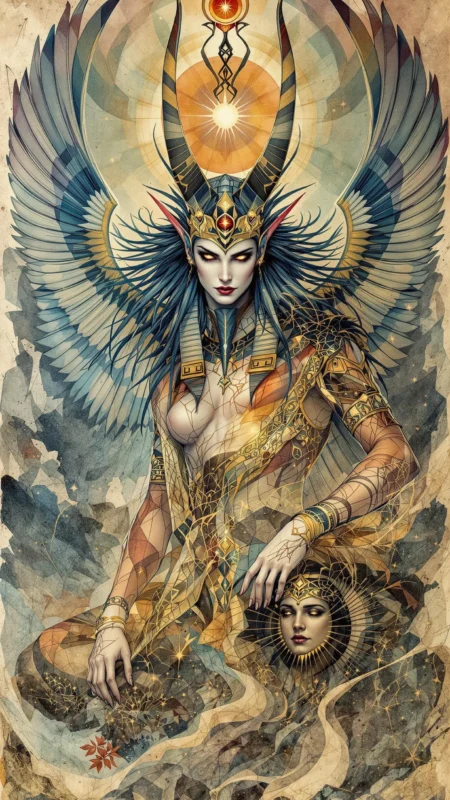
Horus

Archetype Meaning & Symbolism

righteous, focused, royal, solar, protective, clairvoyant, wounded, determined, vengeful, unified

  • The sky has no corners, and neither should your justice. See the whole truth, not just the convenient angle.

If Horus is part of your personal mythology, you may...

Believe

  • That justice is not a mere social construct, but a tangible cosmic law, and it is my personal duty to see it enacted.
  • That my life's struggles are a microcosm of the universal, eternal battle between a meaningful order and a destructive chaos.
  • That true, complete vision requires a synthesis of two ways of seeing: the bright, rational light of the sun and the deep, intuitive knowing of the moon.

Fear

  • Betrayal from my inner circle, a treachery that mirrors the crime of Set against Osiris.
  • Failing my destiny, squandering my birthright, and leaving the kingdom in the hands of chaos.
  • That my righteous quest will become corrupted by its own fire, turning into a blind and merciless vengeance.

Strength

  • An unwavering, almost sacred sense of purpose that provides clarity and direction even in the darkest of times.
  • A profound resilience and strategic patience, allowing you to engage in long-term struggles for a goal you believe in.
  • A powerful commitment to personal and universal integrity, giving you the courage to defend your principles against all opposition.

Weakness

  • A tendency toward self-righteousness, which can manifest as a rigid, black-and-white view of morality and a judgment of others.
  • A difficulty with forgiveness, causing you to hold onto grievances as if they were sacred duties, long after they have served any purpose.
  • A potential for emotional distance and isolation, born from the belief that the weight of your vision and responsibility cannot truly be shared.

The Symbolism & Meaning of Horus

To find Horus in your personal mythology is to be handed a crown and a sword. It is an archetypal summons to a life of purpose, one centered on the restoration of a lost or broken order. You are no longer merely a person living a life; you are the heir to a kingdom in disarray. This kingdom might be your own psyche, your family lineage, or a community you feel sworn to protect. Horus symbolizes the relentless, focused pursuit of justice, not as an abstract ideal, but as a cosmic necessity. He is the active principle of Ma'at, divine order, whose very existence is a response to the treachery of Set, the embodiment of chaos. His is not the story of a placid ruler born to power, but one of a warrior prince who must fight, bleed, and sacrifice to claim his birthright.

The duality of his vision, represented by his two eyes being the sun and the moon, speaks to a specific kind of wisdom. The solar eye is the bright, masculine, analytical clarity that sees facts and structures. The lunar eye is the intuitive, feminine, reflective sight that perceives undercurrents, motives, and hidden truths. The famous loss and restoration of his eye, the Wadjet, suggests a profound journey. To walk with Horus may mean experiencing a blinding wound, a loss of faith or perspective, only to emerge with a new, more integrated way of seeing. This healed eye, this Wadjet, is a symbol that your greatest vulnerability, once addressed, may become your most powerful tool of perception.

Ultimately, Horus is the archetype of righteous leadership and filial duty. He acts not for himself, but for his father, for the kingdom, for the cosmic balance. This lends a sacred weight to one's ambitions. The drive for success or power is transmuted from a personal desire into a divine imperative. In a modern context, this could manifest as a powerful drive to fix systemic problems, to heal generational wounds, or simply to live a life of unimpeachable integrity. It is the impulse to look at the chaos of the world, or the chaos in one's own soul, and decide that you are the one destined to set it right.


Horus Relationships With Other Archetypes

The Shadow Uncle

The relationship with the Shadow Uncle, the usurper Set, is not merely one of opposition, but perhaps of a dissonant, necessary harmony. Set may be seen as the abrasive whetstone against which Horus’s own blade of purpose is sharpened. He is the chaotic wind that gives the falcon’s flight its meaning, the jagged shadow that proves the sun is shining. In the usurper’s violence, the rightful heir finds his own definition; one could argue that without the void of Set’s injustice, the shape of Horus’s destiny, his very reason for being, might never have been carved into the firmament.

The Sacred Wound

The Sacred Wound is perhaps the most intimate of Horus’s companions, a dark lens through which all subsequent light is refracted. The loss of the eye is not an absence but a presence—a phantom limb of perception that aches with the memory of violence. Its restoration may not be a simple healing but a transformation; the world, once seen with the naive clarity of youth, is now forever viewed through the kintsugi of experience. This scar could be the very source of royal empathy, a permanent reminder that to rule the light, one must first have known, and integrated, a profound and personal darkness.

The Throne

With The Throne, Horus has a relationship that is less a kinship and more a geological inevitability, like a river finding its sea. The seat of power is not an achievement so much as a destination, a great, cold stone of duty that has been waiting for him since the beginning of time. To claim it is to surrender the self, to exchange the warm-blooded falcon for the unblinking glyph. The throne could be seen as a kind of tomb for the individual, where the hero’s personal story ends and the impersonal, cyclical narrative of the kingdom begins. It is the final gravity that pulls the sky-god down to earth, binding him to the land he fought to reclaim.

Using Horus in Every Day Life

Navigating Foundational Injustice

When a profound wrong has been committed against you or your lineage, the Horus archetype offers a map not for petty revenge, but for righteous reclamation. It is the long, strategic campaign to restore what was stolen, be it self-worth, family honor, or a sense of order. This is the energy you call upon to pursue a difficult lawsuit, to heal generational trauma, or to systematically rebuild a life shattered by betrayal. It is a slow, focused fire, not an explosive rage.

Unifying Internal Opposites

Like Horus who united the two lands of Egypt, this archetype may guide the integration of your own warring factions: your logic and your intuition, your ambition and your ethics, your light and your shadow. To embody Horus is to become a sovereign nation of one. This may play out in making a career decision that satisfies both your creative spirit and your need for stability, or in learning to trust your gut feelings without discarding rational evidence. It is the creation of a powerful, functional whole from disparate parts.

Healing the Archetypal Wound

Horus’s lost eye, the Wadjet, is a potent symbol for a core wound that, once healed, becomes a source of unique perception. If you contend with a deep-seated vulnerability, a psychic blind spot, or a past trauma that defines you, the Horus mythos provides a path toward not just recovery, but transformation. The process of healing this wound, of finding or building your own 'Eye of Horus,' could become the central quest of your life, ultimately granting you a wisdom and clarity unavailable to the unwounded.

Horus is Known For

The Eye of Horus (Wadjet)

A universally recognized symbol of protection, healing, restoration, and esoteric perception. The healed eye represents the triumph of order over chaos and the ability to see beyond the physical realm.

Avenging His Father, Osiris:

The central myth of Horus involves his multi-generational struggle against his uncle, Set, to reclaim the throne of Egypt. This epic conflict is a story of divine right, perseverance, and the ultimate victory of justice over treachery.

Unification of Egypt:

As the rightful heir who defeated chaos, Horus’s rule symbolized the unification of Upper and Lower Egypt. He became the archetypal divine king, the living embodiment of Ma'at (cosmic order), and the model for all subsequent pharaohs.

How Horus Might Affect Your Personal Mythology

How Horus Might Affect Your Mythos

When Horus becomes a central figure in your personal mythos, your life story may cease to be a meandering narrative and instead sharpens into an epic of reclamation. The theme of the 'usurped throne' could become the central axis around which your experiences revolve. A difficult childhood, a career setback, a profound betrayal: these are no longer unfortunate events but chapters in the great war against your personal 'Set,' the force of chaos that disrupted your rightful state of being. Your mythos becomes a quest narrative, where the goal is to restore the kingdom, to heal your lineage, and to finally wear the crown of your own integrated, authentic self.

Your personal mythology might also become populated with a court of archetypal figures. You may start to identify an 'Isis' in your life, a source of fierce, unwavering support and wisdom. You might seek a 'Thoth,' a wise counselor who provides the strategic knowledge you need for your battles. The antagonist in your story becomes more than a mere obstacle; it is a necessary cosmic force, the Set whose chaos gives your life purpose and direction. Your story is no longer just your own; it is a reflection of a timeless, divine drama, and every small victory feels like a triumph for cosmic order itself.

How Horus Might Affect Your Sense of Self

Your self-concept could become anchored to a profound sense of destiny and responsibility. You may not see yourself as an ordinary individual but as an heir, a protector, a restorer of what is good and just. This can instill a powerful, almost unshakable sense of direction, a belief that your life is not random but has a clear and noble purpose. The mundane struggles of daily existence are elevated; getting that promotion isn't just about money, it's about gaining a platform to enact positive change. Mending a family rift isn't just a personal matter, it's about restoring the integrity of your kingdom.

Simultaneously, you might carry the 'wound of Horus' as a core part of your identity. The myth of his lost eye could manifest as a persistent feeling of vulnerability, a psychic blind spot you are always aware of. This perceived flaw might be a source of deep insecurity, but it could also be the very thing that drives your quest for wholeness. It forces you to develop alternative ways of seeing, to rely on intuition, and to cultivate a deeper empathy for the brokenness in the world. Your wound, in this sense, is not a weakness but the portal through which your greatest wisdom enters.

How Horus Might Affect Your Beliefs About The World

Your worldview may shift from one of random chaos to one of cosmic struggle. You might perceive the world as an eternal battlefield between the forces of Ma'at (order, justice, truth) and Isfet (chaos, injustice, deceit). News headlines, social trends, and even interpersonal conflicts may be interpreted through this mythic lens. This doesn't necessarily mean a literal belief in gods and monsters, but a powerful metaphorical framework that gives meaning to events. Your role in this world becomes clear: you are an agent of order, a soldier for the light, and your actions, no matter how small, have cosmic significance.

This perspective could also foster an incredible sense of patience and long-term vision. Horus did not defeat Set in a single day; their conflict spanned decades. You may therefore view progress, both personal and societal, as a slow, strategic campaign rather than a series of quick fixes. You might develop a hawk's-eye view of time, understanding that true, lasting change requires sustained effort, resilience, and an unwavering focus on the ultimate goal. Setbacks are not failures; they are merely battles in a much longer war.

How Horus Might Affect Your Relationships

In the realm of relationships, you might operate from a code of fierce loyalty and strategic alliance. Friendships and partnerships are not casual affairs; they are sacred pacts. You may find yourself drawn to people who embody other archetypal energies that support your mission: the wise counselor, the nurturing protector, the loyal soldier. Betrayal is therefore felt not as a simple personal slight, but as a deep, cosmic violation, a crack in the foundation of your kingdom. Conversely, loyalty from others is cherished as one of the highest virtues, a bulwark against the forces of chaos.

Romantic partnerships could be viewed as the selection of a co-ruler. The search is not for a passive consort but for an equal partner in the vast project of creating and maintaining a shared kingdom of a life. The bond may be less about fleeting romance and more about a shared vision, mutual respect for each other's strengths, and a commitment to helping one another see more clearly. You and your partner might form a divine dyad, your combined strengths creating a zone of order and stability in a turbulent world. The health of the relationship could be measured by its ability to uphold your shared principles.

How Horus Might Affect Your Role in Life

You may perceive your role in life as that of a guardian or a rightful ruler, whether you hold a formal title or not. This is often a moral or spiritual leadership. You could be the one in your family who upholds tradition and honor, the person in your workplace who insists on ethical standards, or the silent advocate for a cause you deem sacred. Your fundamental role is to be the watchful eye, the sky-god who sees the larger picture and acts to maintain balance. You are the one who takes responsibility when others abdicate it.

This mantle of leadership can also be a source of profound isolation. The pharaoh is divine, set apart from his subjects. You might feel a keen loneliness, a sense that the weight of your vision and your principles is not fully understood or shared by those around you. The burden of the crown is that you must often stand alone in your convictions. You are the final arbiter in your own kingdom, and this ultimate responsibility, while empowering, can also be a heavy and solitary weight to bear.

Dream Interpretation of Horus

In a positive context, dreaming of Horus, a soaring falcon, or seeing the Wadjet eye clearly can be a powerful omen of impending clarity and empowerment. Such a dream may signify that you are about to gain a crucial insight into a long-standing problem, seeing it from a higher, more objective perspective. It suggests that a period of confusion, doubt, or injustice is coming to an end. The dream may serve as a validation from your subconscious, an affirmation that you are on the correct path to reclaim your personal sovereignty and enact your will upon the world with justice and vision.

In a negative context, dreaming of a wounded or dead falcon, a clouded or weeping eye, or being pursued by a menacing hawk-like figure can serve as a potent warning. It might suggest that your noble quest for justice has soured into a self-righteous crusade or a blind, destructive thirst for vengeance. It could point to a misuse of power or a willful refusal to see a difficult truth about yourself or your situation. This dream may be a message that your inner 'Set'—your own capacity for chaos, envy, or cruelty—is gaining the upper hand, and you risk losing your moral authority and shattering the very order you seek to protect.

How Horus Archetype Might Affect Your Needs

How Horus Might Affect Your Physiological Needs

The Horus archetype may connect your basic physiological needs to a sense of mission and readiness. Food is not just for sustenance; it is fuel for the long war, and you might find yourself prioritizing clean, powerful sources of energy. Your body could be viewed as a divine instrument, a weapon that must be kept sharp and battle-ready. Sleep becomes a strategic retreat, a necessary period of restoration to gather strength for the next day's campaign against chaos. There is a purposefulness to your physical maintenance; health is a prerequisite for victory.

You may also develop a hyper-awareness of sight and physical vantage points. Your well-being might feel intrinsically linked to the health of your eyes, and you could be drawn to high places, literally seeking a 'hawk's-eye view' of your surroundings. Practices that cultivate inner vision, such as meditation or visualization, might feel as essential as food or water. Your physical body is the vessel for your perception, and its vitality is paramount to your ability to see clearly and rule your kingdom effectively.

How Horus Might Affect Your Ideas of Belonging

Your need for belongingness may be fulfilled not by large, casual social circles, but by a small, fiercely loyal court. You do not seek mere friends; you seek allies, comrades-in-arms who understand the weight of your mission and share your commitment to a higher order. Love and intimacy are forms of sacred treaties, pacts of mutual defense and support against a chaotic world. You belong with those who are willing to fight alongside you for a shared vision of what is right and true.

Ultimately, the deepest sense of belonging might come from your connection to something larger than yourself: a lineage, a tradition, a cause. Like Horus, the son of Osiris, your identity is secured by your place within a grander narrative. Whether it is your family's history, a cultural heritage, or a philosophical lineage, you find your place by understanding the role you were born to play in this ongoing story. You belong to the past that created you and the future you are sworn to protect.

How Horus Might Affect Your Feelings of Safety

For one with Horus in their mythos, safety is not a passive state of being but an actively defended territory. You may build your life like a fortress, with strong boundaries, secure resources, and strategic alliances serving as the outer walls. Safety is found in vigilance. It is the practice of seeing potential threats before they materialize, of anticipating the moves of chaos and neutralizing them with foresight and preparation. It is the security of the ever-watchful falcon, circling its domain, aware of every shadow that moves below.

The source of danger is often personified; it is the 'Set' figure, the agent of betrayal and disruption. Therefore, security is not just about physical protection but about moral and psychological order. You may feel safest when your life is in alignment with your core principles, when your kingdom is justly ordered, and when you can trust the loyalty of your inner circle. A breach of trust or an act of injustice can feel like a direct assault on your fundamental safety, a crack in the cosmic dam holding back the waters of chaos.

How Horus Might Affect Your Views of Esteem

Esteem, in the Horian framework, is not freely given; it is forged in the crucible of righteous action. Your self-worth could be directly tied to your integrity, your courage, and your effectiveness in upholding order. You may respect yourself most profoundly after you have stood firm on a principle, overcome a daunting challenge through sheer willpower, or successfully defended someone or something you hold sacred. Self-esteem is the feeling of the crown settling justly upon your head; it is heavy, but it is earned.

This can also create a fragile foundation for esteem, one contingent upon perpetual victory. The 'wound' of Horus is a constant reminder of vulnerability. A failure, a moral compromise, or the inability to vanquish your 'Set' can feel like a catastrophic blow to your very identity as a righteous ruler. Stable, lasting esteem might only be achieved when you learn to honor the struggle itself, not just the win. It is in integrating the wound, accepting imperfection, and respecting your own resilience that you may find a self-worth that cannot be usurped.

Shadow of Horus

The shadow of Horus emerges when righteous fury curdles into tyrannical zeal. Here, the world is flattened into a stark and simple battlefield: you are with him, or you are with the enemy. Nuance is the first casualty, followed swiftly by compassion and mercy. The shadow Horus projects his inner 'Set' onto anyone who dissents, transforming disagreements into betrayals and opponents into manifestations of pure evil. His quest for order becomes an oppressive regime, his justice a merciless code. He is a king blinded by the glare of his own sun, unable to perceive the subtle, complex shades of reality, and the kingdom he builds is a brittle prison of his own making.

On the other side of this shadow is not the tyrant, but the abdicated king. This is the Horus who is paralyzed by the enormity of his father's murder, forever fixated on the wound but never taking action. He remains the perpetual prince, lamenting the fallen kingdom but refusing to claim the throne. His noble cause becomes a shield for his passivity, his grievance a source of identity. He talks endlessly of justice but never lifts the sword. This shadow Horus allows his potential for greatness to sour into a quiet, simmering resentment, becoming a victim of the story rather than its hero.

Pros & Cons of Horus in Your Mythology

Pros

  • You are gifted with a powerful internal compass that provides unerring direction and a profound sense of purpose.
  • You possess a deep well of resilience and determination, capable of enduring long, arduous struggles for a worthy cause.
  • Your unwavering integrity and clear vision may inspire immense loyalty and respect in others, allowing you to lead effectively.

Cons

  • There is a significant risk of becoming rigid, self-righteous, and unforgiving, alienating those who do not share your zealous conviction.
  • The constant, heavy burden of responsibility can lead to burnout, chronic stress, and a lonely inability to simply relax and be.
  • You may develop a tendency to perceive threats, betrayals, and injustices where none exist, creating unnecessary conflict and anxiety.