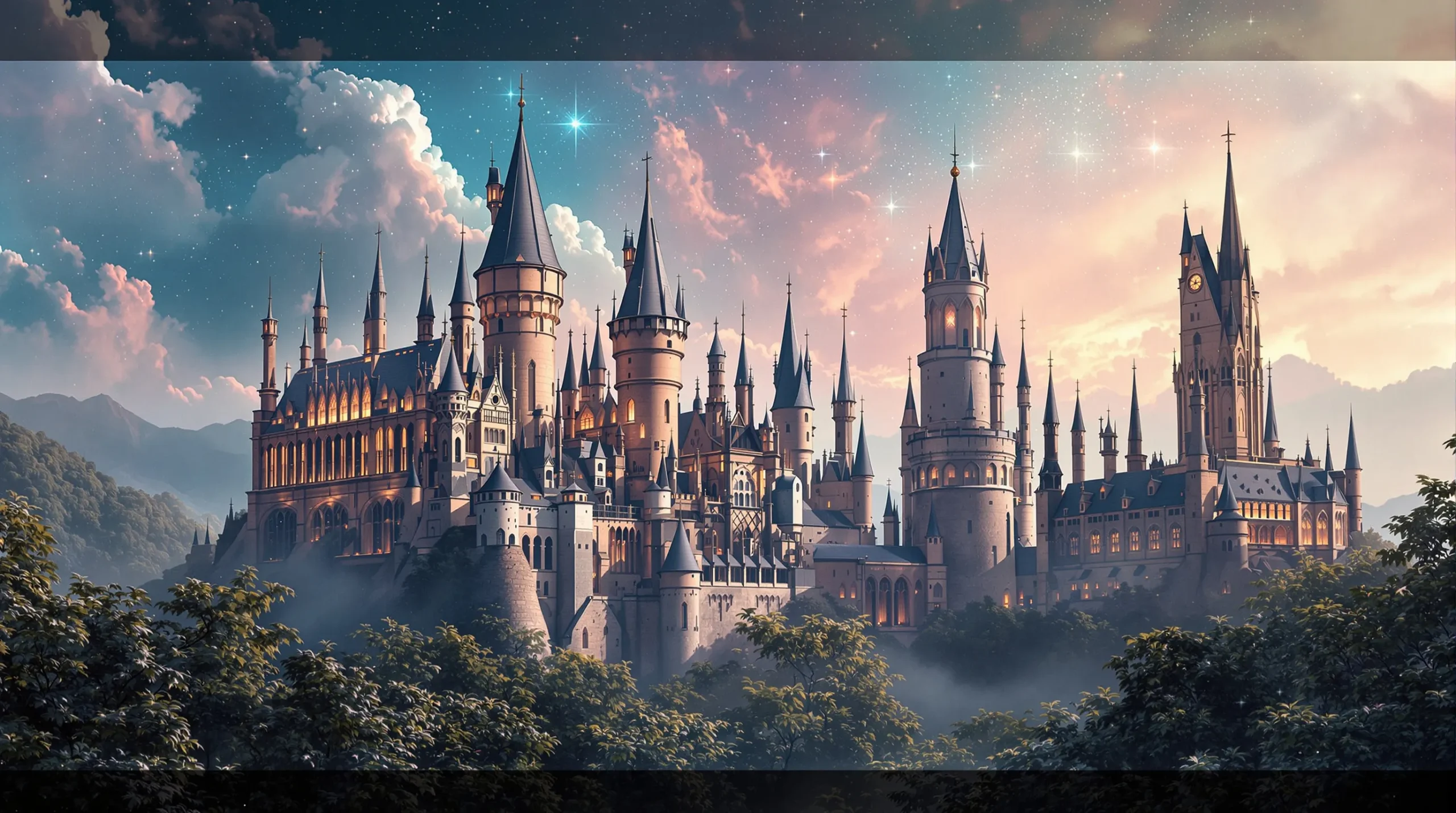


Hogwarts

Archetype Meaning & Symbolism

Magical, Scholastic, Mysterious, Communal, Dangerous, Secretive, Ancient, Transformative, Ordered, Labyrinthine

  • I am not a place you find on a map, but a potential you awaken within. My corridors are your questions, my ghosts are your pasts, and my magic is the courage to finally learn who you are.

If Hogwarts is part of your personal mythology, you may...

Believe

  • You may believe that there is a hidden, magical order to the world, and that its rules can be learned through study, intuition, and courage.

    You may believe that your true family is not necessarily the one you were born into, but the one you choose based on shared values and harrowing experiences.

    You may believe that knowledge is a form of tangible power, and life's greatest challenges are ultimately educational opportunities in disguise.

Fear

  • You may fear expulsion above all else: being cast out of the community that gives you your identity and purpose.

    You may fear being ordinary, a 'Muggle' in a world of magic you can sense but cannot personally access or wield.

    You may fear that there are 'dark arts'—aspects of knowledge or parts of yourself—that are too corrupting or powerful to be safely explored.

Strength

  • You likely possess a lifelong love of learning and a deep-seated belief in the power of education and knowledge to solve the world's most difficult problems.

    You may have a profound and unwavering sense of loyalty to your chosen friends, seeing them as comrades-in-arms in a grand, unfolding adventure.

    You have the ability to find magic, wonder, and hidden meaning in the mundane details of everyday life, sustaining a sense of enchantment.

Weakness

  • You may have a tendency toward tribalism, viewing people through the simplistic and sometimes prejudiced lens of their 'House' or group affiliation.

    You might exhibit an over-reliance on institutional structures for your sense of safety and identity, feeling lost without a clear hierarchy or rulebook.

    You could be prone to a form of intellectual or spiritual snobbery, a belief that only a select, 'magical' few can access true understanding.

The Symbolism & Meaning of Hogwarts

Hogwarts, as an archetype in personal mythology, is the soul's own magical boarding school: a psychic landscape where the unformed self is sent to be forged. It is the promise of a place that will not only accept your strangeness but will see it as a source of power. Its very walls represent the structure of the psyche, with its sunlit towers of conscious thought, its bustling common rooms of social identity, and its deep, forgotten dungeons of the subconscious. The curriculum is life itself, where every challenge is a lesson in a specific kind of magic: Transfiguration for adaptability, Charms for social grace, and Defense Against the Dark Arts for psychological resilience.

The castle is a container for the chaotic energy of adolescence, both literal and metaphorical, a place where immense power can be explored within a framework of rules, tradition, and consequence. It suggests that true growth requires both freedom and limitation. The ghosts that wander its halls are the living memories of our personal and collective pasts, not specters to be exorcised but presences to be understood. To have Hogwarts in your mythos is to believe that your life is a magical education, that you are enrolled in a grand, mysterious course of study, and that somewhere within you is a Headmaster who knows the curriculum, even when you feel utterly lost in the corridors.

Ultimately, the Hogwarts archetype symbolizes the transformative power of knowledge when it is combined with community. It argues that we do not become ourselves in isolation. We are shaped, challenged, and ultimately defined by our houses, our friends, our rivals, and our teachers. It is a place where potential is paramount, a fortification against the mundane world's insistence that magic is not real. It stands for the belief that within every individual is a latent, extraordinary capability waiting for the right letter, the right key, the right incantation to be brought into the light.


Hogwarts Relationships With Other Archetypes

The Mentor

Hogwarts is the grand, silent stage; The Mentor is the one who hands you the script. The castle provides the labyrinth, but an archetypal Dumbledore or McGonagall is the one who offers the cryptic map. While the school itself is a passive teacher, offering lessons through its very structure and history, The Mentor is the active principle of wisdom. Hogwarts may contain the Restricted Section, but it is The Mentor who grants permission, who recognizes a student’s readiness for more dangerous knowledge, and who provides the moral compass needed to wield it. The castle is the body of knowledge; The Mentor is its living, speaking soul.

The Labyrinth

Hogwarts is a purposeful labyrinth, a maze with a soul. Unlike the classical labyrinth designed to contain a monster, the Hogwarts labyrinth is designed to create a hero. Its shifting staircases and hidden chambers are not meant to imprison but to test, to force the seeker to abandon linear thinking and rely on intuition, courage, and the help of allies. While The Labyrinth archetype is often about a single, terrifying journey to a monstrous center, Hogwarts is a place one lives within, suggesting our entire life is a process of navigating complexity, not just a single ordeal to be overcome. It is a labyrinth that wants you to solve it.

The Orphan

For The Orphan, Hogwarts is the ultimate corrective fantasy: it is the ancestral home that was never had, the family crest that was never known. It takes the archetypal figure defined by a lack of belonging and provides the most profound sense of it imaginable. The castle offers The Orphan not just a roof, but a destiny, a history, and a vital role in a magical lineage. It is the place where the parentless child discovers they are heir to a great power, transforming their narrative from one of loss to one of immense, albeit dangerous, significance. Hogwarts is the institution as parent, providing the structure, protection, and identity the world has denied.

Using Hogwarts in Every Day Life

Navigating a New Field of Study

When embarking on a complex new career or academic discipline, you might frame it as your arrival at Hogwarts. The intimidating library becomes a source of ancient power, difficult colleagues are members of a rival house with their own codes and virtues, and the esoteric knowledge you must acquire is a form of spellcasting. This reframes overwhelming data into a magical curriculum, where mastery feels less like a chore and more like unlocking a secret level of reality.

Finding Your Community

In moments of social displacement, perhaps after moving to a new city, the archetype provides a map. You might engage in a personal 'Sorting Ceremony,' asking: am I motivated by courage, ambition, loyalty, or intellect? This isn't about boxing yourself in, but about identifying your core frequency to find others who resonate with it. The search for friends becomes a search for your 'House,' a quest for a common room where you can finally put your feet up and be understood.

Confronting Inner Turmoil

The parts of ourselves we fear to examine—past traumas, hidden shames, deep-seated insecurities—can be envisioned as the Forbidden Forest or a Chamber of Secrets. To enter them is a terrifying prospect, yet the Hogwarts mythos insists this is where the most powerful growth occurs. Framing therapy or deep self-reflection as a journey into these forbidden zones, perhaps with a trusted 'Dumbledore' as a guide, transforms a painful task into a heroic descent necessary to save the kingdom of the self.

Hogwarts is Known For

The Sorting Ceremony

A ritual of profound self-revelation and belonging. It represents the moment an individual's innate character is recognized and given a place within a larger community, affirming that one's core virtues are the key to finding a tribe.

The Shifting Architecture:

The castle's moving staircases and vanishing rooms symbolize that the path to knowledge is never static or straightforward. It suggests that truth and understanding are fluid, requiring adaptability, intuition, and a willingness to get lost.

The Hidden Passages:

Secret tunnels and concealed doorways represent the existence of unconventional routes to power and wisdom. They are a promise that the established, official way is not the only way, and that those who are clever, curious, or desperate enough can find shortcuts.

How Hogwarts Might Affect Your Personal Mythology

How Hogwarts Might Affect Your Mythos

When Hogwarts integrates into a personal mythos, one’s life story ceases to be a sequence of random events and becomes a curriculum. Each failure is not a setback but a failed exam, offering a chance to study and try again. A difficult job becomes a challenging 'Defense Against the Dark Arts' class, a new relationship is a lesson in 'Charms,' and a financial struggle is a complex 'Potions' assignment. This perspective imbues the narrative with purpose and a sense of progression. You are not just living: you are learning, matriculating, and moving toward graduation, even if the nature of that final ceremony remains a mystery.

Furthermore, this archetype introduces the concept of a hidden, magical world operating just beneath the surface of the mundane. Your personal story may now be structured around a 'call to adventure,' the moment you received your 'letter' and realized you were different, destined for more than a conventional life. This alters the entire trajectory of your mythos from a story about fitting in to a story about discovering and mastering a unique, inner magic. Allies become fellow students in your House, and adversaries become agents of a dark lord, raising the personal stakes of your journey to an epic, magical scale.

How Hogwarts Might Affect Your Sense of Self

Incorporating the Hogwarts archetype may foster a view of the self as a perennial student, a being in a constant state of becoming. It suggests that the core of your identity is not fixed but is a magical potential to be unlocked. This can be profoundly liberating, replacing the pressure to 'have it all figured out' with the gentle curiosity of being a 'first-year' in some new aspect of life. You may see your personality not as a static set of traits but as a collection of spells you are learning to master, some coming easily, others requiring immense practice and discipline.

This archetype could also create a partitioned self: the mundane, 'Muggle' self who navigates daily responsibilities, and the secret, magical self who understands a deeper reality. This internal duality can be a source of strength and resilience, a secret garden of identity to retreat to when the outside world feels oppressive. The self is no longer just one person but a student, a seeker, a member of a magical house, holding a private knowledge that colors every experience with a tint of enchantment and meaning.

How Hogwarts Might Affect Your Beliefs About The World

To see the world through the lens of Hogwarts is to live in a state of perpetual enchantment. The world is no longer just a collection of material facts but a place of secrets, symbols, and hidden powers. A strange coincidence is not random; it is a portkey. A sudden flash of insight is a moment of spellcasting. An old bookstore is not just a store; it is a potential portal to a magical alley. This worldview encourages a profound curiosity, a desire to look beyond the surface of things for the magic humming just beneath.

This perspective may also engender a belief in a fundamental battle between good and evil, creation and destruction. The world becomes a grand chessboard where forces of light and darkness are locked in a struggle for influence. This can lend a sense of epic importance to personal choices and moral stances. However, it might also simplify complex geopolitical or social issues into a narrative of 'wizards versus dark lords,' potentially obscuring the nuanced, non-magical realities at play.

How Hogwarts Might Affect Your Relationships

Relationships, through this archetypal lens, are often 'sorted.' There is a powerful impulse to categorize people based on their core values, creating an inner 'House' system. Friends are not merely companions; they are your Dumbledore's Army, your fellow Gryffindors, your loyal Hufflepuffs. This can forge bonds of incredible strength and loyalty, creating a chosen family that feels destined, magical, and forged in the fires of shared trials. A friendship is an unbreakable vow.

Conversely, this sorting impulse can create division and judgment. Those who don't fit into your house system may be unconsciously labeled as 'Slytherins' or, worse, 'Muggles'—people who simply don't get it. Romantic partnerships may be sought on the basis of a shared magical worldview, creating a powerful but potentially insular bond. The archetype insists that the most important relationships are those that help you in your magical education, your allies in the great struggle, which could lead one to neglect or devalue relationships that are simply quiet, mundane, and uncomplicated.

How Hogwarts Might Affect Your Role in Life

Your perceived role in life might shift from a profession to a calling, from a job to a magical vocation. You may not see yourself as a 'project manager' but as the 'Head of House,' responsible for the well-being and success of your team. You might not be a 'researcher' but a 'Seeker of Lost Knowledge,' delving into archives as if they were the Restricted Section. This re-framing infuses work and life roles with a sense of higher purpose and narrative weight, turning a career path into a heroic journey.

The Hogwarts archetype could also define your role in terms of a specialty. Are you a 'Healer,' mending emotional wounds? A 'Potions Master,' skillfully mixing elements of your life to create new outcomes? Or an 'Auror,' fighting against the dark arts of injustice and corruption in the world? This moves your role beyond a mere function and into the realm of a magical identity, suggesting your purpose is not just what you do, but the kind of magic you are uniquely suited to perform for the good of the castle.

Dream Interpretation of Hogwarts

In a positive context, dreaming of Hogwarts may signify a readiness for a new chapter of learning and personal growth. Finding your way easily through the castle, attending a fascinating class, or winning points for your house could reflect a burgeoning sense of competence, belonging, and excitement about your current life path. The dream may be an affirmation from your subconscious that you are in the right place, learning the right lessons, and are well-equipped for the challenges ahead. It can be a powerful symbol of finding your tribe and unlocking your own potential.

In a negative light, a Hogwarts dream can manifest as anxiety and inadequacy. Being lost in the ever-shifting corridors, unable to find your next class, or being publicly shamed by a professor like Snape could symbolize feeling overwhelmed, unprepared, or judged in your waking life. It might point to a fear of not living up to expectations, either your own or others'. Dreaming of a monster loose in the castle could represent an unacknowledged 'shadow' aspect of yourself that threatens the safety and order of your inner world.

How Hogwarts Archetype Might Affect Your Needs

How Hogwarts Might Affect Your Physiological Needs

From the standpoint of mythology, the Hogwarts archetype addresses physiological needs through the magic of reliability. The Great Hall, with its ever-present feasts appearing out of thin air, symbolizes a release from anxiety about basic sustenance. It suggests a world where food is a given, a communal right, allowing the psyche's energy to be diverted from mere survival to higher pursuits like learning and relationship-building. In one's mythos, this might translate to a deep trust that the universe, or one's community, will provide, allowing for a relaxed physiological state conducive to creative and intellectual risk-taking.

Similarly, the assigned dormitory bed within the castle walls speaks to the need for consistent shelter and rest. It is a predictable anchor in a world of chaos and magic. This element of the archetype reinforces the idea that true growth requires a secure physical base. A person living this mythos may prioritize creating a stable, almost ritualized, home environment as the essential foundation from which they can venture out to confront the metaphorical dragons and dark wizards of the world. Without this safe place to rest, the body cannot support the mind's magical work.

How Hogwarts Might Affect Your Ideas of Belonging

The archetype’s effect on the need for belonging is perhaps its most potent magic. The Sorting Ceremony is a fantasy of perfect, instantaneous placement. It is the promise that there is a tribe for you, and that your core identity is the very key to finding it. For someone with the Hogwarts mythos, the search for love and friendship is a search for one's 'House.' This transforms the often-messy process of socialization into a noble quest. Belonging is not just about being liked; it is about being seen for your foundational virtues and finding others who share that same essential magic.

This creates a powerful framework for chosen family. The bonds forged with one's 'housemates'—those who have weathered the same classes, fought the same battles, and shared the same common room—are positioned as more profound than many blood ties. Love, in this context, is a form of protective magic, a powerful spell woven from shared loyalty and experience. The ultimate sense of belonging comes from knowing you are an essential part of a collective, that your unique skills contribute to winning the 'House Cup' of life.

How Hogwarts Might Affect Your Feelings of Safety

Hogwarts offers a profound paradox of safety: it is both a fortress and a crucible. As a fortress, it represents the deep human need for a sanctuary, a place with thick walls to keep the malevolent 'outside' world at bay. Integrating this into personal mythology may lead one to seek or create institutional havens—a stable company, a university, a tight-knit organization—believing that these structures offer protection. There is a faith in the power of tradition, rules, and ancient stones to provide security against the formless chaos of the unknown.

Yet, the archetype simultaneously insists that the greatest dangers lie within the walls of the fortress itself. The troll is in the dungeon, the basilisk is in the plumbing, and the traitor is on the faculty. This duality suggests a sophisticated view of safety: true security is not the absence of threats, but the acquisition of the skills, courage, and alliances needed to face them. It fosters a mindset where one expects to be tested, even in the safest of places, and understands that personal safety is a matter of competence and community, not just high walls.

How Hogwarts Might Affect Your Views of Esteem

Esteem within the Hogwarts archetype is built upon two pillars: mastery and recognition. The first is the confidence that comes from learning a difficult 'spell'—acquiring a tangible skill through practice and dedication. It is the self-respect earned by turning a teacup into a gerbil, by successfully navigating a complex social situation using a well-practiced 'charm.' This suggests that self-worth is not an abstract concept but is forged in the fires of competence. You are as good as the magic you can reliably perform.

The second pillar is communal recognition, symbolized by the awarding of house points. Esteem is not just an internal feeling; it is amplified when your successes contribute to the glory of your tribe. This external validation from admired peers and mentors is crucial. It frames achievement not as a selfish act, but as a contribution to something larger than oneself. Your value is affirmed when the Head of House looks at you and says, 'Ten points to Gryffindor,' acknowledging that your individual courage has brought honor to the collective.

Shadow of Hogwarts

The shadow of Hogwarts is a creeping elitism, a magical caste system that ossifies into prejudice. It is the quiet belief that the world is divided into the magical and the 'Muggle,' the worthy and the mundane. This can manifest as a deep-seated snobbery, a dismissal of people, ideas, or lifestyles that don't fit into its enchanted worldview. In its darkest form, this shadow becomes the pure-blood mania of the Death Eaters: a violent insistence on purity and a terror of the 'other.' It is the perversion of belonging into exclusion, where the warmth of the common room is maintained by keeping the cold realities of the outside world, and its supposedly lesser inhabitants, at bay.

Another shadow aspect is the potential for Hogwarts to become a gilded cage, an eternal school that prevents graduation into the complexities of adult life. It represents a Peter Pan-like refusal to leave the enchanted grounds, a desire to remain a student forever rather than face a world with no clear curriculum, no house points, and no Headmaster to provide cryptic guidance. This leads to a romanticization of academia or other insular communities, and a corresponding fear of the unstructured, ambiguous 'real world,' where the rules are not magical and the stakes are tragically permanent.

Pros & Cons of Hogwarts in Your Mythology

Pros

  • It provides a powerful and inspiring framework for viewing life as a continuous journey of learning, growth, and discovery.

    It encourages the formation of deep, loyal friendships and the creation of a 'chosen family' based on shared core values.

    It instills a lasting sense of wonder and the optimistic belief in one's own hidden, magical potential waiting to be unlocked.

Cons

  • It can foster a divisive 'us vs. them' mentality, leading to social tribalism and a quickness to judge those outside your 'House.'

    It may lead to an unhealthy idealization of institutions and a corresponding fear of the unstructured, ambiguous challenges of the outside world.

    The constant juxtaposition of safety and mortal danger within its walls can create a normalized state of low-grade anxiety and hypervigilance.