
Hog
Symbolism, Meaning & Spirit Animal
A hog is a full-grown domestic pig raised for meat, descended from the wild boar and kept by farming peoples for thousands of years. Hog symbolizes grounded abundance, stubborn resilience, sensual pleasure, and the instinct to protect what sustains you.
The Symbolism & Meaning of Hog
Hog makes meaning from the parts of life people prefer to keep polished over. It eats roots, fallen fruit, insects, carrion, grain, and scraps. Its snout goes directly into the ground. Nothing about that feeding is ornamental. The animal finds value close to the soil, where patience and appetite uncover what a faster creature misses.
That rooting gives Hog its grounding. It does not float above need. It notices hunger, warmth, shelter, breeding, sleep, and the quality of the ground beneath its feet. When this archetype belongs to your mythos, abundance is not merely wealth displayed. It is a stocked kitchen, healthy young, reliable shelter, and enough stored energy to meet a hard season. The hog's abundance is physical and shared. A sow's milk feeds a litter. A farm pig turns waste and surplus into flesh. A wild boar makes its living from whatever the landscape can yield.
Hog also carries pleasure without refinement. It wallows in mud to cool its skin, deter parasites, and protect itself from sun. The wallow looks excessive to a human observer, but the behavior solves several bodily problems at once. Sensuality here is not decoration. It is contact with temperature, texture, food, rest, and touch. The archetype asks you to take bodily satisfaction seriously, while remembering that appetite still needs boundaries.
Root in the earth, revel in the mud, and always savor the feast of life.
Those boundaries appear in the animal's territorial behavior. Wild boars mark routes, use familiar bedding areas, and defend food, females, and young. A threatened hog may run, bluff, charge, or use its tusks. It does not win safety by becoming agreeable. Its stubbornness has a physical basis: a heavy body, a low center of 
This is where resilience enters. Hogs reproduce quickly, eat broadly, and adapt to human landscapes, but resilience is not the same as limitless consumption. The same appetite that sustains a family can foul its enclosure. The same territoriality that protects a home can turn every visitor into an intruder. Hog's wisdom lies in recognizing the difference between enough and more, between a boundary and a barricade.
As a personal symbol, Hog therefore means a life brought back to its usable materials. You are allowed to want what feeds you. You are allowed to be slow, specific, and difficult to move. But the archetype keeps asking whether your pleasures nourish the body and the household, or merely fill an empty place for another hour.
Hog as a Spirit Animal, Totem & Power Animal
When Hog is your spirit animal, totem, or power animal, it often arrives through a renewed attention to the body. You may notice hunger before explanation, recognize the importance of a safe home, or feel an abrupt refusal to keep apologizing for pleasure. The sign may be ordinary: a pig at a county fair, a wild boar crossing a 
Hog asks you to build abundance that can be touched. Fill the pantry. Pay attention to sleep. Learn which people leave you nourished and which leave you picked clean. Make room for pleasure that does not need an audience. A good meal, warm water, clean sheets, physical affection, and an afternoon without performance can all belong to this path. Hog does not make comfort shallow. It makes comfort accountable to the body.
The animal's rooting offers another instruction. It searches below the visible surface, using smell and pressure to find food. Carrying Hog means investigating the practical cause of distress. Is there not enough money, rest, privacy, food, sex, or time? Is a vague resentment pointing toward a boundary that has been ignored? The answer may be less glamorous than the story, but it is usually more useful. Hog brings you down to the place where a need can be named and met.
Its protection is equally direct. A 
Hog also carries the danger of excess. Indulgence may become hoarding, pleasure may become avoidance, and stubbornness may keep a person beside an empty trough. The archetype asks for honest appetite rather than endless consumption. Its deepest power appears when enough feels rich. Then grounding becomes generosity, sensuality becomes presence, and resilience becomes the ability to keep living well after the surface has been disturbed.
Which of these is also you?
Collect 8 to make a mythos.
0 of 8
These archetypes were chosen because you are reading about Hog.
Hog in Mythology & Folklore: Where the Symbolism Comes From
In ancient Egypt, the 

Greek myth gives the boar a more dangerous face. The Calydonian Boar, sent to ravage the fields of Aetolia, became the 
In Celtic tradition, boar meat appears in the otherworldly feasts of Irish and Welsh literature. The animal could feed warriors endlessly, and its flesh restored the slain in some tales. The boar was also linked with kingship, courage, and the warrior elite. Irish stories such as the tale of Mac Dá Thó's Pig present the distribution of a great pig as a test of rank and boastful honor. Here the hog's body becomes communal wealth, but its portions expose rivalry.
Norse mythology gives the boar a brighter place. Freyr rides the golden-bristled Gullinbursti, whose bristles light the darkness, and Freyja's boar Hildisvíni accompanies a goddess associated with desire, fertility, and battle. The boar's fertility and force serve divine abundance, not filth. Germanic and later Scandinavian traditions also preserved the boar as a feast animal and warrior emblem. The Swedish Yule boar, or julbock in related seasonal custom, belongs to the winter table and the hope of plenty.
In ancient China, the pig became one of the twelve zodiac animals. People born in the Year of the Pig are traditionally associated with generosity, appetite, sincerity, and material good fortune, though regional interpretations vary. The pig also appears among the animals used in ritual offerings, where its flesh made wealth visible and shareable. In Japan, the wild boar, inoshishi, is connected with courage, decisiveness, and protection from misfortune. Statues and talismans sometimes show it charging forward, unable to turn aside.
These traditions do not agree on one moral. A pig can be polluted or offered, destructive or nourishing, comic with appetite or splendid with divine purpose. That tension matters. The animal keeps bringing the hidden economy of life into view: what is eaten, stored, divided, defended, and desired.




Hog and Its Relationships With Other Archetypes

Boar
“Boar is what I was before the farm, with tusks, bristles and a temper.”
Domestic pigs were bred from wild boar thousands of years ago, and escaped hogs can turn bristly and wild again within a few generations. Boar beside Hog describes a person whose comfort and fierceness come from the same root, and who can find the old toughness again when pushed.
Visit Boar
Acorn
“In Spain they still turn us loose under the oaks each autumn to fatten on Acorn.”
Iberian pigs that make the most prized Spanish ham spend their last months roaming oak pastures eating fallen acorns. Acorn beside Hog suits a person who knows how to enjoy abundance when it comes, and turns plenty into something that lasts.
Visit Acorn
Demeter
“Greek women offered piglets to Demeter at her autumn festival, asking her for good grain.”
At the Thesmophoria, a women's festival for Demeter, piglets were sacrificed and their remains mixed with seed for the next planting. Demeter beside Hog ties the animal to fertility and harvest, and suits a person whose groundedness feeds others.
Visit Demeter
Odysseus
“Circe turned his crew into hogs, and Odysseus had to talk them back into men.”
In the Odyssey, the sorceress Circe turns Odysseus's men into swine, and he frees them with the help of a protective herb from Hermes. Odysseus beside Hog warns how easily appetite can take over, and suits a person who enjoys pleasure without letting it run them.
Visit Odysseus
Harvest
“After Harvest, I was the winter's meat, the one stored thing that fed a farm until spring.”
For centuries rural families in Europe kept a hog through summer and slaughtered it in late autumn, using nearly every part through the cold months. Harvest beside Hog describes a person who stores up for others, and who knows what it costs to keep a household fed.
Visit Harvest

Hog in Dreams: Meaning & Interpretation
A hog in a dream often brings appetite into the room without disguising it. The dream may concern food, sex, money, rest, bodily comfort, or the wish to stop performing refinement for other people. Because hogs root through soil with their snouts, the image can also point toward something practical and buried: a need, resentment, resource, or pleasure that has been overlooked. Its meaning depends on the animal's condition and the dreamer's response. A calm hog near a full trough feels different from a charging boar.
The dream is usually doing more than offering a symbol to decode. It puts the body back into a life that has become overly mental or dutiful. It may ask whether satisfaction is being permitted, whether boundaries are strong enough, or whether indulgence has begun consuming the ground beneath it. Disgust can show a rejected part of the self. Affection can show permission to want. Fear can show a real pressure that the waking mind keeps calling manageable.
A healthy hog feeding calmly suggests that pleasure, money, or nourishment is available and can be received without drama. A sow with piglets may bring family concerns, fertile work, or the fierce practical labor of keeping others alive into focus.
A boar charging through a gate warns of appetite or anger that has crossed a boundary. A filthy or injured hog may point toward shame surrounding the body, while a slaughtered hog can mark an ending involving resources, comfort, or a role built around constant provision.
Hog: Positive & Negative Meanings
Positive Meanings
- Grounded attention to bodily needs
- Strong protection of home and family
- Practical resourcefulness during lean times
- Loyal enjoyment of food, rest, and touch
- Resilience after disruption
- Capacity to create and share abundance
Negative Meanings
- Overindulgence and compulsive consumption
- Stubborn refusal to change course
- Suspicion of outsiders and unfamiliar ideas
- Possessiveness around resources
- Shame about ordinary physical needs
- Comfort used to avoid difficult action

The Shadow of Hog
Hog's shadow begins when appetite loses its measure. The person carrying it may keep eating, buying, working, sleeping, or seeking sex after satisfaction has already arrived. More becomes easier to recognize than enough. A full trough does not guarantee a settled body.
Territoriality can harden into suspicion. The home becomes a defended enclosure, and ordinary requests feel like trespass. Stubbornness then protects an identity that no longer fits. The person may refuse new evidence simply because changing direction feels like surrender. Hog's resilience can become endurance without purpose, a proud willingness to remain in conditions that have stopped feeding anyone.
There is also a shadow of shame. Because hogs are associated in some traditions with dirt, gluttony, and impurity, a person may hide ordinary bodily needs until they emerge as secrecy or compulsion. Pleasure becomes private contraband. The more it is condemned, the less skillfully it is handled.
The shadow does not ask for self-denial. It asks for contact with consequences. Does this comfort restore the body or dull it? Does this boundary protect life or prevent intimacy? Does this persistence serve a living purpose, or only prove that nobody can move the person? Hog becomes dangerous when rooting continues after the ground is bare.
How Did You End Up at Hog?
What were you praised for protecting, feeding, or enjoying so steadily that your appetite became the part everyone expected to find?
What comfort, freedom, or clean distance did you surrender to keep the trough full, and when did you first notice the cost?
If you stopped guarding your patch of ground today, who might you become instead, and what choice has kept that life outside the fence?
The Hog Hearth
Find Your Hog People
If Hog has ever turned up in your life, in a dream, a moment, a person, you are not the only one. Its people are gathering, and the first stories haven’t been told yet.
Joining is free: put Hog on your page, then press Join.

Talk to Warren about Hog
Hog rarely turns up by accident. Tell me where it found you, in a dream, a person, a habit you cannot shake, and we will work out what it wants with you.

 Written by Warren,
for you alone
A reading by Warren
What Hog means for you
This page says what Hog means. Warren can tell you why it is showing up for you, now.
Hog: Frequently Asked Questions
- What does Hog symbolize?
- Hog makes meaning from the parts of life people prefer to keep polished over. It eats roots, fallen fruit, insects, carrion, grain, and scraps.
- What is the spiritual meaning of Hog?
- When Hog is your spirit animal, totem, or power animal, it often arrives through a renewed attention to the body. You may notice hunger before explanation, recognize the importance of a safe home, or feel an abrupt refusal to keep apologizing for pleasure.
- What does Hog represent?
- In ancient Egypt, the pig carried an uneasy place in religious life. Egyptians associated pigs with Set, the disordering god, and some traditions treated the animal as impure.
- What does it mean to dream about Hog?
- A hog in a dream often brings appetite into the room without disguising it. The dream may concern food, sex, money, rest, bodily comfort, or the wish to stop performing refinement for other people.
- What is the shadow side of Hog?
- Hog's shadow begins when appetite loses its measure. The person carrying it may keep eating, buying, working, sleeping, or seeking sex after satisfaction has already arrived.
- What are the positive and negative meanings of Hog?
- Grounded attention to bodily needs. Overindulgence and compulsive consumption.
- What does a Hog tattoo mean?
- Often, a Hog tattoo marks comfort with appetite, pleasure, or a body that refuses shame. Some wear one for family prosperity or a birth-year connection. Others choose the animal as a private sign of stubborn survival, earthy humor, or protected territory.
Characteristics of Hog
- Color:
- black, pink
- Covering:
- furry
- Form:
- four-legged
- Size:
- small
- Kind:
- mammal
- Diet:
- omnivore
- Active when:
- cathemeral
- Habitat:
- forest, grassland
- Element:
- earth
Hogs investigate with an unusually sensitive snout, turning soil, locating roots, and distinguishing food through smell and touch. Their intelligence supports flexible social behavior, learned routines, and strong memories for places and individuals. Domestic pigs can learn to use mirrors and manipulate simple objects, while wild boars travel through dense ground cover with surprising speed. Their reproductive success and adaptable feeding let them occupy farms, forests, wetlands, and disturbed edges with equal confidence.
Get the next one
Essays on personal mythology, archetypes, and the stories we tell ourselves.
Take Hog home
Printed to order and shipped to you. Please allow a few extra days for production.
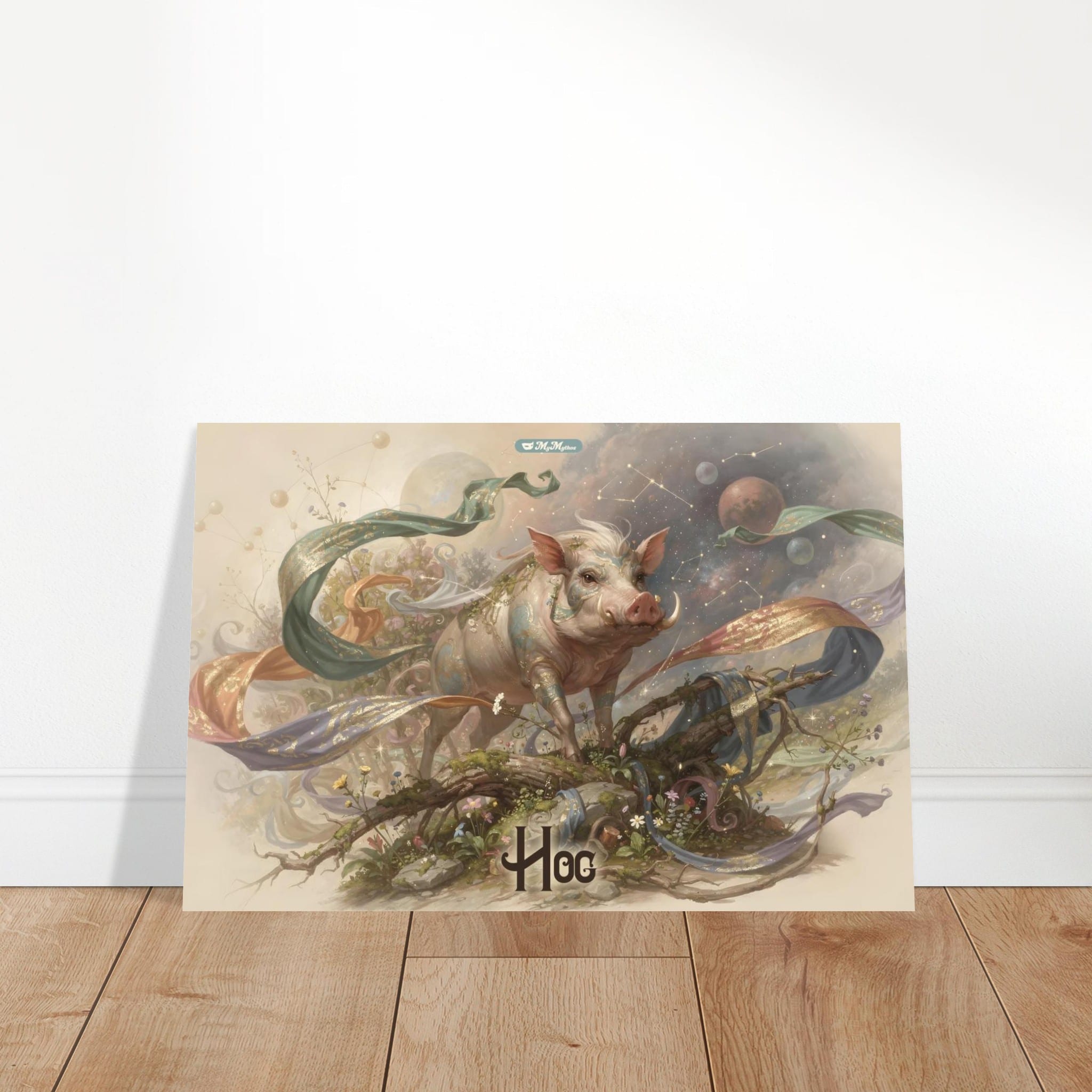
On your wall
Material
$19.00
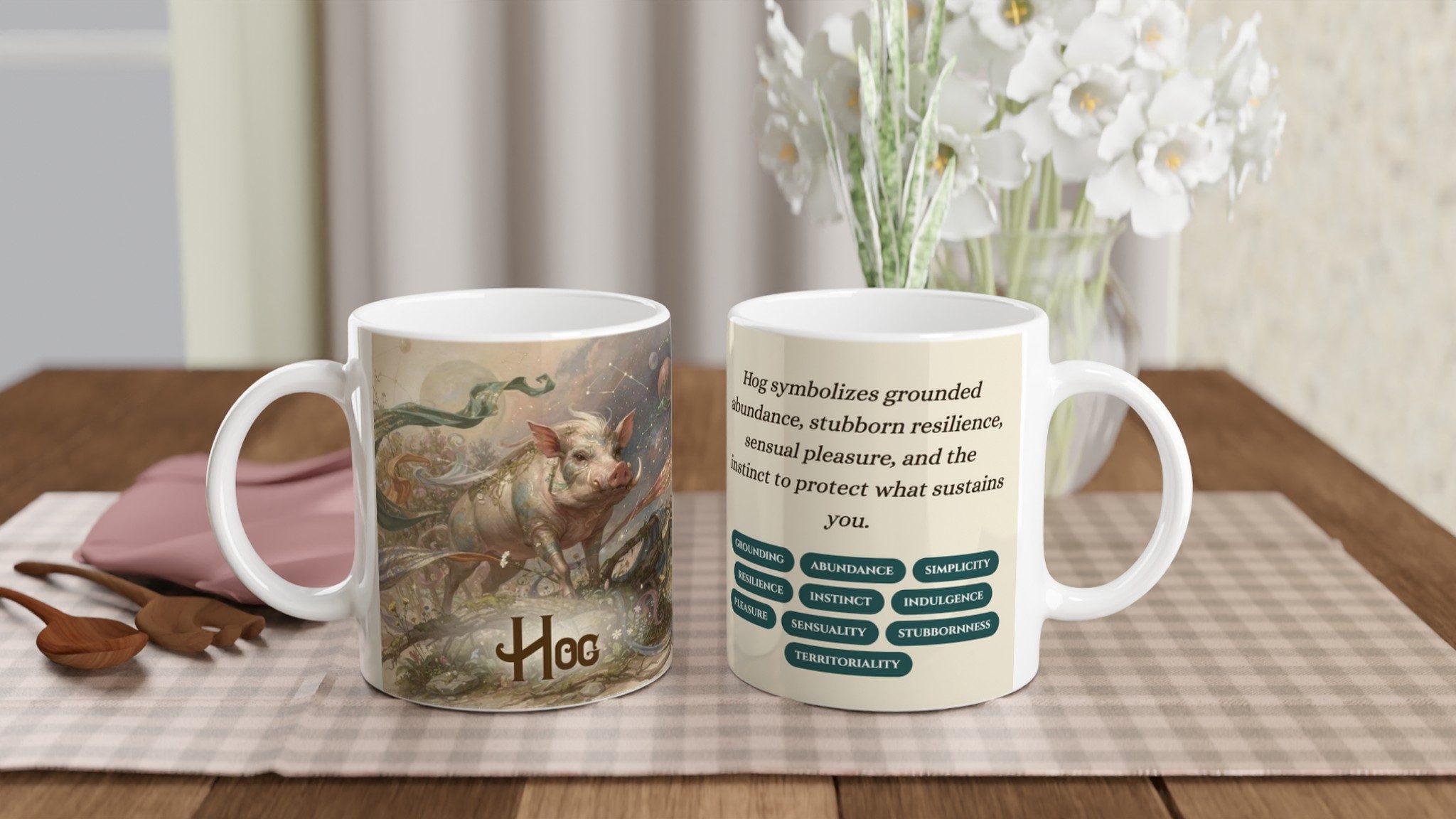
In your hands
Size
Color: White
$18.00
From elsewhere
Paid links: if you buy through these, MyMythos earns a small commission at no cost to you.