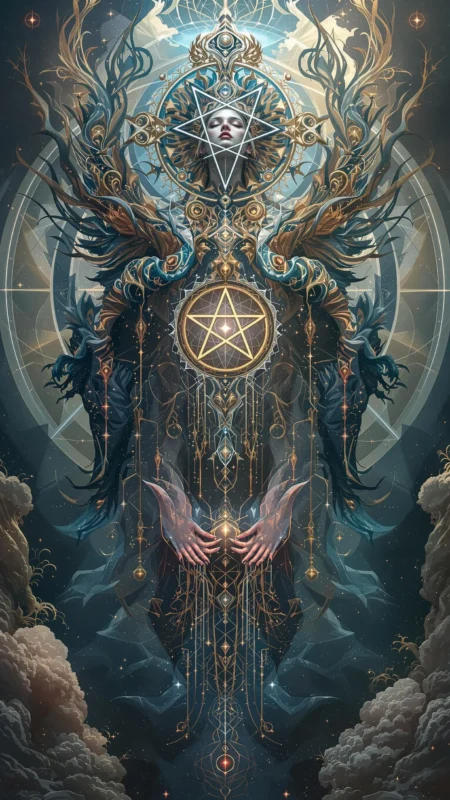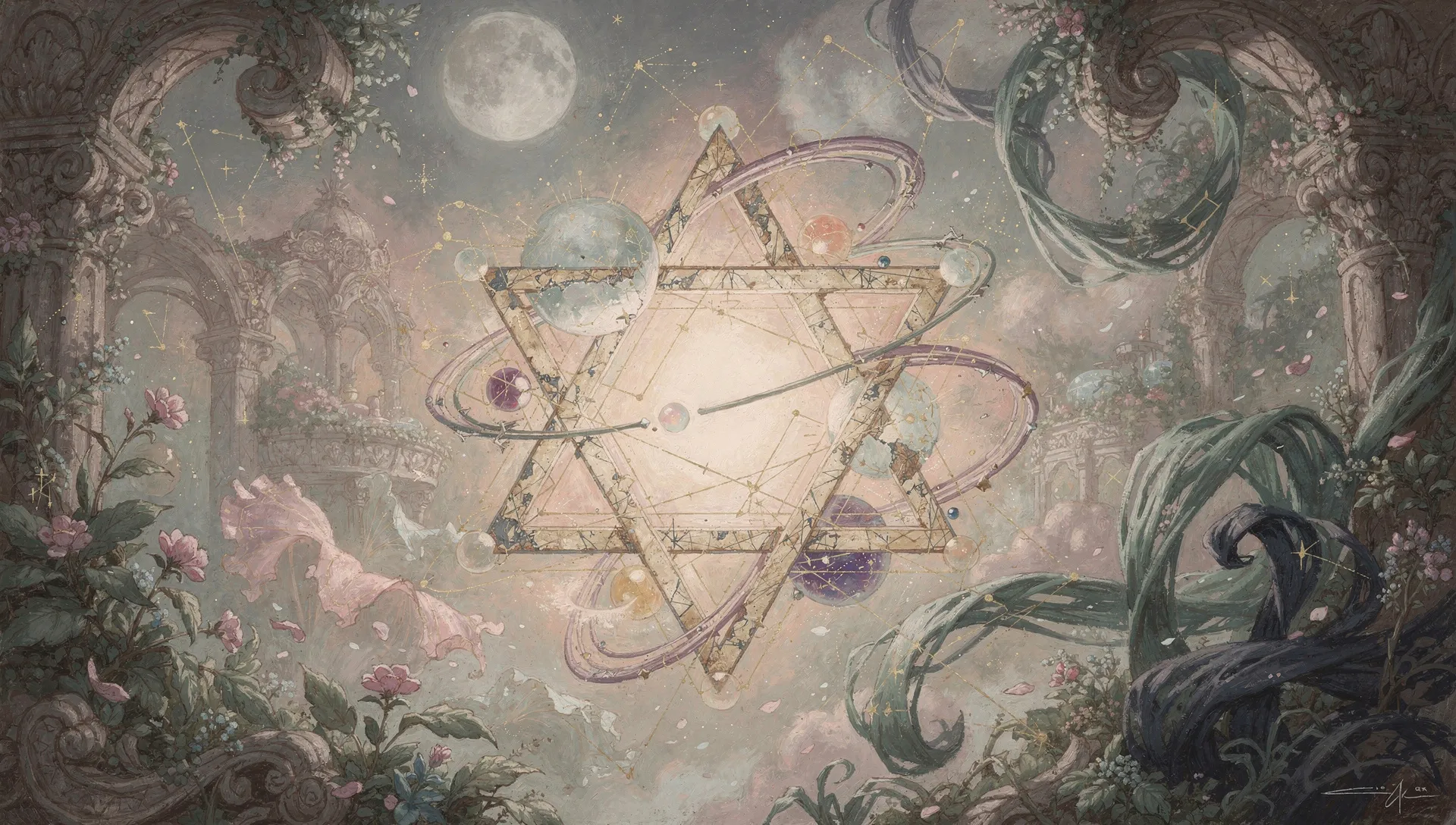


Hexagram

Archetype Meaning & Symbolism

Balanced, integrated, spiritual, geometric, structural, connective, protective, dualistic, symmetrical, mystical

  • Do not seek to conquer the earth or grasp the heavens: find the point where they touch within you, and there you will stand whole.

If Hexagram is part of your personal mythology, you may...

Believe

  • You may believe that truth is never found in extremes, but always in the synthesis of opposites.

    You may believe that the structure of your inner world is mirrored in the structure of the cosmos, and that by balancing yourself, you bring balance to your small corner of the universe.

    You may believe that every conflict, no matter how painful, contains the raw material for a more beautiful and stable creation.

Fear

  • You may fear being torn apart by your own internal contradictions, that the two triangles will pull apart rather than interlock.

    You may fear chaos and formlessness, the loss of the intellectual and emotional structures that give your life meaning and security.

    You may fear that your quest for balance is a form of cowardice, an inability to take a firm stand or commit to a single, passionate truth.

Strength

  • You have a gift for perspective, an ability to see all sides of an issue that makes you an exceptional mediator, strategist, and advisor.

    You possess a profound inner resilience, a psychic center of gravity that allows you to remain stable and clear-headed when others are thrown into turmoil.

    You are a natural system-builder, able to perceive underlying patterns and create order, harmony, and function from disparate elements.

Weakness

  • You can suffer from analysis paralysis, becoming so caught up in weighing every perspective that you are unable to make a timely decision.

    You may have a tendency towards intellectual detachment, observing life as a geometric problem rather than engaging with its messy, passionate reality.

    Your need for order and symmetry can make you rigid and intolerant of spontaneity, unpredictability, and the beautiful imperfections of life.

The Symbolism & Meaning of Hexagram

In your personal mythology, the Hexagram may represent the architecture of the soul. It suggests that the psyche is not a homogenous entity, but a structure built from the tension of interlocking, and sometimes opposing, forces. It is the marriage of fire and water, of ambition that reaches for the heavens and wisdom that is rooted in the earth. To live by the Hexagram is to accept your own internal paradoxes not as flaws to be corrected, but as the very supports that give your being its strength and unique form. It symbolizes a life dedicated to synthesis: the unending project of finding the transcendent third way that arises from the friction between two poles. It is the pattern of a snowflake and the map of a balanced life.

The Hexagram could also be the emblem of profound connection. It shows that two separate forms can interpenetrate without losing their individual integrity, creating something greater than the sum of its parts. This speaks to a way of relating to the world, to others, and to ideas. It is the model for a perfect dialogue, where two distinct viewpoints meet to create a shared space of deeper insight. In your story, the Hexagram may appear at moments where you successfully build a bridge, whether between warring family members, disparate departments at work, or the scientific and spiritual parts of your own worldview. It is the symbol of elegant, functional, and meaningful relationship.

Furthermore, the Hexagram archetype might function as a personal mandala for contemplation on order and chaos. It is a symbol of perfect, crystalline structure against the formless void. When the world feels overwhelmingly random and meaningless, the Hexagram provides a focal point of inherent order. It could suggest a belief that beneath the surface of chaos, there are unseen geometric principles at play, a hidden lattice of cause and effect, a spiritual physics that governs reality. Your mythos may be a search for this underlying pattern, a quest to see the six-pointed star hidden in the noise of everyday life.


Hexagram Relationships With Other Archetypes

The Circle

The Circle represents undifferentiated wholeness, boundless potential, and the cyclical nature of time. The Hexagram, in contrast, represents structured, articulated wholeness. If the Circle is the uncarved block of stone, the Hexagram is the finished sculpture, its beauty derived from specific angles and defined relationships. In a personal mythos, the Hexagram might be what one imposes upon the terrifying boundlessness of the Circle to create meaning and form. It is the act of drawing a map, of creating a system, of defining a self within the infinite possibilities of being.

The Labyrinth

The Labyrinth is a journey of experiential, often confusing, discovery. It must be walked to be understood. The Hexagram is a map of intellectual understanding, a truth that can be grasped in a single instant of insight. One's mythos may involve a tension between these two. You might find yourself lost in the Labyrinth of a complex emotional problem, full of dead ends and winding passages, only to have a moment of clarity where the Hexagram appears in your mind, revealing the underlying structure of the situation and showing the direct, if difficult, path to the center.

The Blacksmith

The Blacksmith takes raw elements, subjects them to the opposing forces of fire and water, and through violent hammering, forges a new, functional object. The Hexagram is the theoretical blueprint for this process. The Blacksmith is the embodied, sweaty, and visceral application of the Hexagram's cool, abstract principles. If the Blacksmith archetype is also present in your mythos, you may not just be a thinker who appreciates balance; you are the active agent who takes the conflicting realities of life (the iron), heats them in the furnace of conflict (the fire), and quenches them in the waters of wisdom to create a life of purpose and strength (the sword).

Using Hexagram in Every Day Life

Navigating Interpersonal Conflict

When faced with a disagreement, you might visualize the Hexagram. One triangle represents your perspective, the other represents the other person's. Instead of seeing them as clashing, you could search for the interlocking space, the shared area of understanding or the higher principle that contains both viewpoints. The goal ceases to be winning and becomes the creation of a more complete, shared truth.

Breaking Creative Stagnation

A project stalled between a grand vision and the messy details of execution can be framed by the Hexagram. The upward-pointing triangle is the celestial fire of inspiration, the idea in its perfect form. The downward-pointing triangle is the terrestrial reality of materials, time, and skill. You may find progress not by pushing one harder, but by tending to the connection between them: acknowledging the limitations of the earth while still honoring the call of the sky.

Fostering Personal Integration

To reconcile parts of yourself that feel at war—perhaps your need for solitude versus your desire for community, or your analytical mind versus your intuitive heart—the Hexagram can serve as a meditative focus. You could see these are not warring factions but necessary components of a more complex identity. The work, then, is not to choose one over the other, but to build the structural integrity that allows both to coexist and inform each other, creating a personality that is both grounded and aspiring.

Hexagram is Known For

Union of Opposites

Its most recognized feature is the interlocking of two equilateral triangles, one pointing to the sky, the other to the earth. This is the visual shorthand for the great alchemical concept of 'as above, so below,' representing the integration of spirit and matter, masculine and feminine, the macrocosm and the microcosm.

Spiritual Protection:

In traditions from Kabbalah to ceremonial magic, the hexagram, or Seal of Solomon, is often used as a powerful talisman. It is not a symbol of aggression, but of divine order and equilibrium, believed to create a space of harmonic resonance that is inherently inhospitable to chaotic or malevolent forces.

Sacred Geometry:

The form itself is a marvel of geometric principle, containing the proportions of the golden ratio within its lines. It is seen as a fundamental building block in the architecture of the universe, a two-dimensional representation of divine thought and the structural laws that govern existence.

How Hexagram Might Affect Your Personal Mythology

How Hexagram Might Affect Your Mythos

When the Hexagram is a core component of your personal mythology, your life story ceases to be a linear progression from A to B and becomes a narrative of synthesis. Key life events are reinterpreted not as mere victories or defeats, but as the meeting of opposing forces that created a new, more complex reality. A painful breakup, for instance, is not just an ending; it becomes the necessary downward-pointing triangle of loss that, when integrated with the upward-pointing triangle of self-love and newfound freedom, forms a more complete understanding of relationship. Your mythos is the story of becoming a human bridge, of constantly seeking the point of integration between past and future, self and other, ideal and real.

Your narrative arc may mirror the creation of the Hexagram itself. The early chapters could be defined by a feeling of being split, of living in a world of harsh dichotomies: success or failure, good or bad, mind or body. The central quest of your mythos is the gradual realization that these are not choices but partners. The climax of your story might not be a single great achievement, but a moment of profound internal alignment, where the warring parts of your psyche finally interlock, forming a stable, radiant whole. Your life becomes a testament to the idea that wholeness is not a state of purity, but a state of perfect, dynamic balance.

How Hexagram Might Affect Your Sense of Self

Your self-perception may be shaped by an awareness of your own internal complexity. You might not identify strongly with any single trait, but rather with your capacity to hold multiple, even contradictory, traits in dynamic tension. You are not just 'intuitive' or 'logical'; you are the space where intuition and logic meet and inform one another. This can lead to a stable, resilient sense of self, one that is not shattered by the emergence of a 'negative' thought or 'unproductive' mood, as these are seen as necessary counterpoints in the geometric structure of your identity.

This archetype could also foster a certain intellectual and emotional detachment. Viewing the self as a geometric structure can place you in the role of the architect rather than the resident. You may analyze your own feelings and motivations with a cool, almost clinical precision, plotting them like points on a diagram. This can be a source of great insight, but it might also create a distance from the raw, lived experience of your own emotions. You may understand your anger perfectly but struggle to simply feel it, always one step removed, observing the pattern instead of living the moment.

How Hexagram Might Affect Your Beliefs About The World

With the Hexagram as a guide, your worldview may be one of inherent, though often hidden, order. You could look at a chaotic political landscape or a volatile market and search for the underlying dialectic: the thesis and antithesis that are struggling toward a new synthesis. This perspective resists simple, dualistic explanations. The world is not a battle between good and evil, but a complex dance of interlocking forces, where every movement in one direction creates a necessary counter-movement elsewhere. This can lead to a profound, almost cosmic optimism: a belief that even the most destructive events are part of a larger, self-correcting system striving for equilibrium.

This view might also engender a certain passivity or fatalism. If all forces are part of a grand, balancing design, the impetus to intervene can be diminished. Why fight injustice with passion when it is merely one point of a triangle that will eventually be balanced by its opposite? This can lead to a worldview that values observation over action, and understanding over intervention. It is the perspective of the sage on the mountain, who sees the distant battle in the valley as a temporary disturbance in a timeless pattern, rather than a matter of immediate, moral urgency.

How Hexagram Might Affect Your Relationships

In relationships, you may seek a balance of intimacy and autonomy, connection and separation. The Hexagram model of relationship is not one of fusion, where two people melt into one, but one of interlocking integrity. You might value partners and friends who have a strong sense of their own identity, who can meet you as a distinct and whole person. The health of the relationship could be measured by its symmetry: a balance of giving and receiving, talking and listening, leading and following. The goal is to create a 'we' that honors and even strengthens the 'me' and the 'you'.

This need for perfect balance can, however, make relationships feel like a fragile equation that must be constantly monitored and adjusted. You might be hyper-aware of any perceived imbalance, leading to a kind of relational accounting that can stifle spontaneity and grace. A partner's bad mood or a friend's period of neediness might be perceived not as a natural phase, but as a threat to the relationship's sacred geometry. This can create pressure and a fear of the natural messiness of human connection, valuing the pristine pattern over the people who comprise it.

How Hexagram Might Affect Your Role in Life

Your perceived role in life might be that of the harmonizer, the mediator, the integrator. In any group, from a family to a corporation, you may naturally gravitate towards the position that connects disparate parts. You are the one who translates between the engineers and the marketers, the one who explains the parents' perspective to the children and vice-versa. Your purpose feels less about pioneering a new direction and more about weaving existing threads into a stronger, more coherent fabric. You might feel a deep sense of satisfaction from creating systems, fostering compromise, and revealing the common ground beneath contentious positions.

This role, while valuable, can also feel thankless and invisible. The bridge is essential, but people are often more focused on the destinations it connects. You may feel that your contributions are overlooked, as your work is to create the smooth functioning that allows others to shine. There can be a sense of being perpetually 'in-between,' belonging to no single camp, which can lead to a feeling of loneliness or of having no tribe of your own. Your role as the keeper of the balance may require you to stand apart from that which you are balancing.

Dream Interpretation of Hexagram

In a positive context, dreaming of a perfect, luminous Hexagram could be a profound affirmation from the subconscious. It may signify that a period of intense inner conflict is reaching a resolution. The dreamer may be successfully integrating opposing aspects of their personality, such as their ambition and their ethics, or their need for freedom and their desire for commitment. The Hexagram might appear as a shield, indicating a newfound sense of psychic protection and inner coherence, or as a map, revealing the elegant, underlying order of a seemingly chaotic life situation. It is a dream of alignment, integration, and spiritual peace.

Conversely, a Hexagram that appears in a dream as broken, distorted, spinning chaotically, or with one triangle grotesquely overpowering the other, can be a potent warning sign. This may symbolize a psyche dangerously out of balance. It could point to a life where one aspect—work, for example—is completely eclipsing all others, or where a core conflict is tearing the dreamer apart. A warped Hexagram might represent a flawed philosophy or a worldview that is creating suffering. It is a call from the deep self to attend to a profound imbalance before the entire structure shatters.

How Hexagram Archetype Might Affect Your Needs

How Hexagram Might Affect Your Physiological Needs

Physiologically, the Hexagram archetype might foster a deep intuitive need for homeostasis. Your body is not just a machine, but a self-regulating system whose wisdom you trust. This could translate into a natural inclination towards activities that balance opposing muscle groups or physiological states, such as yoga's blend of effort and ease, or practices like breathwork that consciously regulate the sympathetic and parasympathetic nervous systems. There's a felt sense that health isn't about pushing to extremes, but about maintaining the body's exquisite, dynamic equilibrium.

Your relationship with food and substance could also be governed by a principle of balance rather than restriction. The focus might not be on eliminating 'bad' foods but on creating a harmonious interplay of different energies, flavors, and nutrients. This could lead to a healthy, sustainable diet, but it might also manifest as a kind of analysis paralysis in the face of a menu, a constant, low-level anxiety about ensuring every meal perfectly balances its constituent parts, turning the simple act of eating into a complex geometric proof.

How Hexagram Might Affect Your Ideas of Belonging

The Hexagram archetype may shape your need for belongingness into a quest for a specific, integral role within a group. You don't want to simply merge or conform; you want to be an essential, interlocking piece. You may feel you belong most deeply when your unique perspective is seen as vital to the group's wholeness, when you are the one who provides balance or bridges a gap. This can lead you to seek out diverse, intellectually stimulating communities where different viewpoints are not just tolerated but are seen as necessary for the group's collective intelligence and stability.

However, this can also lead to a conditional sense of belonging. You might feel your place in the group is contingent upon your functional role as a mediator or harmonizer. This can create a pressure to always be 'on,' to constantly manage group dynamics. If the group finds its own equilibrium without your help, or if it embraces a chaotic, unbalanced mode of being, you might suddenly feel useless and alienated, your sense of belonging dissolving because your structural function is no longer required.

How Hexagram Might Affect Your Feelings of Safety

Safety, through the lens of the Hexagram, may be perceived not as a fortress but as a stable structure. Your sense of security could be rooted in order, predictability, and a well-balanced life portfolio. This is the safety of a diversified financial plan, a predictable daily routine, and a set of unwavering ethical principles that act as an internal gyroscope in turbulent times. You may feel most secure when all aspects of your life—work, health, relationships, finances—are in a state of equilibrium, with no single point of failure that could bring the whole structure down.

This search for structural safety can become a source of profound anxiety. Life is inherently unbalanced and unpredictable. An unexpected job loss or health crisis can feel not just like a problem to be solved, but like a catastrophic failure of the entire system. This can lead to a brittle rigidity, an attempt to control every variable to maintain the perfect, symmetrical balance. True safety may be elusive, as the very effort to eliminate all risk and asymmetry creates a fragile state that is terrified of the slightest breeze.

How Hexagram Might Affect Your Views of Esteem

Your self-esteem could be deeply tied to your ability to manage complexity and maintain inner balance. You may derive a quiet pride from your capacity to hold opposing viewpoints, to resist simplistic judgments, and to remain centered amidst chaos. Esteem is not earned through external victories, but through the internal achievement of coherence and integrity. Successfully navigating a complex ethical dilemma or creating a harmonious solution to a difficult problem could provide a much deeper sense of worth than public accolades or material gain.

The shadow side of this is a self-esteem that is contingent on perfection. The standard you set for yourself may be one of flawless, symmetrical balance, an impossible ideal. Any internal lapse—an outburst of anger, a period of unproductive lethargy—can be perceived as a deep personal failure, a crack in the crystalline structure of the self. This can lead to a harsh inner critic who polices your thoughts and emotions, constantly demanding an unattainable state of perfect equilibrium, making self-acceptance a constant struggle.

Shadow of Hexagram

When the Hexagram archetype falls into shadow, its beautiful symmetry becomes a cold, sterile prison. The pursuit of balance calcifies into a rigid demand for perfection, where any deviation from the ideal pattern is met with anxiety or judgment. This shadow aspect is the tyrant of order, who organizes their spice rack alphabetically but cannot tolerate a spontaneous visit from a friend. Life becomes a diagram to be kept pristine, not a song to be lived. In this state, the individual might reject anything messy, emotional, or asymmetrical, valuing the map over the territory to such an extent that they lose touch with the vitality of life itself.

Another shadow manifestation is that of false balance or moral paralysis. In the name of seeing all sides, the shadow Hexagram insists on giving equal weight to all perspectives, even those that are harmful or nonsensical. It is the person who says 'there are very fine people on both sides' in a situation of clear injustice. This is not true mediation but an abdication of discernment. The desire to hold the center becomes a refusal to take a stand, creating a hollow core where a moral compass should be. It is the passivity that allows entropy to flourish, all under the guise of enlightened, balanced observation.

Pros & Cons of Hexagram in Your Mythology

Pros

  • Your mind is a place of rare clarity and order, allowing you to navigate complexity with grace and find solutions others cannot see.

    You embody a quiet strength and stability that can be a source of comfort and wisdom for those around you.

    You are on a path of lifelong integration, promising a journey towards a profound and resilient sense of wholeness.

Cons

  • You risk being perceived as indecisive, emotionally distant, or frustratingly neutral in situations that demand passionate commitment.

    The constant mental effort of maintaining balance and order can be draining, leading to exhaustion and a lack of spontaneity.

    Your ideal of perfect, symmetrical structure may set you up for chronic disappointment in an imperfect and asymmetrical world.