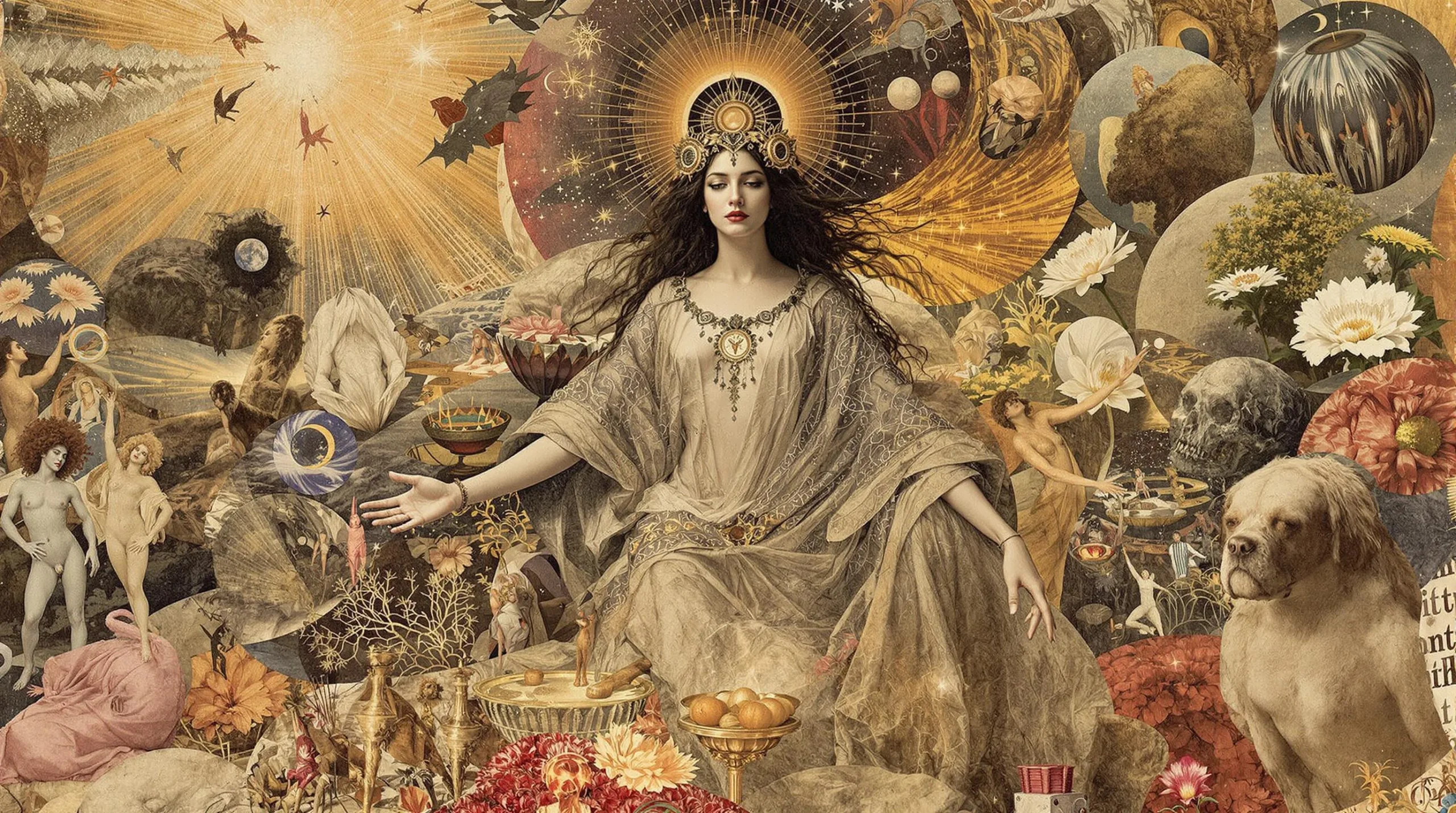


Hestia

Archetype Meaning & Symbolism

Centered, steadfast, introverted, serene, unassuming, foundational, patient, keeper, impartial, anchored, quiet

  • Do not seek me in the grand temples or the clamor of the public square. I am the quiet geometry of the circle you draw around yourself, the silent hum of a room where you are truly at peace.

If Hestia is part of your personal mythology, you may...

Believe

  • You may believe that the most profound spiritual work unfolds not in a monastery or on a pilgrimage, but in the quiet, repetitive, mundane moments of daily life.
  • You may believe that your primary duty is to maintain the integrity of your own inner world, and that from this centered place, all right action will naturally follow.
  • You may believe that true sanctuary is not a place you discover, but a space you consciously create, first within yourself, and then, as a reflection, in your home.

Fear

  • You may fear invasion above all else: the intrusion of chaos, noise, drama, or the unsolicited demands of others into your sacred inner or outer space.
  • You may fear being uprooted, of losing your center and becoming unmoored, adrift in the meaningless, frantic churn of the external world.
  • You may harbor a quiet fear that your internally-focused life is insignificant, that your quietude will be mistaken for emptiness, and that you will be overlooked entirely by a world that rewards only noise.

Strength

  • Your profound capacity to create atmospheres of deep peace, psychological safety, and restoration, both for yourself and for those you welcome into your life.
  • Your unwavering self-possession, an internal anchor that makes you remarkably resistant to being swayed by external drama, social pressure, or fleeting trends.
  • Your rare ability to find rich meaning and genuine contentment in solitude, simplicity, and the quiet rhythms of a life lived intentionally.

Weakness

  • A tendency toward withdrawal that can curdle into isolation, causing you to preemptively shut out new experiences, vital connections, or constructive feedback.
  • A deep-seated resistance to change, even when it is necessary for your own growth, as you may reflexively prioritize the comfort of the known over the potential of the new.
  • A learned passivity that can prevent you from advocating for yourself, asserting necessary boundaries, or taking decisive action in the world when the situation demands it.

The Symbolism & Meaning of Hestia

In the modern psyche, Hestia perhaps emerges as the quiet patron saint of JOMO: the Joy of Missing Out. She is the archetypal force that counters the frantic, outward-facing demands of a hyper-connected world. Her symbolism is not found in grand gestures, but in the profound spirituality of the mundane: the ritual of making coffee in the morning, the careful folding of laundry, the deliberate act of turning off a phone. In personal mythology, she represents the reclamation of the domestic sphere not as a place of drudgery, but as the primary altar for soul-work. She is the permission to find the universe in a grain of sand, or in the quiet hum of a refrigerator, a silent rebellion against the tyranny of the spectacular.

The hearth she tends is circular, a shape that speaks of wholeness, of cycles, and of the center. For a personal mythos infused with Hestia, life may not be imagined as a linear climb toward a distant peak, but as a spiral path leading ever deeper toward a core self. The central task is not to conquer the world but to know the geography of one's own soul. Hestia is the keeper of this psychic integrity, the guardian of the invisible circle we draw around ourselves to define who we are. Her presence suggests that the most important journeys are not across continents, but across the few inches from the head to the heart.

Hestia’s status as a 'virgin' goddess could be understood not as a literal chastity, but as a symbol of profound self-possession. She is wholly herself, inviolate, requiring no other for her completion. In a personal narrative, this translates to a powerful form of sovereignty. It is the story of a self that is its own sacred container, a closed circuit of energy that does not leak out in a desperate search for validation. To embody Hestia is to find that you are your own home, a realization that is perhaps the quietest, and most radical, of all.


Hestia Relationships With Other Archetypes

The Wanderer

The relationship between Hestia and the Wanderer is perhaps that of a quiet sun to an orbiting planet. The Wanderer, defined by the journey and the accumulation of horizons, could be seen as tracing a path whose meaning is only rendered legible by the fixed point from which it departs and to which it, consciously or not, seeks to return. Hestia offers no chase, no grand narrative of her own, but provides the silent, gravitational center that prevents the Wanderer from spinning off into the void. She is the geometric proof of home, an axiom of being that allows the beautiful, chaotic variable of the journey to exist. In her stillness is the permission for all movement; in her silence, the value of every story the Wanderer brings back.

The Anchor

Hestia and the Anchor may share a kinship of purpose, one plunged in brine and the other in spirit. The Anchor’s work is unseen, its virtue lying in the immense, unglamorous weight that holds a vessel against the caprice of current and storm. It is a commitment made in the dark, a bond with the unseen ground below. So too, Hestia’s influence is not in the visible world of action but in the deep, quiet refusal to be swept away by emotional turbulence or external demand. She is the grounding principle within the psyche, the part of the soul that holds fast, allowing the rest of the self—the ship, with all its cargo and crew—to ride out the inevitable tempests of life without losing its place in the world.

The Lighthouse

While the Lighthouse might appear to be Hestia’s coastal counterpart—a solitary beacon against the dark—their functions may be in a state of mirrored opposition. The Lighthouse casts its light outward, a grand, sweeping gesture of public salvation for those lost at sea. Its gaze is extroverted, its purpose a broadcast. Hestia’s flame, however, is a centripetal force. It does not project, but glows inward, warming a contained and sacred space. It is a light not for finding the lost, but for welcoming the found. The Lighthouse is a charity for strangers; the hearth is a communion for those who have already crossed the threshold. One is a desperate plea across the water, the other, a quiet and assured amen.

Using Hestia in Every Day Life

Navigating Career Ambition

When confronted with the frantic climb of a career ladder, the Hestia archetype may not reject ambition outright but reframe it. The goal might shift from external recognition to the cultivation of a sacred craft. Your work becomes your hearth, a practice to be tended with quiet diligence. Success is measured not by the noise you make in the marketplace, but by the steady, internal glow of purpose that warms your own life, independent of an audience.

Cultivating Social Connections

In a world of sprawling networks and superficial contact, a Hestian approach could guide you toward a different kind of sociality. You may feel called to be the host in the truest sense: the one who creates a space where others feel safe enough to be still. Your gift is not witty banter but the creation of an atmosphere. You might curate small, profound gatherings, turning your living room into a temporary temple where genuine connection can take root in the shared silence between words.

Resolving Inner Conflict

When faced with emotional turmoil or a crisis of identity, the Hestian mythos suggests a radical act: do not engage the conflict directly. Instead, you retreat to the center. You may methodically clean your home, light a single candle, or simply sit in silence, focusing on your breath. The strategy is to tend to the inner hearth so diligently that it burns with a quiet, unwavering heat, and in that warmth, the anxieties and conflicts that seemed so monumental may simply lose their power, like shadows receding from a growing light.

Hestia is Known For

The Eternal Flame

This was the fire at the public hearth of the city, the prytaneum, which was never allowed to be extinguished. It represents the unbroken continuity of the self, the persistent inner spark that endures through all of life's changes, a testament to the soul's quiet permanence.

Sanctuary and Asylum

The hearth in any Greek home was a sacred space offering protection to any who sought it. This speaks to the Hestian capacity for creating psychological safety, for establishing spaces—both internal and external—that serve as a refuge from the chaos of the world.

Impartiality

Hestia famously remained neutral in the disputes and dramas of the other Olympian gods, refusing to take sides. This quality points to a profound ability to hold space without judgment, to be a still point of presence for others without becoming entangled in their conflicts.

How Hestia Might Affect Your Personal Mythology

How Hestia Might Affect Your Mythos

When Hestia is a central force, the personal mythos may subtly shift its genre. The narrative arc is no longer the hero’s epic journey of conquest and triumphant return, but perhaps the mystic’s pilgrimage inward. The plot is not driven by external antagonists or dramatic events, but by the quiet, disciplined labor of tending to one’s inner state. The great quests are internal: the struggle to keep the flame of hope lit during a period of despair, the challenge of maintaining serenity amidst chaos, the search for the still point in a turning world. Your life story becomes a testament to endurance and presence, rather than a catalog of accomplishments.

Your role within this mythos may become that of the Keeper, the Anchor, or the Still Point. The protagonist's significance is measured not by their impact on the story's world, but by their ability to maintain a core of integrity from which all else radiates. You may be the fixed point that allows other characters to navigate their own turbulent arcs. The story's meaning is found in the space you hold, the constancy you provide. The narrative climax might not be a great battle, but a moment of profound, world-altering stillness.

How Hestia Might Affect Your Sense of Self

Your perception of self may move away from a definition built on roles, relationships, or achievements, and toward an identity rooted in a singular, internal presence. Self-worth could become decoupled from the metrics of the external world: productivity, social status, or the accumulation of experiences. You might see yourself less as an actor on a stage and more as the stage itself, a container for life to unfold within. This can foster a sense of self-possession that is not aggressive or loud, but deeply rooted and quiet, like a stone at the bottom of a river.

This archetype could also cultivate the understanding of the self as a fundamentally private entity. Your inner world may be your primary reality, a rich and detailed landscape that requires no audience for its validation. The self is not a performance piece to be curated for others, but a state of being to be inhabited for oneself. You may find that who you are in your quietest, most unobserved moments is the most authentic version of you, the person your mythos is truly about.

How Hestia Might Affect Your Beliefs About The World

The world, seen through a Hestian lens, might cease to be a battlefield of competing ideologies or a marketplace of opportunities. Instead, it may appear as a series of concentric circles of meaning, radiating outward from a sacred center. This worldview prioritizes the immediate, the local, and the tangible, not as a limitation, but as the very ground where the sacred becomes real. The home, the neighborhood, the small community: these are not backwaters, but the cosmos in miniature, the only places where true meaning can be reliably cultivated and felt.

This perspective could foster a healthy skepticism toward grand narratives, political fervor, and abstract principles. Truth, for the Hestian soul, is not found in a manifesto but is experienced in the quality of light in a room, the careful preparation of a meal, the texture of a shared silence. The world's problems are not solved by loud pronouncements from afar, but by the patient, rhythmic, and often invisible work of tending to one's own small corner of it with integrity and care.

How Hestia Might Affect Your Relationships

Relationships may be defined by their capacity to be a form of sanctuary. When influenced by Hestia, you might seek or create partnerships that feel less like a whirlwind adventure and more like coming home. The ideal connection is a refuge from the world, not a distraction from it. Friendship is measured not by the frequency of activities, but by the depth of comfortable being, the rare and precious ability to sit together in a room, each lost in their own thoughts, yet feeling profoundly connected.

Intimacy, in love and family, could be centered on the patient co-creation of a shared hearth. The focus is less on the dramatic highs and lows of passion and more on the steady, quiet work of building a life, a home, a world together. Love is expressed not through grand, performative gestures, but through the thousand small, consistent acts of care that keep the emotional and physical space of the relationship warm, safe, and alive. It is a love that builds a container strong enough to hold both people.

How Hestia Might Affect Your Role in Life

In a family, community, or workplace, your perceived role might be that of the anchor. You may not be the designated leader who gives orders, but the quiet center that gives the group its coherence and stability. You are the one who remembers the traditions, who instinctively knows how to create an atmosphere of belonging, the one whose very presence can bring a sense of calm and order to a chaotic meeting. Your power is gravitational rather than directed; people orient themselves around your stillness.

Professionally, this archetype may draw you to roles that involve holding or creating space. You might be a therapist, a librarian, an archivist, a user experience designer, a monk, or any craftsman whose work is about creating an environment of focus, peace, and integrity. Your career path may be guided less by a desire for self-promotion and more by a deep commitment to serving the work itself, to protecting the sanctity of the craft from the corrupting influence of the ego.

Dream Interpretation of Hestia

In a positive context, to dream of Hestia—perhaps as a well-tended fire in a hearth, a warm and tranquil room, or the simple act of lighting a candle—could signify a profound and successful connection with your own core. Such a dream may suggest that you are finding your center, building a life that feels authentic and psychologically secure. It can be an affirmation that you have established a necessary sanctuary for yourself, a space of inner peace and integration. The dream is a message from the psyche: you are home.

In a negative light, a Hestian dream may turn unnerving. You might dream of a cold, ash-filled hearth, a fire that rages out of control and consumes the house, or of being locked out of a home, unable to get inside. These images could point to a painful disconnection from your inner self, a feeling of alienation or soul-homelessness. It may reflect burnout from over-extending into the world or a hollowing out of your inner life. An uncontrolled fire, specifically, might symbolize the shadow of Hestia: a deep, suppressed rage or resentment that, having been denied a voice, now threatens to destroy the very sanctuary you have tried to build.

How Hestia Archetype Might Affect Your Needs

How Hestia Might Affect Your Physiological Needs

The Hestia archetype might reframe physiological needs, elevating them from base requirements to sacred rituals. Food is not just fuel; it is consecrated nourishment, and its preparation becomes a form of meditation. Sleep is not merely a biological function; it is a return to the dark, quiet inner sanctum. The body itself is perceived as the first home, the primary hearth, and its needs for warmth, rest, and sustenance are attended to with a kind of gentle reverence, a quiet, consistent tending of the physical flame.

This mythological lens could foster a heightened sensitivity to one's physical environment. The quality of light, the ambient temperature, the texture of a blanket, the subtle sounds of a house settling—these are not trivial details but essential components of physiological well-being. A Hestian constitution may find chaotic, unpredictable, or sensorily harsh environments to be physically draining. It seeks out spaces that offer calm, rhythm, and predictability, as this external order helps to maintain the body's own fragile equilibrium.

How Hestia Might Affect Your Ideas of Belonging

Belonging, for one with Hestia in their mythos, is rarely found by joining the crowd. It is, perhaps, cultivated from the inside out. The primary work is to create a self and a home so authentic and warm that the right people are naturally drawn into its orbit. You first belong completely to yourself; only then can you extend that circle of belonging to include a select few who can share the sanctity of your space without disturbing its peace. It is the antithesis of belonging through conformity.

Love and deep friendship are experienced as a form of mutual indwelling. To be loved is to be granted access to another's innermost sanctuary, to be trusted with the quiet truths of their being. To love is to offer that same refuge in return. Intimacy is the profound, comfortable silence of two people tending to a shared flame, a connection that requires no constant performance or validation because its reality is felt in the very atmosphere they create together.

How Hestia Might Affect Your Feelings of Safety

Within this mythos, safety is less about alarms and deadbolts and more about a psychic state of being. It is the feeling of being inwardly anchored, shielded not by walls but by the integrity of one's own center. Safety is the quiet confidence that comes from knowing you have a self to return to, a hearth that remains warm regardless of the storms outside. The greatest security is not a well-funded bank account, but a well-tended soul. It is the portable sanctuary you carry within.

This internal state often inspires an external life structured around stability and predictability. A Hestian individual may create routines and rhythms that act as a form of protective architecture for the psyche. They might pursue financial security not for the purpose of lavish spending, but for the profound luxury of freedom from anxiety. The need for safety is fulfilled by the quiet, daily work of reinforcing the foundations of one's life, ensuring that the ground beneath one's feet feels solid, reliable, and deep.

How Hestia Might Affect Your Views of Esteem

Esteem, in the Hestian mythos, is not sourced from public accolades or external achievements. It arises from a quiet, unshakable sense of self-possession. It is the deep, internal confidence that comes from knowing your own center and living in alignment with it. The respect that matters is the self-respect earned through the disciplined, daily tending of your own inner flame. This form of esteem is not loud or prideful; it is a silent, solid conviction of your own worth, independent of any gaze but your own.

Consequently, the traditional markers of esteem—promotions, awards, social popularity, online influence—may hold little appeal. In fact, they might be perceived as dangerous distractions from the 'real work,' which is the cultivation of the inner life. Accomplishment is measured by a different metric: the quality of one's presence, the depth of one's peace, the steadfastness of one's integrity. It is the esteem of being, not the esteem of doing.

Shadow of Hestia

When the Hestian archetype falls into shadow, the sacred sanctuary becomes a prison of fearful isolation. The desire for peace metastasizes into a rigid, obsessive control of one's environment and a phobic avoidance of anything new, spontaneous, or disruptive. Here, the gentle keeper of the hearth becomes the anxious jailer of her own soul, refusing to open a window for fear that a draft of life might get in. The inner fire no longer provides warmth; it consumes all the oxygen in the room, leading to emotional and spiritual stagnation, a life meticulously preserved but never truly lived.

Alternatively, the shadow can manifest as a cold, banked rage beneath a placid surface. After years of silently providing the emotional warmth and stability for others without reciprocation or acknowledgment, a profound resentment may build. This is the story of the neglected hearth, where the embers of bitterness smolder quietly for decades before erupting into a destructive blaze that burns down the very home it was meant to protect. It is the passivity that sours into passive-aggression, the quiet presence that becomes a heavy, judgmental silence, punishing the world for failing to notice its sacrifice.

Pros & Cons of Hestia in Your Mythology

Pros

  • You possess a deep and renewable well of inner peace, making you a grounding, calming presence for those around you.
  • You are fundamentally self-sufficient, able to find contentment and meaning without needing constant external validation or entertainment.
  • You often have a gift for creating physical environments—homes, rooms, gardens—that are harmonious, beautiful, and deeply restorative to the human spirit.

Cons

  • Your contributions, being foundational and quiet, are often invisible, leading you to be easily overlooked or taken for granted by others.
  • You may reflexively avoid healthy conflict, necessary risks, or difficult conversations, sometimes prioritizing immediate peace over long-term truth and growth.
  • Your inward focus can lead to a state of chosen isolation, causing you to miss out on the vital energy and perspective that comes from active engagement with the wider world.