 Believe
 Fear
Fear Strength
 Weakness
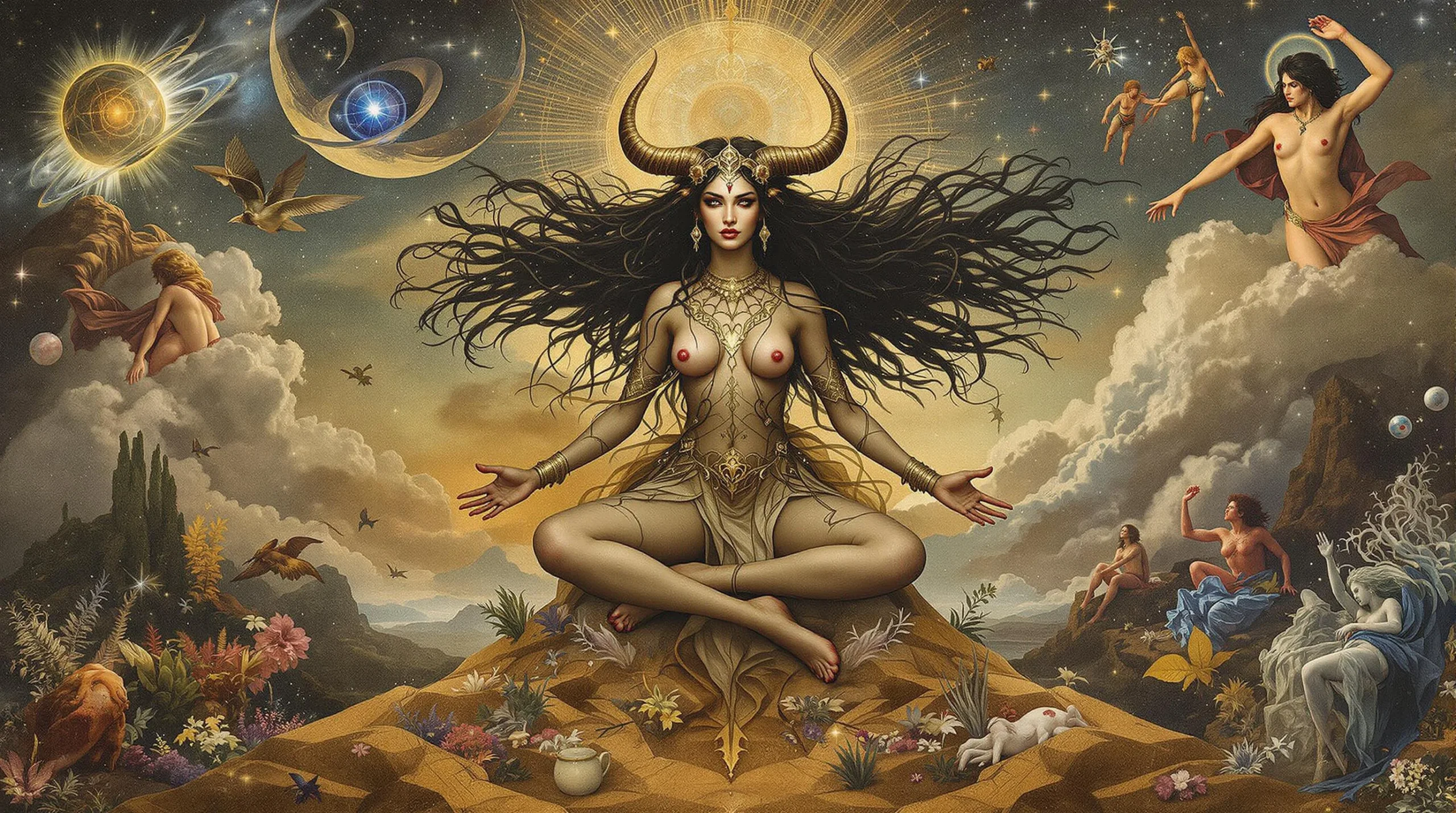
To find Hathor in your personal mythology is to re-consecrate the body and its senses. It is a rebellion against the idea that spirituality requires asceticism or a denial of the flesh. Instead, pleasure becomes a form of prayer, and joy, a direct line to the divine. This archetype teaches that beauty is not an indulgence but a nutrient, as critical to the soul as water is to the body. You may find yourself curating a life rich in sensory detail: the texture of a silk scarf, the taste of honey, the sound of wind chimes. It is a worldview where the physical world is not a distraction from the spirit but its most immediate and vibrant expression.
The symbolism of Hathor is fundamentally dual. She is the gentle, nurturing celestial cow, offering sustenance to all. Yet she holds the memory of the roaring lioness, Sekhmet. For personal mythology, this means that true gentleness and generosity may require a capacity for formidable ferocity. To be a true source of comfort and creativity for others, one must be able to fiercely protect the sacred space—both internal and external—from which that nourishment flows. Your capacity for love could be directly proportional to your ability to define and defend its boundaries. The archetype suggests that authentic kindness is not passive; it is a protected, cultivated garden.
At her core, Hathor is a goddess of creative flow and connection. The sistrum, her sacred instrument, was used to shake away malevolent influences and clear the air, just as music and dance can clear a psychic space. Her mirror was not for vanity but for revealing the soul's true essence. In a modern context, this translates to a life path centered on creative expression as a way of knowing oneself and the cosmos. Art, music, lovemaking, even cooking a beautiful meal become acts of magic, ways of participating in the universe's endless dance of creation. Your own reflection, seen through this lens, is not just a physical form but a glimpse of the divine.