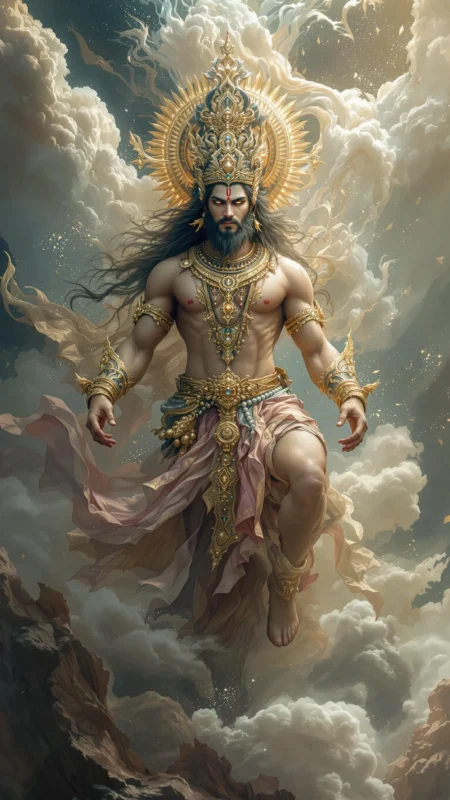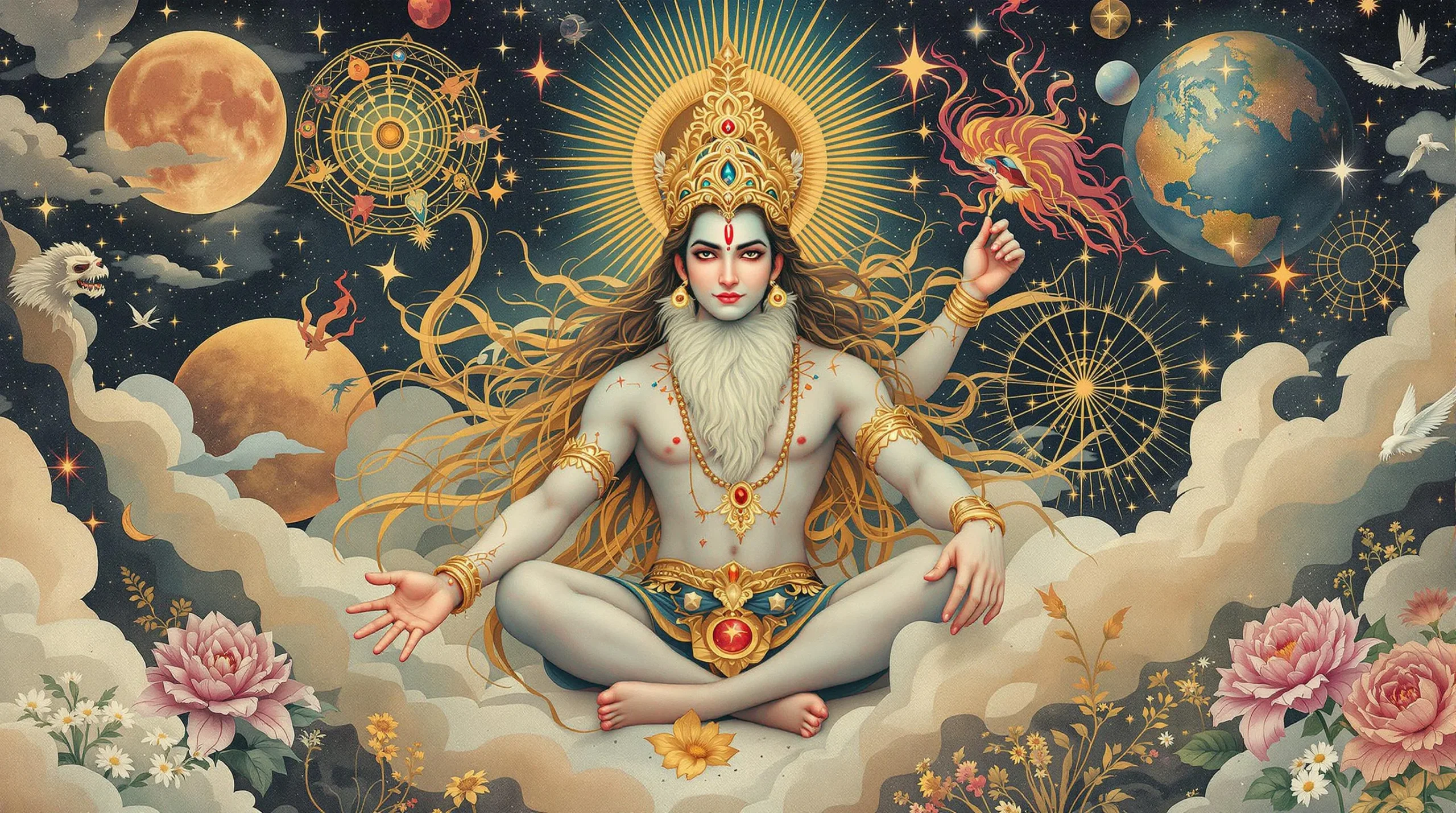


Hanuman

Archetype Meaning & Symbolism

Devoted, powerful, humble, loyal, mischievous, selfless, courageous, energetic, resourceful, transcendent

  • Forget the peak. The mountain is not a thing to be conquered but a heart to be carried. Lift what you love, and you will fly.

If Hanuman is part of your personal mythology, you may...

Believe

  • That the greatest power is not your own, but flows through you when you are perfectly aligned with a purpose greater than yourself.
  • That loyalty is not a passive state of being but an active, world-altering force.
  • That true humility is not thinking less of yourself, but thinking of yourself less, thereby unlocking godlike potential.

Fear

  • Forgetting your purpose and, in that amnesia, losing access to your own power and identity.
  • That your profound devotion might be misplaced in an unworthy cause or a manipulative person, wasting your life's energy.
  • Failing in a crucial moment of duty, thereby betraying the sacred trust placed in you by those you serve.

Strength

  • An almost inexhaustible well of energy and motivation when inspired by a cherished ideal or person.
  • The courage to face seemingly insurmountable obstacles with creativity and a pragmatic, 'can-do' spirit.
  • A profound and unshakable loyalty that makes you an incredibly reliable and trustworthy friend, partner, or ally.

Weakness

  • A powerful tendency to neglect your own needs, desires, and personal well-being in the relentless service of others.
  • A potential for blind spots, following a chosen path or charismatic leader without sufficient critical analysis.
  • Difficulty functioning or finding a sense of self-worth in the absence of a clear, external 'Rama' to serve.

The Symbolism & Meaning of Hanuman

To have Hanuman in your personal mythology is to understand devotion as a superpower. It is not blind faith, but a directed, concentrated channel for immense personal energy. Your heart becomes a compass, pointing not north, but toward your personal 'Rama': a person, a creative work, a community, an ideal. This archetype suggests that the greatest force one can wield is the focused, unconditional love for something outside the self. It reconceptualizes power, shifting it from an attribute of the ego to a gift that flows through you when your intention is pure and your focus is absolute. You are the bow, but devotion is the string that launches the arrow.

The archetype thrives on the paradox of immense power and profound humility. Hanuman possesses godlike strength, the ability to change form, and wisdom that impresses the heavens, yet he sees himself only as a servant. For your personal narrative, this might mean recognizing that your greatest talents are not for self-aggrandizement, but are tools for service. Success is not measured by the throne you occupy, but by the throne you help to stabilize. This allows for a strange and potent confidence: a certainty in your capabilities that is untethered from personal arrogance. It is the confidence of the perfect tool in the hands of a master artisan, in this case, your chosen purpose.

Hanuman is the bridge between the animalistic and the divine, the primal and the enlightened. His form is simian, a nod to the untamed, chattering 'monkey mind' within us all, yet his spirit is a beacon of self-mastery. To integrate this archetype is to cease fighting your instincts and instead give them a noble task. It is about harnessing your raw, chaotic energy—your passions, your fierceness, your mischievous creativity—and directing it toward a singular, worthy goal. You do not cage the monkey; you teach it to move mountains in the name of love.


Hanuman Relationships With Other Archetypes

The Sovereign

The Hanuman archetype may find its pole star, its truest north, in the presence of the Sovereign. This relationship is perhaps not one of simple subjecthood, but rather of a purpose finding its vessel, a river meeting its sea. The Sovereign could be seen as the still, silent axle around which Hanuman’s tremendous power turns, transforming what might otherwise be a cyclone of chaotic energy into a perfectly calibrated orbit of service. Without this gravitational center, this divine object of affection, the Hanuman force is a song without a key; with it, its every action becomes a note in a celestial harmony, a testament to the idea that true strength is not owned, but offered.

The Mountain

When faced with The Mountain—that archetype of the immoveable, the unchangeable, the colossal fact of reality—Hanuman does not seek to shatter it. Instead, his devotion allows for an altogether different miracle. He lifts it, whole. This relationship could suggest that profound love does not always vanquish an obstacle but may grant one the grace to carry it, to bear its impossible weight for a purpose greater than the self. The Mountain, perhaps, represents a burden of history, a collective sorrow, or an intractable truth. The Hanuman archetype demonstrates that service may not mean solving the problem, but shouldering it in its entirety, transforming a landscape of impossibility into a pilgrimage.

The Ocean

The Ocean represents the great chasm of separation, the psychic abyss that yawns between what is and what is longed for. For Hanuman, the leap across this void is perhaps the ultimate expression of faith. It is an act that defies the logic of distance and the gravity of despair. This relationship with the archetype of the great divide suggests that devotion is its own form of physics, a force that allows the soul to traverse the vast emptiness between hearts. The crossing is not a feat of engineering but of pure, kinetic love. It may be that for the Hanuman, the existence of the far shore—the beloved—is the only proof needed that the chasm, no matter how wide, is not, in the end, uncrossable.

Using Hanuman in Every Day Life

Facing an Impossible Task

When a project at work or a personal crisis feels like a literal ocean to be crossed, the Hanuman archetype offers a shift in perspective. It's not about the mechanics of the crossing, but the singular focus on the goal on the other side. The power to leap is generated not by the legs, but by the heart's unwavering commitment to the mission. You may find yourself able to marshal resources and energies you didn't know you possessed, simply by fixing your gaze on the 'Sita' that needs rescuing.

Feeling Unheard or Insignificant

In moments of feeling small and powerless, this archetype reminds you that form is a utility. Hanuman could shrink to the size of a gnat to infiltrate a fortress or grow to the size of a mountain to face a demon. If your current form isn't working, you could metaphorically change it. This might mean shifting your communication style from a roar to a whisper, or instead of a grand gesture, performing a small, precise act of service that changes everything. Power lies in adaptability for the sake of the mission.

Communicating a Difficult Truth

Delivering a message that may be unwelcome requires the delicate balance of Hanuman's diplomacy and fierce loyalty. He was a messenger, a diplomat in a court of enemies, yet never wavered from his truth. This archetype could guide you to speak with profound humility, framing your truth not as a personal attack but as an act of service to a greater good: the health of the relationship, the integrity of the project, the wellbeing of the family. Your loyalty to that greater good becomes the shield for the difficult words.

Hanuman is Known For

The Leap to Lanka

An impossible leap across the ocean, powered by sheer will and devotion, to find the captive goddess Sita. A metaphor for overcoming any obstacle through faith in a purpose.

Lifting the Mountain

When unable to identify a specific life-saving herb, he lifted the entire Dronagiri mountain and carried it back. This symbolizes a commitment to the goal that transcends precision

when you don't have the perfect solution, you bring all possible solutions.

Unwavering Devotion

His entire identity is defined by his selfless service to his chosen ideal, Rama. He is the embodiment of 'bhakti yoga,' the path of devotion, where the ego is surrendered to a higher cause.

How Hanuman Might Affect Your Personal Mythology

How Hanuman Might Affect Your Mythos

When Hanuman enters your personal mythos, your life story may subtly pivot from a hero’s journey of self-discovery to a devotee’s pilgrimage of service. The central animating question of your narrative could shift from 'Who am I and what can I achieve?' to 'What do I love, and how can I serve it?' Your personal victories might be re-contextualized as contributions to a larger, more significant epic. You might find you are not the protagonist of your story, but rather the indispensable companion, the one whose actions make the protagonist's victory possible. The climax of your life chapters may not be about personal glory, but about delivering the crucial message or finding the lost piece of the whole.

Your mythology could become a tapestry of impossible feats performed not for fame, but as expressions of love. The 'origin story' of your power may involve a moment of forgetting your own potential, a self-imposed amnesia broken only when a 'Jamavant' figure—a mentor, a friend, a sudden insight—reminds you of your true purpose and the strength it confers. Your life's great challenges become oceans to be leaped, mountains to be lifted. The narrative is less about conquering the world and more about mending it, one devoted act at a time. Your story becomes a testament to the idea that the most loyal heart is also the most powerful.

How Hanuman Might Affect Your Sense of Self

Your view of self may become that of a conduit, a vessel for a power that is not entirely your own. This could foster a deep and authentic humility, a sense that your talents for art, leadership, or healing are on loan from the universe for a specific assignment. Self-worth might detach from the ego's clamor for recognition and reattach to the purity of your intent and the steadfastness of your commitment. You may see your hands not as your hands, but as the hands that get the job done. This creates a quiet, unshakable confidence, free from the anxieties of personal performance.

Simultaneously, you might cultivate a more forgiving and playful relationship with your own imperfections. The young Hanuman was a divine mischief-maker, powerful yet untamed. Seeing this within yourself allows for a profound self-acceptance. You may recognize a capacity for monumental, innocent mistakes born from a place of unbridled energy and curiosity. Your missteps are not moral failures but surges of a powerful current you are still learning to direct. This allows you to integrate your wild, primal nature with your higher aspirations, viewing your entire self as a divine work-in-progress.

How Hanuman Might Affect Your Beliefs About The World

The world, seen through the lens of the Hanuman archetype, may transform from a competitive arena into a vast, interconnected drama requiring selfless participation. Ideals like truth, compassion, and justice could cease to be abstract concepts and become tangible forces, as real as mountains and oceans—things one can actively serve and champion. You might come to believe that the most potent force in the universe is not wealth or military might, but the focused, loving energy of a devoted heart. The world is not a problem to be solved, but a beloved to be served.

This perspective could radically alter your perception of obstacles. A daunting challenge is no longer a barrier but an opportunity for a leap of faith. A complex problem is not a source of despair but a mountain of possibilities that can be lifted wholesale when a precise solution is not forthcoming. Your worldview may be infused with a pragmatic, action-oriented optimism. This isn't a naive belief that things will simply work out, but a deep-seated conviction that with enough focused will and dedication to a worthy cause, a path will either be found or be created.

How Hanuman Might Affect Your Relationships

In the landscape of your personal life, relationships could be framed as a form of sacred service. Your role within a partnership, friendship, or family might feel less like a negotiation of needs and more like a devotional practice. Loyalty becomes your primary love language, expressed not just in words, but in unwavering presence during crises and a willingness to perform Herculean tasks for the sake of your beloved's wellbeing. You might become the champion, the guardian, the one who ensures the other's light is not extinguished by the winds of hardship.

This devotion-centric view could lead you to seek a 'Rama' in others: a person, an ideal, or a community that inspires your complete and utter commitment. You may find yourself irresistibly drawn to those who possess a strong sense of purpose, seeing your own role as ancillary but essential to their quest. The metric for a relationship's health might become your capacity to contribute to their mission and their genuine appreciation for your selfless support. Love is not about what you get; it is about where you can give your strength.

How Hanuman Might Affect Your Role in Life

Your perceived role in life, whether in your career, community, or family, could crystallize into that of the ultimate enabler, in the most positive and powerful sense of the term. You may not be the one with the title or the crown, but you are the one who makes the reign possible. You are the path-clearer, the problem-solver, the one who volunteers for the impossible task so that the collective mission can succeed. Satisfaction is found not in the spotlight, but in the quiet knowledge of your own indispensability to a cause you believe in. You are the force behind the throne, the roots that anchor the great tree.

This may manifest as a quiet, profound competence, a reservoir of strength and resourcefulness that others instinctively rely upon in times of chaos. Your role is defined by your actions, not your position. You are the rescuer who brings back the life-saving remedy when all hope seems lost. Your identity is forged not in boardrooms or on stages, but in the crucible of crisis, where your fierce love and boundless energy become the tools of salvation. You are the answer to the question, 'But how will we ever get this done?'

Dream Interpretation of Hanuman

In a positive context, dreaming of Hanuman—or of leaping across vast chasms, carrying immense weight with ease, or speaking with a humble authority—may signal an awakening of your own dormant power. It could be a message from your deep psyche, reminding you of a forgotten purpose or a well of devotion you have yet to tap. The dream might be an invitation to commit yourself wholeheartedly to a project, a person, or an ideal, assuring you that you possess the spiritual and physical resources to see it through. It is a dream of potential unlocked through purpose.

In a negative context, a dream where Hanuman appears enraged, destructive, or where you are the one being crushed by the mountain he carries, could symbolize the archetype's shadow. It might suggest your devotion has soured into fanaticism, or that the weight of your service has become a crushing, self-destructive burden. It could also point to a misuse of your power: using your strength for selfish ends, or causing immense collateral damage in your zealous, single-minded pursuit of a goal. This dream is a warning: your great strength requires equally great wisdom, lest it harms you or the very things you seek to protect.

How Hanuman Archetype Might Affect Your Needs

How Hanuman Might Affect Your Physiological Needs

When the Hanuman archetype informs your mythos, your relationship with your physical body may become one of profound instrumentality. The body is a tool, a vehicle to be maintained and honed for a higher purpose. This could manifest as a rigorous dedication to physical fitness, diet, and rest, not for aesthetics or vanity, but for a state of constant readiness. You understand your body as the engine for your service; therefore, keeping it fueled and in good repair is a sacred duty. Every meal, every hour of sleep, is in service of the mission.

There could also be a tendency to view the body's limitations as illusory, as mere suggestions that can be overridden by sufficient willpower and devotion. The spirit, you may believe, can command the flesh to perform feats beyond its apparent capacity. This is the source of legendary endurance and the ability to push through pain and exhaustion. However, it is also a potential path to severe burnout or injury. The mythos may encourage you to ignore the body’s legitimate signals for rest, believing that to stop is to fail in your duty, making a mindful balance between spirit and sinew essential.

How Hanuman Might Affect Your Ideas of Belonging

For you, belonging might be found not in a place, but within a mission. You feel most at home among comrades-in-arms, a 'Vanara sena' of fellow devotees dedicated to the same cause. Intimacy is forged not through casual conversation or shared hobbies, but in the crucible of shared struggle and mutual reliance on the battlefield of life. Your tribe is the one you fight alongside, the ones who understand the weight of your shared purpose without needing it explained. Belonging is a verb, an act of collective service.

Love and connection are both expressed and received through grand acts of loyalty. You demonstrate love by moving mountains for someone; you feel loved when that unwavering support is recognized and cherished as essential. This can make more subtle, nuanced forms of affection feel thin or even confusing. Why talk about feelings when there are oceans to be crossed? You belong where your strength is needed, where your loyalty has a worthy object, and where your service is the highest form of communication.

How Hanuman Might Affect Your Feelings of Safety

Your sense of safety may become detached from external metrics like financial security or physical fortifications. Instead, safety could be an internal state, a profound trust in your purpose and path. Like Hanuman, who faced down demonic armies and the wrath of gods, you might feel that your devotion is its own impenetrable shield. Safety lies in alignment with your personal 'dharma' or righteous duty; as long as you are serving your cause, you may feel divinely protected and untouchable, walking through fire with the name of your ideal on your lips.

Conversely, this same dynamic can create a fragile sense of security. Safety could feel conditional, predicated entirely on your utility and strength. The moment you are unable to serve, to leap the ocean or lift the mountain, a deep and terrifying vulnerability may surface. Your security is inextricably tied to your ability to perform. This fosters a constant, low-grade anxiety to remain powerful and essential, because the alternative feels like being rendered defenseless, cast out from the protective circle of your purpose.

How Hanuman Might Affect Your Views of Esteem

Self-esteem, in the Hanuman mythos, is rooted in a paradoxical blend of effectiveness and humility. It is a quiet, solid confidence born from knowing exactly what you are capable of, without any need for external praise or validation. Your esteem does not come from the thought 'I am great,' but rather from the conviction 'The cause I serve is great, and I am a worthy and effective instrument for it.' Pride is not personal; it is derived from the successful execution of your duty, from a job well done in the name of something larger than your own ego.

This can also lead to a strange and persistent feeling of personal insignificance. You might possess extraordinary abilities yet sincerely dismiss any compliments, attributing your successes to your chosen ideal, your 'Rama.' While this is a noble expression of humility, it can, if unchecked, prevent you from fully owning your innate talents and acknowledging your own intrinsic worth. You might struggle to feel valuable outside of your role as a servant, risking an esteem that is entirely dependent on your utility to others.

Shadow of Hanuman

The shadow of Hanuman rises when devotion curdles into fanaticism. The focused energy that can leap oceans becomes a destructive fire, incinerating everything that is not perfectly aligned with its singular, narrow vision. Service to your 'Rama' becomes a justification for intolerance, for dismissing, dehumanizing, or destroying any other way of being. The loyal servant becomes a zealot, and their great strength is used not to build bridges but to burn them, creating a world of stark, unforgiving binaries: you are either with the cause or you are an obstacle to be removed. Humility vanishes, replaced by a terrifying self-righteousness.

A more subtle shadow is codependency disguised as heroic service. Here, the need to be needed becomes the true, unacknowledged driving force. You may unconsciously sabotage the independence and competence of those you 'serve' in order to maintain your indispensable role. The mountain is lifted, but then it is held perpetually over the heads of others as a reminder of their debt and helplessness. Power is not relinquished after the task is done; it becomes a tool of subtle emotional control. In this shadow, humility is a mask for a deep-seated fear of being useless, powerless, and ultimately abandoned.

Pros & Cons of Hanuman in Your Mythology

Pros

  • You may possess an extraordinary capacity for effective action, fueled by a passion that transcends personal gain and inspires others.
  • You are likely a profoundly reliable and trustworthy presence in your relationships, the person others turn to in the darkest of hours without hesitation.
  • You could have a powerful, clarifying sense of purpose that provides a potent antidote to modern anxieties of existential drift and apathy.

Cons

  • You may be at high risk for burnout, sacrificing your own physical, mental, and emotional health on the altar of your cause.
  • Your personal identity can become so completely enmeshed with your role of service that you feel lost, worthless, and invisible without it.
  • You could be uniquely susceptible to manipulation by charismatic leaders or unworthy causes that know how to exploit your innate and powerful loyalty.