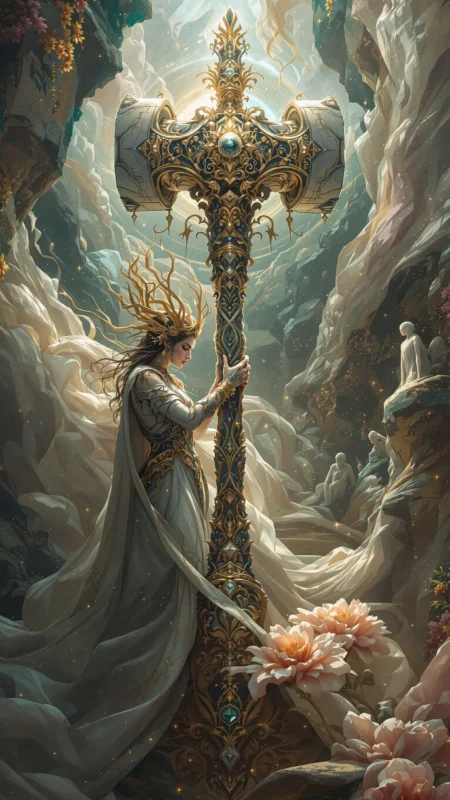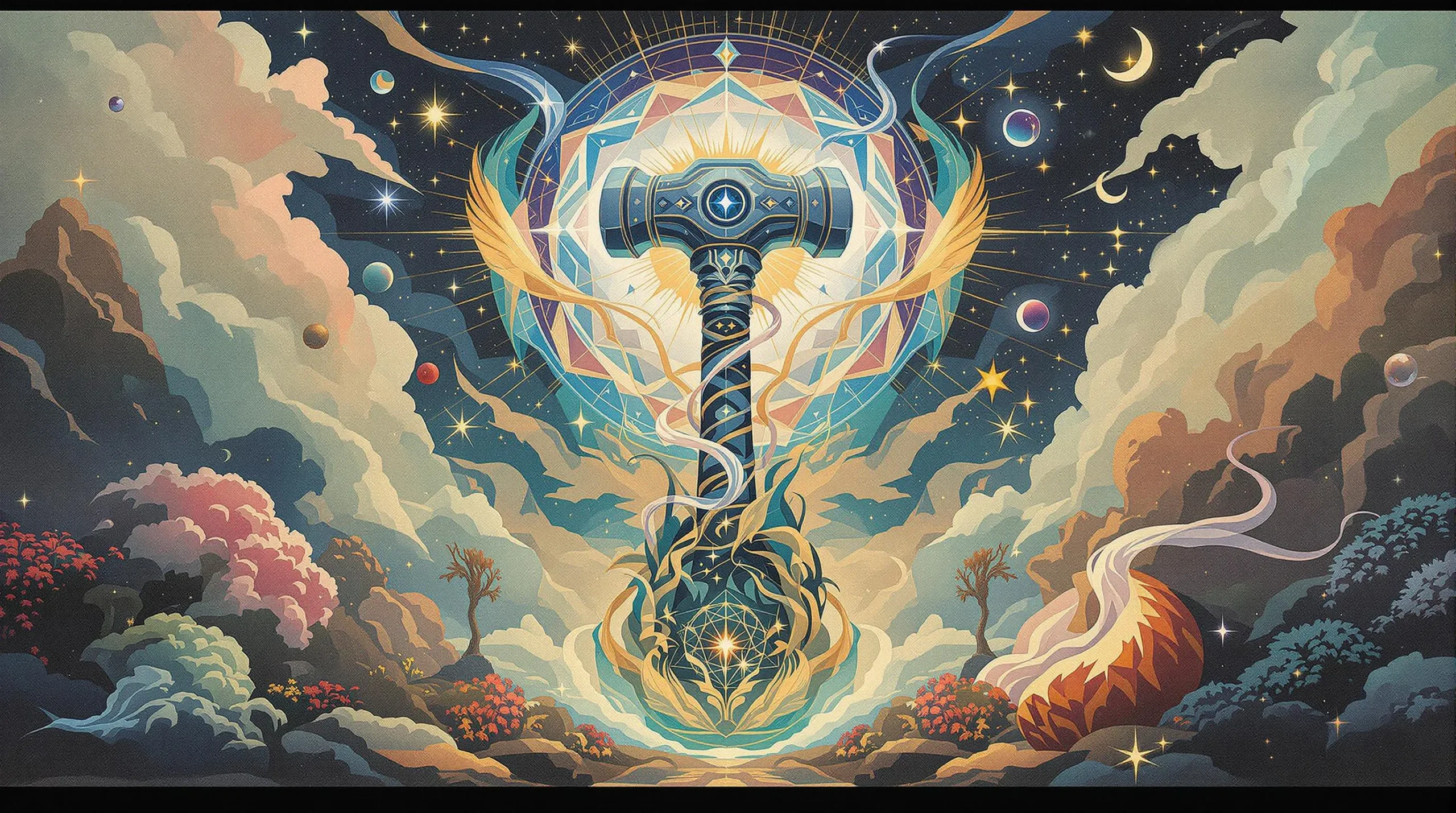


Hammer

Archetype Meaning & Symbolism

Forceful, direct, impactful, blunt, constructive, destructive, unyielding, simple, rhythmic, loud

  • The world is not shaped by wishes, but by repeated, focused blows.

If Hammer is part of your personal mythology, you may...

Believe

  • Action is the only real measure of intent. Words are wind, but a deed has weight.
  • Every problem, no matter how complex, has a critical point of leverage—a place to strike.
  • It is better to break something that is flawed and start over than to live with its brokenness.

Fear

  • Paralysis and inaction. The feeling of being unable to act is a form of death.
  • Problems that are amorphous, subtle, and cannot be solved with direct force, such as emotional manipulation or systemic decay.
  • Becoming useless. A hammer that cannot be wielded serves no purpose and has no value.

Strength

  • An unwavering ability to make decisions and take direct, effective action, especially in a crisis.
  • The power to create tangible change in the world, to build new things, and to repair what is broken.
  • A focused will and a resilience that allows you to apply pressure until an obstacle gives way.

Weakness

  • A bluntness that can damage delicate situations or relationships. A lack of surgical precision.
  • A tendency to oversimplify, viewing every problem as a nail that requires the same forceful solution.
  • An impatience with processes that require nurturing, diplomacy, or passive observation.

The Symbolism & Meaning of Hammer

The Hammer in one's personal mythology speaks to a fundamental duality: it is a tool of both creation and destruction, often in the same swing. To drive a nail is to pierce the wood, a small act of violence for a larger act of construction. To live with the Hammer is to understand that progress may require breaking things: breaking habits, breaking silences, breaking ties, breaking open one's own heart. This archetype is not concerned with subtlety. Its truth is the truth of impact. It suggests that your life story might be one of tangible results, of things built and things dismantled. The narrative is not one of gentle growth, like a plant, but of percussive change, of distinct blows that shape your reality.

This archetype is perhaps the purest symbol of applied will. A hammer lying on a bench is inert, a piece of potential energy. It requires a hand to lift it, an arm to swing it, and an eye to guide it. In your mythos, the Hammer may represent your own capacity for action, a power that is yours to wield. It asks a critical question: what will you use this force for? Will you be a builder of bridges or a demolisher of sanctuaries? It posits that the world is not a thing to be passively observed but a material to be worked. Your reality is an anvil, and your will is the Hammer you bring down upon it, again and again, shaping your existence with every rhythmic strike.

Furthermore, the Hammer could symbolize a connection to a primal, almost terrestrial, power. It is an extension of the fist, a concentration of force that allows a person to alter the physical world. Its weight is a reminder of consequence, its impact a lesson in cause and effect. To have the Hammer in your mythos is to feel grounded in the world of the real, the solid, the demonstrable. You may find more truth in a well-built table than in a thousand abstract philosophies. It is the archetype of the artisan, the revolutionary, the builder: anyone who believes that the world is changed not by ideas alone, but by the focused, forceful application of work.


Hammer Relationships With Other Archetypes

The Nail

The Nail is the Hammer's most intimate partner. It represents a specific intention, a focused goal, a single point of entry. The Hammer provides the raw power, but without the Nail, that power is diffuse and ineffective, a blunt blow against a broad surface. The Nail gives the Hammer's force a purpose. In one’s mythos, the Nail could be the brilliant idea, the specific commitment, or the pointed truth, while the Hammer is the will required to drive it home. A successful life, from this perspective, may depend on the perfect alignment of a sharp intention (the Nail) with decisive action (the Hammer). A misaligned strike leads to bent nails and splintered wood: wasted effort and unintended damage.

The Anvil

If the Hammer is will, the Anvil is reality. The Anvil is the unyielding surface upon which all work is done. It represents the immutable facts, the hard truths, the foundational principles that cannot be changed. One may use the Hammer to shape the metal placed upon the Anvil, but one cannot shape the Anvil itself. A relationship with this archetype suggests an understanding of limits. A person with the Hammer in their mythos learns that their power is most effective when working with, not against, the fundamental nature of things. To strike the Anvil directly is an act of folly that only damages the Hammer, a metaphor for fighting battles against immovable realities.

The Hand

The Hand is the archetype of agency, skill, and consciousness that wields the Hammer. It is the sensitive intelligence that decides where, when, and how hard to strike. The Hammer has no morality of its own; it is the Hand that chooses whether to build a house or break a skull. For an individual, the Hand may represent their higher self, their conscience, or their strategic mind. The journey of maturing with the Hammer archetype is the journey of developing a wiser Hand: one that knows the difference between a tap and a blow, one that can feel the subtle feedback of each impact, and one that has the strength to put the Hammer down when a softer touch is required.

Using Hammer in Every Day Life

Breaking Through Denial

When a difficult truth remains unacknowledged, a silent agreement to ignore the obvious, the Hammer archetype provides the force for a single, shattering blow. It is the decision to finally speak the unspeakable, not with malice, but with the clear-eyed purpose of breaking a dysfunctional structure. This is not a conversation: it is an intervention, a singular moment of impact meant to clear the way for something new to be built on a foundation of honesty.

Forging a New Habit

The Hammer may represent the rhythmic, repetitive force needed to forge a new pattern of being. Each day you choose the new behavior: waking early, writing a page, going for a run. Each action is a single, deliberate strike. It is not glamorous or easy. It is the steady, percussive work of shaping the raw, resistant material of your own inertia until it takes on a new, stronger form. The power is in the consistency of the impact.

Establishing a Boundary

For a boundary that has been repeatedly tested or ignored, the Hammer offers the tool for a final, decisive declaration. This is not a gentle suggestion but a solid wall, erected with force. It is the unequivocal “no” that leaves no room for negotiation. It is the act of claiming your space with such authority that its violation becomes unthinkable. This use of the Hammer is not about aggression: it is about the powerful, definitive construction of personal safety.

Hammer is Known For

Driving a Nail

The quintessential act of construction. It symbolizes focused intention, the marriage of force and precision to join separate things into a functional whole. Each strike is a step towards a finished structure, a testament to the power of directed effort.

Forging Metal

In the smithy, the hammer is an instrument of profound transformation. It shapes incandescent metal on an anvil, beating raw material into a tool or a weapon. This symbolizes the power to mold circumstance, character, and potential through the application of pressure and will.

Demolition

The hammer’s power to destroy. A swing of a sledgehammer can bring down a wall, shattering what once stood strong. This represents the necessary act of deconstruction: breaking down old beliefs, obsolete structures, or unhealthy situations to clear the ground for something new.

How Hammer Might Affect Your Personal Mythology

How Hammer Might Affect Your Mythos

When the Hammer becomes a central object in your personal mythos, your life story may cease to be a meandering river and instead become a series of deliberate constructions. Your narrative is likely punctuated by decisive moments of impact: the day you quit the job, the moment you made the commitment, the argument that shattered a false peace. These are the hammer-blows that shape your timeline. You may see your past not as a collection of experiences, but as a series of projects, some successfully built, others left half-finished or demolished. Your personal legend is not written in ink but forged in iron and wood, a testament to what you have actively made of your life.

This mythos could also be one of profound utility. You may see your purpose as being fundamentally useful, a force for change in your family, community, or field. The story you tell yourself is that of the artisan, the builder, the fixer. The central conflict in your narrative may often revolve around a struggle against inertia, chaos, or decay. Your heroic journey is the act of bringing order from chaos, of building a stable structure in a volatile world, of applying force and will to a problem until it yields a solution. Your legacy, in this story, is not what you were, but what you built and what you fixed.

How Hammer Might Affect Your Sense of Self

To see yourself through the lens of the Hammer archetype is to see yourself as an agent of force. Your self-concept may be deeply entwined with your capacity to make an impact, to effect change. This can foster a powerful sense of competence and agency. You might not identify with who you are in a state of rest, but with who you are in a state of action. You are the swing, not the tool on the bench. This perspective can be a source of immense strength, giving you the confidence to tackle challenges that others might find overwhelming. You know, on a fundamental level, that you possess the power to alter your environment.

However, this identification carries a risk. If your sense of self is based on your utility, you may feel worthless when you are not actively “fixing” or “building.” You might struggle with moments of quietude or ambiguity, feeling a kind of existential panic when there is no nail to strike. There is a danger of objectifying yourself, of seeing your value as purely instrumental. This can lead to a disconnect from the softer, more receptive aspects of your being, and a fear that without your power to act, you are nothing at all.

How Hammer Might Affect Your Beliefs About The World

With the Hammer as a guide, you may view the world as fundamentally malleable. It is not a fixed, immutable stage upon which you play a predetermined part, but rather a workshop full of raw materials. Problems, from social injustice to a broken chair, are not states of being to be lamented; they are invitations to apply force and ingenuity. This is a profoundly empowering worldview, one that rejects victimhood and passivity. It fosters a belief that with the right tool and enough will, any structure can be dismantled and any new vision can be built.

This perspective, however, can also lead to a form of ideological blindness famously known as Maslow's Hammer: “I suppose it is tempting, if the only tool you have is a hammer, to treat everything as if it were a nail.” You may oversimplify complex, systemic problems, seeking a single point of impact where none exists. You might become impatient with diplomacy, nuance, and the slow, organic processes of growth. The world, when viewed only through the Hammer, can appear as a crude binary of things to be built and things to be broken, missing the vast, intricate web of connections that require a more delicate touch.

How Hammer Might Affect Your Relationships

In relationships, the Hammer archetype could manifest as a powerful, if sometimes clumsy, form of love. You may show affection through acts of service and problem-solving. When a loved one is in distress, your first instinct is not to soothe, but to act: to find a solution, to remove the obstacle, to fix what is broken. This can make you an incredibly reliable and helpful partner, friend, or parent, the one everyone turns to in a crisis. Your love is tangible; it builds, it repairs, it protects.

Yet, this approach has its shadow. The same impulse to “fix” can feel invalidating to a person who simply needs to be heard. Your direct, blunt communication style, meant to be efficient and honest, may be perceived as harsh or insensitive. You may struggle to navigate the delicate emotional landscapes that have no clear problem to be solved, no nail to be struck. You might inadvertently try to hammer down a partner's feelings, treating their emotions as a problem to be solved rather than a reality to be shared, creating distance where you intended to build a bridge.

How Hammer Might Affect Your Role in Life

Embodying the Hammer archetype often means you naturally assume the role of the Prime Mover or the Enforcer. In any group setting, whether a family or a company, you may be the one who pushes past debate and initiates action. You are the one who makes the difficult call, who drives the project forward when it stalls, who holds others accountable. Your role is defined by activity and decisiveness. You are not the keeper of the flame, but the smith who forges the tools for the future.

This role, while essential, can also be isolating. As the one who wields the force, you may be seen as intimidating or overly aggressive. Others might become dependent on you to make the hard choices, abdicating their own responsibility and fostering a dynamic of resentment. There is also the danger that you become trapped in this role, unable to show vulnerability or ask for help, because your identity is so tied to being the strong one, the one with the Hammer in hand. Your function becomes your identity, and you may forget how to simply be.

Dream Interpretation of Hammer

In a positive dream context, wielding a hammer can be a potent symbol of newfound agency and personal power. To dream of skillfully building a structure—a house, a boat, a bridge—may suggest that you are making tangible progress in your waking life. It could reflect the successful construction of a new identity, a healthy relationship, or a career path. The rhythmic sound of the hammer in the dream could be the heartbeat of your own creative force. Finding a hammer might symbolize the discovery of a new skill or a solution to a long-standing problem. It is the psyche telling you that you have the tool you need to shape your own reality.

Conversely, a hammer appearing in a negative dream context often speaks to themes of blunt force, aggression, and destruction. To be threatened by someone with a hammer could symbolize a fear of a direct, brutal confrontation or a feeling of being attacked by a powerful, unsubtle force in your life. If you yourself are wildly swinging a hammer and breaking things, it might represent your own unchecked anger or a destructive impulse that you fear. A dream of a hammer shattering something precious could signify the violent end of an illusion, a relationship, or a part of your life, a change that feels brutal and without finesse.

How Hammer Archetype Might Affect Your Needs

How Hammer Might Affect Your Physiological Needs

From the perspective of personal mythology, the Hammer archetype deeply informs one's approach to securing basic physiological needs. It represents the raw, physical effort required for survival. This is the energy that builds the shelter, chops the wood for the fire, and defends the home. For someone with this archetype, ensuring their own physical sustenance is not an abstract task but a series of concrete, forceful actions. They may feel a primal satisfaction in physical labor that directly contributes to their well-being, finding more security in a well-stocked pantry they filled themselves than in a promising stock portfolio.

The presence of the Hammer suggests a belief that survival is earned through direct impact on the physical world. There is little patience for passivity when basic needs are on the line. This can lead to incredible resourcefulness and a powerful drive to provide. However, it can also manifest as a deep-seated anxiety if one is prevented from taking direct action, as the feeling of being unable to swing the hammer to secure one's own survival can feel like a fundamental, existential threat.

How Hammer Might Affect Your Ideas of Belonging

Within the realm of love and belonging, the Hammer archetype translates into a language of action. Love is a verb. It is shown through tangible acts of service and fierce, protective loyalty. The person with this archetype may not be gifted with poetic words, but they will be the first one to show up to help you move, to fix your car, or to build a crib for your baby. They forge belonging by being demonstrably useful and reliable to their tribe. Their contributions are solid, weighty, and real.

This way of relating can create deep bonds of trust, but it may also falter where emotional nuance is required. A partner or friend who needs empathy and gentle listening might instead receive a list of solutions, feeling unheard and invalidated. The Hammer's approach to connection can be, “Let me fix this for you,” when what is needed is, “Let me sit with you in this.” This can create a tragic disconnect, where acts intended to build a bridge of connection inadvertently create a wall of misunderstanding, leaving the wielder of the Hammer feeling unappreciated and alone.

How Hammer Might Affect Your Feelings of Safety

The Hammer archetype addresses the need for safety with a direct and unambiguous force. Safety is not a passive state but an active construction. It is the hammer driving the bolt across the door, nailing the boards over the broken window, or building a fence around a property. To have the Hammer in your mythos is to believe that you are the primary agent of your own security. You do not wait for protection; you forge it with your own hands and your own will. This can create a profound sense of self-reliance and resilience.

This same tool for creating safety can also be a weapon. The Hammer represents the capacity for decisive, even brutal, self-defense. This aspect of the archetype suggests that safety sometimes requires a willingness to meet a threat with overwhelming force. The potential downside is a worldview where threats are seen everywhere, leading to a state of hyper-vigilance. The impulse to build walls can, if unchecked, lead to the creation of a prison, isolating oneself from the world in the name of security and seeing every interaction as a potential nail that must be hammered down.

How Hammer Might Affect Your Views of Esteem

Esteem, for one who identifies with the Hammer, is forged on the anvil of accomplishment. Self-worth is directly proportional to one's impact on the world. The satisfying thud of a nail driven true, the sight of a finished project, the resolution of a difficult problem through decisive action: these are the experiences that build a robust sense of self. Esteem is not given; it is earned through competence, strength, and the ability to produce tangible results. This creates a person who is often highly capable and confident in their abilities.

However, this foundation for esteem is conditional and potentially fragile. If worth is measured by productivity, then periods of rest, failure, or contemplation can trigger a crisis of self-worth. A missed swing, a bent nail, or a project that falls apart can feel like a direct blow to one's identity. The Hammer-wielder may struggle to value themselves for who they are, rather than for what they do. They risk becoming a human doing rather than a human being, their self-esteem perpetually dependent on the next successful strike.

Shadow of Hammer

When the Hammer's energy is too strong or misapplied, its shadow falls as tyranny and brute force. This is the person who uses their power not to build but to dominate. It is the rage that punches walls, the argument that demolishes another's spirit, the leader who rules through fear and intimidation. The shadow Hammer sees no difference between a nail and a thumb, and brings the same crushing force to both. It is destruction for its own sake, the unthinking application of power that creates rubble instead of foundations. In this shadow form, the wielder becomes a blunt instrument, incapable of finesse, and ultimately breaks not only their projects but also themselves and everyone around them.

The absence or suppression of the Hammer's energy manifests as its other shadow: utter powerlessness. This is the person who cannot assert a boundary, who cannot take the necessary action to build a life, who stands frozen before a clear and present problem. They see the nail but cannot bring themselves to swing. This leads to a life of passivity and victimhood, where one is constantly shaped by external forces rather than shaping their own destiny. This shadow is a quiet desperation, the tragedy of knowing what must be done and lacking the fundamental will or force to do it, becoming a permanent resident of a life they never intended to build.

Pros & Cons of Hammer in Your Mythology

Pros

  • You are profoundly effective. You get things done, turn ideas into reality, and solve concrete problems.
  • You possess a rare clarity and decisiveness, making you a pillar of strength and a natural leader in times of crisis.
  • Your reliability and tangible expressions of care can make you a cherished and secure presence in the lives of others.

Cons

  • You risk alienating others with a bluntness that can be perceived as insensitivity or aggression.
  • You may struggle mightily with complex, nuanced situations that have no simple point of impact, leading to frustration and poor outcomes.
  • Your self-worth may become perilously tied to your productivity, leading to burnout and an inability to value yourself in moments of rest or failure.