Believe
 Fear
Fear Strength
 Weakness
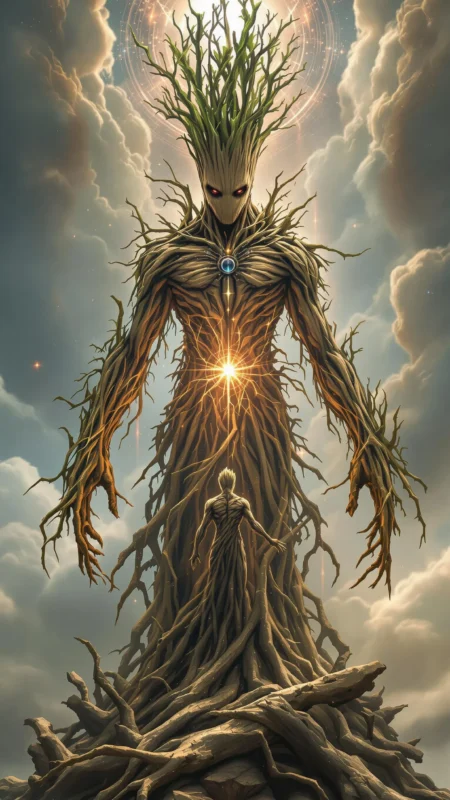
The archetype of Groot is, perhaps, our modern myth for resilience. It speaks not of the invulnerable hero who cannot be harmed, but of the hero who can be utterly destroyed and yet persist. This is not the clean resurrection of a phoenix from ash, but a messier, more organic process. To grow back from a twig is to carry the memory of the great tree you once were, a process shaded with the melancholy of what was lost. The symbolism here is potent for a personal mythology: it suggests that our traumas and losses do not simply vanish. Instead, they become the fertile ground from which a new, perhaps smaller and more vulnerable, version of ourselves must painstakingly grow. It sanctifies the period of diminishment, framing it not as failure but as a necessary fallow season before the return of life.
Furthermore, Groot symbolizes the power of communication that transcends the poverty of words. In a world saturated with noise, his simple, repeated phrase, “I am Groot,” becomes a canvas onto which all meaning can be projected. Its power lies in its context, in the trust between speaker and listener. To have a Groot in one’s mythos may be to acknowledge a profound truth: that the deepest understanding is often non-verbal, intuitive, and forged in shared presence. It suggests that what we do and who we are for each other is a language far more potent than what we say. He is a testament to the idea that true connection does not require eloquence, only a willingness to listen with one’s whole being.
He is also the quintessential gentle giant, a figure of immense physical power whose primary instinct is not aggression but protection. The Groot archetype challenges conventional narratives of strength, which often equate power with dominance. His strength is that of the ancient forest: sheltering, life-giving, and fiercely defensive when the ecosystem is threatened. In a personal mythos, this could represent a commitment to a form of power rooted in compassion. It is the strength to absorb a blow rather than to deal one, the might to be a living shield for the vulnerable, and the courage to express tenderness without shame. It is a quiet, rooted power that enables others to flourish in its shade.