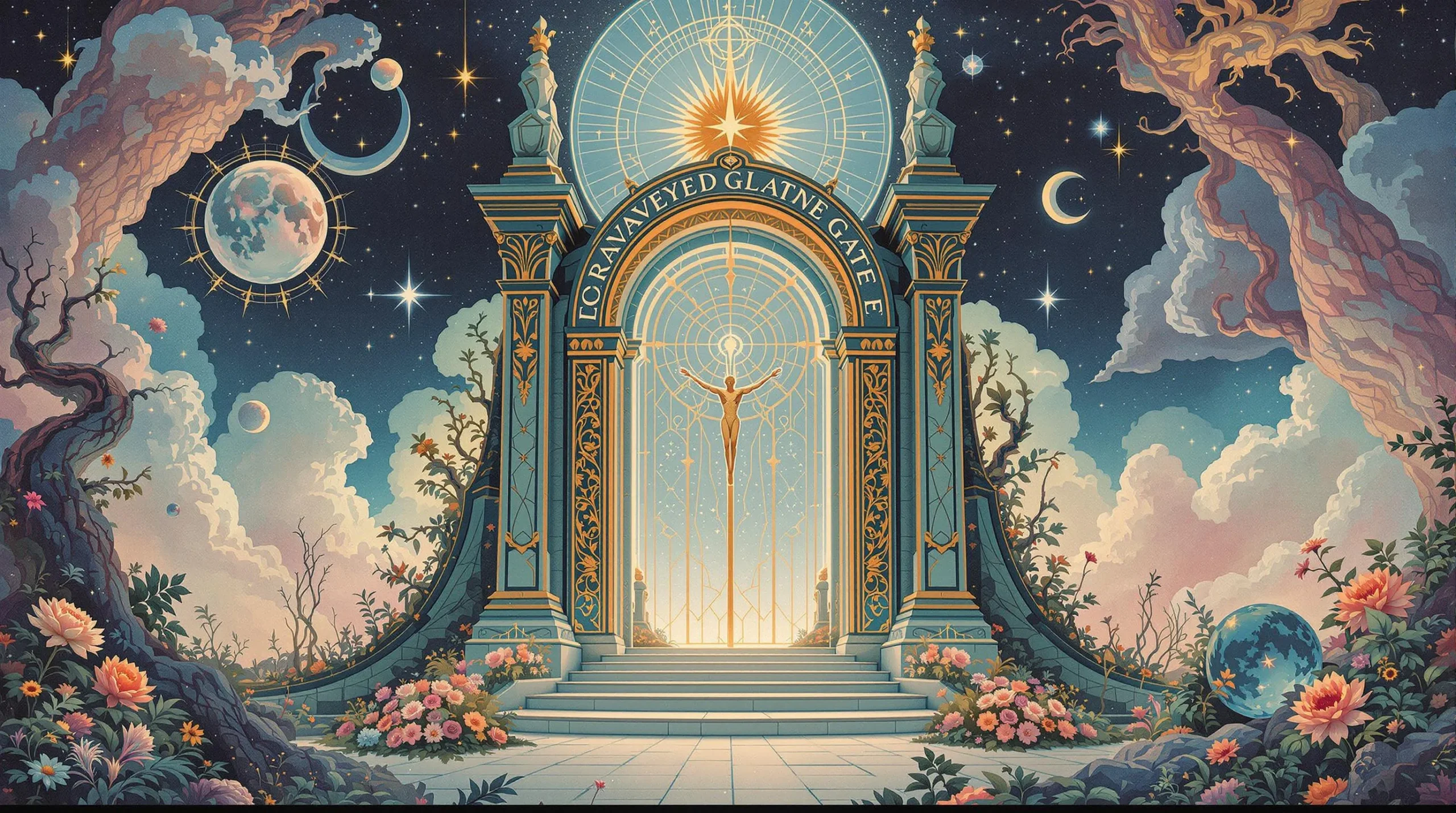


Graveyard Gate

Archetype Meaning & Symbolism

Liminal, Sentinel, Ornate, Stoic, Weathered, Final, Imposing, Silent, Definitive, Protective

  • Tread with reverence for the finality you seek and the peace you leave behind. All things pass through me, but only once.

If Graveyard Gate is part of your personal mythology, you may...

Believe

  • Endings deserve the same reverence, ritual, and attention that we give to beginnings.

  • True peace is found not in keeping options open, but in having the courage to close a door for good.

  • Boundaries are the highest form of respect: they honor what is being protected inside and what is being kept outside.

Fear

  • Lingering ambiguity and unresolved situations that allow the past to haunt the present.

  • Being forced to reopen a chapter of your life that you have ceremonially and officially closed.

  • The cold finality of your own decisions, the terrifying thought that some gates, once locked, can never be unlocked again.

Strength

  • An unparalleled ability to establish and maintain firm, healthy boundaries in all areas of life.

  • A profound capacity for finding closure after loss or failure, and for guiding others through that process.

  • A stoic resilience that allows you to face endings and finality with a rare and calming grace.

Weakness

  • A tendency toward rigidity and black-and-white thinking that struggles with nuance or compromise.

  • A risk of being too quick to close the gate, prematurely ending relationships or cutting off opportunities for growth and reconciliation.

  • An emotional guardedness that can be perceived by others as coldness, detachment, or an unwillingness to be truly vulnerable.

The Symbolism & Meaning of Graveyard Gate

In personal mythology, the Graveyard Gate is the quiet custodian of our conclusions. It is not the morbid skull, but the ornate, wrought-iron sentinel that stands between what is and what was. Its presence in one's inner landscape suggests a deep, perhaps unconscious, understanding that endings require as much structure and dignity as beginnings. This archetype represents the crucial act of creating boundaries with our own history. It is the part of us that knows when to declare something over: a job, a love, an identity. It's the sacred pause before we turn away, the formalization of a goodbye. The Gate doesn't slam shut in anger; it closes with a heavy, resolute click, promising to guard the memories within, protecting them from the carelessness of the present.

More than a symbol of death, it is a symbol of well-managed life. A life without such gates is a chaotic landscape where the past bleeds into the present, where old wounds are never allowed to scar over, and old conversations echo endlessly. To have the Graveyard Gate in your mythos is to value psychological tidiness, to believe in the power of ritual to bring order to the chaos of loss. The moss on its stone pillars may speak of time, the rust on its bars of the tears of many partings, but its form stands resolute. It offers a profound peace: the peace of knowing that what is done is done, and it has been laid to rest with honor.

This archetype challenges the modern obsession with keeping all options open. It posits that true freedom may not come from infinite choice, but from the courage to make a few profound ones, including the choice to end things. The Gate asks you to consider what parts of your life you have allowed to become restless ghosts, wandering because they were never given a proper burial. It offers itself as the instrument for that ceremony, a tool for building a sanctuary for your past so that you might fully inhabit your present.


Graveyard Gate Relationships With Other Archetypes

The Gardener

The Gardener, who cultivates life, and the Graveyard Gate, which consecrates its end, share a symbiotic, if somber, relationship. The Gardener's domain of vibrant, chaotic growth ends precisely where the Gate's jurisdiction begins. For the Gardener, the Gate may be a constant, melancholic reminder of the ultimate fate of all living things they tend. For the Gate, the Gardener is the one who brings beauty and continuation to the threshold, planting roses that climb its stone pillars or laying wreaths upon its bars. This relationship speaks to the personal mythos of one who understands that tending to life and honoring its conclusion are two sides of the same sacred duty.

The Key

The relationship between the Graveyard Gate and the Key is one of profound tension. The Key's essential nature is to open, to reveal, to grant access. It may see the Gate's lock as a challenge to be overcome, a puzzle to be solved. But the Gate's lock may not be for entry; its purpose may be to seal. The Gate teaches the Key that some doors are meant to remain closed, that not all secrets are for the living to uncover. This dynamic within a personal mythology could represent the conflict between the desire to revisit and analyze the past (the Key's impulse) and the wisdom of letting it rest undisturbed (the Gate's purpose).

The River

The River embodies constant flow, change, and the relentless passage of time, carrying all things with it. The Graveyard Gate is its antithesis: static, permanent, and a monument to finality. A river may flow past a graveyard, a powerful metaphor for life continuing alongside acknowledged endings. The River might see the Gate as a stubborn obstacle to its eternal current, a place of unnatural stillness. The Gate, in turn, sees the River as a reminder of all that is fleeting. It teaches the River, and the individual, that some things are not meant to be swept away and forgotten in the current, but must be anchored in place, honored, and left behind.

Using Graveyard Gate in Every Day Life

Navigating a Career Change

The end of a long-held job is not a failure but a passage. The Graveyard Gate archetype encourages you to treat this transition with ceremony. Instead of slinking away or burning bridges, you might perform a private ritual: writing a letter of gratitude to the role, boxing up mementos with intention, and consciously 'locking the gate' on that chapter. This act transforms a painful exit into a dignified closing, freeing your energy to face the new path without the ghosts of the old one clinging to your back.

Ending a Relationship

When a partnership concludes, the impulse can be to leave the door ajar for ambiguity, for a possible return. The Gate teaches the wisdom of a clean, respectful break. It is the decision to have one final, honest conversation, to state the ending clearly, and then to cease contact not out of malice, but out of respect for the reality that what you shared now belongs to the past. It's the symbolic turning of a key in a lock, protecting the memory of the relationship from the slow decay of maybes and what-ifs.

Processing Grief

The Gate is the point of acceptance in mourning. It is the moment you stop fighting the reality of a loss and begin the work of remembrance. To use this archetype is to create a formal space for your grief: to build an altar, to visit a meaningful place, to set aside a specific time to feel the sorrow fully. This act is the Graveyard Gate in motion. It delineates the wild, chaotic pain from the structured, hallowed ground of memory, allowing you to honor what was lost without letting it consume all that remains.

Graveyard Gate is Known For

Marking a Threshold

It serves as the clear, undeniable boundary between the world of the living and the realm of memory, between the active present and the sealed past. Its very presence is a statement of separation and transition.

Imposing Finality:

The Gate symbolizes a one-way passage. It is not about return trips or casual visits. It embodies the concept of absolute closure, the stark reality that some things, once concluded, are permanent.

Silent Witness:

It stands impassively through seasons of sorrow and remembrance, observing generations of human experience without judgment. It represents a stoic, unshakable acceptance of life's ultimate cycles of beginning and end.

How Graveyard Gate Might Affect Your Personal Mythology

How Graveyard Gate Might Affect Your Mythos

When the Graveyard Gate is a central object in your personal mythos, your life story is likely not a meandering stream but a series of distinct, well-defined chambers. Transitions are not gradual drifts; they are decisive moments of passage. Your narrative is marked by clear endings that give subsequent chapters their meaning. You might describe your life in terms of 'before' and 'after' a significant event, and that event is symbolized by you walking through a gate, consciously closing it, and hearing the lock click shut. This mythos is not about avoiding the past, but about curating it, giving each era its own protected space.

The story you tell of yourself could be one of transformation through conclusion. You are not the person you were ten years ago because you intentionally laid that person to rest, with honor and respect. This narrative structure provides a sense of order and control in a chaotic world. It suggests that you are the author and gatekeeper of your own story, deciding with intention which chapters are finished and which are yet to be written. The recurring motif is one of respectful finality, where goodbyes are as important and powerful as hellos.

How Graveyard Gate Might Affect Your Sense of Self

Your view of self may be deeply intertwined with the role of a guardian. You might see yourself as the keeper of your own boundaries, someone who is unafraid of the solitude that comes with saying 'no' or 'this is over.' There could be a quiet pride in your ability to withstand the emotional storms of endings, to offer a steady hand when others are falling apart. You may not see this as coldness, but as a necessary strength, a service to yourself and others. This self-concept is built on a foundation of emotional integrity; you are someone who means what they say, especially when it comes to goodbyes.

There is a stoicism here, a sense of being weathered by experience but not broken by it, much like the Gate itself. You might identify with a kind of old-world dignity, believing that composure in the face of loss is a virtue. This could lead to a very self-reliant persona, one who processes grief privately and believes in the importance of maintaining structure even when your inner world is in turmoil. You may see vulnerability not as spilling your feelings indiscriminately, but as having the courage to face finality and close the gate when it is time.

How Graveyard Gate Might Affect Your Beliefs About The World

Your worldview may be structured around the sanctity of boundaries and the importance of cycles. You might see the world not as a seamless whole, but as a collection of distinct spaces, each with its own rules, purpose, and energy. A workplace, a home, a friendship, a memory: each is a territory with a gate. This perspective values order, ritual, and the clear delineation of things. It could lead to a deep appreciation for traditions, laws, and social contracts that make life predictable and safe. The world makes sense when things are in their proper place, and the past is kept respectfully separate from the present.

This view may also foster a profound acceptance of mortality and the natural rhythm of life and death. You may not fear endings in the way others do, seeing them instead as a necessary and even beautiful part of the whole design. This perspective could find comfort in the changing of seasons, the setting of the sun, and other natural symbols of conclusion. The world is not a place of infinite, messy potential, but a structured, elegant system of passages, each leading to a new state of being, with the Graveyard Gate serving as the silent, ever-present symbol of that ultimate, orderly transition.

How Graveyard Gate Might Affect Your Relationships

In relationships, you may operate with a code of absolute clarity. You are likely the one who defines the relationship, who insists on conversations about where things stand, and who values explicit commitment. Your friendships and partnerships are built on the security of knowing the boundaries. This can make you an incredibly trustworthy and reliable partner, someone whose 'yes' means yes and whose 'no' means no. You offer a sanctuary of certainty in a world of relational ambiguity. People know where they stand with you, for better or for worse.

However, this need for definition can be challenging. You might struggle with the 'talking phase' of dating or with friendships that are situational and fluid. Your instinct is to establish the gate and know who is inside and who is outside. When a relationship ends, your approach is likely to be swift and decisive, which can be perceived as cold or unforgiving. You may not be one for drawn-out breakups or on-again, off-again dynamics, as these violate the Gate's core principle of clean, honorable closure. You seek partners who appreciate your structure, not those who wish to live in a state of perpetual openness.

How Graveyard Gate Might Affect Your Role in Life

You may unconsciously adopt the role of the 'Closer' or the 'Executor' within your family, friend group, or workplace. You are the one people turn to when a hard decision needs to be made, when a project needs to be officially terminated, or when a painful truth needs to be spoken to end a period of uncertainty. This role is a heavy one, often thankless, but you may feel it is your duty to provide the steady hand that guides things to their proper conclusion. You are the one who plans the memorial, who cleans out the deceased's home, who fires the underperforming employee with as much dignity as the situation allows.

This role of gatekeeper extends to protecting the integrity of a group or a tradition. You may be the family historian who insists on honoring anniversaries of loss, ensuring that the departed are not forgotten. In a community, you might be the one who upholds the standards, the one who has to say 'this is not who we are' when the group strays from its values. You act as a social and emotional gate, preserving the sanctity of what lies within by being a judicious guardian of its entrance.

Dream Interpretation of Graveyard Gate

In a positive context, dreaming of a Graveyard Gate may signal a profound moment of psychological transition. To see the gate standing open, perhaps with light streaming through, could suggest that you have successfully processed a period of grief and are now ready to move forward. You have made peace with a significant ending in your life. Walking through the gate willingly and calmly into the graveyard might symbolize a healthy acceptance of your own past, mortality, or a desire to connect with your ancestry. It is not a dream of death, but a dream of respectful integration of what has come before.

Conversely, a dream featuring the Graveyard Gate can be unsettling. If the gate is rusted shut, you are locked out, and you desperately need to get in, it could signify unresolved grief or a feeling that you have unfinished business with the past. If you find yourself locked inside the graveyard, unable to get out, it may represent a fear of being trapped by your past, morbidly attached to a loss, or a feeling that your life is over in some meaningful way. A menacing or crumbling gate might speak to a fear that the boundaries between your past and present are failing, that the ghosts you thought were laid to rest are threatening to return.

How Graveyard Gate Archetype Might Affect Your Needs

How Graveyard Gate Might Affect Your Physiological Needs

The Graveyard Gate archetype may manifest in your physiological needs through a deep-seated demand for cycles and completion. Your body might not just prefer, but require, a clear end to its processes. You may be someone who needs to finish every meal on your plate, not out of hunger, but to honor the ritual of completion. Sleep might be governed by a strict schedule, a closing of the gate on the conscious world, and you may find interruptions to your sleep cycle deeply unsettling, a violation of a sacred boundary.

This need for demarcation could extend to exercise, where a routine must be completed in its entirety, or to daily work, where loose ends create a palpable sense of physical anxiety. Your body's sense of well-being may be directly tied to this rhythm of beginning, doing, and definitively ending. It is a physiological expression of the need for order, where the body itself becomes a territory with gates that must be opened and closed with intention for it to function optimally.

How Graveyard Gate Might Affect Your Ideas of Belonging

Love and belonging are understood through the lens of inclusion and exclusion. For you, to belong is to be brought 'inside the gate.' It is a conscious, deliberate act of inclusion into a sacred, protected space. This can lead to incredibly deep, loyal, and fiercely protective relationships. You may not have a wide circle of friends, but your chosen few are family, granted full access to your trust and support. Love is not a casual or fluid thing; it is a commitment, a key offered to another.

This need for clear demarcation can make navigating larger, more fluid social situations challenging. You may feel uneasy in groups where allegiances are temporary and relationships are superficial. You might be perceived as aloof or cliquey, when in reality you are simply trying to determine where the boundaries lie. The feeling of being 'in-between'—not quite a friend, not quite a stranger—can be a source of profound discomfort. For you to feel a sense of belonging, the gate must be opened for you, and you must know you are truly on the inside.

How Graveyard Gate Might Affect Your Feelings of Safety

Your need for safety is likely met not by the absence of threats, but by the presence of strong, unambiguous boundaries. Security is a locked door, a signed contract, a promise kept. The Graveyard Gate in your mythos means you find comfort in structure and predictability. You may feel most safe when you know the rules of engagement in any given situation and when you are confident that your personal space, both physical and emotional, is inviolable. The greatest threat to your safety is not chaos itself, but the blurring of lines.

This translates to a life where you may invest heavily in securing your home, managing your finances with meticulous care, and being highly selective about who you allow into your inner circle. Safety is the certainty that the past cannot intrude upon the present without your permission. It is the peace of mind that comes from knowing that the gate to past traumas or toxic relationships is not just closed but securely locked. Ambiguity feels dangerous; clarity feels like a fortress.

How Graveyard Gate Might Affect Your Views of Esteem

Your self-esteem is built upon a foundation of personal integrity, decisiveness, and emotional fortitude. You feel good about yourself when you act in accordance with your principles, especially when it involves making a difficult but necessary choice. Your esteem swells when you successfully establish a boundary that protects you or someone you care for. There is a deep sense of self-worth derived from being a reliable, steadfast guardian of your own life, a person who can be counted on to close a door when it needs to be closed.

You likely pride yourself on your ability to handle finality with grace and to provide stability for others in times of loss. Your self-respect is not tied to being liked by everyone, but to being respected for your consistency and strength. Conversely, your esteem may plummet when you act with ambiguity, leave a situation unresolved, or allow your boundaries to be violated. For you, self-worth is synonymous with being a trustworthy keeper of the gates.

Shadow of Graveyard Gate

The shadow of the Graveyard Gate emerges when the guardian becomes a jailer. In this dark aspect, you don't use the gate to protect a sacred space of memory, but to create a prison for your own feelings. The gate is turned inward, locking away unfelt grief, unprocessed anger, and unacknowledged parts of the self. Your inner world becomes a series of tombs, each holding a feeling you were too afraid to face. You become brittle, emotionally constipated, and your stoicism curdles into a profound and lonely detachment. The gate is no longer about honoring the past, but about denying it, and the ghosts you refuse to bury rattle their chains behind it, draining the life from your present.

Conversely, the shadow can manifest as an inability to ever close the gate. Here, you become a morbid curator of your own museum of sorrows. The gate is left perpetually ajar, and you spend your days wandering among the tombstones of past hurts, failed relationships, and old grievances. You invite others to tour your graveyard, making your past wounds the most interesting thing about you. This prevents any new life from taking root, as the present is constantly overrun by the ghosts of yesterday. The archetype's purpose of providing peace through closure is inverted into a state of perpetual, romanticized mourning, where nothing is ever allowed to truly end and, therefore, nothing new can ever truly begin.

Pros & Cons of Graveyard Gate in Your Mythology

Pros

  • You cultivate a life of profound clarity, with distinct chapters and minimal emotional baggage from the past.

  • In times of crisis, loss, or transition, you are a source of immense strength and stability for yourself and others.

  • You possess a deep and abiding respect for the cycles of life, which grants you a unique and powerful form of peace.

Cons

  • Your decisiveness and need for clear boundaries can be perceived by others as cold, rigid, or unforgiving.

  • You risk missing out on second chances or opportunities for reconciliation by being too quick to declare something permanently over.

  • Your inner need for clean, definitive closure can make it difficult to exist in the messy, unresolved, and ambiguous flow of everyday human life.