
Gorgon
Symbolism, Meaning & Spirit Animal
A gorgon is a female monster from Greek myth with snakes for hair whose gaze turns onlookers to stone, the best known being Medusa. Gorgon symbolizes protective power, truthful terror, transformation, and the refusal to be made harmless.
The Symbolism & Meaning of Gorgon
The Gorgon means power that refuses to become reassuring. Its face does not charm danger away. It meets danger with a stare so direct that the viewer loses the ability to move. That is why the image carries such force. The Gorgon does not symbolize fear alone. It symbolizes fear turned outward, shaped into a boundary, and made capable of defending what remains vulnerable behind it.
Medusa's severed head gives the symbol another charge. A person can lose the life they knew and still retain a power that was not visible before. The head becomes portable protection. It can be carried, displayed, mounted on a shield, or placed above an entrance. What was once attached to a condemned body becomes an emblem that protects others. The image therefore speaks to transformation without promising that transformation will feel beautiful while it happens.
The Gorgon is often misunderstood because its appearance announces danger before its story can be heard. Ancient artists gave it snakes, tusks, wings, and a protruding tongue. Those details make the face difficult to domesticate. Yet Greek communities placed the gorgoneion on temples, armor, coins, and household objects. The same face that petrified enemies could turn harm away. Its ugliness had a public function. It warned the world not to come closer.
Do not fear what turns others to stone. It is merely the truth, solidified. Look at it.
This makes the Gorgon a symbol of the protective use of the monstrous. Some experiences leave a person less available to easy trust. The Gorgon does not call that failure. It asks what suspicion can guard, what anger can clarify, and which forms of beauty were built to survive rather than please. Its fierceness is not random aggression. It is a response with a target: intrusion, violation, arrogance, and the demand that danger be welcomed politely.
The symbol also holds a conflict between truth and punishment. In Ovid's version, Medusa's beauty and transformation become part of a story about sexual violence and divine retribution. In older Greek accounts, the story is less sympathetic and more monstrous. Both versions leave the reader with a figure whose appearance records what others did to her, what they feared in her, or what they needed her to represent. The Gorgon tells the truth without making it comfortable.
To carry this archetype is to recognize that protection may look severe. It may involve distance, refusal, a guarded face, or an unwillingness to explain every wound. The Gorgon does not praise isolation for its own sake. It gives isolation a purpose. It stands at the threshold until trust has earned passage. Its beauty lies in the fact that it remains dangerous to what would destroy it.
What It Means When You See Gorgon: Signs & Symbolism
When Gorgon keeps appearing in art, dreams, jewelry, stories, or passing images, the important question is not whether the world has sent a supernatural message. The more revealing question is why this particular face has become difficult to ignore. Gorgon is not a gentle emblem of instinct. It is an image of protection after innocence has become unsafe, and of truth that cannot be made pleasant for someone else's comfort.
Meeting Gorgon with unease may suggest that a person is avoiding their own anger. They may have learned to appear agreeable while privately tracking every threat. The image brings the guarded part into view. It asks whether fear is still protecting the person, or whether it has started deciding where they can go. Unease can also mean recognition. The face looks frightening because it resembles a defense that has worked too well.
Meeting Gorgon with curiosity points somewhere different. The person may be looking for permission to become less available, less decorative, or less easily understood. They may want a form of strength that does not require constant warmth. Gorgon's presence can reveal a wish to tell the truth without translating it into something harmless. The attraction is not necessarily to violence. It may be to an unmistakable boundary.
Meeting Gorgon with grief often brings Medusa's altered body to the center. The person may be mourning the self they were before betrayal, public shame, displacement, or a life-changing rupture. They may also be grieving the fact that protection became necessary. Gorgon gives that grief a face that can survive being seen. It does not erase what happened, but it refuses to let the wound remain defenseless.
A person who keeps meeting Gorgon may be seeking a 

Gorgon can also appear when someone is about to reclaim a quality others called too much. Anger, intensity, suspicion, sexuality, ambition, or refusal may have been treated as defects. The image says those qualities can become deliberate rather than destructive. The question is not whether the person looks frightening. The question is what their frightening face now protects, and who has earned the right to see beneath it.
Which of these is also you?
Collect 8 to make a mythos.
0 of 8
These archetypes were chosen because you are reading about Gorgon.
Gorgon in Mythology & Legend: Where the Symbolism Comes From
In Greek mythology, the Gorgons were three daughters of the sea gods Phorcys and Ceto. Hesiod names them Stheno, Euryale, and 

Medusa became the best-known Gorgon through the story of Perseus. Athena and Hermes helped him approach her while she slept. Perseus used a polished shield to see her reflection instead of meeting her gaze directly, then cut off her head. From Medusa's severed body came 
The Gorgon's face appeared across the Greek world on temples, armor, shields, coins, pottery, and household objects. In this setting, the image did not simply represent evil. It guarded thresholds by confronting danger with a more frightening face. A traveler, soldier, or worshipper could place the gorgoneion on an object to repel harm. The same stare that killed in myth could protect in practice. Gorgon imagery often appeared at entrances and on objects meant to face outward.
Greek traditions did not give Medusa one settled origin. In Hesiod, she is already a daughter of ancient sea powers. In Ovid's Roman retelling, she was once a beautiful woman transformed after Poseidon violated her in Athena's temple. Ovid makes her change central to the story, while earlier Greek sources focus more on her monstrous form and death. Later readers have therefore found in Medusa both a dangerous monster and a punished woman whose appearance became a defense.
The protective reading continued into Roman art, where Medusa's head appeared on armor, mosaics, buildings, and luxury objects. In parts of the ancient Mediterranean, the face worked as an apotropaic sign, meaning an image intended to turn away harm. Its purpose depended on opposition. A terrifying face could keep a worse force outside.
Modern artists, writers, and activists often reclaim Medusa as an image of rage, survival, female autonomy, or resistance to sexual violence. That interpretation belongs to later reception, not to every ancient account. Across the traditions, however, one tension remains clear: the Gorgon is both threat and guard, both victim in some versions and killer in others. Her face frightens because it does not ask permission to remain powerful.




Gorgon and Its Relationships With Other Archetypes

Medusa
“Medusa is the one they remember; we were three sisters, and only she could die.”
In Greek myth the Gorgons were three sisters, and only Medusa was mortal, which is why Perseus could take her head. Medusa gives Gorgon its human story of harm and punishment, while Gorgon is the older, wider power behind her.
Visit Medusa
Athena
“Athena wears my face on her breast, and it fights on her side.”
After Perseus killed Medusa, Athena set the Gorgon's head on her aegis, so the terror became the goddess's protection. The pairing describes a person who turns what once threatened them into armor, and is feared for it.
Visit Athena
Shield
“Greek warriors painted my face on their shields so the enemy met me first.”
The gorgoneion, a Gorgon's face, appears on Greek shields, armor and temple roofs as a guard against harm. Shield and Gorgon together say that a frightening face can be a protective one, and that some people look fierce in order to keep others safe.
Visit Shield
Stone
“Look straight at me and you become Stone, still forever in that one moment.”
Anyone who met a Gorgon's gaze turned to stone, which is why Perseus looked at Medusa only in the reflection of his shield. Stone is what Gorgon makes of those who will not look at the truth sideways, and the pairing warns that some things can only be faced indirectly.
Visit Stone
Evil Eye
“Evil Eye and I both stare back, so the harm turns and goes elsewhere.”
Like the gorgoneion, evil eye charms work by looking back at whatever ill will is aimed at their owner. Together they belong to a person who protects themselves by refusing to look away, and who would rather unsettle than be made harmless.
Visit Evil Eye
Gorgon also keeps company with the otherworld: Astral Projection, Dagda, Harry Potter, Neo, Ron Weasley and The Twilight Zone, among sixty-nine others of the otherworld.

Gorgon in Dreams: Meaning & Interpretation
Dreaming of a Gorgon often brings attention to fear that has become useful. The dream may appear when a person feels watched, judged, exposed, or forced to face something without softening it. The Gorgon can also arrive during a change in identity, especially when an older version of the self no longer feels safe to inhabit. Its snakes, stare, and severed head give the dream a severe vocabulary for protection.
The dream is doing more than predicting danger. It may be testing whether fear still controls the dreamer, or whether fear has become a boundary. A frightening Gorgon can mark anger that has been hidden too long. A calm Gorgon may show that the dreamer is ready to look directly at a difficult truth. When the dreamer feels grief, Medusa's story can hold the pain of being changed by what happened. When the dreamer feels curiosity, the image may be inviting a less obedient self into view.
A Gorgon stands at a doorway and does not attack: this often welcomes a firm boundary. The dreamer may be ready to stop explaining a private decision or guarding everyone else's comfort. If the Gorgon turns away, protection may be available without confrontation.
A Gorgon chases the dreamer through a familiar house: this can warn that suppressed anger has entered ordinary life. A Gorgon whose face appears in the mirror may point toward shame, self-recognition, or fear of becoming unacceptable. A dreamer who defeats the Gorgon may be trying to cut away a defense before understanding why it was needed.
Gorgon: Positive & Negative Meanings
Positive Meanings
- Protects vulnerable boundaries without apology.
- Recognizes danger before others name it.
- Turns painful change into formidable presence.
- Tells difficult truths plainly.
- Defends outsiders from intrusion.
- Refuses beauty that depends on obedience.
Negative Meanings
- May treat uncertainty as proof of danger.
- Can make isolation feel morally superior.
- May punish curiosity before trust develops.
- Confuses fear with respect.
- Keeps old defenses after circumstances change.
- Can make tenderness difficult to receive.

The Shadow of Gorgon
The shadow of Gorgon begins when protection becomes identity. A person may keep every door closed because one door was once unsafe. Suspicion can feel like intelligence, and distance can feel like control. Over time, the guarded face may appear before any real threat arrives. Other people then encounter a verdict rather than a person, and the Gorgon becomes trapped inside the role of the one who cannot be approached.
This shadow can turn truth into punishment. The person may believe that being honest requires being cutting, or that softness proves surrender. They may use anger to end conversations before vulnerability becomes possible. They may also confuse being feared with being respected. The ancient image of the severed head matters here: a defense can keep functioning after the life that created it has changed.
Gorgon's shadow is not ugliness. It is the loss of choice beneath the armor. When every gaze feels invasive, the person may petrify themselves as thoroughly as anyone else. They stop moving toward friendship, pleasure, repair, or surprise. The protective face remains powerful, but it no longer protects a living future. Its deeper work is to preserve discernment without making isolation the only proof of safety.
How Did You End Up at Gorgon?
When did you first survive a moment by keeping your Gorgon face still, letting suspicion guard you while everyone else looked away?
What praise or payment made you keep showing the hard face, even after being feared became the reward, and what do you want now?
The Gorgon Hearth
Find Your Gorgon People
If Gorgon has ever turned up in your life, in a dream, a moment, a person, you are not the only one. Its people are gathering, and the first stories haven’t been told yet.
Joining is free: put Gorgon on your page, then press Join.

Talk to Warren about Gorgon
Gorgon rarely turns up by accident. Tell me where it found you, in a dream, a person, a habit you cannot shake, and we will work out what it wants with you.

 Written by Warren,
for you alone
A reading by Warren
What Gorgon means for you
This page says what Gorgon means. Warren can tell you why it is showing up for you, now.
Gorgon: Frequently Asked Questions
- What does Gorgon symbolize?
- The Gorgon means power that refuses to become reassuring. Its face does not charm danger away.
- What is the spiritual meaning of Gorgon?
- When Gorgon keeps appearing in art, dreams, jewelry, stories, or passing images, the important question is not whether the world has sent a supernatural message. The more revealing question is why this particular face has become difficult to ignore.
- What does Gorgon represent?
- In Greek mythology, the Gorgons were three daughters of the sea gods Phorcys and Ceto. Hesiod names them Stheno, Euryale, and Medusa.
- What does it mean to dream about Gorgon?
- Dreaming of a Gorgon often brings attention to fear that has become useful. The dream may appear when a person feels watched, judged, exposed, or forced to face something without softening it.
- What is the shadow side of Gorgon?
- The shadow of Gorgon begins when protection becomes identity. A person may keep every door closed because one door was once unsafe.
- What are the positive and negative meanings of Gorgon?
- Protects vulnerable boundaries without apology. May treat uncertainty as proof of danger.
- What does a Gorgon tattoo mean?
- Often, a Gorgon tattoo marks survival after violation or unwanted change. Some people choose it to claim anger and protection. Others wear the face because beauty, danger, and self-definition feel inseparable in their story.
Characteristics of Gorgon
- Covering:
- bare-skinned
- Form:
- winged
- Element:
- spirit
- Realm:
- otherworld
- Tradition:
- Greek
- Era:
- ancient
Gorgon imagery combines a human body with traits borrowed from several animals, making the face readable from a distance and disturbing up close. In archaic Greek art, wings, snakes, tusks, a protruding tongue, and wide staring eyes appear together rather than forming a natural species. The head could be detached and remain active as a weapon, an unusual visual solution that allowed one image to guard armor, buildings, and objects.
Get the next one
Essays on personal mythology, archetypes, and the stories we tell ourselves.
Take Gorgon home
Printed to order and shipped to you. Please allow a few extra days for production.
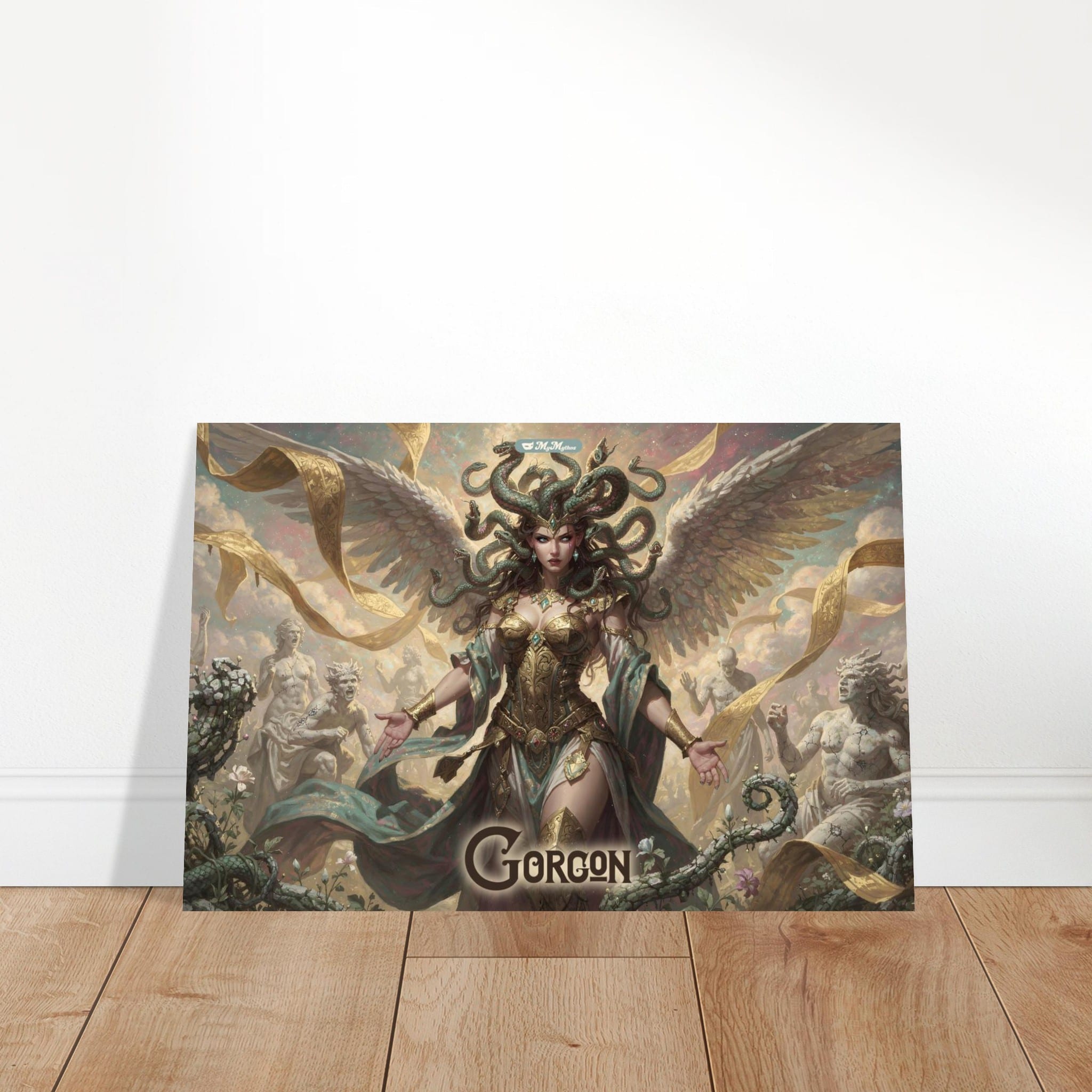
On your wall
Material
$19.00
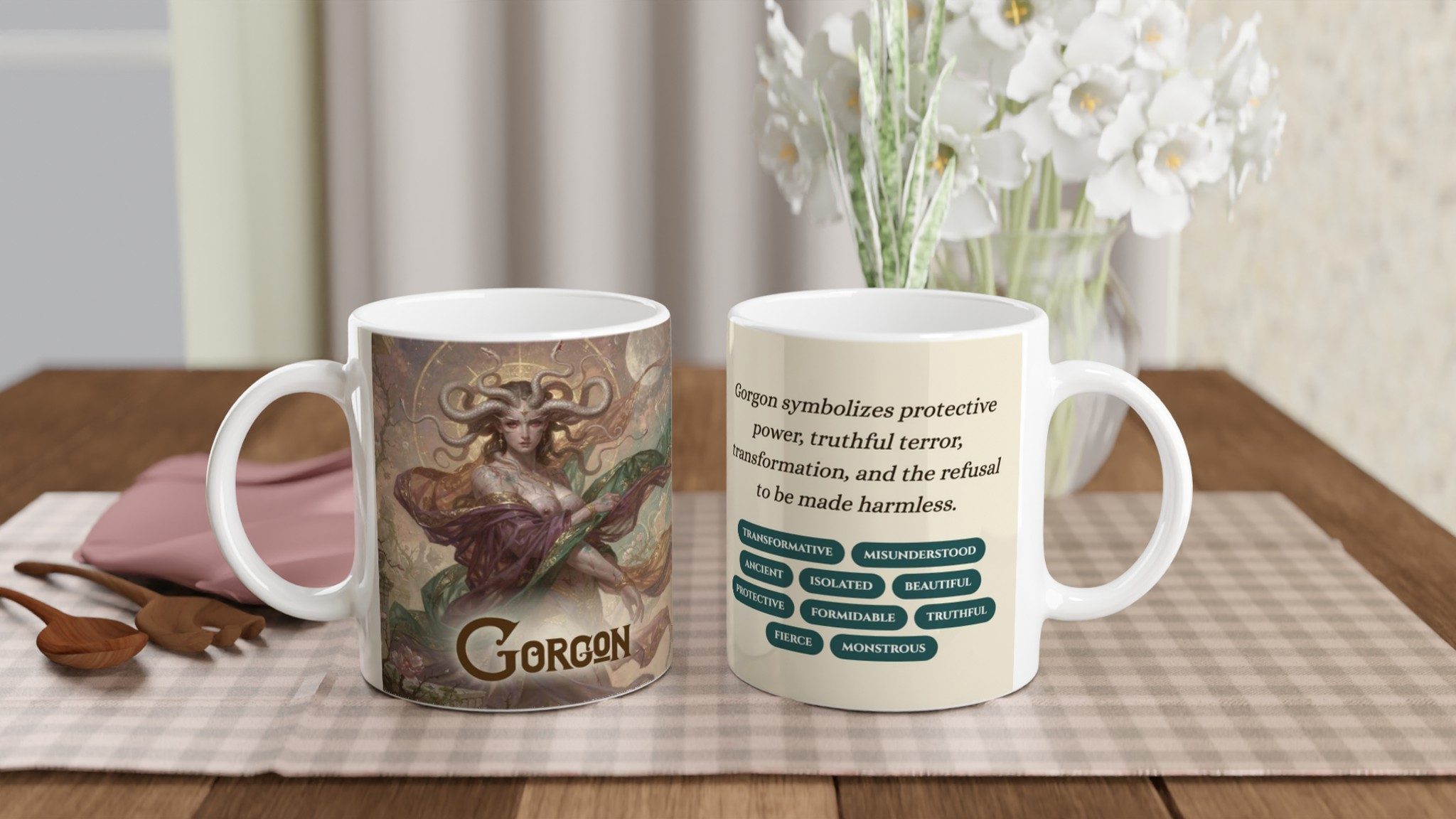
In your hands
Size
Color: White
$18.00
From elsewhere
Paid links: if you buy through these, MyMythos earns a small commission at no cost to you.