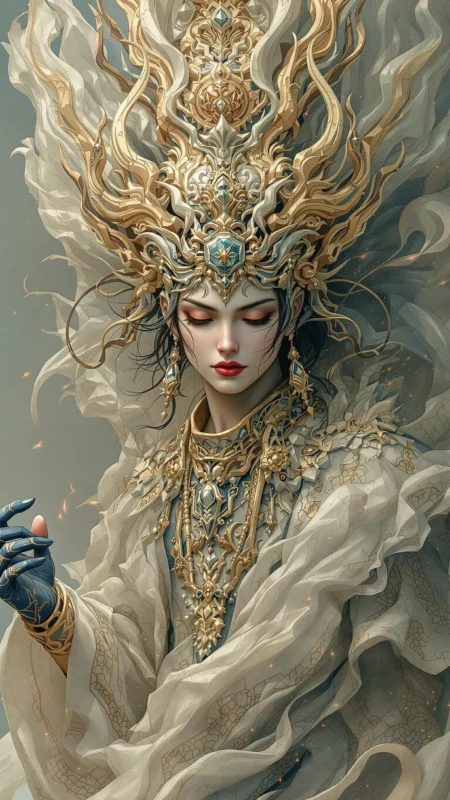
Gojo Satoru

Archetype Meaning & Symbolism

Powerful, Flamboyant, Isolated, Mentor, Reckless, Confident, Playful, Burdened, Revolutionary, Unpredictable, Godlike

  • Throughout Heaven and Earth, I alone am the honored one.

If Gojo Satoru is part of your personal mythology, you may...

Believe

  • That the only responsible use of overwhelming power is to tear down the old world to make way for the new.
  • That educating the next generation is the only revolution that truly matters.
  • That being alone at the top is not a choice, but a consequence of sight.

Fear

  • That you will be sealed away, your potential locked in a box while the world you meant to save crumbles.
  • That the very people you are trying to protect and empower will be the ones who betray you.
  • That for all your power, you cannot save everyone, and that the loss of a single, crucial person will be your ultimate failure.

Strength

  • A boundless well of self-confidence that allows you to treat impossible situations as mere inconveniences.
  • An almost supernatural ability to perceive the hidden mechanics of any system, allowing for brilliant and unorthodox solutions.
  • A charismatic and inspiring presence that can awaken the dormant potential in others.

Weakness

  • A blinding arrogance that leads you to underestimate genuine threats and overestimate your own indestructibility.
  • An emotional detachment that, while protecting you, prevents the formation of truly reciprocal, vulnerable relationships.
  • A tendency to take on every burden single-handedly, believing that asking for help is an admission of failure.

The Symbolism & Meaning of Gojo Satoru

The Gojo Satoru archetype may symbolize the apotheosis of individual power in a hyper-modern world. He is not a hero who struggles against the system; he is a living singularity so powerful the system itself becomes irrelevant around him. His existence poses a question for one’s personal mythology: what happens when your potential is not just great, but boundless? This archetype represents a break from the narrative of the incremental climb, suggesting instead the possibility of a quantum leap in ability, a sudden awakening to one’s own 'Limitless' nature. He is the myth of the beautiful, untouchable force, the man who flew so close to the sun he became one, casting a shadow of both awe and terrifying solitude.

The blindfold is perhaps the most potent symbol. In a world of information overload, Gojo’s choice to intentionally limit his perception is a radical act. It suggests that true power comes not from seeing everything, but from filtering out the noise to perceive the essential currents beneath the surface—the flow of 'Cursed Energy,' the hidden architectures of power. For a personal myth, this could represent the discipline of strategic ignorance. It is the conscious decision to ignore the metrics of failure, the chorus of doubters, and the overwhelming static of modern life, thereby preserving one's focus for what truly matters. It is a shield not against threats, but against the trivial.

His nonchalant, often flippant demeanor is a mask for a profound loneliness and the crushing weight of being the sole pillar holding up the sky. He is the lonely god who cracks jokes, the apex predator who plays with his food. This duality could symbolize the internal landscape of the exceptionally gifted. It may reflect a coping mechanism for a life where no one can truly share your perspective or your burdens. The humor is both a bridge to connect with others on a human level and an 'Infinity' barrier to keep them from getting close enough to see the exhaustion at the core. In this, he is a patron saint of the brilliant and the isolated, his laughter echoing in an empty room.


Gojo Satoru Relationships With Other Archetypes

The Unbreakable Cage

The relationship here may be the central paradox of a limitless existence. For a being whose very essence is the negation of boundaries, the Unbreakable Cage is not merely an adversary but perhaps the sole point of definition in an otherwise boundless void. It is the silent, geometric certainty against which the chaos of infinite power is measured. This Cage could be a physical prison, an ideological system, or even the metaphysical weight of a destiny one cannot outrun. The Gojo archetype does not struggle against it as one might a simple wall; rather, he dances with it, a brilliant comet skirting the edge of a black hole. The Cage is the one truth his power cannot unmake, the one question his confidence cannot answer. It represents a humbling, terrifying finitude, and its presence suggests that even a god might be shaped by the one prayer that can bind him, the horizon that gives the endless sky its form.

The Dying Star

There is, it seems, a unique melancholy reserved for the singular. The Dying Star is the ghost in this solitary cosmos—a former twin, a companion who once shared the same celestial orbit before its light began to curdle and collapse. The relationship is one of a profound, unresolved grief, a phantom limb in the night sky. The Gojo archetype may look upon this collapsing star not with simple enmity, but with the sorrow of a survivor, forever tethered to a memory of shared brilliance. This Dying Star could represent a fallen friend, a corrupted ideal, or the path not taken. It serves as a constant, silent accusation: that such immense power isolates, that it may inevitably sour, and that for every star that burns with impossible brightness, another must perhaps implode into darkness, leaving only the echo of its light to haunt the one left behind.

The Hopeful Seed

In the shadow of a mountain, a single flower struggles for light. The Gojo archetype’s relationship with the Hopeful Seed is that of this overwhelming, and perhaps dangerous, protector. He is the storm that clears the invasive weeds but could also uproot the very thing he means to save. The Seed represents potential, the fragile promise of a future, a new world he is trying to cultivate. Yet, his own nature—his blinding power, his isolating exceptionalism—makes him a precarious gardener. His touch could be a benediction or a blight. This dynamic is fraught with a tender anxiety; he may see in the Seed a chance for a legacy beyond his own destructive capacity, a world that will not need a figure like him. It is the tension between the nuclear reactor and the bird's egg it is trying to warm—a profound, almost desperate, attempt to nurture something pure without inadvertently crushing it beneath the weight of his own apotheosis.

Using Gojo Satoru in Every Day Life

Navigating Bureaucracy:

When faced with an unyielding institutional wall, one might channel this archetype not through force, but through playful disruption. You may not break the rules, but you might bend them into such baroque shapes that they lose their meaning. It is the act of treating a solemn procedure like a child’s game, a strategy that can disarm and confuse rigid gatekeepers, allowing you to slip through the cracks they never knew existed.

Confronting Burnout:

In a moment of profound exhaustion, the Gojo archetype could suggest a radical re-evaluation of energy expenditure. His blindfold filters the world; you might adopt a metaphorical one. This is not self-care as retreat, but as strategic optimization. It involves consciously choosing to disengage from trivial data streams—petty office politics, doomscrolling, draining social obligations—to conserve your 'Cursed Energy' for the few tasks that truly define your purpose. It is the art of achieving more by perceiving less.

Mentoring a Protégé:

When guiding someone with raw potential, this mythos encourages a form of teaching that is less instruction and more controlled chaos. You may create high-stakes, unconventional challenges designed to force a breakthrough. The goal is not to impart knowledge, but to awaken an innate power within the other person. It’s a pedagogy of the abyss: pushing them to the edge with the supreme confidence that they will not fall, but learn to fly.

Gojo Satoru is Known For

How Gojo Satoru Might Affect Your Personal Mythology

How Gojo Satoru Might Affect Your Mythos

To integrate the Gojo archetype into one's personal mythos is to fundamentally alter the plot. The story may cease to be a 'Hero's Journey' and become instead a 'Savior's Burden.' Life is no longer a quest for a prize but a long, strategic campaign to reform a corrupt world, a campaign only you have the vision and strength to lead. Your personal history might be re-contextualized not as a series of struggles, but as the forging of a weapon. Every past failure was merely data; every success a confirmation of your singular trajectory. The central conflict of your mythos becomes internal: how to wield absolute power without losing your humanity.

Furthermore, this archetype introduces the theme of the 'Benevolent Anomaly.' You may see yourself as a bug in the code of reality, a glitch whose existence forces the system to recalibrate. Your life narrative may shift from one of seeking belonging to one of accepting your inherent difference. The goal is not to find your place in the world, but to create a new world that has a place for you and for the 'strong, clever allies' you choose to cultivate. The story becomes less about self-discovery and more about world-creation, with you as its playful, unpredictable, and ultimately solitary architect.

How Gojo Satoru Might Affect Your Sense of Self

Adopting the Gojo archetype may instill a profound, almost unshakable sense of self-assurance. You might begin to view your own talents not as skills to be honed, but as fundamental laws of your own being. This could manifest as a belief in your own 'Limitless'—a core of boundless potential that, once accessed, can deconstruct any problem. The self is no longer a fragile thing to be protected, but a force of nature to be unleashed. It is a shift from 'I think I can' to 'I know it's possible because I am here.'

Conversely, this perspective could cultivate a deep and permeating sense of alienation. To view yourself, even metaphorically, as 'The Honored One' is to stand alone. You might feel a chasm opening between your perception of reality and that of those around you. Their fears may seem trivial, their problems easily solved, their joys simple. This is not born of arrogance, but of a genuine difference in processing power. The self becomes an island universe, intensely bright and powerful, but with seas too vast for anyone else to cross.

How Gojo Satoru Might Affect Your Beliefs About The World

With the Gojo archetype as a guide, one's worldview might become radically fluid. The world may no longer appear as a set of immutable facts and structures, but as a dynamic interplay of systems and energies. Institutions, traditions, and authority figures could lose their solidness, revealing themselves as mere patterns of belief, 'Cursed Techniques' of the collective, waiting to be analyzed and dispelled. The world is a puzzle box, and the belief is that you possess the unique insight—the 'Six Eyes'—to see how all the pieces fit and how they can be rearranged.

This perspective could foster a peculiar blend of cynicism and revolutionary optimism. The cynicism is directed at the present: the world is broken, run by self-serving, fearful old men who perpetuate a corrupt system. The optimism is reserved for the future. It is a belief in the power of the next generation, in the possibility of a total 'reset.' The focus shifts from incremental reform to radical replacement. One's purpose becomes not to fix the existing world, but to invest everything in the people and ideas that will one day tear it down and build something better.

How Gojo Satoru Might Affect Your Relationships

Relationships may be perceived through a strategic, almost pedagogical lens. People might be unconsciously categorized: are they a potential 'strong ally,' a civilian to be protected, or a part of the stagnant system to be bypassed? This doesn't preclude affection, but it frames it. Love and friendship are intertwined with potential and purpose. You may find yourself drawn to mentoring roles, pouring immense energy into a select few who you believe have the capacity to grow into something extraordinary. Connection is about mutual empowerment.

The archetype's influence might also erect an invisible wall around you: a personal 'Infinity.' People may feel they are close to you, they might even admire you, but they can never seem to make contact with your core self. This could be a deliberate choice, a way to protect others from the complexities of your inner world, or to protect yourself from distractions. Intimacy becomes a paradox. You are the center of your social universe, the sun that all planets orbit, yet you remain fundamentally untouchable, your warmth felt from a distance.

How Gojo Satoru Might Affect Your Role in Life

You may perceive your role in life as that of the great disruptor. You are not here to maintain harmony or uphold tradition; you are here to be the catalyst. Your purpose is to challenge every assumption, question every authority, and dismantle every system that stifles potential. This could manifest in a career path—the innovator, the startup founder, the activist—or in a more personal sphere, as the one in the family or friend group who always speaks the uncomfortable truth. Your role is defined by the impact you have, the degree to which you can 'reset' your corner of the world.

This also positions you in the role of the unorthodox mentor. Your purpose is not simply to teach, but to awaken. The goal is not to create followers, but to foster independent power, to raise allies so capable that they might one day surpass you. This is the long game. Your legacy is not your own list of accomplishments, but the strength of the generation you empower. The ultimate fulfillment of this role is to make yourself obsolete, to build a future that no longer needs a single, solitary pillar to hold it up.

Dream Interpretation of Gojo Satoru

In a positive context, to dream of Gojo Satoru may symbolize a profound connection with your own untapped power. His appearance, perhaps effortlessly dispelling a shadowy monster that was chasing you, could be your subconscious mind telling you that you already possess the solution to a waking problem. It might be a call to adopt a more confident, even playful, approach to your obstacles. The dream could be an invitation to activate your 'Limitless,' to see that the barriers you perceive are not as solid as you believe. He represents the part of you that is already free, powerful, and untouchable.

In a negative context, a dream featuring Gojo could be deeply unsettling. Dreaming that he is sealed within his prison realm, or that his powers are suddenly ineffective, may reflect a terrifying fear of your own potential being neutralized. It could symbolize a situation in your life—a suffocating job, a restrictive relationship, a systemic barrier—that is containing your brilliance and rendering you impotent. The dream is an expression of the horror of being extraordinary yet trapped, of having the power to change the world but being locked in a box, unable to act.

How Gojo Satoru Archetype Might Affect Your Needs

How Gojo Satoru Might Affect Your Physiological Needs

The Gojo archetype, when integrated into one's mythos, might reframe physiological needs as performance metrics. The body is not merely a vessel to be kept healthy; it is a high-performance machine that generates the 'Cursed Energy' needed to fuel one's ambitions. This could lead to a fascination with optimization: meticulously tracking sleep cycles, experimenting with nootropics, engaging in elite fitness regimes. Diet isn't about pleasure or health, it's about fuel efficiency. The goal is to fine-tune the body to achieve a constant state of peak mental and physical output, to run one's own 'Reverse Cursed Technique' to regenerate and push beyond normal human limits.

This relentless pursuit of optimization may create a dangerous disconnect from the body's innate wisdom. Fatigue might be interpreted not as a signal for rest, but as a system failure to be corrected with more caffeine, more discipline, more willpower. The body's gentle requests for downtime could be ignored in favor of the myth that you are beyond such mundane needs. This can lead to a cycle of pushing through burnout, treating your own physical form as an expendable resource in the service of a greater goal, risking a catastrophic system crash from which even the 'Honored One' cannot easily recover.

How Gojo Satoru Might Affect Your Ideas of Belonging

The need for belongingness may be sublimated into a quest for alliance. You may not seek to fit into a pre-existing group; you seek to build a new one, curated around a shared mission and mutual strength. Belonging is not found in comforting conformity but in the exhilarating camaraderie of fellow revolutionaries. Connection is forged in the crucible of shared challenge and a commitment to upending the status quo. You don't belong with just anyone; you belong with the other 'strong and clever' ones, the people who see the world as you do.

This pursuit, however, can lead to a state of profound and noble isolation. You might be surrounded by devoted allies and adoring students, yet feel fundamentally separate, the lonely god at the center of his own cosmos. Love and affection from others might feel like tributes offered to a monument, not connections between equals. The very power and vision that draw people to you become the invisible 'Infinity' that keeps them from ever truly reaching you, leaving you to bear the weight of your purpose alone.

How Gojo Satoru Might Affect Your Feelings of Safety

If this archetype shapes your mythos, the concept of safety might be inverted. Security may not be sought from external sources like a stable job, a gated community, or the approval of a group. Instead, safety becomes an internal state, a direct result of your own overwhelming competence. The core belief is: 'I am the safest place for me.' Threats are not something to flee from; they are data points to be analyzed and neutralized. This can cultivate a rare and potent form of fearlessness, a calm assurance that no matter the chaos, you have the internal tools to deconstruct it and remain untouched.

Paradoxically, this profound sense of internal security could lead to a life that courts danger. If safety is guaranteed by your own ability, there might be a compulsion to test that ability against increasingly severe threats. You may find yourself drawn to volatile situations, risky investments, or challenging personalities, not out of a death wish, but to reaffirm your own 'Infinity.' The greatest danger to your safety, then, is not an external enemy, but your own hubris. The one variable you didn't account for, the one attack that slips past your defenses because you couldn't conceive of it, becomes the ultimate threat.

How Gojo Satoru Might Affect Your Views of Esteem

Esteem, in a mythos shaped by Gojo, may be derived almost exclusively from your own capabilities and their impact on the world. External markers of success—praise, awards, social climbing—could seem like hollow trinkets. The only validation that truly resonates is the internal knowledge that you are supremely competent, that you possess the power and insight to enact real change. Self-respect is not given; it is earned through the constant demonstration of your own 'Limitless' potential. It is the quiet, unshakeable confidence of knowing you are the strongest person in the room.

This foundation for esteem, while appearing invincible, is perilously fragile. If your self-worth is tethered to being 'the strongest' or 'the chosen one,' then any encounter with a problem you cannot solve or a power greater than your own threatens a total ego collapse. The existence of a true equal, or worse, a superior, could shatter the entire mythos. The fear of being surpassed, of being sealed away, or of becoming obsolete is a constant, humming anxiety beneath the surface of your confidence. Your esteem requires you to be the pinnacle, and in that rarefied air, there is no safety net.

Shadow of Gojo Satoru

The shadow of the Gojo archetype is the emergence of the tyrant god. When this mythos is untempered by humility, the playful confidence calcifies into a chilling narcissism. The world becomes a stage for the sole performance of your own greatness. Other people cease to be individuals and are demoted to the status of tools, obstacles, or adoring fans. The noble goal of 'resetting the world' becomes a self-serving justification for casual disruption and a reckless disregard for collateral damage. The 'Infinity' that once protected you now becomes a cage for others, creating a reality where only your will is real and everything else is just an amusing, disposable phenomenon.

When this archetype collapses, its shadow is not darkness but a void. If the core belief 'I alone am the honored one' is shattered—by defeat, by being sealed, by a power you cannot comprehend—the result is a catastrophic nihilism. The person who believed they could do anything now believes that nothing is worth doing. The brilliant mind that saw all possibilities now sees only the futility of action. This is the fallen god, not raging, but terrifyingly placid. The vibrant, limitless blue of his potential becomes a flat, empty sky, and the man who once moved the world sits perfectly still, a monument to his own obsolescence.

Pros & Cons of Gojo Satoru in Your Mythology

Pros

  • You may develop the courage and vision to dismantle oppressive systems in your personal and professional life.
  • Your unshakeable belief in your own potential can fuel extraordinary achievements and mastery of complex skills.
  • You might become a truly transformative figure in the lives of others, acting as a catalyst for their own growth and success.

Cons

  • Your belief in your own singularity can foster a profound and inescapable loneliness, even when surrounded by people.
  • You may take on reckless, ill-advised risks, your supreme confidence blinding you to the possibility of failure until it is too late.
  • Your relentless focus on a grand, world-changing mission might cause you to devalue and neglect the small, intimate, human moments that give life its richness and meaning.