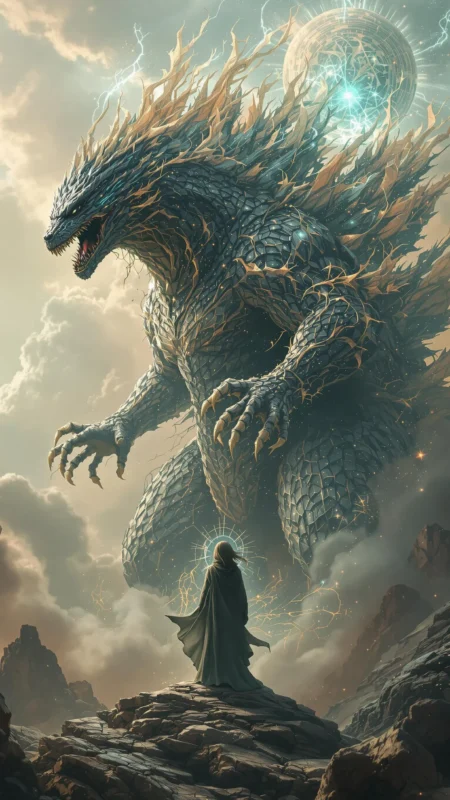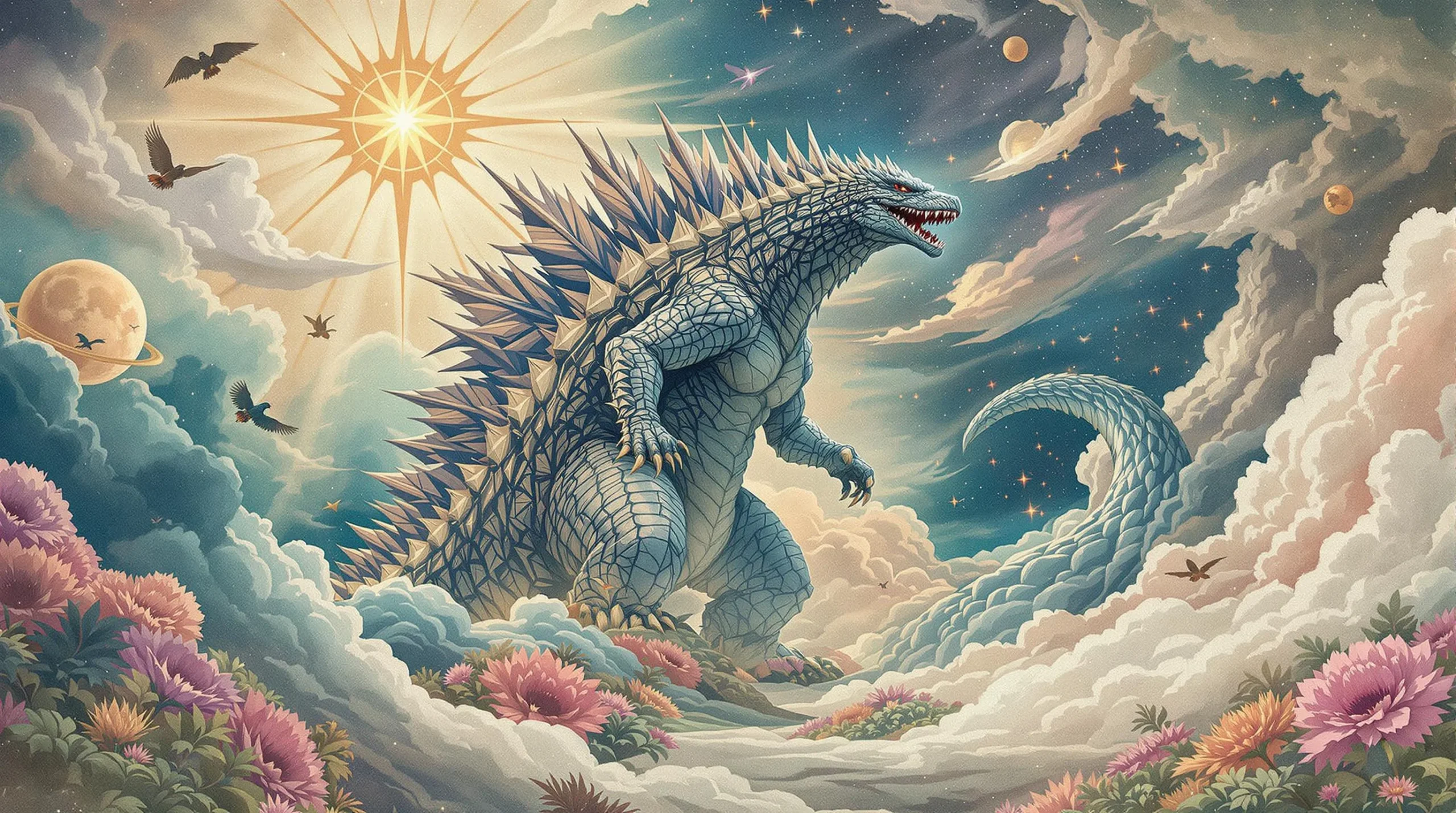


Godzilla

Archetype Meaning & Symbolism

Primal, destructive, protective, misunderstood, resilient, solitary, radioactive, ancient, unstoppable, balancing

  • Sometimes, the only way to heal our wounds is to make peace with the demons who created them.

If Godzilla is part of your personal mythology, you may...

Believe

  • That some forms of order are so oppressive that their destruction is a creative and necessary act.
  • That your rage is not a personal failing, but a sacred, intelligent force responding to a deep imbalance in your world.
  • That true strength lies not in fitting in, but in having the courage to stand alone as an untamable force for what is right.

Fear

  • That in a moment of uncontrolled anger, you will unleash a level of destruction from which you and your loved ones can never recover.
  • That you will be eternally misunderstood, hunted by a world that fears your power and can never see the protective heart within the monster.
  • That your very nature condemns you to a life of profound solitude, too immense and intense to ever truly connect with another.

Strength

  • An almost supernatural resilience; you can be knocked down, blown apart, or driven into the sea, but you will rise again, often stronger than before.
  • A profound capacity to challenge and dismantle entrenched, unjust systems, creating space for radical, necessary change.
  • A fiercely protective instinct for your loved ones or your principles, making you a formidable guardian and ally.

Weakness

  • A tendency to cause significant collateral damage; your solutions are often sweeping and can harm the innocent alongside the guilty.
  • Difficulty with nuance, subtlety, and diplomacy; you may see problems as structures to be leveled rather than knots to be untangled.
  • An inclination toward self-imposed isolation, born from the fear that your intensity will overwhelm or harm others.

The Symbolism & Meaning of Godzilla

Godzilla is the sublime terror of the natural world wearing a nuclear crown. Born of humanity's atomic sin, he is a walking, roaring consequence: a force beyond our control, a judgment we unleashed upon ourselves. To have Godzilla in your personal mythology is to acknowledge a power within you that is both terrifying and necessary. It is the part of the psyche that awakens when the ecosystem of your life is thrown into profound imbalance by external hubris or internal neglect. This archetype is not a hero in a shining cape. It is the earthquake, the hurricane, the volcano: a destructive event that, in its awesome devastation, also clears the slate and allows for a new, more authentic landscape to emerge. It symbolizes a power so fundamental that it owes no allegiance to politeness or social convention.

Furthermore, Godzilla represents a kind of sacred monstrosity. In a world that demands we be palatable, controllable, and neatly categorized, the Godzilla within us is the unapologetic beast. It may be the repository for our deepest rage, our most profound grief, our most visceral fears. But it is not merely a shadow to be suppressed. It could be a guardian. Its emergence may signal that a profound boundary has been crossed, that our personal sovereignty is under dire threat. The destruction it wreaks might be the tearing down of a life built on false premises, a career that is killing your soul, or a relationship dynamic that has become toxic. It is the terrible, beautiful truth that sometimes, the only thing that can save you is the monster you are most afraid of becoming.

This archetype also speaks to a profound solitude. Godzilla walks alone. He is too large, too ancient, too fundamentally different to ever truly belong to the world he so often saves or terrorizes. For an individual, this may resonate with a feeling of being misunderstood, of carrying an intensity that others find overwhelming. This solitude is not necessarily a weakness: it is the isolation of a mountain peak. It could grant a perspective unavailable to those in the bustling cities of social conformity. It is a mythos that finds belonging not with the crowd, but with the deep, tectonic forces of the earth itself, with the fundamental truths that exist long after the cities have fallen.


Godzilla Relationships With Other Archetypes

The Sovereign

The relationship between The Godzilla and The Sovereign may be seen as a cosmic argument between the map and the territory. The Sovereign, in their gilded hall, represents the fragile human insistence on order, on grids and laws and meticulously drawn borders. Their power is a filigree of consensus, a delicately constructed artifice. The Godzilla, however, is the earth shrugging off the map entirely. It is the raw, untamable geography that renders all decrees meaningless. Its passage through a city is not an act of rebellion against the king, for it hardly acknowledges the king's existence. It is, perhaps, a geological event wearing the flesh of a myth, a force whose crown is a corona of atomic fire, beside which a golden circlet is but a child's toy. The Sovereign builds walls to keep chaos out, while The Godzilla could be the very embodiment of the deep, chaotic truth that the walls were only ever a temporary suggestion.

The Innocent

When confronted by The Innocent, The Godzilla’s immense, amoral gravity may experience a moment of profound and unsettling stillness. The Innocent—be it a child offering a flower or a creature that shows no fear—does not perceive a monster, but perhaps a walking mountain range, a lonely island of sorrow given furious form. In this gaze, devoid of judgment or terror, the roaring inferno of Godzilla’s being could be reflected back not as malice, but as an unutterable, misunderstood pain. This encounter does not necessarily tame the beast, but it might introduce a single, fragile grace note into a symphony of destruction. It suggests that the abyss has a floor, and that even the most cataclysmic force may possess a quiet, un-activated capacity for recognition, a deep-sea trench in its soul where something other than pure, reactive power resides.

The Scientist

With The Scientist, The Godzilla shares a bond of tragic, inverted parentage. The Scientist is the modern Prometheus who, in seeking to steal the fire of the gods, split the very atom and inadvertently gave birth to a walking consequence. This relationship is a horrifyingly literal take on the burden of creation. The Scientist may represent the apex of human intellect, the belief that nature is a codex to be cracked and its power a tool to be wielded. The Godzilla, then, is the runaway equation, the footnote that consumes the entire text. Theirs could be a circular dance of penance and obsession; the creator forever drawn to the terrible beauty of their creation, compelled by guilt or a desperate need for control to study the mushroom cloud of their own making. The Scientist looks upon Godzilla and perhaps sees not a beast, but the horrifying, physical manifestation of an idea—a shadow so vast it blots out the sun of reason itself.

Using Godzilla in Every Day Life

Confronting Systemic Injustice:

When faced with an entrenched, unfeeling bureaucracy or a deeply rooted societal problem, the Godzilla archetype allows you to stop playing by the established, ineffective rules. You may cease writing polite letters and instead become the earthquake. It is a permission slip to embody a force so large that the system cannot ignore it, to trample the pristine lawns of protocol in service of a deeper, more urgent equilibrium.

Processing Suppressed Rage:

For the individual who has swallowed a lifetime of anger, Godzilla offers a path to catharsis. This archetype suggests that your rage is not a personal failing but a natural response to imbalance: a sacred, radioactive power source. To embody it is to finally allow the roar to surface, to let the atomic breath vaporize old narratives of compliance. This is not about petty anger, but a monumental release that clears the internal landscape for something new to grow.

Establishing Unbreakable Boundaries:

When diplomacy fails and your personal space is repeatedly violated, the Godzilla archetype provides the ultimate boundary. It is the act of becoming so immense, so self-contained in your power, that others have no choice but to respect your perimeter. It is less a shouted “no” and more a seismic presence that communicates, non-negotiably: this far, and no further. Your territory, your energy, is yours to defend with the force of a tidal wave.

Godzilla is Known For

Atomic Breath

A focused, superheated beam of radioactive energy fired from the mouth. It is the ultimate weapon, a visible manifestation of a primal power source made manifest, capable of leveling cities and defeating other massive creatures.

Urban Destruction

The iconic imagery of Godzilla wading through a metropolis, toppling skyscrapers as if they were children’s blocks. This represents a complete disregard for human constructs and a powerful clash between the natural world and modern civilization.

Protector of the Planet

Despite the destruction, Godzilla often emerges as a balancing force of nature, an anti-hero who defends the Earth from greater threats, whether they be other monsters (kaiju) or the hubris of humanity itself. This is the source of his deep archetypal ambiguity.

How Godzilla Might Affect Your Personal Mythology

How Godzilla Might Affect Your Mythos

When Godzilla stomps into your personal mythos, your life story ceases to be a straightforward narrative of progress and accumulation. It becomes a cyclical tale of cataclysm and rebirth. The major turning points in your life may no longer be promotions or marriages, but the moments the ground shook: the epic failures, the towering rages, the relationships that ended not with a whimper but a bang. You might see your past not as a series of mistakes, but as a landscape littered with the beautiful ruins of former selves, each one leveled to make way for the next, more resilient version. Your personal story is not about building a perfect city, but about learning to survive its inevitable, necessary destructions.

This archetype reframes you as the agent of that destruction, not just its victim. You are not the villager fleeing the monster: you are the monster. This is a profound shift in agency. The narrative may become one of taking responsibility for your own immense power, for the collateral damage you may cause, and for the deep, intuitive sense of balance you serve. Your mythos is no longer about finding your place within the established world. It may be about becoming the force that reshapes the world to create a new, more authentic place for yourself, even if it means you must, for a time, walk a path of solitary devastation.

How Godzilla Might Affect Your Sense of Self

To see yourself through the lens of Godzilla is to accept your own immensity. You may come to understand that you possess a core of power that is fundamentally untamable, a reserve of energy that, if repressed, will only grow more volatile. This could lead to a radical self-acceptance that includes the “monstrous” parts: the rage, the stubbornness, the sheer disruptive force of your presence. You might stop apologizing for being “too much” and instead see your intensity as a vital instrument, a tool for survival and change. This view fosters a profound resilience, the knowledge that you can withstand almost anything because you are, at your core, a force of nature.

However, this self-perception could also be freighted with a heavy sense of responsibility and a potential for deep self-alienation. If you are the monster, are you worthy of love? Can you engage with the fragile, beautiful things of the world without crushing them? This might lead to a constant, careful negotiation with your own strength, a conscious effort to moderate your impact. You may feel a deep solitude, a sense that no one can truly understand the scale of the forces you carry within. Your sense of self may become a paradox: a being of immense power who must practice the most delicate restraint.

How Godzilla Might Affect Your Beliefs About The World

The world, viewed through Godzilla's ancient eyes, is not the stable, human-centric stage we pretend it is. It is a chaotic, dynamic, and profoundly powerful system where human endeavors are fleeting and fragile. With this archetype in your mythos, you may lose faith in institutions, protocols, and the permanence of human achievement. You might see cities, corporations, and social structures as temporary arrangements, sandcastles awaiting the tide. This is not necessarily a cynical view: it can be liberating. It frees you from the anxiety of maintaining the unmaintainable and allows you to align yourself with deeper, more enduring forces like justice, nature, and truth.

This perspective fosters a deep respect for the concept of balance. You may come to see events not as “good” or “bad,” but as actions and reactions in a planetary-scale ecosystem. A corporate collapse, a political scandal, a social upheaval: these might be viewed as the planet’s immune system kicking in, as a necessary fever to burn out a sickness. You may find yourself watching the follies of human hubris with a kind of patient, geological sorrow, knowing that balance will be restored, one way or another, with or without our consent.

How Godzilla Might Affect Your Relationships

In relationships, the Godzilla archetype can manifest as a fierce, almost terrifying protectiveness. Your loved ones, your family, your chosen few, exist on an island you will defend with atomic breath. You may have a very small circle, but your loyalty to it is absolute and primal. Intrusions or threats are not met with discussion, but with an immediate, overwhelming show of force. This can make your loved ones feel incredibly safe, sheltered by a power that will let nothing harm them. You are the guardian at the gate, the monster that other monsters fear.

Conversely, this same immensity can make intimacy a challenge. You may fear that your own power—your anger, your intensity, your sheer presence—will inadvertently harm those you wish to protect. This can lead to a kind of emotional isolation, a tendency to keep people at a distance to ensure their safety from you. Relationships may be marked by cycles of intense presence followed by solitary withdrawal. You might struggle with the delicate dance of vulnerability, as it feels antithetical to your archetypal role as the invulnerable protector. Finding a partner who is not intimidated, one who can see the heart within the radioactive beast, may be a central quest of your life.

How Godzilla Might Affect Your Role in Life

Your perceived role in life may shift from that of a participant to that of a regulator. You are not just another cog in the machine: you may be the failsafe that melts the whole apparatus down when it malfunctions. You might feel a profound, often burdensome, calling to be a truth-teller, a disruptor, the one who says the thing no one else dares to say. Your role is not to build, but to clear the ground so that others may build anew on a healthier foundation. This could manifest in a career as an activist, a reformer, a investigative journalist, or simply as the person in any group who cannot abide hypocrisy and is willing to shatter the peace to address it.

This can be an incredibly lonely role. You may be admired from a distance but feared up close. Society often celebrates its disruptors only in hindsight, and you may find yourself perpetually on the outside of the very systems you are trying to balance or save. Your purpose is not derived from accolades or belonging, but from a deep, internal sense of ecological duty. You might see yourself as a steward of a deeper principle, a force whose job is to knock the world back into alignment, bearing the misunderstanding and isolation that comes with such a monumental task.

Dream Interpretation of Godzilla

To dream of Godzilla in a positive context is to dream of empowerment and liberation. If you are standing with Godzilla, or perhaps even embodying him, as he calmly and deliberately levels a structure that represents an oppressive force in your waking life—a stifling office building, a childhood home filled with bad memories—it may signify that you are finally integrating your own power. You are accessing your righteous anger and using it to clear a path forward. The destruction is not chaotic but purposeful. The dream is telling you that you have the strength to dismantle the obstacles you face, and that this act of destruction is, in fact, an act of healing.

In a negative context, dreaming of Godzilla can be an encounter with overwhelming, uncontrollable force. If you are fleeing in terror as he rampages indiscriminately, it could symbolize a feeling that your life is being destroyed by circumstances beyond your control: a health crisis, a financial disaster, a global event. It might also represent your own suppressed rage turning against you, a warning that your unexpressed anger has become so powerful it now threatens to destroy your own life, your relationships, and your well-being. This dream is a potent call to consciously engage with the 'monster' before it lays waste to everything you have built.

How Godzilla Archetype Might Affect Your Needs

How Godzilla Might Affect Your Physiological Needs

The Godzilla archetype may tie your sense of physical well-being to a need for cathartic, primal release. A life of quiet routine and gentle exercise may feel like a cage, leading to a physiological sense of restlessness, of energy building to an intolerable pressure. Your body might crave intense, explosive exertion: not a jog, but a full-bore sprint; not a calm discussion, but a primal scream into a pillow. This is the physiological need to discharge the radioactive energy you carry, to vent the steam before the engine explodes. Without these outlets, you may feel physically ill, lethargic, or perpetually on edge, your nervous system humming with a power that has no place to go.

This connection to a vast, ancient energy source can also manifest as incredible physical resilience. You might feel that your body can endure more than others, that it can recover from illness or injury with a surprising speed and completeness. It’s as if you can tap into a deep, geological well of vitality. This might translate to a belief that your body is a fortress, a powerful instrument that is difficult to break. You may feel a deep, cellular need for sustenance that is pure and powerful, a craving for foods that feel elemental and grounding, as if you are fueling a nuclear reactor that happens to be your own body.

How Godzilla Might Affect Your Ideas of Belonging

Belonging is perhaps the greatest challenge for the Godzilla archetype. By your very nature, you may feel too large, too intense, too fundamentally different to fit comfortably into any group. Like the kaiju itself, you might feel you are of a different species than those around you. Social gatherings can feel like trying to navigate a dollhouse, full of fragile rules and delicate interactions that you are bound to break. This may lead to a profound sense of loneliness and a self-imposed isolation, a belief that it is better to be alone than to risk causing harm or being misunderstood.

True belonging, then, may not be found in conventional social structures. It may be discovered with the few other 'monsters' one might meet in a lifetime: other intense, powerful souls who recognize and respect your nature. Or, belonging could be found in a connection to a cause larger than yourself, a sense of kinship with nature, or a role as a protector of the vulnerable. You might not belong *with* the people, but you may belong *to* them, in the way a shepherd belongs to the flock it guards from a lonely distance. It is the belonging of a guardian, not a participant.

How Godzilla Might Affect Your Feelings of Safety

From a safety perspective, the Godzilla archetype is a profound paradox. On one hand, you may feel an ultimate sense of security in your own power. In a dangerous world, you are the most dangerous thing in it. This could grant a deep-seated fearlessness. You are not afraid of walking home in the dark, of confronting a bully, or of facing a threat, because you know that a colossal, protective force resides within you, ready to be unleashed. Your safety is not dependent on others or on external systems, but on your own capacity to become a cataclysmic event for anyone who would harm you.

On the other hand, a primary source of anxiety may be the monster itself. You might fear your own power and its potential for collateral damage. Your deepest safety concern might be not what others can do to you, but what you could do to others in a moment of lost control. Can you keep the atomic breath in check? Can you walk through the delicate city of your relationships without crushing something precious? This creates a need for hyper-vigilance, a constant monitoring of your own internal state. Safety, then, becomes less about protecting yourself from the world and more about protecting the world from you.

How Godzilla Might Affect Your Views of Esteem

Esteem, for one with Godzilla in their mythos, is likely not built on praise or social acceptance. In fact, seeking such validation may feel deeply inauthentic. Instead, self-esteem may be forged in the crucible of survival and impact. It comes from the quiet, internal knowledge that you have faced devastation—internal or external—and endured. It is the esteem of the survivor, the mountain that is still standing after the storm. Your sense of worth could be directly tied to your ability to enact change, to be a force that matters, to know that when you move, the world moves with you.

Conversely, a crisis of esteem may arise from the destruction you cause. The guilt of a friendship shattered by your anger, a project ruined by your impatience, or an opportunity lost to your intimidating presence can be immense. You might see yourself not as a balancing force, but simply as a wrecking ball. This can lead to deep feelings of shame and a belief that you are fundamentally flawed or 'bad.' The core journey for esteem, then, is to integrate the destructive and protective aspects of your nature: to forgive yourself for the collateral damage while honoring the sacred, balancing purpose your power serves.

Shadow of Godzilla

The shadow of Godzilla emerges when the force of destruction loses its connection to the purpose of balance. This is rage untethered from righteous cause. It becomes a tyrant, a bully, a force of pure ego that rampages through the lives of others, leveling careers, relationships, and well-being for the simple, terrifying sake of asserting its own dominance. The atomic breath is no longer a tool of last resort against a mortal threat but a first response to any perceived slight. Here, the archetype manifests as catastrophic self-sabotage, destroying one's own 'city'—your job, your family, your health—out of a refusal or inability to regulate the immense power within. It is the monster that has forgotten it is a guardian and believes it is a god.

Conversely, the repressed shadow—too little of the Godzilla energy—results in a state of profound powerlessness. It is the person who endures abuse without a roar, who watches injustice unfold in silence, who allows their own life force to be drained by parasitic situations and people. They have buried their monster so deep that they cannot access its strength even when it is desperately needed for survival. This leads to a life lived as a perpetual victim, a cityscape constantly trampled by the kaiju of others, with no guardian to call upon. They feel a deep, gnawing frustration, the sense of a nuclear reactor within them that they are too terrified to ever switch on.

Pros & Cons of Godzilla in Your Mythology

Pros

  • You possess the raw power and resilience to overcome obstacles that would crush others.
  • You are deeply connected to a primal sense of justice and have the courage to fight for it, no matter the cost.
  • You are not afraid to tear down what is false, broken, or unjust, making you a powerful catalyst for authentic growth and renewal.

Cons

  • Your intensity can be overwhelming, causing you to alienate potential allies and loved ones.
  • Your solutions often lack subtlety, and you may find yourself creating new problems in the course of solving old ones.
  • You may struggle with immense guilt and loneliness as a result of the destruction you cause and the path you must walk.