

Gefjon

Archetype Meaning & Symbolism

Resourceful, determined, independent, creative, pragmatic, fertile, fierce, boundary-setting, visionary, untamed

  • The world does not grant you your kingdom. You must plow it from the earth yourself, and the cost is the transformation of all you hold dear.

If Gefjon is part of your personal mythology, you may...

Believe

  • That your reality is not found but forged, and you are the blacksmith.
  • That all great creations require a great and painful sacrifice.
  • That true security lies not in being given a place, but in carving out your own.

Fear

  • Stagnation: the horror of living on unplowed land, of being defined by circumstances you did not create.
  • Resource failure: the terror that your strength, your money, or your will might give out before your island is complete.
  • Isolation: that in building your own kingdom, you will permanently sever your connection to the shared world of humanity.

Strength

  • Radical self-reliance: an ability to thrive in circumstances where others would flounder, drawing on deep wells of inner resourcefulness.
  • Visionary creation: the capacity not just to improve what is, but to imagine and manifest what is not.
  • Unstoppable determination: a work ethic and focus that can seem superhuman to others, driven by the singular vision of the goal.

Weakness

  • Instrumentalism: a tendency to view people, relationships, and even yourself as tools to be used in service of a goal.
  • Inability to rest: a deep discomfort with stillness and being, feeling that your worth evaporates when you are not actively producing.
  • Emotional isolation: a fortress of self-reliance so thick that it prevents true vulnerability and deep, interdependent connection.

The Symbolism & Meaning of Gefjon

In personal mythology, Gefjon represents the radical power of self-creation. She is the architect of the soul's territory, the patroness of those who refuse to accept the map they are given and instead choose to forge their own. To have Gefjon in your personal pantheon is to believe that your life is not a path you find but land you must actively claim and cultivate. Her plow is a potent symbol: it does not just till, it separates. It is a tool of creation that works by an act of forceful division, carving a space for the self out of the undifferentiated mass of the world. This archetype whispers that your kingdom, your safety, your very substance, must be earned through sweat and strategic, transformative effort. It is the myth for the start-up founder, the solo artist, the immigrant who builds a new life from nothing: anyone who looks at a barren field and sees a future homeland.

The paradox of Gefjon as a virgin goddess who is also a mother speaks to a very modern form of power: a self-contained, generative force. Her children, the oxen, are not the result of a partnership but of her own will and dealings. In a personal mythos, this could symbolize that your greatest creations—your business, your art, your legacy—are your true offspring. It suggests that these projects may require you to transform what is most precious to you, to yoke your own energy, your past, your heart, and put it to work. This archetype honors the creator who is singularly devoted to their task, whose generative power is wholly their own, un-partnered and fiercely independent. It is the power to be both the maiden, unbeholden to any, and the mother, the creator of new life.

Finally, Gefjon is a deity of boundaries. She does not just create land; she creates an island, a space defined by its separation from the mainland. The lake she leaves behind in Sweden, Mälaren, is as much a part of her story as the island of Zealand she creates. This suggests that every act of creation requires a corresponding void, a sacrifice. To build a new career is to leave behind the safety of the old one. To establish a strong sense of self is to create distance from those who would define you. For an individual, this means that personal growth may feel like a kind of tearing away, a necessary act of separation that creates both a sovereign space for the self and an aching void where a connection used to be. Gefjon teaches that boundaries are not passive walls but actively plowed frontiers of the self.


Gefjon Relationships With Other Archetypes

The Plow

The relationship between Gefjon and The Plow is perhaps less that of a wielder to a tool and more that of a mind to its most articulate, earth-shattering thought. The Plow is the harsh, glinting sentence with which she begins her argument against the world as it is. It is the focused point of her will, the metallic nerve-ending that she pushes into the soil of the possible, translating the abstract map in her mind into the groaning, undeniable reality of the furrow. In her grasp, The Plow is not merely an implement of agriculture but an instrument of cartography; it does not simply till the soil but re-writes the very coastline of a continent. It could be said that The Plow represents the painful but necessary incision into the complacency of the given, the line of committed action that separates what was from what will be.

The Unclaimed Land

With The Unclaimed Land, Gefjon may share the quiet intimacy of a sculptor with a block of unhewn marble. The land is not an adversary to be conquered, but a silent partner, a vast, sleeping potentiality that awaits the right kind of touch to awaken it. It offers itself up to her efforts, a canvas of mud and stone that trusts her vision. This relationship could be seen as a form of profound listening; Gefjon senses the island that slumbers within the mainland, the new reality nascent in the old. She is not so much imposing her will upon the terrain as she is acting as its midwife, her plowing a kind of potent caress that coaxes a new form into being. The Unclaimed Land, it seems, is the deep, silent promise that her work makes real.

The Giant

Gefjon’s congress with The Giant is a venture into the chthonic, a pact with the primal and untamed forces that lie beneath the veneer of the world. The Giant is not a partner in civilization but the very source of the raw, chaotic power she must harness to create it. Her sons, born of this union and transformed into oxen, are the embodiment of this relationship: the monstrous, untamable energy of the giant-world, yoked and disciplined into the service of a singular, creative vision. This connection suggests that true, world-altering strength may not come from purity or order, but from a willingness to descend into the wild depths, to bargain with primordial chaos, and to channel its immense, fearsome vitality not into destruction, but into the slow, tectonic work of building a new home.

Using Gefjon in Every Day Life

Negotiating Your Worth:

When faced with a professional ceiling or an undervalued role, the Gefjon archetype does not simply ask for more: it demonstrates its power to create new territory. You might not just negotiate a raise, but propose a new division you would lead, carving out a piece of the company’s future for yourself. The argument is not your past performance, but the fertile ground you promise to generate. It is an act of claiming land, not asking for a key to a pre-existing room.

Establishing Boundaries in a Relationship:

If a relationship, familial or romantic, feels encroaching, the Gefjon impulse is not to build a wall but to plow a defining line, creating a new, separate, and viable space. This may look like physically moving out and creating your own home, a space that is wholly yours. Or it could be an emotional plowing: a clear, non-negotiable declaration of your needs and limits, separating your emotional landscape from another’s. It is the creation of a personal sovereignty, your own island in the sea of connection.

Undertaking a Monumental Creative Project:

When starting a novel, a business, or any act of profound creation, the Gefjon mythos informs the process. You may have to yoke your most precious resources: your time, your comfort, your old identity, transforming them into the “oxen” that will power the work. It is an understanding that true creation is not gentle. It is a messy, forceful tearing away of the old to make way for the new, leaving a void where the old life used to be, like the lake left in Sweden.

Gefjon is Known For

The Plowing of Zealand

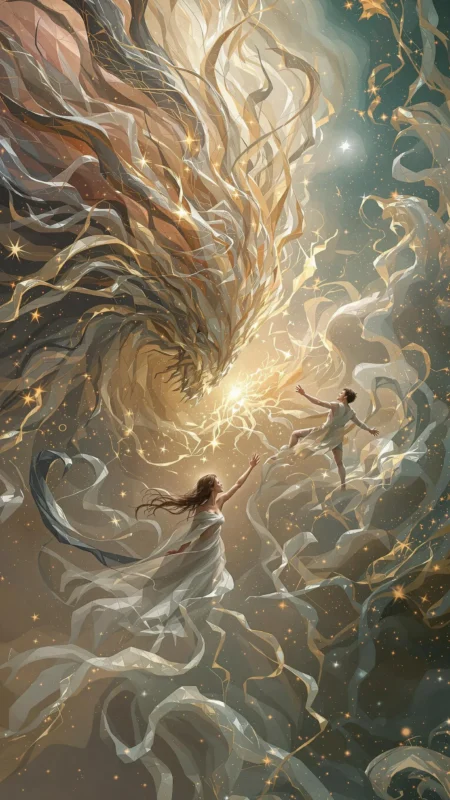
Her most famous deed, in which the goddess, promised as much land as she could plow in a day and night, transformed her four giant-born sons into oxen. With them, she plowed a vast section of Sweden, dragging it into the sea to form the Danish island of Zealand.

The Four Oxen

A symbol of her profound power of transformation and resourcefulness. These were her own children, repurposed and yoked to a monumental task, representing the immense sacrifices and transformations that creation demands.

A Goddess of Virgins and Abundance

She holds a paradoxical station as a goddess to whom maidens who die are said to go, while also being a mother and a figure of earthy fertility and prosperity. This suggests a self-contained, sovereign power that does not require a traditional male counterpart to be complete or creative.

How Gefjon Might Affect Your Personal Mythology

How Gefjon Might Affect Your Mythos

When Gefjon plows through your personal mythos, your life story ceases to be a narrative of discovery and becomes one of deliberate creation. You are no longer the hero on a quest to find a hidden treasure; you are the titan forging the treasure from raw earth. Major life events may be re-contextualized not as things that happened to you, but as territories you claimed or failed to claim. A career change is not a door opening, but a field you chose to plow. A difficult breakup is the creation of a necessary island, a painful but deliberate act of setting a new coastline for your emotional world. Your personal history becomes a map of these self-made lands and the lakes of sacrifice left in their wake.

Your narrative may also be punctuated by moments of profound and costly transformation. The Gefjon mythos insists that you cannot create without sacrifice, without changing the very nature of your resources. The story of your success might be inextricably linked to the story of what you yoked to the plow: the youthful passions repurposed for a career, the carefree relationships transformed by responsibility, the parts of yourself you harnessed to serve a greater ambition. Your mythos becomes a testament to this process, honoring the ghosts of the oxen, the forms your energy and love once took before they were put to the monumental work of building your life. It is a story that acknowledges its own costs with a stoic, clear-eyed pride.

How Gefjon Might Affect Your Sense of Self

To see oneself through the lens of Gefjon may be to feel a profound and sometimes daunting sense of agency. You may view your own hands not as appendages for gesture, but as instruments for shaping reality. There could be a deep-seated conviction that your circumstances are a direct reflection of your will, your effort, and your resourcefulness. This can foster an incredible resilience, a belief that no matter how fallow the ground, you possess the innate power to cultivate it. It is an identity built on the bedrock of capability: not “I am good” or “I am loved,” but “I am able.”

This potent self-view, however, may be shadowed by a stoic loneliness. The act of creating your own island is, by definition, an act of separation. You might feel a sense of sovereign solitude, the quiet that fills the fortress you built yourself. While you may be the undisputed ruler of your own life, there's a risk of becoming a stranger to the mainland of shared, messy, interdependent human experience. Your self-reliance could become so complete that it precludes the vulnerability needed for deep connection, leaving you the powerful but isolated monarch of a kingdom of one.

How Gefjon Might Affect Your Beliefs About The World

With Gefjon as a guide, the world may cease to appear as a solid, immutable reality. Instead, it becomes a malleable territory, a canvas of potential waiting for a strong hand and a sharp plow. Borders, whether national, social, or professional, might seem less like fixed lines and more like suggestions, challenges to be redrawn through effort and will. Opportunities are not things you wait for; they are landscapes you carve out of the existing terrain. This is a worldview brimming with potential, seeing in every crisis a field to be plowed, in every institution a piece of land to be claimed and reshaped.

This perspective could also foster a profoundly pragmatic, almost unsentimental, view of resources. Everything—time, money, knowledge, relationships, even one’s own emotions—can be seen as potential energy, a force to be harnessed for a creative purpose. Like Gefjon viewing her sons as potential oxen, you might assess the world in terms of its utility for your grand project. This is the source of immense effectiveness, the ability to orchestrate disparate elements into a functioning whole. But it carries the risk of a kind of instrumentalism, where the intrinsic value of things can be overshadowed by their potential use-value in the great work of creation.

How Gefjon Might Affect Your Relationships

In the realm of relationships, the Gefjon archetype might compel you to seek out fellow builders. You may be drawn to partners, friends, and collaborators who are also plowing their own fields, creating a kinship of mutual effort and respect. The bond is not one of gentle comfort, but of shared construction. Love and friendship may be expressed through practical support, co-creating a life, a business, or a home. It is a connection forged in the heat of the forge, a partnership of sovereigns who admire the territory each other has claimed.

However, this powerful independence can make true interdependence a challenge. The impulse is to create your own island, not to cohabitate a continent. This could manifest as fiercely guarded emotional boundaries, a difficulty in merging your life fully with another's, or a subconscious resistance to relying on anyone else. There may be a fear of losing sovereignty, of having your carefully plowed land encroached upon. This can lead to relationships that are more like treaties between allied nations than a true union: respectful and supportive, but always maintaining a carefully demarcated border.

How Gefjon Might Affect Your Role in Life

You may perceive your primary role in life as that of the pioneer, the founder, the ground-breaker. You are not here to maintain what exists, but to bring into being what does not yet exist. This could be felt in a family, where you are the one who changes its trajectory for generations, or in a community, where you start the institution that becomes its heart. There is a sense of being the first mover, the one who endures the hardship of the initial plowing so that others may later enjoy the harvest. It is a role defined by action and origins, the primal force that sets things in motion.

Consequently, you may feel a deep and abiding discomfort in roles you did not create for yourself. Being a cog in a machine, a settler on someone else’s land, or a functionary in a pre-existing hierarchy could feel like a spiritual straitjacket. The need is not just to have a role, but to have authored it. This can lead to a life of serial entrepreneurship, constant innovation, or even a quiet but determined resistance to any form of external authority. Your purpose is not to fit in, but to create the space where you, and perhaps others, can finally belong.

Dream Interpretation of Gefjon

In a positive context, dreaming of Gefjon, or engaging in her symbolic acts, is a potent affirmation of your power. You might dream of driving a team of strong oxen, the earth turning over easily under your plow. Or you could witness a new, lush island rising from a calm sea. Such dreams may signify that you are successfully harnessing your resources, that a period of immense creativity is upon you, and that your efforts to establish boundaries and create a new reality for yourself are bearing fruit. It is the subconscious mind confirming your agency and celebrating your capacity to shape your world.

Conversely, a dream colored by the shadow of Gefjon can be a stark warning. You might dream that your plow is broken, that the earth is stone and will not yield. The oxen may turn wild, resisting the yoke or even threatening you. Perhaps you are stranded on a shrinking island as the waters rise, or you stare into the abyss of the lake you left behind, feeling an overwhelming sense of loss. These images could point to burnout, a sign that the cost of your ambition is too high. They might warn that your relentless drive is alienating you from others, or that your fierce independence has curdled into a self-destructive isolation.

How Gefjon Archetype Might Affect Your Needs

How Gefjon Might Affect Your Physiological Needs

From a mythological perspective, the Gefjon archetype grounds your existence in the primal need for sustenance, but with a twist: you are the one who must create it. The physiological drive is not merely to find food and shelter, but to secure the means of their production. This may manifest as a relentless focus on creating a stable source of income, building a home from the ground up, or cultivating a garden. It’s a belief that the body's fundamental needs are best met not by what is given, but by what is generated through one's own labor. Your physical well-being feels directly linked to your capacity to plow your own field.

This archetype may also foster a view of the physical body as the primary instrument of will, the first and most important ox yoked to the plow. There might be a deep respect for physical stamina, strength, and endurance. Health is not pursued for vanity, but for utility. The body must be kept strong, resilient, and ready for the monumental tasks you set for it. Illness or fatigue could be perceived not just as a physical state, but as a frustrating failure of the essential tool required for the creation of your world.

How Gefjon Might Affect Your Ideas of Belonging

Belonging, for one with Gefjon in their heart, is often forged in the crucible of shared work. You may feel most connected to others when you are building something together, side-by-side in the field. Love and friendship are rooted in mutual respect for each other’s strength, vision, and capacity to create. The tribe is not one of shared origin, but of shared destination: a collection of pioneers and founders bound by the common goal of creating a new world. Belonging is the camaraderie of the construction site, not the comfort of the living room.

This purposeful approach to connection can make unconditional belonging feel elusive. The sovereign of an island may be admired from the shore but rarely visited without an invitation. You might struggle with the feeling of being respected but not truly enmeshed, loved for what you build rather than for who you are at rest. The fierce independence that allows you to create your own world may simultaneously prevent you from fully inhabiting the world of another. There can be a profound loneliness in this, the quiet echo on a shore you yourself have made.

How Gefjon Might Affect Your Feelings of Safety

Within the Gefjon mythos, safety is not a passive state of being protected; it is an active state of being defensible. Security is not found in a harbor but on the island you yourself have fortified. This translates into a life strategy focused on building tangible assets: financial independence, a robust career with unique skills, a strong network of allies. Safety is the direct result of the territory you have successfully claimed and can hold. It is a fortress built brick by brick through relentless effort, a bulwark against the chaos of the world.

This constant construction of safety can, however, lead to a state of perpetual vigilance. The threat is not just a hostile force from the outside, but the integrity of the borders themselves. You may live with a quiet, humming anxiety about the land eroding, the lake overflowing its banks, or the resources running out before the fortifications are complete. Safety is never a finished project; it is a continuous act of plowing, building, and defending the perimeter of your life, which can be both empowering and utterly exhausting.

How Gefjon Might Affect Your Views of Esteem

Self-esteem within the Gefjon framework is directly and powerfully tied to tangible accomplishment. Worth is not an abstract concept; it is measured in acres plowed, islands formed, and realities built. You may feel your value most keenly when you look upon the evidence of your labor: the successful business, the finished novel, the thriving family, the secure home. It is the deep, resonant pride of the creator, a self-worth built on the solid ground of your own manifest power to affect the world. Esteem is the silent nod of approval from the goddess, acknowledging a field well plowed.

This foundation for esteem, while potent, is also precarious. If the project fails, if the ground proves barren, if the oxen fall, self-worth can collapse with it. When esteem is tethered exclusively to productivity and results, there is little room for failure, rest, or simple being. The fear of stagnation is not just a fear of boredom, but a fear of worthlessness. This can create a relentless internal pressure to always be building, always be creating, lest you look in the mirror and see not a creator, but an empty, fallow field.

Shadow of Gefjon

In its shadow, the Gefjon archetype becomes a ruthless force of consumption. The plow is no longer a tool of creation for the self, but an engine of destruction turned upon others. The shadow Gefjon sees the world as nothing but fallow ground for their own ambition, and other people as nothing but oxen to be yoked and broken. This is the tyrant boss who burns out their team for a personal vision, the partner who consumes their loved one’s energy and resources to fuel their own projects, the colonizer who sees inhabited land as empty. It is creation devoid of ethics, a monstrous will that carves its kingdom from the lives of others, leaving not just a lake of personal sacrifice but a sea of devastation in its wake.

Another manifestation of the shadow is a profound, creative paralysis. The myth becomes a source not of inspiration, but of intimidation. The scale of the task, the magnitude of the required sacrifice, the fear of the lonely void that must be created—it all becomes too much. The individual stands frozen before the field, the plow rusting at their feet. They are trapped in the potential of the unplowed land, tortured by visions of the island they could create but terrified to make the first cut. This is a life lived in the agonizing space of “what if,” a permanent resident of the Swedish mainland, forever gazing across the water at a Zealand that will never be.

Pros & Cons of Gefjon in Your Mythology

Pros

  • You possess an almost supernatural ability to create tangible change and build new realities for yourself and others.
  • You are profoundly resilient and self-reliant, able to navigate hardship with a deep trust in your own capabilities.
  • You experience a powerful sense of agency, seeing yourself as the primary author of your own life story.

Cons

  • You may find it difficult to rest or to value yourself outside of your productivity, leading to burnout.
  • Your fierce independence and pragmatic worldview can lead to emotional isolation and difficulty with deep, vulnerable relationships.
  • You risk sacrificing too much—health, connection, joy—on the altar of your ambition, yoking every part of your life to the plow.