
Frog
Symbolism, Meaning & Spirit Animal

Top Level
Top Active
Top Level
Top Active
A frog is a tailless amphibian with long hind legs that lives part of its life in water and part on land, hatching as a tadpole. Frog symbolizes cleansing, fertility, transformation, sensitivity, and the ability to thrive between worlds.
The Symbolism & Meaning of Frog
Frog begins in water and often leaves it behind. Eggs hatch into tadpoles with tails and gills; later, legs emerge, lungs develop, and the tail is absorbed. The animal does not merely grow larger. It reorganizes its body for another medium. That physical sequence gives Frog its strongest meaning: transformation that is messy, embodied, and irreversible. You do not have to pretend the old shape was false. You can recognize that it served a season and still let it go.
Its bare skin makes Frog unusually exposed to the world. Many frogs breathe partly through their skin, and polluted or drying water can harm them before the damage is obvious to a person standing nearby. Sensitivity here is not a decorative softness. It is a survival system. Frog as an archetype often belongs to people who notice changes in atmosphere, tone, health, or belonging early. The gift is accurate reception. The difficulty is having nowhere to put everything received.
Frog also brings cleansing because water is not an abstract symbol in its life. It is where Frog begins, feeds, hides, mates, and raises the next generation. Rain can bring a sudden chorus from a landscape that seemed empty. The sound makes renewal audible. Yet Frog does not cleanse by becoming spotless. It lives close to mud, algae, decay, insects, and dark water. Its kind of purity is the continuation of life through conditions that are not pure at all.
Embrace the mud, for it is the birthplace of the lotus. Leap into the unknown, for it holds the promise of transformation.
Fertility and abundance follow from the same evidence. A female frog may lay hundreds or thousands of eggs, though many will be eaten or fail to mature. Frog's abundance is therefore generous but not guaranteed. It can speak to creative output, family growth, sexual energy, or a season when possibilities multiply. It also asks for a suitable pond. More beginnings do not help if the environment cannot sustain them.
Frog's duality comes from its border life. It belongs to water and land, silence and chorus, stillness and explosive motion, prey and predator. A frog may wait motionless for an insect, then catch it with a tongue that moves faster than the eye can follow. It may freeze under threat, inflate itself, release a foul secretion, or spring away. The meaning is not passive patience. It is the ability to conserve energy until the exact moment when action becomes simple.
In a personal mythos, Frog can therefore mean a return to conditions that let life work. It may arrive when you need to leave a dry identity, protect your sensitivity, or make room for a new form without demanding that the change look graceful. Its magic is practical: find water, listen to the weather, wait close to the ground, and leap when the body knows.
Frog as a Spirit Animal, Totem & Power Animal
If Frog is your spirit animal, totem, or power animal, you may recognize yourself in the creature that waits beside a pond until the night becomes loud enough to answer. You do not need constant visibility to be alive or effective. Your power gathers in margins, in quiet observation, in places where other people overlook the first signs of change.
Frog arrives through transition. You may notice it when a former identity has become too dry, when your body reacts before your reasoning catches up, or when a long silence breaks into unexpected creative energy. It can come through a real encounter after rain, a repeated image in dreams, a family story, a tattoo, or a childhood fascination that refuses to disappear. The connection is not proven by a supernatural event. It is made meaningful by the pattern you keep recognizing.
Carrying Frog asks for conditions, not performance. A frog cannot live indefinitely without moisture, and neither can a sensitive person thrive while treating exhaustion, grief, or overstimulation as character flaws. This archetype turns attention toward the pond: the relationships, rooms, rhythms, and practices that let your nervous system remain responsive without becoming overwhelmed. It also asks you to stop mistaking exposure for honesty. Frog hides when hiding preserves life.
Frog's power is especially strong during metamorphosis. It can help you respect the ugly middle, when the old structure has dissolved and the new one is still forming. Tadpoles do not look like failed frogs. They are a necessary stage with their own way of moving and feeding. You may need to let a temporary form be temporary rather than forcing it to explain your whole future.
As a totem, Frog can link you with fertility, rain, wetlands, and the return of life after drought. Those associations are strongest when they remain concrete. Make room for what you are growing. Notice which environments leave you parched. Listen for the people and projects that become possible after emotional weather changes. Abundance is not simply having more. It is having enough living conditions for what matters to survive.
As a power animal, Frog gives you the leap. It is not reckless motion. It is the sudden release of energy after stillness has done its work. When danger approaches, frogs may vanish into water, freeze against the ground, inflate, secrete something bitter, or jump. You can carry the same range: retreat, remain still, make yourself difficult to swallow, or move quickly toward a better place. The archetype does not demand one response. It helps you sense which response the moment can support.
Which of these is also you?
Collect 8 to make a mythos.
0 of 8
These archetypes were chosen because you are reading about Frog.
Frog in Mythology & Folklore: Where the Symbolism Comes From
In ancient Egypt, the frog belonged to the wet, fertile world created by the Nile. Heket, a goddess shown with a frog's head, helped bring birth and was associated with renewal after the annual flood. Frogs appeared on amulets and objects connected with childbirth because their sudden arrival in flooded fields seemed to announce life returning. The fact was physical and seasonal: when the Nile rose, frogs multiplied, and the landscape changed with them.
In ancient Mesopotamia, frogs also belonged to the watery beginning of things. In the Babylonian creation story Enuma Elish, the primeval sea contains monstrous powers, including frog-like beings in later artistic and symbolic traditions. Across the ancient Near East, frogs could carry associations with marshes, birth, and the unruly fertility of water. They were not simply gentle emblems. A creature that appears in 
Chinese tradition often gives the frog a lunar and wealth-bringing character. The three-legged money frog, or jin chan, is commonly placed in homes and businesses with a 
In Japan, the word kaeru means both frog and return. A frog charm can therefore mark a safe return home, the coming back of money, or the recovery of something lost. The pun gives an ordinary animal a place in travel and household custom. The frog does not promise a one-way ascent. It leaves, disappears into mud or water, and comes back.
European folklore often turns more sharply. In the German tale collected by the Brothers Grimm, The Frog King, a frog becomes a prince after a broken promise is confronted. The story makes transformation depend on an unpleasant, rejected creature crossing the boundary of the household. In medieval Europe, frogs could also be treated as signs of witchcraft, poison, damp disease, or corruption, especially when they appeared in dark water or indoors. The same animal that signaled fertility in Egypt could look ominous in a European cottage.
Some Indigenous North American traditions place Frog among beings connected with rain and weather. In stories from peoples including the Haida and Tlingit, Frog can appear as a 
Frog's folklore gathers around its actual life. It waits in water, calls at night, changes form, disappears into mud, and returns in numbers when conditions allow. Those same behaviors have produced blessing, wealth, birth, danger, and enchantment, sometimes in the same culture's neighboring stories.




Frog and Its Relationships With Other Archetypes

Tadpole
“I was Tadpole once, breathing through gills, and my body took back its own tail to make me.”
A tadpole's tail is not dropped but absorbed, its material reused as legs and lungs grow. Together they describe a person whose change is total, who carries the old life inside the new one instead of leaving it behind.
Visit Tadpole
Water Lily
“Water Lily lends me a floating floor, and I wait on it for whatever flies low.”
Frogs use lily pads as resting places and hunting perches, half in water and half in air. The pairing is about thriving at a boundary, a place most creatures only pass through.
Visit Water Lily
Water
“In one story I drank every lake and river dry, and only laughter gave the water back.”
In an Aboriginal Australian story, a giant frog named Tiddalik swallows all the fresh water, and the other animals make him laugh until it pours out as a flood. Frog and Water together speak to someone who holds a great deal in and needs joy, not force, to let it go.
Visit Water
Prince Charming
“Inside my skin waited a prince, though in the oldest telling no kiss set him free.”
In the Grimm brothers' version of The Frog Prince, the princess throws the frog against a wall in disgust, and that breaks the spell; the kiss came later. Frog and Prince Charming are the same person seen before and after being taken seriously, which says something about how worth gets recognized.
Visit Prince Charming
Marsh
“Marsh is my concert hall, and on spring nights I call from it until the whole dark answers.”
Male frogs gather in wetlands in spring and call in chorus to draw mates, and each species has its own song. Marsh also explains Frog's sensitivity: a creature with thin, permeable skin needs clean, wet ground, so frogs are often the first to vanish when a place is poisoned.
Visit Marsh
Frog also keeps company with the Egyptian tradition: Bee, Eye of Horus, Horus, Nut, Scorpion and Water Lily, among forty-three others of the Egyptian tradition.

Frog in Dreams: Meaning & Interpretation
Dreaming of Frog often brings attention to a change that is already underway but not yet complete. The dream may gather around a muddy pond, a sudden chorus after rain, a small body crossing the floor, or the startling sight of something alive where it should not be. Frog moves between water and land, egg and tadpole, tadpole and adult, so the image can meet you when an old identity has loosened and the next one has not settled.
The dream is often doing less predicting than revealing. It puts your sensitivity close to the surface and asks whether you can tolerate a season of awkwardness without calling it failure. A lively frog may give renewal a pulse, while a trapped or drying frog can show that your emotional environment has become unlivable. The feeling matters as much as the animal: delight points toward welcome transformation, disgust toward a change resisted, and fear toward a threat that may be real or inherited.
A frog leaping into clear water can mark a welcome release, especially when the dream leaves you refreshed rather than startled. It may show that you are ready to move from a stale enclosure into a more responsive emotional life.
A frog multiplying in a house can warn that a small neglected matter is breeding faster than expected. A silent frog in a dry container may point to sensitivity without the conditions it needs, while a frog changing into another creature can ask whether transformation is being welcomed or forced.
A frog speaking to you may bring an unwelcome truth from the damp, hidden edge of your life. A chorus of frogs after rain can be a generous dream of fertility, social energy, and a return of voices that had gone quiet.
Frog: Positive & Negative Meanings
Positive Meanings
- Welcomes renewal after a difficult season
- Senses changes before they become obvious
- Adapts physically and emotionally to new conditions
- Creates abundance from modest beginnings
- Knows when stillness is more useful than force
- Finds life in overlooked or muddy places
- Can shed an outdated identity without contempt
Negative Meanings
- Absorbs the mood of every environment
- Mistakes discomfort for a sign to flee
- Multiplies projects beyond available energy
- Hides when direct conversation is needed
- Chases transformation instead of sustaining growth
- Becomes vulnerable to emotional contamination
- Waits for perfect conditions that never arrive

The Shadow of Frog
Frog's shadow begins when sensitivity becomes constant alarm. Because Frog detects changes through its skin and depends on exact environmental conditions, a person carrying this archetype may scan every room, message, and silence for signs of danger. The body notices everything, but the mind may turn each sensation into a 
The shadow can also make transformation into an addiction. Frog changes form, and a person may keep shedding identities before any one of them has time to develop strength. New beginnings feel cleaner than maintenance. A new job, lover, belief, or project offers the intoxicating dampness of possibility, while the ordinary work of sustaining it feels like dry ground. Metamorphosis becomes an excuse not to be known in one shape for very long.
Abundance has its own danger. Frogs may produce huge numbers of eggs because survival is uncertain, but a human life cannot tend every possibility at once. The shadow multiplies commitments, ideas, invitations, and emotional obligations until the pond clouds. Generosity turns into leakage. Fertility without selection becomes clutter.
Frog may also retreat too far. Hiding in mud can protect a vulnerable body, yet a person can make privacy into disappearance and call avoidance discernment. The challenge is not to become less sensitive or less changeable. It is to give those traits boundaries, enough water, and a chosen direction. A frog that never leaves the pond never discovers what its legs can do.
How Did You End Up at Frog?
Where are you still crouched at the edge of a pond, repeating a vigilance that once kept you safe but may no longer be needed?
What dry ground, hungry bird, or sudden shadow were you keeping yourself safe from, and is that danger still moving through your life?
When did your first small leap land safely enough to become a habit, and where are you still making that same leap now?
The Frog Hearth
Find Your Frog People
If Frog has ever turned up in your life, in a dream, a moment, a person, you are not the only one. Its people are gathering, and the first stories haven’t been told yet.
Joining is free: put Frog on your page, then press Join.

Talk to Warren about Frog
Frog means something different in every life it walks through. Tell me about yours, and we will see what it has been saying.

 Written by Warren,
for you alone
A reading by Warren
What Frog means for you
This page says what Frog means. Warren can tell you why it is showing up for you, now.
Frog: Frequently Asked Questions
- What does Frog symbolize?
- Frog begins in water and often leaves it behind. Eggs hatch into tadpoles with tails and gills; later, legs emerge, lungs develop, and the tail is absorbed.
- What is the spiritual meaning of Frog?
- If Frog is your spirit animal, totem, or power animal, you may recognize yourself in the creature that waits beside a pond until the night becomes loud enough to answer. You do not need constant visibility to be alive or effective.
- What does Frog represent?
- In ancient Egypt, the frog belonged to the wet, fertile world created by the Nile. Heket, a goddess shown with a frog's head, helped bring birth and was associated with renewal after the annual flood.
- What does it mean to dream about Frog?
- Dreaming of Frog often brings attention to a change that is already underway but not yet complete. The dream may gather around a muddy pond, a sudden chorus after rain, a small body crossing the floor, or the startling sight of something alive where it should not be.
- What is the shadow side of Frog?
- Frog's shadow begins when sensitivity becomes constant alarm. Because Frog detects changes through its skin and depends on exact environmental conditions, a person carrying this archetype may scan every room, message, and silence for signs of danger.
- What are the positive and negative meanings of Frog?
- Welcomes renewal after a difficult season. Absorbs the mood of every environment.
- What does a Frog tattoo mean?
- Often, a person wears a Frog to mark recovery, fertility, or a life change that altered them from the inside out. Some choose it for a bond with wetlands or family folklore. Others carry it as a private reminder to return, adapt, and begin again.
Characteristics of Frog
- Color:
- green
- Marking:
- mottled
- Covering:
- bare-skinned
- Form:
- four-legged
- Size:
- small
- Kind:
- amphibian
- Diet:
- insectivore
- Active when:
- nocturnal
- Habitat:
- wetland, river
- Element:
- water
- Tradition:
- Egyptian, Jewish
Frogs turn water into a nursery, then abandon it for a life that may be spent on land, in trees, underground, or back among reeds. Their skin participates in breathing and water exchange, making dehydration an immediate physical danger rather than a distant inconvenience. Many species use stillness as camouflage and launch themselves only when prey or danger enters range. Their bodies therefore combine permeability with sudden, precise action.
Get the next one
Essays on personal mythology, archetypes, and the stories we tell ourselves.
Take Frog home
Printed to order and shipped to you. Please allow a few extra days for production.
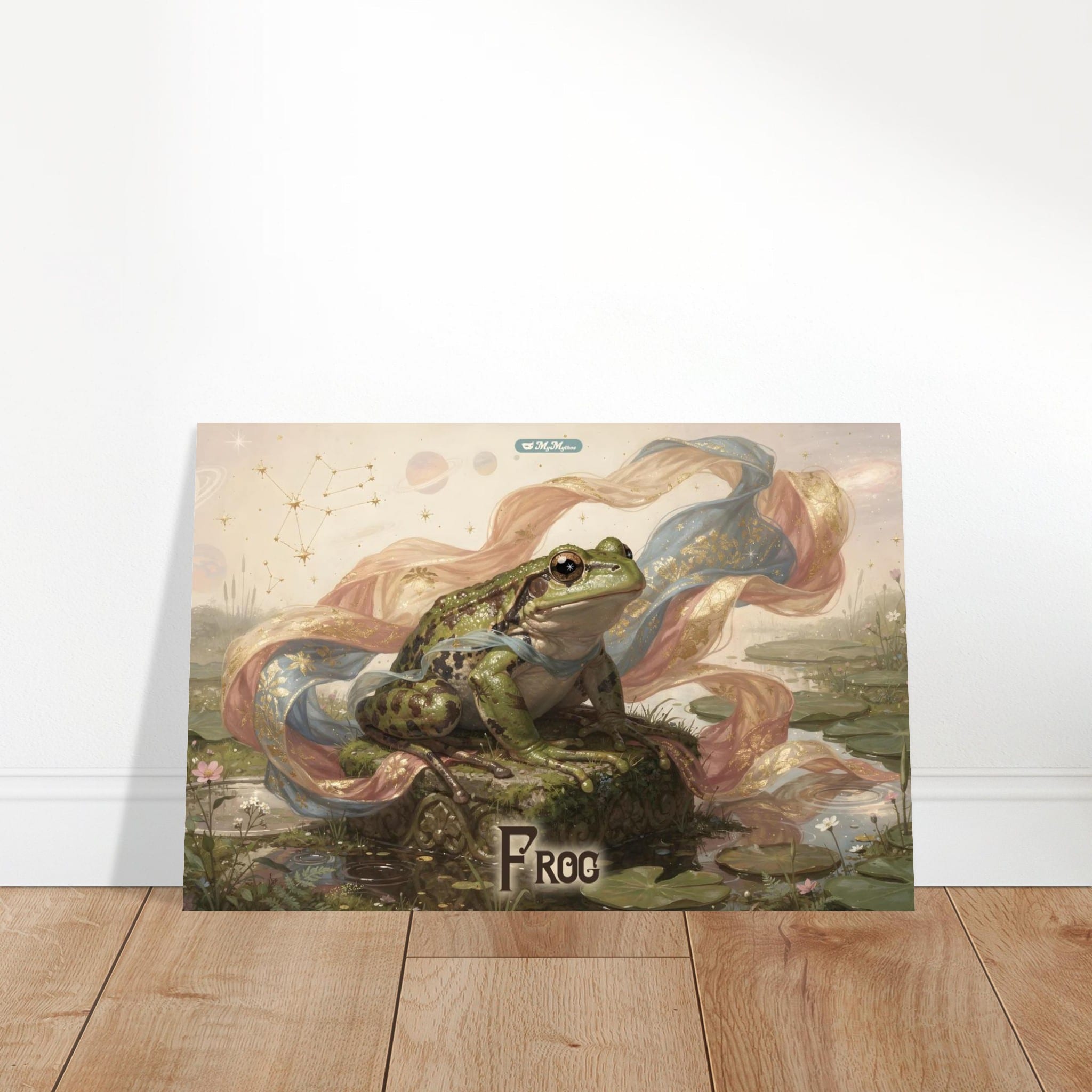
On your wall
Material
$19.00
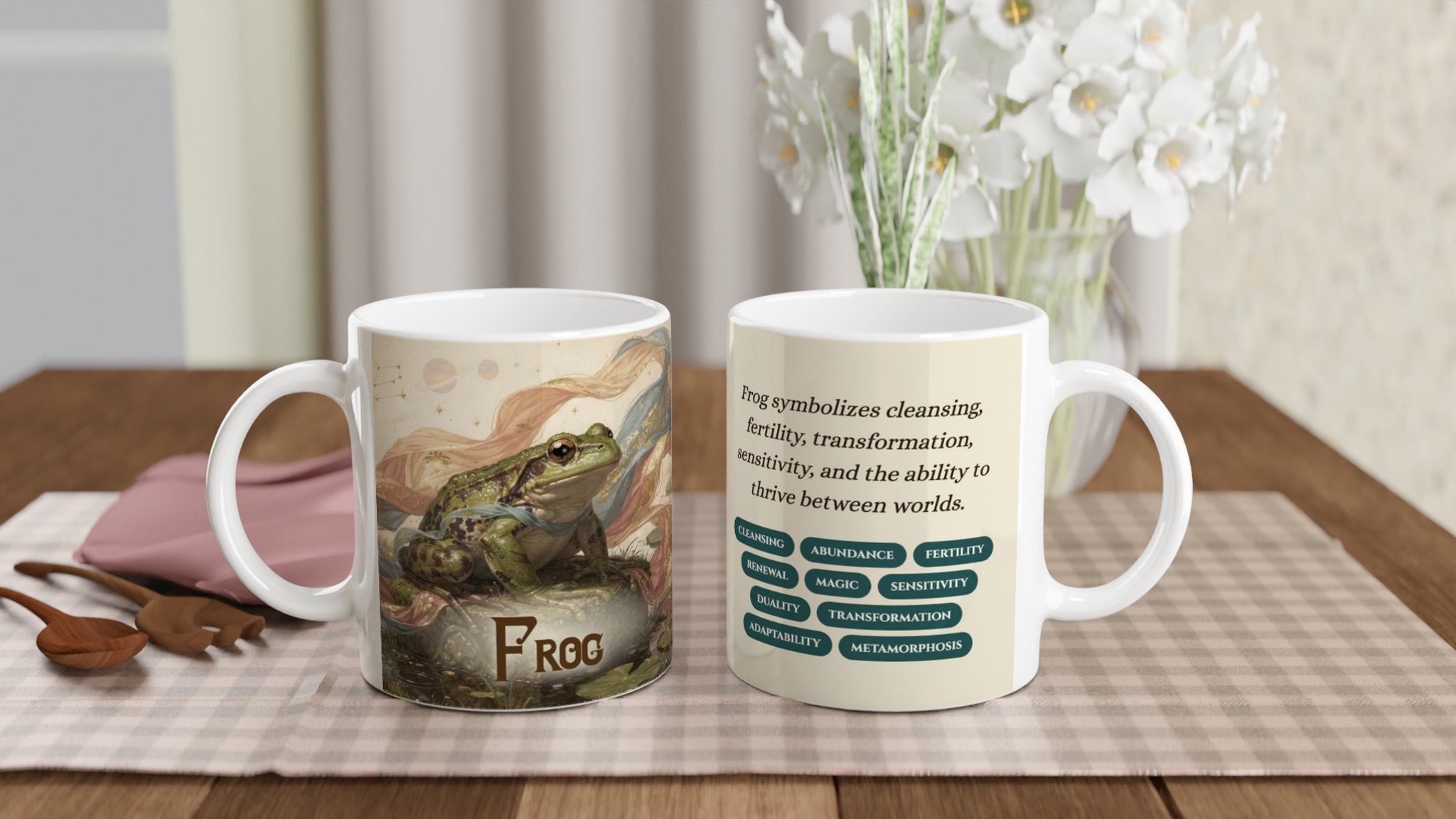
In your hands
Size
Color: White
$18.00
From elsewhere
Paid links: if you buy through these, MyMythos earns a small commission at no cost to you.