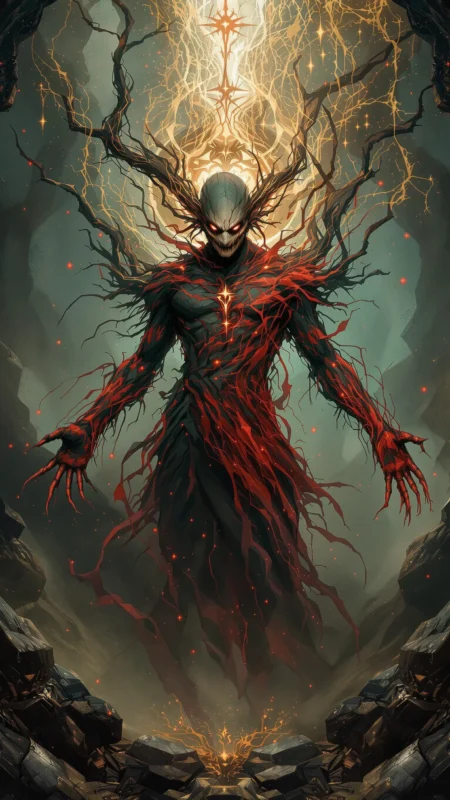
Freddy Krueger

Archetype Meaning & Symbolism

Vengeful, Inescapable, Sadistic, Subconscious, Traumatic, Punishing, Taunting, Resilient, Inventive, Unforgiving

  • Every town has an Elm Street.

If Freddy Krueger is part of your personal mythology, you may…

Believe

  • You may believe that the sins of the past are never truly dead, but merely sleeping, and that every generation is called upon to answer for them.
  • You may believe that the mind is the ultimate reality, a landscape where battles of life and death are waged every night.
  • You may believe that true courage is not the absence of fear, but the will to act while being terrified.

Fear

  • You may fear that your own mind is not a sanctuary, but a prison designed by a malevolent architect.
  • You may fear that a hidden transgression, committed by you or your ancestors, will one day return in a monstrous form to demand payment.
  • You may fear sleep itself, seeing it not as rest, but as a nightly surrender to your deepest vulnerabilities.

Strength

  • You may possess an uncanny ability to find creative and unconventional solutions to problems, born from navigating surreal, nightmarish landscapes.
  • You may have a profound resilience and a deep well of courage, forged from repeatedly facing your own personalized avatar of terror.
  • You may have a unique understanding of the power of trauma and memory, recognizing how the past actively shapes and intrudes upon the present.

Weakness

  • You may suffer from chronic hyper-vigilance and paranoia, unable to ever truly feel safe or at rest.
  • You may be profoundly isolated, feeling that the nature of your internal struggle is so unique that it can never be fully shared or understood.
  • You may have a deep-seated distrust of authority and history, believing that the official story is always a cover for a darker, buried truth.

The Symbolism & Meaning of Freddy Krueger

Freddy Krueger is not a monster who comes from without; he is a monster who erupts from within, a psychic abscess formed from a community’s festering secret. He symbolizes the return of the repressed, not as a subtle neurosis, but as a fully-sentient predator with a name and a grudge. He is the ugliness that society, or the family, tries to burn away and bury, only to discover it has granted it immortality in the collective unconscious. To have Krueger in your personal mythology is to acknowledge that some truths, when denied, do not die. They metastasize. They learn to hunt in the one place you cannot build walls: your own mind. He is the personification of trauma’s timeline, a ghost who is not bound by linear progression, reminding you that the horror of the past can be as lethally present as the pillow beneath your head.

The archetype also speaks a terrible truth about justice. Born from a failure of the established system and a subsequent act of mob violence, Freddy represents a cycle of vengeance that cannot be broken, only perpetuated. He is what happens when a society’s moral compass cracks, creating a monster far worse than the one it sought to destroy. In a personal mythos, he may embody the fear that our own righteous anger, if left unchecked, could curdle into something sadistic and monstrous. He exists in the space between victim and perpetrator, a figure whose own horrific acts are rooted in a horrific act committed against him, blurring the lines and forcing a contemplation of whether any vengeance can ever be clean.

Furthermore, Krueger represents the terrifying sovereignty of the subjective. In the dream world, his world, your fears are the bricks and mortar of his cathedral. He is a craftsman of psychological terror, using your personal history, your insecurities, and your deepest anxieties as his weapons. He is the ultimate argument against the idea that “it’s all in your head,” because in his realm, what is in your head is the only thing that is real, and it can kill you. This makes him a profound symbol for the power of belief and the tangible consequences of our internal narratives. If a nightmare believed with enough intensity can manifest a physical wound, then what other realities are we authoring in the quiet theater of our own minds?


Freddy Krueger Relationships With Other Archetypes

The Dreamer

The relationship between Freddy Krueger and The Dreamer is perhaps less that of a simple predator and its prey, and more that of a phantom tide and the moon that commands it. He is a creature woven from the very loom of the subconscious, and The Dreamer is the silent partner who provides the thread. Each sleeping mind is a haunted gallery, and The Dreamer may be seen as the unwitting curator of their own demise, their latent fears and forgotten traumas serving as the marble from which this specter is carved. He is a parasite of the psyche, yet one that could not exist without the host’s own imagination to serve as its lifeblood. In this dark symbiosis, The Dreamer is both the stage for the horror and, in a way, the author of the play, giving form to the formless anxiety that stalks the quiet halls of slumber.

The Furnace

The Furnace could be understood as the archetype’s grim womb, the alchemical chamber where mortal vengeance was transmuted into immortal myth. It is more than an instrument of death; it is a point of origin, a baptismal fire that purified a man of his humanity and left only the scorched, unyielding ore of retribution. The searing heat of that vigilante justice may have forged him into a new state of being, his soul a pilot light of pure malevolence that can never be extinguished. He carries its heat with him, a permanent echo of that inferno, suggesting that his very essence is inseparable from the communal sin that first ignited in the boiler room. The Furnace, then, is the secular altar upon which a monster was sacrificed and a god of nightmares was born.

The Suburb

The Suburb is the placid, sun-drenched canvas upon which Freddy Krueger is the violent slash of red and green. His relationship with this archetype is that of a festering secret, a poltergeist born of parental hypocrisy. The well-kept lawns and sleepy cul-de-sacs of Elm Street are not a sanctuary from him, but rather the fertile soil in which the seed of his legend was planted and sealed with a pact of silence. He may represent the psychic sewer system running beneath the idyllic facade, the repressed rot that inevitably bursts through the pristine pavement of American normalcy. He is the Sandman that the parents, in their desperate attempt to protect their children from a past crime, inadvertently invited into their beds, proving that the most terrifying ghosts are often those we create ourselves in the pursuit of a quiet life.

Using Freddy Krueger in Every Day Life

Confronting Buried Trauma

When a past event, long relegated to the mind’s dusty attic, begins to bleed into the present through anxiety or nightmares, the Krueger archetype serves as its avatar. It is the personification of a trauma that refuses to stay buried, a specter born of a specific wound that now demands acknowledgment. To invoke Freddy is not to invite terror, but to give the formless fear a form, a name, and a set of rules. It transforms a passive haunting into an active confrontation, allowing one to study the enemy, learn its patterns, and finally, perhaps, drag it out of the boiler room of the psyche and into the light of conscious awareness.

Exposing Generational Sins

The archetype may surface when one senses a rotten foundation in their family or community history: a secret kept, a crime unpunished, a truth burned and buried. Freddy is the monstrous bill collector for these collective debts, the sins of the parents visited upon the children. Engaging with this figure in one’s mythos is to take on the role of the reluctant inheritor, tasked with understanding the original transgression. It’s a lens through which to examine how the silence of one generation can become the screaming nightmare of the next, and how your own struggles might be the echoes of a crime you didn’t commit but are now responsible for resolving.

Harnessing Dark Creativity

Freddy is, above all, an artist of fear. His methods are surreal, specific, and grotesquely imaginative. When faced with a creative block or a need to understand the architecture of a problem, this archetype can be a strange muse. It represents the power to twist reality, to weaponize the mundane, and to build entire worlds out of psychic material. By studying Freddy’s methods, one might learn to access a more primal, liminal form of creativity, one that isn’t afraid to be ugly or terrifying. It is about transforming the raw material of nightmares into a map, a weapon, or even a work of art, proving that even from the most terrifying corners of the mind, something new can be forged.

Freddy Krueger is Known For

The Dream World

His sovereign territory is the subconscious mind during sleep, a realm where he is a god, capable of rewriting physics and reality to terrorize his victims. This establishes the mind itself as the primary battlefield of existence.

The Bladed Glove

An iconic, self-made weapon that merges the organic with the industrial, flesh with steel. It represents a will so bent on harm that it has become an inseparable extension of the self, turning the hand that could build into an instrument of deconstruction.

The Sins of the Parents

His very existence is a consequence of vigilante justice enacted by the parents of Springwood. He is a ghost of vengeance, a living embodiment of the axiom that a buried past never stays dead and its debts will be paid by the children.

How Freddy Krueger Might Affect Your Personal Mythology

How Freddy Krueger Might Affect Your Mythos

Incorporating the Krueger archetype into one’s personal mythos fundamentally alters the landscape of the inner world, transforming it from a sanctuary into a potential hunting ground. Your life story may no longer be a simple hero’s journey toward a treasure, but a desperate flight from a pursuer who knows your name. It introduces the element of an inherited curse, a psychic debt passed down through generations. Your narrative may become defined by this confrontation: you are the “final girl” or “dream warrior,” the one destined to face the specter that your predecessors created or failed to vanquish. The central conflict of your mythos shifts from external achievement to internal survival, where the greatest victory is not conquering a kingdom, but simply waking up in the morning, unharmed.

This archetype also frames your personal story within a context of collective responsibility and consequence. Your mythos is not solely your own; it is interwoven with the actions, secrets, and silences of your family or community. Freddy’s presence suggests you are paying for a crime you did not commit, forcing a reckoning with history. The narrative becomes one of excavation, of digging up the bones of the past to understand the haunting of the present. Your personal quest might be to break the cycle, to bring the sin to light, to do what the generation before you could not. In this story, you are both victim and detective, haunted by a monster while simultaneously hunting for the truth that created him.

How Freddy Krueger Might Affect Your Sense of Self

When Freddy Krueger is a figure in your personal pantheon, your perception of self may be cleaved in two: the waking self and the dreaming self. The waking self is vigilant, resourceful, perpetually preparing for battle. The dreaming self is vulnerable, a pawn in a terrifying landscape it cannot control. This duality can forge a profound distrust of one’s own mind. Sleep, a universal state of rest and recovery, becomes a source of immense anxiety. You might see yourself as a soldier on a tour of duty with no end, where rest itself is the most dangerous act. This can lead to a state of hyper-awareness, a mind that never fully powers down, always scanning the shadows for a striped sweater or the glint of steel.

Conversely, surviving this internal crucible could forge an identity of incredible resilience. To face a monster made of your own fear, to outwit a predator who knows your every weakness, is to undergo a trial by psychic fire. If you can pull him into the waking world, if you can learn the rules of his game and turn them against him, you may emerge with a self-concept rooted in radical courage. You see yourself not as a victim, but as a survivor who has stared into the abyss of your own terror and found a way to fight back. Your weaknesses, once exploited by the inner demon, become known quantities, territories you have mapped and learned to defend. This creates a self that is not fearless, but is masterful in the art of feeling fear and acting anyway.

How Freddy Krueger Might Affect Your Beliefs About The World

A worldview shaped by the Krueger archetype is one where the membrane between the psychological and the physical is perilously thin. It suggests that the world’s most dangerous threats are not foreign armies or natural disasters, but the unresolved horrors that fester in the collective subconscious. History is not a static record; it is a restless ghost that actively intrudes upon the present. This perspective fosters a deep skepticism toward surface appearances and official narratives. It whispers that every quiet suburban street has its own Elm Street, its own buried sin, its own dark history that the inhabitants have agreed to forget. The world is not a safe, rational place; it is a dreamscape where the nightmares of the past can, and will, reach out and touch you.

This archetype also cultivates a belief that true evil is often banal in its origins. Freddy was just a man before he became a myth, his power granted to him by the simple, understandable fear and rage of a group of parents. This perspective suggests that monsters are not born, they are made, often by the very people who seek to protect themselves from them. It leads to a worldview that is deeply suspicious of mob justice and righteous certainty. The world becomes a place of complex, tragic cycles, where acts of vengeance only sow the seeds for future horrors, and the line between hero and monster is a matter of whose story is being told. The greatest dangers are not always clear and present, but latent, sleeping, waiting for the right conditions to awaken.

How Freddy Krueger Might Affect Your Relationships

In the shadow of the Krueger archetype, relationships are often defined by a shared sense of imminent threat. Friendships and romantic partnerships may become alliances of survival, forged in the foxhole of a shared nightmare. The central question of intimacy becomes: will you stay awake with me? This creates a potential for profound, trauma-forged bonds, where trust is not a casual assumption but a lifeline. You and your loved ones are the “Elm Street children,” a tribe defined by a secret terror that outsiders cannot comprehend. This can foster an insular, deeply loyal social circle, where vulnerability is both a great risk and the ultimate act of faith.

However, this archetype can also poison relationships with isolation and suspicion. The core terror of Freddy is that, ultimately, you are alone in your dream. No one can enter your nightmare to save you. This can manifest as a deep-seated belief that your most profound struggles are incommunicable, that no one can truly understand or share your burden. It may lead to pushing others away to “protect” them, or a constant testing of their loyalty, born from the fear of abandonment at the moment of greatest peril. Relationships with parental figures can be particularly strained, colored by the archetype’s origin story: the idea that the protectors, through their actions or secrets, are the very source of the danger.

How Freddy Krueger Might Affect Your Role in Life

Adopting the Krueger archetype into one’s mythology often assigns the role of the Watcher or the Dream Warrior. Your purpose is not to seek treasure or build kingdoms, but to remain vigilant, to stay conscious while others sleep. You are the guardian at the gates of the subconscious, the one tasked with fighting the monsters that emerge from the collective dark. This role is isolating and exhausting. It demands a sacrifice of peace, a forfeiture of the right to be blissfully unaware. Your life may feel less like a story being written and more like a siege being endured, where your primary function is to hold the line against the encroaching chaos.

Alternatively, one might take on the role of the Inheritor of the Curse. You are not the source of the problem, but you are the one who must live with its consequences. This role is defined by a sense of cosmic unfairness and a heavy burden of historical weight. Your life’s work may become an investigation into this inheritance, a quest to understand the original sin that has now ensnared you. This is the role of the detective and the exorcist, seeking to name the demon in order to gain power over it. It is a reactive role, shaped by the actions of the past, and fulfillment comes not from creating something new, but from finally bringing a long and terrible story to its conclusion.

Dream Interpretation of Freddy Krueger

In a positive context, a dream of Freddy Krueger may not be an attack, but a summons. His appearance could signify that the subconscious is forcing a confrontation with a fear so deeply buried that it requires a monstrous form to be noticed. He is the terrifying surgeon arriving to excise a psychological tumor. His presence, while horrifying, indicates a readiness within the psyche to finally deal with a core trauma. The dream is not about the monster himself, but what he represents: the specific fear he embodies, the secret he taunts you with. To fight him and survive in the dream is to achieve a powerful integration, to reclaim a piece of your own mind that has been held hostage by fear. He is the gatekeeper, and his appearance means you are finally ready to pass through the gate.

In a negative context, dreaming of Freddy represents the psyche under absolute siege. It suggests a state of profound powerlessness, where an internal anxiety or trauma has become so dominant that it has achieved a kind of predatory sentience. The dream is a reflection of a waking life colored by inescapable dread. It symbolizes a fear that you believe will literally consume you, a loss of control so complete that even the sanctity of your mind is violated. This is not a call to arms, but a cry of surrender. It indicates that the dreamer feels utterly alone, persecuted by their own mind, and that the mechanisms for coping have been completely overwhelmed, leaving them with no sanctuary, awake or asleep.

How Freddy Krueger Archetype Might Affect Your Needs

How Freddy Krueger Might Affect Your Physiological Needs

The presence of the Krueger archetype strikes at the very foundation of physiological well-being: rest. Sleep, the non-negotiable process of cellular repair and mental consolidation, is reframed as a portal to annihilation. This may manifest as a deep-seated chronophobia, a fear of the passage of time leading toward bedtime, or full-blown insomnia born not of a busy mind, but of primal terror. The body is kept in a perpetual state of emergency, flooded with cortisol and adrenaline. This chronic stress response, this refusal to surrender to a basic biological need, can begin to degrade the physical self as surely as any dream-demon’s claws. The body is no longer a home, but a trap waiting to be sprung.

This archetype fosters a profound disassociation from one’s own biological rhythms. The gentle pull of drowsiness is not a comfort but a siren song luring you toward danger. As a result, one might wage war against their own body, using caffeine, stimulants, or sheer force of will to fight off sleep. This creates a state of being where you are a ghost in your own machine, disconnected from the body’s wisdom and needs. Physical exhaustion becomes a constant companion, paradoxically making the mind more susceptible to the very hallucinatory, dream-like states one is trying to avoid. The mythos becomes a self-fulfilling prophecy: the fear of what happens in sleep actively destroys the health of the waking body.

How Freddy Krueger Might Affect Your Ideas of Belonging

Love and belongingness, in a world haunted by Freddy Krueger, become matters of life and death. The archetype creates a profound sense of isolation; the terror is yours alone, playing out on the private screen of your mind. This can make authentic connection feel impossible, creating a chasm between you and those who sleep peacefully. You may feel like a survivor from a different, more terrible war, unable to relate to the peacetime concerns of others. This deepens the need for belonging while simultaneously making it feel unattainable. You are part of the human family, yet set apart by the nature of your haunting.

However, this same crucible of fear can forge the most powerful bonds imaginable. The “Elm Street children” who band together find a belongingness that transcends ordinary friendship. It is a fellowship of the haunted, a community built on the shared secret of the nightmare. Love, in this context, is not about candlelit dinners, but about staying awake with someone through the night, about believing them when they speak of the unbelievable. It is a fierce, protective camaraderie. Belonging is not found in a crowd, but in the eyes of the one other person who knows the name of your demon and doesn’t run away.

How Freddy Krueger Might Affect Your Feelings of Safety

The Krueger archetype systematically dismantles the concept of safety. It teaches a terrifying lesson: the most secure fortress is worthless if the enemy is already inside. Your home, your bedroom, your locked doors—all are rendered meaningless because the threat is not external. The archetype relocates the site of danger from the dark alleyway to the folds of the cerebral cortex. This means that safety is not a place you can go, but a state of mind that is perpetually under assault. The need for security becomes an unquenchable thirst, as no physical measure can truly address a psychological predator. This may lead to obsessive behaviors or a baseline of anxiety that hums beneath the surface of all daily activities.

Furthermore, the archetype demolishes the ultimate sanctuary: the self. If your own mind can generate a lethal threat, then where can you possibly retreat? This fosters a profound sense of existential vulnerability. The world becomes a place of hidden dangers, not because of what might be lurking in the shadows, but because of what might be sleeping in the minds of others, or even in your own. Safety is an illusion, a child’s story you can no longer afford to believe. True security, if it exists at all in this worldview, must be forged from something other than physical walls. It must be built from radical awareness, mental fortitude, and the courage to face the monster within.

How Freddy Krueger Might Affect Your Views of Esteem

The Krueger archetype is a master of psychological warfare, and its primary target is esteem. He is a predator who feeds on insecurity, using your deepest shame and fear as his personal playbook. To be hunted by him is to have your self-worth systematically dismantled, night after night. He confirms your worst suspicions about yourself: that you are weak, that you are cowardly, that your past mistakes define you. This can lead to a state of learned helplessness and a shattered sense of self, where you begin to believe the taunts of the monster because they echo your own inner critic. Esteem is not just low; it is under active, nightly assault.

Yet, this is the very reason why defeating him provides such a powerful boost to esteem. To survive this personalized hell, one must cultivate a ferocious form of self-belief. You cannot rely on external validation; you must find a core of strength within yourself that the demon cannot touch. The act of fighting back, of setting traps for your own fear, of finding the courage to pull the monster out of the dream and into your world, is an act of supreme self-affirmation. Esteem is no longer something you hope to have; it is something you have forged in battle. You have faced the absolute worst version of your own fear and proven it can be overcome. This creates a quiet, unshakable confidence, the esteem of the warrior who knows exactly what they are capable of.

Shadow of Freddy Krueger

When the Krueger archetype casts its longest shadow, the line between Dream Warrior and monster begins to blur. To live in this shadow is to become what you behold. You may adopt the archetype’s sadism, developing a cruel wit that preys on the insecurities of others. You might find a perverse pleasure in psychological games, using your insight into the human heart not to heal, but to manipulate and control. Your own past traumas become a justification for inflicting pain, creating a feedback loop of vengeance. You become the master of your own private, nightmarish boiler room, inviting others in only to terrorize them. This is the path of the victim who, instead of healing, learns to perfect the methods of their tormentor.

The shadow can also manifest in its inverse: a complete and total repression of the archetype’s energy. This leads not to cruelty, but to a state of profound and dangerous naivety. You refuse to acknowledge the darkness in yourself or in the world, insisting on a vision of reality that is all light and safety. You dismiss the warnings from your subconscious as mere fantasy. This leaves you utterly defenseless. By refusing to even look at the monster, you give it complete, uncontested control over your blind spots. You become the eternal victim, the one who never sees the attack coming, who walks willingly into the nightmare while insisting that everything is fine.

Pros & Cons of Freddy Krueger in Your Mythology

Pros

  • You may develop an unparalleled capacity for facing deep, personal fears, having rehearsed for it in the most extreme psychic theater imaginable.
  • This archetype can serve as a key, granting you access to the symbolic, often terrifying, language of your own subconscious and the unhealed wounds it points to.
  • It fosters a warrior’s resilience, teaching you to strategize, adapt, and survive under the most intense psychological pressure.

Cons

  • The constant presence of this archetype can infuse waking life with a persistent, low-grade dread, making true peace and restful sleep feel like unattainable luxuries.
  • It can cultivate a worldview steeped in paranoia, leading to an inability to trust others, the world, or even your own mind.
  • You may suffer from a unique form of chronic exhaustion, a soul-deep weariness that comes from fighting a nightly battle for your own sanity.