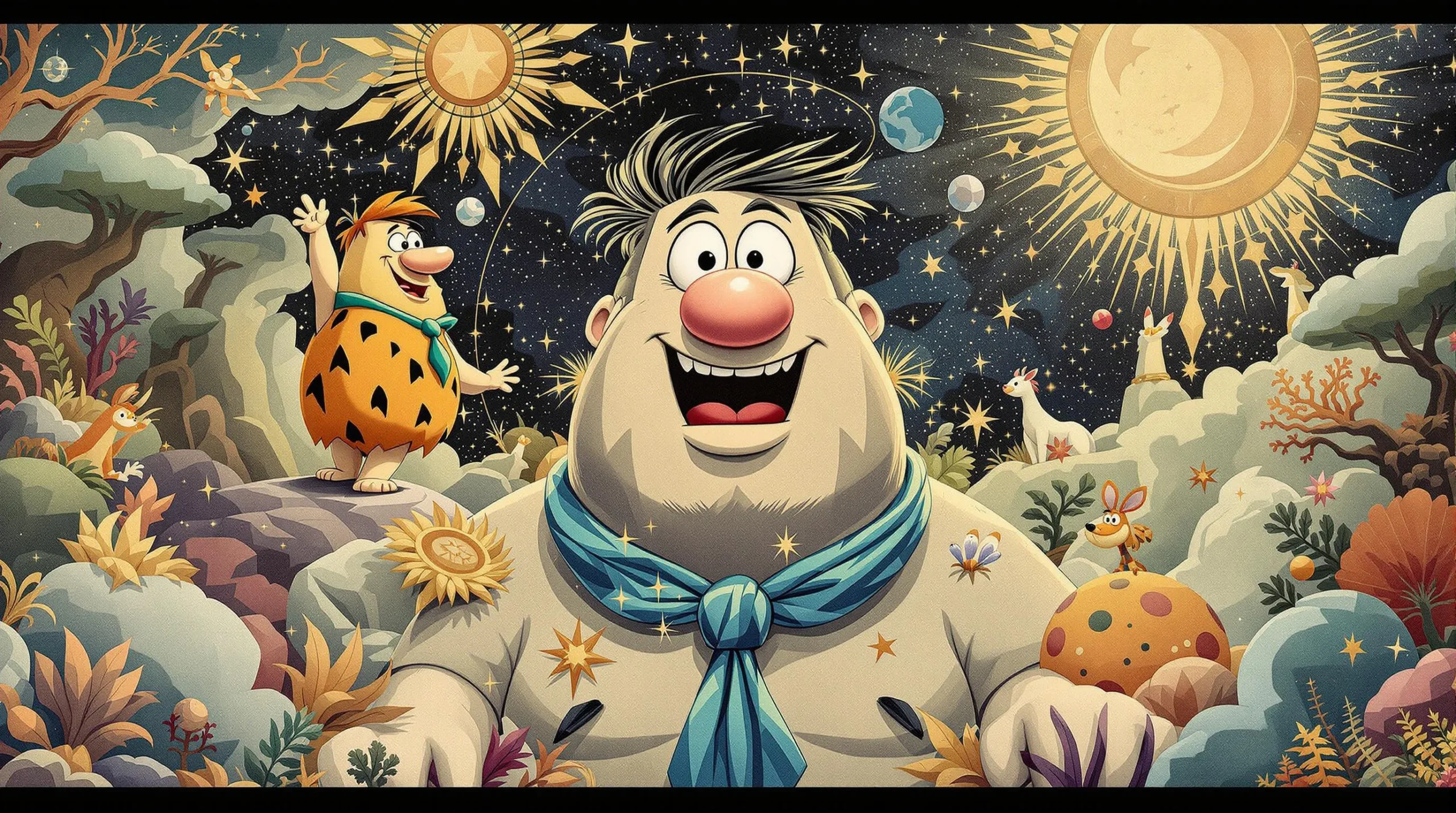


Fred Flintstone

Archetype Meaning & Symbolism

Impulsive, boisterous, loyal, stubborn, ambitious, simple, gregarious, primal, frustrated, loving

  • Yabba Dabba Doo!

If Fred Flintstone is part of your personal mythology, you may...

Believe

  • You may believe that a hard day's work earns you the right to life's simple, loud pleasures.
  • You may believe that loyalty to your family and your best friend is the highest virtue, trumping sophistication, success, and even common sense.
  • You may believe that most problems can be solved with enough enthusiasm and a clever, if slightly crazy, plan.

Fear

  • You may fear public failure and the humiliation of having your grand ambitions crumble into a comical heap of rubble for all to see.
  • You may fear being seen as inadequate in the eyes of your family, of failing in your fundamental role as a provider and protector.
  • You may fear being permanently stuck in a monotonous life, a future of endless days at the quarry with no hope of achieving something more.

Strength

  • A boundless, almost heroic optimism, allowing you to bounce back from any setback and charge into the next endeavor with renewed vigor.
  • An immense capacity for loyalty and love for your inner circle, creating unshakably strong bonds of family and friendship.
  • A deep appreciation for the simple, visceral joys of life, allowing you to find profound happiness in a good meal, a fun game, or time with loved ones.

Weakness

  • A volcanic temper that can erupt with little warning, causing collateral damage to the relationships you hold most dear.
  • A profound impulsiveness that leads you to leap into ill-conceived plans without considering the consequences, often creating chaos and instability.
  • A stubborn, bone-deep refusal to listen to advice, particularly from those who are more cautious and sensible.

The Symbolism & Meaning of Fred Flintstone

Fred Flintstone may represent the unvarnished soul of modern ambition housed in a prehistoric vessel. He is a walking paradox: the suburban patriarch in a cave, the company man in a leopard-skin tunic. This archetype speaks to the part of the personal mythos that is forever wrestling with its own anachronisms, the part that holds deeply civilized values of family and community while being driven by untamed, primal urges. To see Fred in oneself is perhaps to acknowledge a fundamental, tectonic friction between who we are expected to be in a complex world and the simpler creature who just wants a giant rack of ribs and a good laugh with a friend. He is the patron saint of the beautifully flawed plan, a testament to the idea that intention can sometimes matter more than execution.

The Flintstone archetype could also be a map to a particular kind of happiness, one that is loud, uncomplicated, and profoundly physical. His joy is not found in quiet contemplation but in the visceral release of a bowling strike, the triumph of sliding down a dinosaur’s tail at the end of a workday. In a personal mythology, he may embody the permission to be unsophisticated. He sanctifies the simple pleasures and elevates them from mere distractions to the central pillars of a good life. He suggests that meaning isn’t always found in the ethereal or the intellectual but can be quarried directly from the bedrock of everyday experience: work, food, family, and play.

Furthermore, Fred could symbolize the eternal struggle of the working class, translated into the absurd. His conflicts with his boss, Mr. Slate, his constant financial anxieties, and his dreams of a slightly easier life are the timeless narrative of labor. By placing this narrative in the Stone Age, the archetype strips it of modern complexity, revealing the raw essence of the conflict. For the individual whose mythos includes Fred, their own struggles for recognition, for fair compensation, for a sense of dignity in their work, are not just personal grievances. They are part of an ancient, epic, and faintly ridiculous human story that has been playing out since we first decided to chisel a wheel out of stone.


Fred Flintstone Relationships With Other Archetypes

The Patient Spouse

The Patient Spouse may serve as the quiet shoreline to Fred Flintstone's crashing, temperamental sea. Where he is a geyser of ill-conceived ambition and sudden fury, she is the deep, still reservoir of reason, absorbing his seismic energy without ever truly being displaced. She is not a dam, which might suggest outright opposition, but rather a patient geology, the bedrock that quietly dictates the course of his wild, roaring river. Her presence could be seen as the gentle hand of civilization on the shoulder of primal man, a constant, low hum of sanity beneath his percussive shouts, reminding him that the boulder of his ego must eventually come to rest in the soft earth of home.

The Loyal Sidekick

If the Fred Flintstone figure is a kind of primary color—a loud, unmixed red of passion and impulse—then the Loyal Sidekick is perhaps the gentle blending agent that makes him palatable. He is the echo in the canyon, a softer, less defined repetition of the original shout, validating the initial impulse while robbing it of its isolating singularity. This relationship may not be one of equals, but rather a kind of gravitational pact; the sidekick as a smaller, more placid moon caught in the orbit of a chaotic, low-atmosphere planet. He is the essential audience and the willing accomplice, the quiet confirmation that even the most harebrained scheme is better than the silence of solitude, providing a fragile second pillar for fantasies that could never stand on one alone.

The Unyielding Boss

The Unyielding Boss could be viewed as the face of the quarry wall itself—impersonal, ancient, and utterly indifferent to the sweat on Fred Flintstone's brow. He is the embodiment of the Sisyphean bargain, the monolithic structure against which Fred’s schemes for a better life are perpetually shattered. Their dynamic may be the primal drama of labor itself: the individual will, with all its roars and grand designs, pitted against the unmovable mass of the system. The boss is less a villain than a geological fact, a mountain of implacable authority that Fred must chip away at daily, not in the hope of conquering it, but perhaps just to hear the echo of his own efforts, a small, percussive proof of his own existence against the vast, silent stone.

Using Fred Flintstone in Every Day Life

Navigating Career Frustration:

When you feel like just another cog in a vast, indifferent machine, a number on a timecard punched into a rock, the Flintstone mythos invites a primal scream. It suggests that your frustration is not a failing but a fuel. This archetype doesn't counsel quiet desperation: it champions the outlandish, perhaps ill-advised, get-rich-quick scheme. In modern terms, this could be the sudden urge to launch a passion project, to start a side business based on a wild idea, or to simply demand a raise with the full-throated belief that you, the operator of the bronto-crane, deserve more than just gravel for your efforts.

Strengthening a Core Friendship:

The bond between Fred and Barney is a study in unconditional, if occasionally exasperated, loyalty. When a friendship feels strained by the complexities of adult life, invoking this archetype means returning to the simple foundations: shared activities, mutual support in absurd endeavors, and the unspoken pact of being there for each other's follies. It’s about deciding to go bowling, metaphorically or literally, to set aside sophisticated discourse for shared, simple joy. It is a reminder that the most profound connections are often built not on intellectual alignment, but on the shared experience of dragging our feet to power a ridiculous vehicle together.

Reconnecting with Family:

When the pressures of providing for a family create distance, the Flintstone archetype offers a clumsy but heartfelt path back. It’s the grand, often misguided gesture. Fred doesn't write poetry for Wilma: he tries to buy her a state-of-the-art rock-washer he can't afford. The lesson isn't in the success of the scheme, but in its loving, if shortsighted, intention. To use this mythos is to embrace the imperfect offering, to understand that bursting through the door yelling “I’m home!” is its own kind of love language, a declaration of presence that anchors the entire domestic world.

Fred Flintstone is Known For

The Primal Yell

His catchphrase, “Yabba Dabba Doo!,” is a pure, unadulterated expression of joy or triumph. It is pre-lingual, a sound of pure feeling that erupts when the pressures of work are released or a moment of simple pleasure is achieved. It represents the victory of the id.

The Bronto-Crane Operator:

His blue-collar job at the Slate Rock and Gravel Company, operating a dinosaur as heavy machinery, is central to his identity. It grounds his fantastic world in the relatable struggle of the working man: the tough boss, the monotonous labor, the dream of quitting time.

The Loyal Friend and Family Man:

Despite his many schemes and outbursts, his defining relationships are with his wife Wilma, his daughter Pebbles, and his best friend Barney Rubble. His entire narrative arc always bends back toward the gravity of home and friendship, the true bedrock of his world.

How Fred Flintstone Might Affect Your Personal Mythology

How Fred Flintstone Might Affect Your Mythos

Incorporating the Fred Flintstone archetype into one's personal mythos crafts a life story not of elegant ascents, but of glorious, cyclical striving. The narrative is not a straight line towards success but a series of comical orbits around a stable home life. Your personal history might be cataloged by its grand schemes: the time you tried to launch that improbable business, the ambitious but flawed home renovation, the disastrous vacation plan that became a legendary family story. Failure, in this mythos, is not the end of a chapter but the humorous pivot upon which the story turns, always leading back to the hearth, to the 'Wilma, I'm home!' moment of reconciliation and grounding.

This mythos may also be defined by a clear delineation between the world of 'work' and the world of 'life'. The quarry is a place of toil, a necessary gray backdrop against which the vibrant colors of home, friendship, and the Water Buffalo Lodge can truly shine. Your life's narrative could be a tale of enduring the former to earn the latter. It is a story that measures wealth not in clams or currency, but in the richness of a friendship with a 'Barney', the steadfastness of a partnership with a 'Wilma', and the unquantifiable joy of a perfectly executed bowling night. Your legend isn't about what you accomplished at the office: it’s about the life you built after you slid down the dinosaur's tail.

How Fred Flintstone Might Affect Your Sense of Self

When Fred Flintstone is a guiding archetype, you may view yourself as a creature of powerful, if sometimes unruly, appetites. Your identity could be deeply entwined with your passions, your temper seen not as a flaw but as evidence of your capacity for great feeling. You might see yourself as fundamentally good-hearted, a 'lovable lug' whose blunders stem from an excess of enthusiasm rather than malice. There is a certain innocence in this self-perception, a belief that your intentions are pure even when the results are chaotic. You are the mover, the shaker, the one who initiates, and you might take a certain pride in this role, even when it leads you astray.

This archetype could also foster a self-image that is deeply connected to a provider role. Your sense of self-worth might be directly proportional to your ability to put a roof (even a rock roof) over your family's head and a bronto-burger on their plates. This is not about accumulating wealth for its own sake, but about creating comfort and security for your clan. Consequently, your self-perception may be vulnerable to external factors: a bad day at the quarry or a failed scheme can feel like a fundamental assault on your identity, a questioning of your very purpose.

How Fred Flintstone Might Affect Your Beliefs About The World

Through a Flintstone lens, the world may appear as a simple, tangible place to be wrestled with. It is a world of clear structures: the home, the workplace, the lodge. Problems are not abstract psychological knots but concrete obstacles to be bulldozed, often literally. This worldview doesn't have much patience for nuance or subtlety. Things are what they are. A boss is a boss, a friend is a friend, and work is work. It is a profoundly un-cynical perspective, one that believes that with enough energy and a clever enough angle, any quarry can be mined, any scheme can succeed, any problem can be solved by either brute force or a harebrained idea.

The world, in this mythos, is also a stage for broad comedy. Life's setbacks, frustrations, and absurdities are not tragedies but punchlines. Your worldview could be cushioned by a sense of the ridiculous, an ability to see the humor in being chased by your own pet dinosaur or having your car tip over from the weight of a rack of ribs. It suggests that the universe, for all its harshness, has a sense of humor and that the proper response to its trials is not despair but a loud, exasperated, and ultimately forgiving laugh.

How Fred Flintstone Might Affect Your Relationships

In the realm of relationships, the Flintstone archetype prioritizes loyalty above all else. Love and friendship are expressed not through eloquent speeches or delicate gestures, but through unwavering presence and shared experience. A relationship with you might feel like being part of an unbreakable team: you are the loud, ambitious engine, and your partner is the smart, grounding force that keeps the whole contraption from careening off a cliff. Romance is about shared goals, even silly ones, and the profound intimacy of knowing someone will always be there to bail you out of your latest jam.

However, this approach can also create a dynamic of affectionate chaos. Your relationships may be characterized by loud arguments followed by swift, heartfelt apologies. You might express love through grand, impulsive gestures that sometimes miss the mark, buying a wildly impractical gift when what was needed was a quiet conversation. The emotional landscape is a dramatic topography of high peaks and low valleys, with little room for gentle, rolling hills. Your love is a force of nature: powerful, sometimes destructive, but always, in its own way, nourishing the bedrock of connection.

How Fred Flintstone Might Affect Your Role in Life

Adopting the Fred Flintstone mythos likely casts you in the role of the Prime Mover, the Patriarch, the center of gravity around which the family unit orbits. You may feel it is your responsibility to initiate, to provide, to protect, and to entertain. This is a role of action, not contemplation. You are the one who gets the ball rolling, whether it's planning a vacation, starting a new project, or simply deciding what's for dinner. It's a role that carries the weight of being the 'rock,' the person everyone depends on for stability, even if your methods for achieving it are anything but stable.

This role also comes with a built-in script of fallibility. You are the leader who often leads the troop into a comical mess. Part of your perceived role, then, is to be the one who makes the mistakes so that lessons can be learned and the group can be unified in the aftermath. It's a strange, paradoxical leadership style: leading from the front, but frequently into a wall. Your role is to be the engine of the family narrative, providing both the forward momentum and the dramatic, humorous conflict that makes the story worth telling.

Dream Interpretation of Fred Flintstone

In a positive dream context, encountering Fred Flintstone or embodying his archetype could signify a connection to your own primal, joyful nature. To dream of yelling 'Yabba Dabba Doo!' might be your subconscious celebrating a recent success or giving you permission to embrace simple, unadulterated happiness. Operating a bronto-crane with ease could symbolize a newfound sense of power and competence in your work life. A harmonious dinner with the Flintstone and Rubble families might represent a deep feeling of belonging and contentment within your own social circle, a sign that your foundational needs for love and community are being met.

Conversely, a negative Flintstone dream could point to feelings of frustration and entrapment. To be stuck at the quarry under the tyrannical gaze of Mr. Slate may reflect a sense of being trapped in a dead-end job or a powerless situation. Dreaming that one of Fred's schemes has gone spectacularly wrong—the car has tipped over, the invention has exploded—could be a manifestation of anxiety about your own ambitions and a fear of public failure. An argument with Wilma might symbolize a disconnect between your own impulsive desires and the needs of your closest relationships, a warning from your psyche that your actions are creating instability in the home you hold so dear.

How Fred Flintstone Archetype Might Affect Your Needs

How Fred Flintstone Might Affect Your Physiological Needs

The Flintstone archetype grounds your personal mythology in the body's most basic demands. Physiological needs are not just a prerequisite for higher pursuits: they are the point. Hunger isn't a mere signal: it's a roaring desire for a brontosaurus steak, a quest for visceral satisfaction. Your mythos may celebrate appetite, both literal and metaphorical, viewing a healthy capacity for consumption as a sign of a life fully lived. The need for rest is not just about recovery but about the profound, bone-deep satisfaction of collapsing after a hard day's work, the physical release that precedes the psychic one.

This mythos could also sacralize physical effort. The act of powering a vehicle with your own two feet becomes a metaphor for a life propelled by personal, tangible exertion. There is little room for the abstract or the automated. Your story is written in callouses, in the sweat of your brow, in the sheer physical force required to move your world forward. Your physiological reality is not something to be transcended or optimized with bio-hacks: it is the very stone from which your identity is carved, a source of raw power and undeniable presence.

How Fred Flintstone Might Affect Your Ideas of Belonging

For a mythos shaped by Fred Flintstone, belonging is not a gentle affiliation: it is a loud, fiercely loyal, and all-encompassing state of being. Love and friendship are the twin pillars that hold up the entire structure of a meaningful life. Belonging is found in the unwavering bond with a best friend like Barney, a partner who is both an anchor and a co-conspirator. It’s the kind of friendship that doesn't require constant maintenance, built on a shared history of surviving ridiculous situations together. It is assumed, foundational, and absolute.

The need for community is expressed through tribe-like structures such as the Water Buffalo Lodge. This archetype suggests a deep-seated desire for group identity, for rituals, for a sense of being 'one of the guys'. It's a belongingness defined by shared symbols (the goofy hats), shared activities (the lodge meetings), and a clear sense of in-group solidarity. Love for family is demonstrative and possessive, a powerful gravity that pulls you home no matter how far your schemes have taken you. It’s the non-negotiable center of your universe.

How Fred Flintstone Might Affect Your Feelings of Safety

Within a Flintstone-informed mythos, the need for safety is paramount and deeply tied to the concept of 'home' as a fortress. The cave is the ultimate sanctuary, a solid, immutable barrier against the wildness of the world and the pressures of the quarry. Your narrative may be a constant striving to build, maintain, and protect this haven. Safety means having a solid roof over your head and a loyal, prehistoric dog-as-doorbell to warn of intruders. It is a primitive and powerful drive, focused on securing the physical perimeter of your life so that those within it may flourish.

Paradoxically, the archetype's own impulsiveness may be the greatest threat to this safety. Fred's schemes constantly risk the family's financial security and domestic tranquility. This creates a core tension in your personal mythology: the simultaneous, conflicting drives to build a fortress and to gamble it all on a wild bet. Your need for safety might be in constant battle with your desire for something more, creating a narrative where security is something that must be perpetually lost and regained, a cycle of risk and return to the safety of the cave.

How Fred Flintstone Might Affect Your Views of Esteem

Esteem, in the Flintstone mythos, is built on a foundation of tangible achievement and social recognition. It is the feeling of being a 'big man,' not just in physical stature but in your role within the family and community. Your self-worth could be directly linked to your success as a provider, your skill in a chosen pastime like bowling, or your status within your social club. It is an externalized esteem, reliant on the applause, gratitude, and respect of others. A strike at the bowling alley or a successful fishing trip isn't just fun: it's a vital affirmation of your competence and value.

Because this esteem is externally validated, it can be incredibly fragile. A reprimand from Mr. Slate, a failed get-rich-quick scheme, or being bested by Barney can trigger a catastrophic collapse of self-worth. Your personal narrative might be a volatile stock market of esteem, with soaring highs of 'Yabba Dabba Doo!' and crushing lows of being called a 'dunderhead'. This creates a constant, restless drive to prove yourself, to embark on the next grand project that will, you hope, finally cement your status as a respected and successful head of your cavehold.

Shadow of Fred Flintstone

When the Fred Flintstone archetype falls into shadow, the lovable lug becomes a petty tyrant. The boisterous energy curdles into rage. The simple desire for a better life metastasizes into unchecked greed, and the get-rich-quick schemes are no longer charmingly naive but genuinely reckless, jeopardizing the well-being of his family for a shot at selfish glory. In this shadow form, his loyalty becomes possessiveness, his love a tool of control. He is no longer the flawed but good-hearted center of the home but a black hole of need, his famous temper used not as a momentary release but as a weapon to intimidate and silence dissent.

The shadow doesn't just amplify the flaws: it corrupts the virtues. The pride in being a provider becomes a cudgel to demand deference and obedience. The simple worldview becomes a willful ignorance, a refusal to engage with any complexity that challenges his desires. This shadow Fred resents his Wilma for her reason and his Barney for his simple contentment. He is a man trapped not by the quarry, but by his own roaring ego, forever yelling not in joy, but in a desperate, frustrated demand to be seen as the king of a cave he himself is dismantling, stone by stone.

Pros & Cons of Fred Flintstone in Your Mythology

Pros

  • You possess a powerful engine of ambition and energy, constantly driving you to improve your situation and provide for those you love.
  • You have the ability to find and create immense joy in the simplest aspects of life, fostering a celebratory and appreciative atmosphere.
  • Your fierce loyalty builds a fortress of security and trust around your relationships, making you an incredibly dependable friend and partner.

Cons

  • Your impulsive nature and penchant for ill-conceived plans can frequently introduce chaos and instability into your own life and the lives of those around you.
  • Your emotional expression may lack nuance, swinging between boisterous joy and explosive anger, making it difficult to navigate subtle or complex interpersonal issues.
  • You may be prone to stubbornness, rejecting sound advice and repeating mistakes because of an unwavering belief in your own, often flawed, instincts.