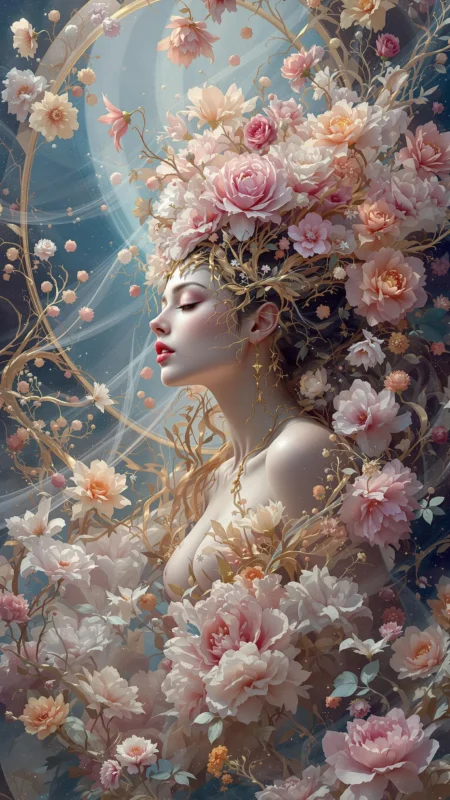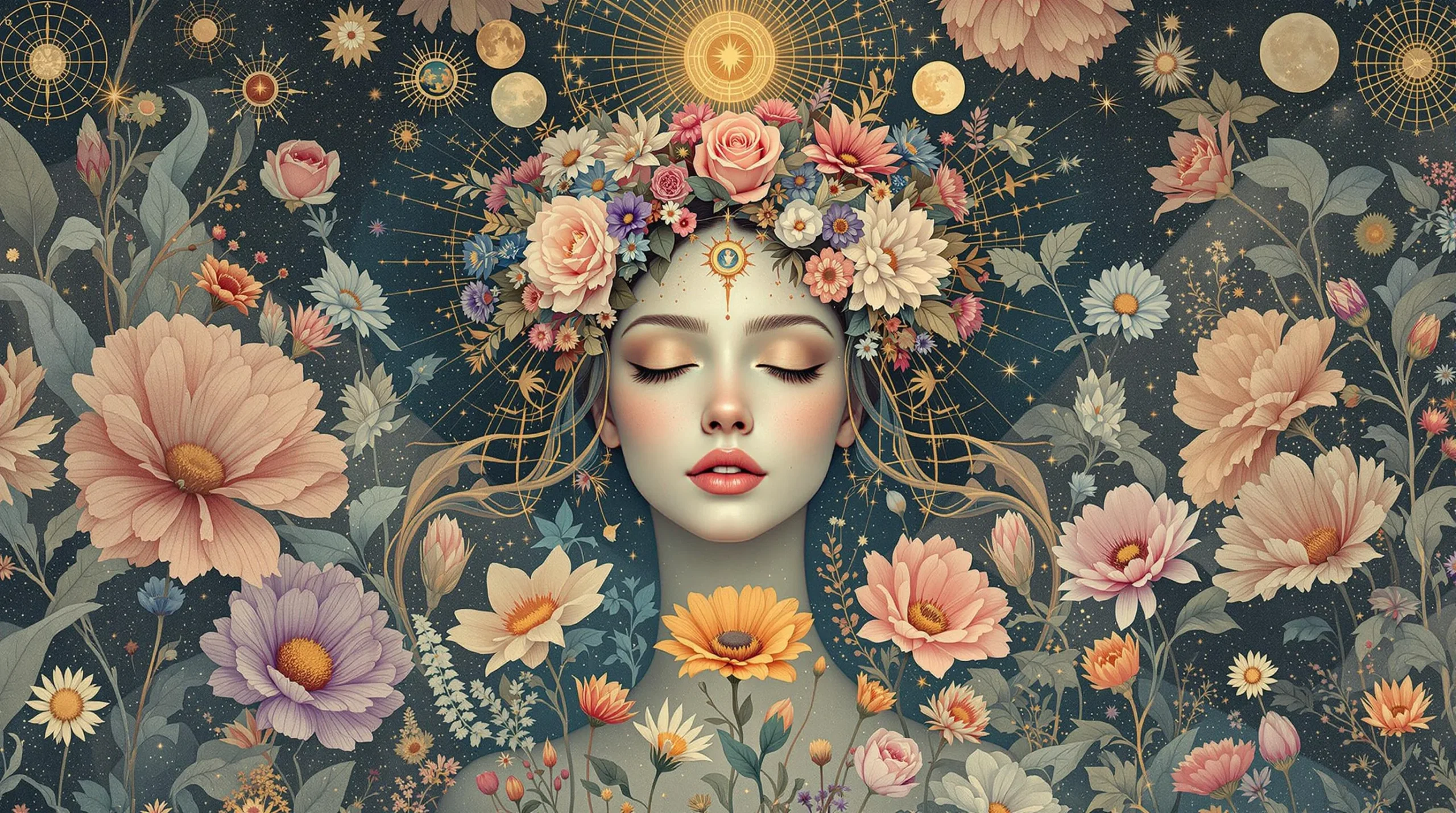


Flora

Archetype Meaning & Symbolism

Generative, cyclical, patient, rooted, vulnerable, nurturing, wild, ephemeral, resilient, intoxicating

  • I enjoy perpetual spring: the year is always bright, the trees are ever-leafy, the ground is always green. In the fields that are my dower, I have a fruitful garden.

If Flora is part of your personal mythology, you may...

Believe

  • That beauty is not a superfluous luxury but a necessary form of spiritual and psychological nourishment.
  • That all life, including your own personal story, unfolds in seasons, and that periods of rest, decay, and dormancy are as vital as periods of growth and blossoming.
  • That the most profound growth happens slowly, quietly, and often invisibly, like a seed germinating underground.

Fear

  • A sudden, unexpected frost: a catastrophic event, a betrayal, or a sudden loss that destroys everything you have cultivated.
  • Blight and infestation: the fear of an inner corruption, a toxic relationship, or a creeping depression that sickens your life from within.
  • To be unseen: the terror of living a life of quiet beauty and growth that is never witnessed, acknowledged, or appreciated by another.

Strength

  • A profound patience: an intuitive understanding that complex and beautiful things take time and cannot be rushed.
  • Resilience: the ability to draw on deep inner resources to survive harsh seasons and to bloom again after periods of loss or failure.
  • Generativity: a natural talent for creating environments, whether physical or psychological, where ideas, projects, and people can flourish.

Weakness

  • Vulnerability: an openness to life that can also leave you susceptible to being hurt, damaged, or negatively affected by your environment.
  • Passivity: a tendency to wait for the perfect conditions to align before taking action, rather than actively creating the change you wish to see.
  • An attachment to the ephemeral: a focus on the peak moments of beauty and success that can lead to a fear of aging, decline, and the natural process of letting go.

The Symbolism & Meaning of Flora

To invite Flora into your personal mythology is to court the profound permission she grants: the permission to be beautiful for its own sake. In a world obsessed with utility and productivity, Flora stands for the unapologetic splendor of the poppy in the field, a slash of red with no purpose other than to be itself. This archetype suggests that your own flourishing—your joy, your creativity, your unique expression—needs no justification. It is not a means to an end; it is the point. Personal growth, then, is not about self-optimization. It is about cultivation, allowing the seeds within you to blossom in their own time, trusting the strange and wonderful shape they may take.

Flora also navigates the tension between the wild meadow and the cultivated garden. Her spirit resides in both the curated perfection of a rose bed and the chaotic, resilient dandelion cracking through the pavement. Within a personal mythos, this duality may speak to the relationship between your authentic, untamed self and the persona you present to the world. Are you a manicured lawn, beautiful but uniform and inhospitable to pollinators? Or are you a wildflower prairie, a bit messy but teeming with life and diversity? Flora suggests that health lies in the balance: in having a structure that supports life but allowing for wild, spontaneous growth to emerge.

The archetype is forever tethered to the ephemeral. A flower's beauty is potent because it is fleeting. To embody Flora is to learn the art of embracing the peak moment without desperately clinging to it. It is the wisdom of the cherry blossom: to be fully present in the brief, breathtaking bloom, and to have the grace to let the petals fall when the wind comes. This symbolism teaches a profound lesson about life itself, encouraging an appreciation for the transient nature of youth, success, and moments of perfect happiness. It fosters a perspective that does not fear endings, seeing them instead as a necessary part of the cycle that makes the next bloom possible.


Flora Relationships With Other Archetypes

The Ruin

With The Ruin, Flora enters into a relationship of quiet, patient reclamation. It is not an act of conquest, but perhaps a form of profound commentary. Where The Ruin stands as a monument to a past ambition or a failed human order, Flora offers a slow, green counter-argument. Its vines and roots may probe the fractures in stone not with malice, but with a kind of gentle insistence, softening the hard grammar of history into a more cyclical, living prose. The relationship could be seen as a form of sacred art, where Flora is the artist that transforms a testament to what is lost into a sanctuary for what is eternally alive, draping a blanket of forgetting over the sharp edges of memory.

The Stone

The relationship between Flora and The Stone is a dialogue written across millennia. The Stone offers a foundation of deep time, a seemingly immutable stage upon which Flora’s fleeting, vibrant life may play out its seasons. It is the silent, ancient witness to countless generations of bud and decay. In turn, Flora’s persistence—a single seed finding purchase in a crevice, a root system exerting imperceptible, inexorable pressure—may represent the soft, undeniable power of life itself. Theirs is not a battle, but a partnership of profound contrasts; one is the anchor of permanence, the other the relentless engine of change, and together they could form a complete picture of earthly existence.

The Gardener

The Gardener represents a complicated and intimate collaborator, a force of intention that seeks to arrange Flora’s wild poetry into structured verse. This relationship is a delicate dance between curation and wildness, love and control. To The Gardener, Flora may be a canvas, a subject to be pruned, shaped, and perfected into an aesthetic ideal. Yet, Flora, in its quiet, responsive way, could also be said to cultivate The Gardener. It teaches a language of patience, roots the itinerant human spirit to a single patch of earth, and demands a devotion that follows the sun and seasons rather than the clock. Their bond, then, is one of mutual domestication, a constant negotiation between the blueprint of the mind and the irrepressible, unplannable surge of life.

Using Flora in Every Day Life

Navigating Creative Blocks

When confronting a fallow period in your work, the Flora archetype suggests this is not failure, but dormancy. It is a necessary winter. Rather than forcing a bloom, you may instead focus on enriching the soil: reading new things, resting, seeking different forms of nourishment. The mythos of Flora trusts that after the quiet of the bulb comes the inevitable shoot of the hyacinth. Your creative energy is not gone; it has simply gone to ground to gather strength.

Cultivating Patience in Projects

For a long-term goal that feels impossibly distant, Flora teaches the wisdom of the seed. You cannot shout at a seed to make it grow faster. It requires the right conditions: consistent light, water, and time. This archetype encourages you to view your project as a living thing. You tend to it daily with small actions, protect it from pests like doubt and distraction, and have faith in the process of germination, which happens invisibly, underground, long before any results are visible.

Healing from Loss

A personal narrative shaped by Flora frames grief not as a permanent wound but as a controlled burn on a prairie. The landscape may look blackened and desolate, but the process has cleared away what was no longer living and enriched the soil for what is to come. Loss becomes a form of pruning, a harsh but necessary act that allows for more robust and beautiful growth in the future. You may learn to see the first, tender green shoots of new joy as sacred, signs of the land’s deep resilience.

Flora is Known For

Goddess of Flowers and Spring

As the Roman deity of all that blooms, Flora governs the flowering of plants, the vitality of spring, and the generative, life-giving forces of nature. She is the animating principle behind every blossom and fruit.

The Floralia Festival

A festival held in her honor in ancient Rome, known for its jubilant, licentious, and theatrical atmosphere. It celebrated the cycle of life, fertility, and pleasure with an unapologetic, joyful abandon that defied sober Roman sensibilities.

Patroness of Youthful Becoming

Flora is intrinsically linked to the blossoming phase of life. She is a patroness of youth, not in a naive sense, but as a symbol of the peak moment of unfolding, of becoming what you are meant to be, in all its vibrant and ephemeral glory.

How Flora Might Affect Your Personal Mythology

How Flora Might Affect Your Mythos

When Flora enters your personal narrative, your life story may cease to be a linear quest with a single heroic goal. Instead, it transforms into a garden. Your past is the soil, enriched by all experiences, even the decay. Your present is a season of tending, and your future is a potential harvest. Failures are no longer catastrophic endings; they are dormant periods, winters of the soul that are necessary for rest and the gathering of subterranean strength. Success is not a mountain peak to be conquered and held, but a seasonal bloom to be celebrated before it naturally fades, making way for the next cycle. Your mythos becomes one of co-creation, a dance between your efforts and the mysterious, uncontrollable forces of weather, time, and grace.

This archetype reframes your identity from a solitary actor to a rooted, responsive organism. Your personal myth is no longer just about you; it's about your ecosystem. Who are the pollinators in your life, bringing new ideas and energy? What are the invasive species, the relationships or habits that choke out your growth? Your story becomes a tale of cultivation, of tending to the landscape of your inner and outer worlds. Your greatest heroic act might not be slaying a dragon, but patiently nurturing a single, precious seed of an idea through a long, cold winter until it finally breaks ground.

How Flora Might Affect Your Sense of Self

An alignment with Flora could fundamentally alter your relationship with yourself, fostering a deep and abiding patience. You may begin to see your own development not as a project to be managed with aggressive timelines, but as a natural process of unfolding. There is a quiet acceptance that you cannot force yourself to bloom out of season. This perspective could release you from the tyranny of constant self-improvement and allow for a more compassionate view of your own fallow periods. Self-worth might become untethered from productivity and instead rooted in the simple, profound fact of your being, as inherent and valuable as a flower in a field.

Furthermore, Flora may awaken a deeper connection to your own body and its sensual nature. The archetype is one of pleasure, fragrance, color, and texture. It is an invitation to inhabit your physical form with the same joy and lack of shame as a flower opening to the sun. You might develop a newfound appreciation for your body's transient beauty, its cycles, and its capacity for pleasure. This is not vanity, but a form of presence. It is the practice of seeing your own physical self not as a flawed object to be corrected, but as a living, breathing landscape that deserves to be tended, celebrated, and enjoyed.

How Flora Might Affect Your Beliefs About The World

Through Flora's lens, the world may no longer appear as a collection of inert resources to be exploited, but as a single, breathing organism. Systems, whether social, political, or ecological, might be viewed as interconnected ecosystems. Problems are not mechanical failures requiring a simple fix, but imbalances that call for holistic, patient tending. This worldview fosters a deep sense of relationality; the well-being of the individual is inseparable from the health of the community and the environment. It prioritizes symbiosis over competition, seeing the world as a vast network of dependencies where the health of the soil determines the vibrancy of the bloom.

A worldview informed by Flora inherently values beauty, celebration, and play as essential to a thriving society, not as mere luxuries. The arts, public parks, festivals, and moments of shared, unproductive joy are seen as the cultural equivalent of flowers: they are signs of a healthy, well-nourished community. This perspective might lead one to challenge purely utilitarian metrics of progress. A city's greatness, for instance, might be measured not just by its economic output, but by the number of its public gardens, the vibrancy of its arts scene, and the quality of the air its citizens breathe. It is a worldview that insists life is not just about survival, but about flourishing.

How Flora Might Affect Your Relationships

In the realm of relationships, Flora suggests the metaphor of the garden. A partnership, friendship, or familial bond is not a static structure or a contract to be enforced, but a living entity that requires constant, gentle cultivation. It has seasons. There will be springs of new intimacy, summers of vibrant connection, autumns of quiet harvesting, and winters of dormancy where connection seems distant but is merely resting underground. This view encourages a profound patience, an understanding that you cannot force another person to grow or change on your schedule. You can only tend to the soil of the relationship: providing light, support, and the space to be.

One who embodies Flora might naturally create an atmosphere of psychological safety where others feel they can be vulnerable and expose their tender shoots of self. You may become a nurturer, a cultivator of people. However, this same archetypal influence could lead to a preference for relationships that are beautiful but ephemeral, like a bed of annuals. There may be a pattern of intense, vibrant connections that fade with the season, perhaps shying away from the deep, gnarled, and sometimes difficult root systems of lifelong, all-weather commitment. The focus may be more on the beauty of the shared bloom than the work of surviving the winter together.

How Flora Might Affect Your Role in Life

Adopting Flora into your personal mythology may lead you to assume the role of the cultivator. This is not limited to gardening; you may find your purpose in nurturing nascent ideas, fledgling businesses, or fragile communities. Your greatest contribution might be your ability to see the potential for life in barren places and to patiently create the conditions for it to thrive. You are the one who brings a plant to the sterile office, who starts the community garden in the abandoned lot, who fosters a creative spark in a discouraged friend. Your role is to be a quiet catalyst for growth.

Alternatively, you may embody the role of the celebrant. With Flora as a guide, you might become the keeper of joy and ritual in your circle. You are the one who insists on marking the small victories, who plans the parties that honor life's passages, who reminds everyone to pause and appreciate the beauty of the present moment. Your function is to counteract the world's relentless forward march, to champion pleasure and festivity as sacred acts. In a society that often forgets, your role is to remember that life is not just a problem to be solved or a project to be completed, but a festival to be attended.

Dream Interpretation of Flora

In a dream, the appearance of Flora or a landscape bursting with vibrant, healthy blossoms often signifies a period of profound inner growth and creative fertility. It may be a message from the subconscious that the conditions are right for a new phase of life to begin. This dream could point to the successful integration of past experiences, suggesting the soil of the psyche is rich and ready to support new ventures, relationships, or a blossoming of self-acceptance and joy. It is an invitation to embrace your own beauty, sensuality, and life-force without reservation. The dream is an affirmation: you are in your season of bloom.

Conversely, to dream of a dying garden, wilted flowers, or a vengeful, thorny version of Flora can be unsettling. Such imagery may reflect a state of neglect in one's inner world. It might symbolize creative stagnation, a relationship that has become toxic and life-draining, or a deep-seated fear of aging and decay. The dream could be a warning that you are resisting a necessary ending or a fallow period, clinging to a bloom that has passed its time. It may also point to a part of yourself that feels unseen, unappreciated, or unable to grow due to a harsh inner critic or a toxic external environment.

How Flora Archetype Might Affect Your Needs

How Flora Might Affect Your Physiological Needs

From a mythological perspective, Flora ties your physiological needs directly to the living earth. The need for food ceases to be about mere calories and becomes a quest for nourishment that aligns with natural cycles. You might find yourself drawn to eating seasonally, feeling a deep, instinctual satisfaction from a summer tomato or a winter squash. Your body is not a machine to be fueled, but a plant that requires specific nutrients from its immediate environment. Rest, too, becomes cyclical. You may feel a natural pull towards more activity and social engagement in the longer days of summer, and a desire for quiet, sleep, and introspection during the winter, honoring the body's ancient rhythms.

This archetype could also heighten your physiological sensitivity to your surroundings. The need for fresh air and sunlight may feel less like a health recommendation and more like a spiritual imperative. A stuffy, windowless room could induce a kind of soul-level claustrophobia, a feeling of being a plant deprived of light. Your physical well-being might become deeply entwined with your access to nature, whether it's a sprawling park or a simple pot of herbs on a windowsill. The body's cry for water, sun, and clean air is heard as the soul's cry for its most fundamental, life-giving connections.

How Flora Might Affect Your Ideas of Belonging

With Flora as a guide, belongingness is experienced as being part of a thriving ecosystem. You are a flower in the meadow, a tree in the forest. Your unique presence contributes to the overall beauty and health of the whole. Love and friendship are seen as forms of pollination: a vital, reciprocal exchange of energy, ideas, and support that creates new life and strengthens the entire community. Belonging is not about fitting in or conforming; it is about finding your niche, the place where your unique offerings are needed and received, and where you, in turn, are nourished by the diversity around you.

This archetypal lens can also shape the need for love and connection into a desire to be admired and appreciated for one's unique beauty, much like a flower. There is a deep need to be seen, to be witnessed in your blossoming. When this need is met, it can lead to a profound sense of intimacy and belonging. You feel chosen, cherished. But when it is not, it can result in a specific kind of loneliness: the feeling of being a wildflower blooming unseen in a vast, empty landscape. The need for love becomes a need for an audience, for a witness to one's ephemeral glory.

How Flora Might Affect Your Feelings of Safety

When Flora informs your sense of safety, security may be perceived not as a fortress but as a deep root system. True safety is not about walls and alarms, but about being firmly planted in a place, a community, and a sense of self. It is the resilience of a perennial that can withstand the harshest winter because its core is protected underground. Financial security might be viewed through this lens: not as hoarding wealth, but as storing enough nutrients (resources, savings, skills) to confidently survive a dormant period. Safety is the quiet confidence that, even if the blossoms are fragile, the roots are strong.

However, the Flora archetype also carries an intrinsic vulnerability. The petal can be bruised, the stem broken. Life is fragile and susceptible to a sudden frost, a blight, an act of carelessness. This could manifest as a persistent, low-level anxiety about the precariousness of health, happiness, and all beautiful things. One's sense of safety might become dependent on maintaining a controlled, predictable environment, a personal greenhouse to protect against the chaotic, unpredictable weather of the outside world. There may be a deep fear of sudden loss, the unexpected catastrophe that can wipe out the entire garden in a single night.

How Flora Might Affect Your Views of Esteem

Esteem, when filtered through the Flora archetype, may be cultivated from within. It becomes rooted in the quiet knowledge of your own resilience and capacity for renewal. Like a crocus pushing through the frozen earth, self-worth is derived from the act of becoming, not from the applause that may or may not follow. Accomplishments are viewed as the natural fruiting of your being, and your value is inherent, present even in dormancy. You bloom not for praise, but because it is your nature to do so. This creates a stable, internal source of esteem that can weather the changing seasons of external validation.

Conversely, esteem could become perilously attached to the bloom itself: to youth, beauty, and vibrant productivity. The inner narrative might be one where you are only as valuable as your last success or your current attractiveness. This creates a deep-seated fear of wilting, of the inevitable aging process, and of periods of rest. The pressure is to be constantly performing, constantly flowering, which is an exhausting and unsustainable way to live. Any sign of decay or dormancy can be misinterpreted as a personal failure, triggering a crisis of self-worth. Esteem becomes as fragile and fleeting as a magnolia blossom in a spring storm.

Shadow of Flora

When the shadow of Flora takes hold, growth becomes cancerous. It is the kudzu vine that smothers the entire forest, the algae bloom that deoxygenates the lake, the beautiful but deadly nightshade. In a person, this shadow may manifest as a possessive, smothering form of nurturing, where love becomes a cage and care becomes control. It is creativity without discipline, spilling into a chaotic mess that overwhelms and exhausts. It could be a relentless hedonism that consumes all resources—time, money, the energy of others—for its own fleeting pleasure. This is the dark side of generativity: life that grows so uncontrollably it chokes out all other life around it.

The other facet of Flora's shadow is not overgrowth but absolute barrenness. It is the fear of life's messiness taken to a sterile extreme. This manifests as a person who endlessly prepares the soil but never dares to plant a seed. They are the over-planner, the perfectionist paralyzed by the possibility of failure. Their inner landscape is a desert, or perhaps a perfectly manicured lawn where no wildflower, no unexpected joy, is ever permitted to grow. This is the shadow of control, a refusal to embrace the vulnerability, decay, and unpredictable beauty that are essential to a life fully lived. It is the denial of the bloom for fear of the eventual wilt.

Pros & Cons of Flora in Your Mythology

Pros

  • You develop a deep, sustaining patience with your own life's rhythms and the developmental pace of others.
  • You have a natural gift for cultivating beauty, joy, and psychological safety, making you a nurturing presence for people, projects, and ideas.
  • You are deeply attuned to the cycles of life, which allows you to find meaning and wisdom in all seasons, from the most vibrant bloom to the most dormant winter.

Cons

  • Your inherent openness and sensitivity can make you overly vulnerable to harsh environments and the negative actions of others.
  • You may have a tendency toward passivity, sometimes waiting for ideal external conditions to emerge rather than taking decisive, proactive steps.
  • Your self-esteem may become too closely tied to your periods of vibrancy and 'blooming,' causing fallow seasons or the natural aging process to feel like personal failures.