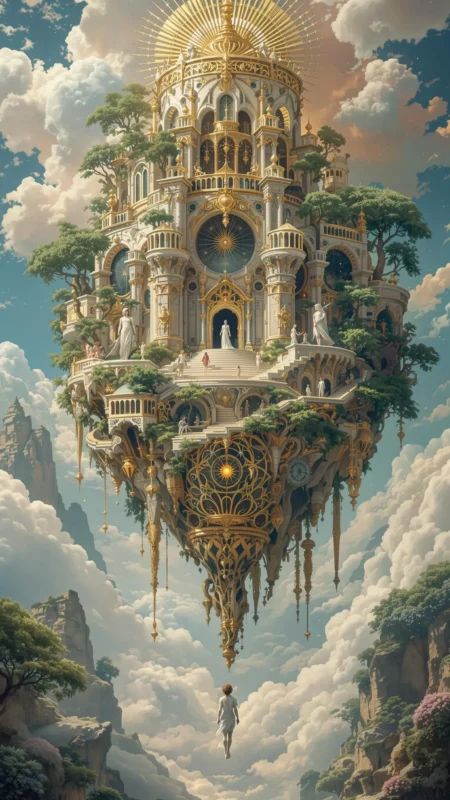
Floating Island

Archetype Meaning & Symbolism

Sovereign, detached, self-contained, migratory, isolated, sanctuary, wondrous, precarious, aloof, visionary

  • The world below is a map of possibilities, not a set of chains. Drift where the winds of your own truth take you.

If Floating Island is part of your personal mythology, you may...

Believe

  • My truest home is the one I carry within me, and it is more real than any physical place.

    Radical freedom requires a degree of detachment from the shared turmoil and expectations of the world.

    A unique perspective, seen from a distance, is more valuable for understanding the truth than an immersive experience.

Fear

  • Being forcefully grounded or tethered by responsibility, love, or circumstance, thereby losing your mobility and unique vantage point.

    That your splendid isolation is not a choice but a symptom of being fundamentally incompatible with the world, and that you are destined for a profound loneliness.

    The slow erosion of the 'magic' that keeps your island afloat—your creativity, your belief, your will—leading to a catastrophic fall from grace.

Strength

  • A profound self-reliance and the capacity to not just endure, but thrive in solitude.

    Access to a unique, 'bird's-eye' perspective that allows for extraordinary creativity, insight, and pattern recognition.

    Emotional sovereignty: the ability to remain stable and centered even when the world below is in chaos.

Weakness

  • A significant difficulty in forming and sustaining deep, lasting, interdependent relationships.

    A tendency towards aloofness and intellectual isolation that can curdle into a painful loneliness.

    Being chronically out of touch with the practical, 'ground-level' realities of daily life, which can lead to a lack of empathy or worldly incompetence.

The Symbolism & Meaning of Floating Island

In a personal mythos, the Floating Island may represent the sovereign psyche, a mind that has untethered itself from the consensus reality of the mainland. It is a symbol of a self-contained world, a bespoke reality complete with its own weather, gravity, and private species of thought. This island is perhaps a space of genius, where radical ideas can gestate without interference. Or it might be a landscape of exquisite madness, a beautiful and intricate delusion. Its existence challenges the very notion that we must be grounded to be real, suggesting instead that our truest self might only be found when we are adrift, held aloft by the strange physics of our own spirit.

The symbolism may also speak to a particular kind of modern loneliness. It is not the loneliness of exclusion, but the loneliness of chosen altitude. The island is not cast out; it has floated away. To have this archetype in your mythology could mean you carry a portable homeland within you, a place of ultimate refuge and creative control. Yet, the air is thin up there. The views are vast, but the voices from the world below become faint. The island's journey across the sky might be a triumphant pilgrimage toward self-actualization or a tragic, aimless wandering in search of a connection it cannot, by its nature, sustain.

Ultimately, the Floating Island is a symbol of profound paradox. It is both sanctuary and prison, freedom and isolation, perspective and detachment. It embodies the choice between the interconnected, messy, rooted life of the world and the pristine, lonely, elevated life of the mind. To identify with it is to acknowledge a fundamental tension in your soul: the desire to build your own world versus the need to live in the one you share with everyone else. It is the myth of the individual, taken to its logical, atmospheric extreme.


Floating Island Relationships With Other Archetypes

The Ocean

The Floating Island's relationship with the Ocean archetype is one of quiet, constant dialogue. The Ocean is the vast, churning unconscious, the collective dream from which all things emerge and to which they return. The island floats above it, a conscious, organized structure hovering over boundless mystery. It may look down and see its own reflection, distorted in the waves of collective feeling. The Ocean's storms can buffet the island, its fogs can obscure the view, symbolizing how the individual psyche, for all its sovereignty, is never truly free from the influence of the deep, shared currents of humanity. The island defines itself by its separation from the water, yet it is the water's presence that gives its altitude meaning.

The Anchor

The Anchor is the Floating Island’s antithesis and secret longing. It represents everything the island is not: groundedness, stability, commitment, a fixed point of reference. In a personal mythology, the Anchor may appear as a person, a place, a memory, or a responsibility that threatens to pull the island from the sky. This relationship is often one of conflict, a push-and-pull between the soul's desire for radical freedom and its yearning for rest and connection. A fear of the Anchor could define the island's flight, a constant movement away from anything that might tether it. Conversely, a search for the 'right' anchor might become the island's secret quest, a hope to find a mooring that feels like home rather than a cage.

The Bird

The Bird is the island's diplomat, its messenger, its only consistent link to the outside world. Birds can come and go without compromising the island's isolation. They bring seeds from other lands, songs from distant forests, and news from the continents below. In a mythos, the Bird archetype could represent fleeting connections, moments of inspiration, or communications that bridge the gap between the isolated self and the wider world. It is the model for relationships for the Floating Island soul: visitors are welcome, companionship is cherished, but residence is temporary. The Bird understands the nature of the island because it too is a creature of the air, respecting the need for both height and distance.

Using Floating Island in Every Day Life

Creative Incubation

You may use the archetype to build a sanctuary for a fledgling idea. Treat the project as your own private island, cultivating its unique ecosystem away from the critiques and compromises of the mainland. You water it with your focus, let your thoughts be the strange and wonderful flora that grow there, and only when it is lush and self-sustaining do you consider building a bridge for visitors.

Navigating Conflict

When faced with interpersonal turmoil, you could invoke the Floating Island to gain altitude. You might visualize yourself lifting away from the tangled arguments and accusations on the ground, rising to a place where you can see the patterns of the conflict, not just the emotional flare-ups. From this vantage, a disagreement may look less like a personal attack and more like a weather system passing below: turbulent, temporary, and not intrinsic to the landscape of your soul.

Emotional Regulation

This archetype could become a tool for managing overwhelming feelings. Instead of being consumed by an emotion, you might see it as a foreign element arriving on your island's shores. Is it a nourishing rain or a corrosive acid? Is it a flock of visiting birds or a swarm of locusts? The island remains itself, a sovereign territory, and you, its warden, can observe, engage with, or gently repel the emotional weather that comes and goes without losing the core of your selfhood.

Floating Island is Known For

Sovereign Existence

The Floating Island is known for its ability to exist apart from the grounded world, a self-contained ecosystem charting its own course through the sky. It follows no roads and acknowledges no borders save its own.

A Higher Perspective:

By its very nature, it offers a unique vantage point. From its heights, the quarrels and strivings of the world below may shrink, revealing larger patterns, forgotten pathways, and the curvature of the horizon.

Unpredictable Journey:

Its path is not fixed. It may be moved by celestial currents, psychic winds, or its own unknowable whims. This makes its journey a narrative of constant discovery and perpetual uncertainty.

How Floating Island Might Affect Your Personal Mythology

How Floating Island Might Affect Your Mythos

When the Floating Island drifts into your personal mythos, it reframes your life story from a conventional, ground-level narrative into a singular, migratory epic. Your biography is no longer about climbing a predetermined ladder or following a map drawn by others; it becomes the logbook of a world-traveler whose world is itself the vehicle. Your key life events may not be seen as planting roots, but as shifts in atmospheric currents, moments where your island caught a new wind and journeyed into unforeseen skies. The central theme of your story may become the curation of your own private ecosystem of beliefs, values, and creativity, a world you carry with you through all circumstances.

This archetype also introduces a core tension into your mythos: the search for belonging versus the imperative of freedom. Your narrative might be filled with poignant departures, near-landings, and encounters with other worlds, both floating and terrestrial. The dramatic question of your life could be, 'Will this island ever find a permanent home, or is its purpose to wander forever?' Or perhaps the story resolves in the discovery that the journey itself is the destination, and 'home' is the state of being airborne. Your mythos becomes one not of settlement, but of sublime, perpetual pilgrimage.

How Floating Island Might Affect Your Sense of Self

To see yourself as a Floating Island is to perceive your core identity as something self-contained and sovereign. Your sense of self may not be defined by your relationships, your job, or your community, but by the private landscape of your inner world. You might feel that your thoughts, dreams, and values constitute a real, tangible place that is more authentically 'you' than your physical body or social roles. This can foster immense self-reliance and a powerful inner locus of control. You may believe that you are the sole creator and warden of your own reality, responsible for its climate, its resources, and its defense.

However, this perception could also cultivate a sense of being fundamentally different or alien. While others seem to walk on a shared earth, you are subject to different laws of gravity. This can lead to a feeling of being perpetually misunderstood, your unique perspective feeling less like a gift and more like a pane of glass separating you from authentic connection. There may be a quiet grief that accompanies this self-image, a sorrow for the easy camaraderie and shared ground that you have, by nature or by choice, floated away from.

How Floating Island Might Affect Your Beliefs About The World

With the Floating Island as a key part of your mythos, you may view the world from a profound and literal distance. Life on the 'mainland' might appear as a complex, beautiful, and sometimes baffling tapestry. You are less a participant in its dramas and more of an observer of its patterns. This can grant you a philosopher's perspective, allowing you to see the interconnectedness of systems—political, social, ecological—that those enmeshed within them cannot. You might see history not as a linear march but as a series of continental shifts on the surface below.

This elevated view might also color your perception of reality itself. The world of consensus and convention could seem flimsy, arbitrary, and optional. You may believe that 'reality' is not a single, solid thing, but a multiplicity of worlds, and you simply inhabit one that is portable. This can be incredibly liberating, freeing you from dogma and peer pressure. Yet, it could also foster a subtle condescension or detachment from the urgent, messy problems of the world, which can seem small and far away from your serene altitude. The suffering of the world might become an abstract concept, a sad weather pattern you float above but do not feel.

How Floating Island Might Affect Your Relationships

In the realm of relationships, the Floating Island archetype suggests a navigation based on sovereignty and space. You may view connections not as fusions or mergers, but as orbits. Other people are celestial bodies, some grounded, some also adrift, and the art of relationship is to find a harmonious distance, a gravitational pull that is engaging but not capturing. You might fear being 'grounded' by a partner's needs or 'tethered' by expectations, viewing such entanglements as a threat to your very essence, which is mobility.

This could lead to a preference for relationships that honor autonomy above all else. You may seek partners who are themselves self-contained worlds, who understand the need for solitude and private skies. Love, for you, might not be about building a home together, but about admiring each other's islands from a respectful proximity, perhaps visiting on occasion. While this can lead to beautifully unconventional and respectful partnerships, it may also create a barrier to the profound, messy, and transformative intimacy that comes from true interdependence and vulnerability. The risk is always that the space between islands becomes a cold, unbridgeable void.

How Floating Island Might Affect Your Role in Life

Your perceived role in life, under the influence of the Floating Island, may be that of the visionary, the observer, or the outlier. You might not see yourself as a builder of communities, but as a keeper of a unique perspective. Your purpose, as you see it, is not to fit into the machinery of society but to provide a vantage point that others lack. You could be the artist who brings back visions from strange altitudes, the thinker who sees the whole system from above, or the hermit who preserves a way of being that the world has forgotten.

This archetype steers you away from conventional roles defined by institution or tradition. Your role is portable, inherent to your being, not bestowed by an external power. You are the 'emeritus of the sky.' This can be a source of great personal integrity, as your function in the world is not dependent on status or approval. However, it can also lead to a crisis of purpose. If your role is simply to float and observe, what is your impact? It may create a struggle to translate your unique vision into meaningful action on the ground, leaving you to feel like a spectator to a world you are not truly a part of.

Dream Interpretation of Floating Island

In a positive context, dreaming of a Floating Island may symbolize a breakthrough in self-sufficiency and creative freedom. The dream island might be lush, vibrant, and stable, moving serenely through a clear blue sky. This could suggest you have successfully integrated a higher perspective into your life, rising above past conflicts or limitations. It may point to a period of fertile solitude, where your inner world is thriving and you feel at peace with your own company. To land on such an island in a dream could mean discovering a new, powerful aspect of your own psyche, a sanctuary of peace and inspiration you can return to in waking life.

Conversely, a dream of a Floating Island in a negative context could be a potent symbol of alienation and precariousness. The island might be crumbling, barren, or caught in a violent storm, signifying a fear that your isolation is becoming destructive. You might be drifting aimlessly in a dark or empty sky, a metaphor for profound loneliness or a feeling of being disconnected from reality and purpose. A dream of falling from the island, or the island itself plummeting, could articulate a deep-seated fear that your independence is built on a fragile foundation, and that a catastrophic collapse into chaos is imminent.

How Floating Island Archetype Might Affect Your Needs

How Floating Island Might Affect Your Physiological Needs

When the Floating Island shapes your mythos, your relationship with fundamental physiological needs may become complex. In one expression, the island, as a metaphor for the mind or spirit, takes precedence over the 'earth' of the body. You might see bodily needs—for food, water, rest—as inconvenient anchors, base requirements that distract from the higher purpose of thought and observation. This can lead to a neglect of physical health, an asceticism that prizes the mind by punishing the body, seeing it as mere ballast.

In another expression, the archetype could manifest as an intense focus on creating a perfectly self-sustaining system. The body becomes the island's ecosystem, and physiological needs are met with meticulous, curated care. You may become a connoisseur of perfect nutrition, optimized sleep, and purified water, treating your physical self as a closed-loop terrarium that must be flawlessly maintained to keep the whole enterprise afloat. Health is not just health; it is a prerequisite for maintaining altitude and sovereignty.

How Floating Island Might Affect Your Ideas of Belonging

The Floating Island archetype poses its most profound challenge to the need for belonging. To embody this archetype is to exist in a state of sublime separation, which can make true belonging seem like a contradiction in terms. You may believe that to belong is to be grounded, to surrender your unique trajectory and merge with the mainland. Love and intimacy, therefore, might be viewed with deep ambivalence: a powerful desire for connection warring with an equally powerful fear of being tethered and losing your self-contained nature.

This can lead to a redefinition of belonging itself. Perhaps you do not seek to belong *to* a group, but to belong *to yourself* so completely that your solitude becomes a resonant and fulfilling state. Love and friendship are possible, but they must be relationships between sovereigns. You might seek out other 'islands' and form a constellation, a community of wanderers who understand each other's need for space. Belonging becomes not about proximity, but about a shared understanding of distance, a mutual respect for the sacredness of each other's private skies.

How Floating Island Might Affect Your Feelings of Safety

Your need for safety, filtered through the Floating Island archetype, is likely met through distance and detachment rather than through walls and weapons. Safety is altitude. By floating above the fray, you may feel insulated from the physical and emotional threats of the 'ground level.' The world's chaos, its conflicts and contagions, cannot reach you in your serene orbit. This provides a powerful sense of psychological security, the belief that as long as you can maintain your perspective, you are untouchable.

However, this feeling of safety is inherently precarious. The island has no foundation but its own mysterious buoyancy. Your security is entirely dependent on maintaining the internal state that keeps you afloat. This can lead to a subtle, pervasive anxiety: the fear of falling. A strong psychic wind, an emotional storm, or simply the slow erosion of your self-belief could send your entire world crashing down. True safety, therefore, becomes a constant internal balancing act, a fragile peace maintained at a great and lonely height.

How Floating Island Might Affect Your Views of Esteem

Esteem, for a person with the Floating Island in their mythos, is typically sourced from within. Your self-worth is not built upon the praise of others or external achievements, but on the richness, beauty, and integrity of your inner world. You are the sole curator of your island, and your esteem comes from a job well done: from the wisdom of your insights, the originality of your ideas, the resilience of your spirit. This internal validation is a superpower, granting you immunity from criticism and the whims of public opinion.

This can, however, shade into a kind of untouchable arrogance. If all esteem is self-generated, you may become incapable of accepting feedback or acknowledging flaws in your own thinking. Criticism may be perceived not as helpful input, but as an attempted invasion of your sovereign territory, an attack on your very existence. Your self-esteem, while robust, might also be brittle, as it isolates you from the corrective and humbling experiences that come from genuine dialogue and being truly seen by others, flaws and all.

Shadow of Floating Island

When the Floating Island falls into shadow, its sovereign solitude curdles into a paranoid and desolate isolation. The island ceases to be a sanctuary and becomes a fortress. Its weather turns harsh, its landscape barren, its borders patrolled against any and all contact. This is not the peaceful detachment of the observer, but the fearful retreat of the exile. The person may sever all ties, viewing connection not as a risk but as a guaranteed contamination. They drift in a perpetual, self-imposed twilight, mistaking their prison for a kingdom and their loneliness for purity. Their unique perspective sours into a grim confirmation bias, where everything they see below only reinforces their decision to remain aloof and superior.

The shadow can also manifest as a desperate, frantic aimlessness. Instead of a majestic, purposeful journey, the island's movement becomes erratic, fleeing imagined threats and chasing fleeting mirages of peace. This shadow aspect reveals a spiritual arrogance, a condescending pity for the 'grounded' masses. The individual may mistake their detachment for enlightenment, their lack of connection for superiority. They become a critic of a world they refuse to participate in, offering pronouncements from a height that ensures they will never have to test their ideas or face the consequences of their judgments. It is the ultimate intellectual cul-de-sac: a beautiful, intricate world of one, floating in a cold, meaningless void.

Pros & Cons of Floating Island in Your Mythology

Pros

  • It fosters an unparalleled sense of inner freedom and psychological autonomy, freeing you from the need for external validation.

    It provides the perfect internal conditions for cultivating a rich, unique inner world and a singular creative vision.

    It offers a natural and powerful defense against emotional contagion, groupthink, and the psychological noise of society.

Cons

  • It can create a profound and painful sense of loneliness, of being a permanent spectator to the shared human experience.

    It may fundamentally hinder the development of deep intimacy, trust, and the ability to healthily depend on others.

    It can lead to a dangerous disconnect from practical reality, fostering a lack of empathy and an inability to function effectively on the 'ground.'