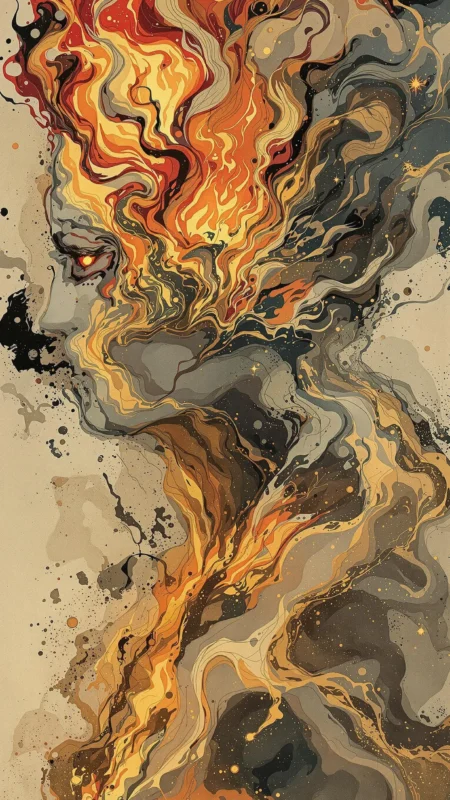
Fire

Archetype Meaning & Symbolism

Volatile, creative, purifying, consuming, passionate, dangerous, illuminating, sudden, generative, impatient

  • Consume what no longer serves you. I am the light that shows the way, but also the heat that clears the path.

If Fire is part of your personal mythology, you may...

Believe

  • Change is not merely a part of life; it is the entire point. Stagnation is the only true death.
  • Honesty, even when it is searing and difficult, is a higher form of kindness than a comfortable lie.
  • Your passion is not a personal indulgence; it is a sacred responsibility and your primary gift to the world.

Fear

  • The ultimate terror is being extinguished: a life of mediocrity, apathy, or being controlled by forces that dampen your spirit.
  • A deep-seated fear of your own destructive capacity, of your anger or passion causing irreparable harm to those you love.
  • The horror of inauthenticity, of living a life so compromised and muted that your inner light becomes invisible to yourself and others.

Strength

  • A boundless and contagious passion that can fuel immense creative acts, social movements, and personal transformations.
  • Profound courage to face difficult truths and to initiate necessary, albeit painful, changes in your own life and in the world around you.
  • An incredible capacity for renewal, for rising from the ashes of failure or despair with renewed purpose and vision.

Weakness

  • A powerful impatience with slow processes, gradual change, and people who do not operate with the same intensity, which can lead to frustration and burnout.
  • A tendency toward impulsivity, to burn bridges or make rash decisions in a moment of high emotion without considering the long-term consequences.
  • A vulnerability to burnout, to living at such a high pitch of intensity that you exhaust your own emotional and physical resources, leading to periods of collapse.

The Symbolism & Meaning of Fire

In personal mythology, Fire represents the untamable life force, the divine spark that animates and inspires. To have Fire as a central element in your mythos is to tell a story of intensity. Your narrative may be one of passion, not of gentle affection; of sudden, blazing epiphanies, not gradual understanding. Life may not be a placid river but a series of bonfires, each marking a significant transformation, a burning away of a former self. This archetype could suggest a belief that the psyche, like a forest, requires periodic fires to clear out the underbrush of old traumas and outdated beliefs, allowing for new, more resilient growth to emerge. The meaning it grants is one of purpose found in action, in creation, and even in the holy act of letting things burn.

The symbolism of Fire is inherently dual. It is the comforting hearth at the center of the home, a symbol of community, warmth, and security. Yet it is also the wildfire, a terrifying, indiscriminate force of nature. This polarity may live within the individual. You might see your role as providing a gathering point of light and warmth for your circle, a source of creative energy and inspiration. Simultaneously, you may harbor a deep awareness of your own potential for destructive rage, for words that scorch and actions that consume. The personal myth becomes a careful dance of the fire-tamer: learning to tend the hearth of your soul without letting it erupt into a conflagration that burns down your own house.

Ultimately, Fire symbolizes a connection to the sacred and the primal. It is the burning bush of revelation, the alchemist’s flame, the phoenix’s nest. Its presence in one's mythos could point to a life path that is less about accumulating and more about refining: burning away impurities to get to the core of one’s being. The personal story may become a quest for a certain kind of truth, one that is not soft or comforting but searing and absolute. It suggests a journey toward a state of being that is pure energy, a life lived so fully and brightly that it becomes, in itself, a source of light for others navigating their own darkness.


Fire Relationships With Other Archetypes

The Ocean Archetype

The relationship between Fire and Water, particularly in its form as the vast and deep Ocean, is one of primal opposition and paradoxical synergy. They are forces that can extinguish one another, a meeting of pure energy and pure mystery. In a personal mythos, this may manifest as a core tension between the impulse to act, to burn, to express (Fire), and the urge to feel, to reflect, to sink into the subconscious depths (Ocean). A person holding both might feel perpetually caught between a life of passionate engagement with the world and a deep, solitary call to inwardness. Their greatest challenge and potential gift is finding the shoreline where these two forces meet: where the heat of passion can create steam, a new state of being, and where the water can cool recklessness into thoughtful, deliberate action.

The Wind Archetype

Fire’s relationship with the Wind is one of dangerous codependence. Wind can nurture a tiny spark into a roaring blaze or extinguish a mighty flame with a single gust. For the Fire-aligned individual, this could symbolize a profound sensitivity to external forces: to the words of others, to the currents of public opinion, to the winds of fate. Their inspiration and passion (Fire) may feel powerfully amplified by collaboration and encouragement (the Wind that feeds the flame). Conversely, they might feel snuffed out by criticism or a sudden change in circumstance. The personal mythos becomes about learning to build a good fire, one with a strong enough core of self-belief that it can withstand the shifting winds, using them to its advantage rather than being at their mercy.

The Mountain Archetype

Fire and Mountain exist in a dynamic of transformation and endurance. Fire can reshape the surface of a Mountain, burning its forests to the ground, but it cannot destroy the Mountain itself. The Mountain, in turn, contains the fire, its stone providing a crucible that directs the flame’s path. In a personal narrative, this could represent the interplay between a volatile, transformative personality (Fire) and the unchangeable realities of life or the stable structures they build (Mountain). One might feel a constant urge to change their career, their relationships, their very identity, while simultaneously relying on the immense stability of their home, their core principles, or a lifelong partnership. Their life's work may be to understand which parts of their world are forests to be cleared by fire and which are the bedrock that must, and should, remain unmoved.

Using Fire in Every Day Life

Navigating Creative Stagnation

When a project feels cold and inert, the Fire archetype suggests not gentle coaxing but a controlled burn. You may need to metaphorically set fire to the first draft, abandoning precious but unworkable ideas to clear the ground for new growth. This is not failure; it is fallowing the field of the mind with heat, trusting that the ashes will fertilize a more potent and authentic creation that rises from the ruin.

Ending a Relationship

To end a significant connection through the lens of Fire is to choose a swift, clean break over a slow, painful dissolution. It is the cauterizing of a wound. This approach recognizes that some bonds, when they become unhealthy, must be fully severed to prevent lingering infection. It may be a painful, pyric act, but it honors the truth of the situation and, in its devastating honesty, perhaps provides a strange form of kindness, allowing both parties to begin rebuilding from a clear and unambiguous end.

Instigating Social Change

The Fire archetype in a social context is the spark of revolution or the illuminating flame of truth. It is speaking an incendiary, necessary reality in a room of comfortable falsehoods. It could mean organizing a protest, publishing a provocative piece of art, or simply refusing to be silent about injustice. This is not about indiscriminate destruction but about applying focused heat to a specific point of a corrupt or stagnant structure until it yields, transforms, or breaks, letting in the light.

Fire is Known For

Transformation

Fire is the elemental agent of change. It does not merely alter a substance; it transmutes it into something new: wood to ash, sand to glass, ignorance to awareness. This power of total conversion is its most fundamental characteristic.

Illumination:

Before it is a force of heat, fire is a source of light. It reveals what is hidden in the darkness, symbolizing knowledge, consciousness, and the sudden flash of insight that can reorient an entire life. It is the light of the hearth and the bolt of lightning.

Destruction:

Fire’s power is inseparable from its danger. It consumes, it purges, it destroys. This destructive capacity is not inherently evil; it can be a purifying force that clears away the dead and decaying to make way for new life, a necessary, if terrifying, part of the natural cycle.

How Fire Might Affect Your Personal Mythology

How Fire Might Affect Your Mythos

When Fire is a dominant force in your personal mythology, your life story is unlikely to be a linear progression. It may read more like a collection of dramatic turning points, each marked by a symbolic fire that consumed a previous identity. The narrative arc is one of reinvention. The move across the country wasn't just a change of scenery; it was a self-immolation of a past life. The end of that major relationship wasn't a quiet parting; it was burning a bridge to ensure there was no return. Your mythos is episodic, favoring the sudden blaze of a new passion or career over the slow, steady build. You may see your past not as a foundation upon which you've built, but as piles of ash that have fertilized the ground for whatever you are now.

This mythos is often centered on a core event of transformation, a “first fire” that defined the pattern. Perhaps it was a youthful moment of speaking a terrifying truth, a creative breakthrough born from desperation, or a crisis that burned away all illusions. This event becomes the central chapter in your sacred text, the story you return to in order to understand your own nature. Subsequent life events are interpreted through this lens: every success is a well-tended flame, every failure a moment of near-extinguishing, every new beginning an act of striking a match in the dark. Your life story becomes a testament to the power of starting over, a heroic narrative about the one who dances in the flames of change rather than fleeing from them.

How Fire Might Affect Your Sense of Self

Your perception of self, if informed by Fire, may be one of a vessel for a powerful, almost alien energy. You might not feel entirely in control of your own passions or inspirations; they seem to arrive in flashes, demanding expression. This can lead to a self-concept that is both exalted and precarious. On one hand, you may see yourself as a conduit for creativity, a catalyst for change in the lives of others, a source of warmth and light. You might identify with your own intensity, viewing it as the most authentic part of your being. Your sense of self-worth could be deeply tied to your productivity, your passion projects, and your ability to live with courage and verve.

On the other hand, there might be a fear of this internal furnace. You may feel a deep-seated anxiety about your own temper, your impulsivity, or your capacity to hurt others with a sharp, burning honesty. This could create a bifurcated self-image: the “good” fire of the hearth (creative, warm, communal) and the “bad” fire of the wildfire (destructive, angry, out of control). The journey of self-development becomes about integration: learning that the same energy that fuels a masterpiece can also fuel a devastating argument. Self-acceptance means embracing the totality of the flame, learning to modulate its heat rather than trying to extinguish the parts of it that feel dangerous.

How Fire Might Affect Your Beliefs About The World

A worldview shaped by the Fire archetype is one that sees reality as fundamentally dynamic, fluid, and defined by transformation. The world is not a static set of structures but a crucible of constant change. You may believe that progress, on both a personal and societal level, requires periodic destruction. Old institutions, outdated traditions, and limiting beliefs must be metaphorically burned down to make way for new, more vital forms. This perspective can foster a kind of revolutionary optimism: no matter how bleak things seem, a single spark of a new idea or a courageous act can ignite a fire that changes everything.

This worldview may also have a cynical or impatient edge. There might be a deep frustration with stasis, with bureaucracy, with anything that feels slow, cold, and resistant to change. You might view stability not as a virtue but as a form of stagnation, a slow death. The world may appear to be divided between those who carry a flame and those who seek to extinguish it. This can lead to a perception of life as a constant struggle to protect one's own inner light from the dampening forces of conformity, apathy, and fear. Reality is a place of friction, and it is from that friction that the sparks of meaning are born.

How Fire Might Affect Your Relationships

In relationships, the Fire archetype manifests as a desire for intensity, passion, and transformative connection. You are likely not drawn to placid, comfortable partnerships but to those that challenge, energize, and change you. The process of falling in love might feel like a conflagration, a sudden and total merging of energies that is both thrilling and a little frightening. You may offer immense warmth, encouragement, and a contagious zest for life to your partners, friends, and family, acting as the hearth around which they gather. You inspire them, you champion their dreams, and you bring a vital energy to every interaction.

However, this same intensity can be the source of relational difficulty. A need for constant high energy can lead to burnout, both for you and for those who cannot match your pace. Your passion can easily tip into drama, and your honesty can feel scorching to more sensitive souls. There may be a pattern of relationships that burn incredibly bright and then flame out just as quickly, leaving behind a sense of emptiness. The mythos of Fire in relationships is about learning the art of the slow burn: how to maintain passion without demanding constant crisis, how to provide warmth without scorching, and how to find a partner who is not consumed by your light but knows how to dance with you in its glow.

How Fire Might Affect Your Role in Life

If Fire informs your personal mythos, you may perceive your role in life as that of a catalyst. You are not the person who maintains the status quo; you are the one who disrupts it for the sake of progress. Whether in your family, your workplace, or your community, you might subconsciously take on the role of the truth-teller, the one who points out the uncomfortable reality that everyone else is ignoring. Your purpose feels tied to action, to initiation, to starting the project, the conversation, or the movement. You are the spark plug, not the engine block; your function is to ignite, not necessarily to sustain the long, steady work that follows.

This role can be both a blessing and a burden. It brings a sense of profound purpose: you are here to make things happen, to bring light to darkness, to warm a cold world. However, it can also be an isolating position. Catalysts are often seen as troublemakers, and the truths they tell can make them unpopular. There may be a feeling that you are destined to be on the move, never quite belonging to the structures you help to change. The developmental task within this role is to embrace your incendiary nature with wisdom, learning when to apply a gentle, warming flame and when to unleash a purifying blaze, and finding peace in the knowledge that your purpose is to start fires, even if you don't always get to enjoy their long-lasting warmth.

Dream Interpretation of Fire

To dream of fire in a positive context is often to witness your own life force in its purest form. A controlled fire, such as a bright candle in a dark room or a warm, crackling hearth, could symbolize a dawning of consciousness, a potent new idea, or a reconnection with your deepest passions. It may suggest that your creative energies are flowing well and that you are on a path of authentic self-expression. Cooking over a fire in a dream can point to the nourishment you are receiving from your work or relationships, suggesting a healthy transformation of raw potential into something life-sustaining. Seeing a phoenix rise from flames is a powerful omen of personal rebirth, indicating that a period of hardship is ending and you are emerging from it stronger and renewed.

Conversely, a fire dream in a negative context speaks of uncontrolled, destructive energy. A dream of your house burning down may not be a literal premonition, but a stark symbol of burnout, overwhelming stress, or a family conflict that is consuming your sense of safety. Being chased by a wildfire could represent a feeling of being overwhelmed by your own rage, or by external circumstances that are spiraling out of your control. If you are the one setting the fire indiscriminately (arson), your subconscious may be warning you about your own destructive impulses, perhaps a desire to burn bridges or sabotage your own success out of anger or fear. A weak, sputtering flame that you cannot keep lit might symbolize a loss of hope, a creative block, or a feeling of deep exhaustion and dwindling vitality.

How Fire Archetype Might Affect Your Needs

How Fire Might Affect Your Physiological Needs

When Fire is woven into your mythos, your physiological needs may feel more acute and demanding. There can be a sense that your body is a furnace that requires high-quality fuel to burn brightly. You might have a naturally fast metabolism or feel a deep, almost primal need for foods that are energizing and warming. A lack of this vital energy doesn't just feel like tiredness; it can feel like a profound coldness, a dampening of the spirit that manifests as physical lethargy and a dulling of the senses. Your baseline state is one of warmth and radiant energy, and anything less can feel like a fundamental state of 'wrongness' that must be corrected through movement, nourishment, or stimulation.

The connection between your emotional state and your physical body may be exceptionally direct. A surge of inspiration can feel like a literal fever, a rush of heat through the limbs. Anger may manifest as a flushed face and a feeling of being about to combust. The need for rest is not about gentle repose but about managing the risk of burnout. The body demands periods of cooling down, of banking the embers, to avoid a systemic overload that could lead to illness or collapse. Health is not a state of quiet equilibrium but a dynamic process of tending to your inner flame.

How Fire Might Affect Your Ideas of Belonging

The need for belongingness, seen through the lens of the Fire archetype, is a quest for a tribe that can stand the heat. You may seek connections that are not based on casual affinity but on a shared intensity and a common passion. True belonging is felt in the presence of those who are not intimidated by your light but are drawn to it, who see your fire as a source of warmth and inspiration. You may find your people in high-stakes environments: creative collaborations, activist groups, or intellectual circles where ideas are forged in the heat of debate.

You may function as the campfire for your chosen group, the central point of energy and light around which others gather. However, there can be a profound loneliness to being the flame. You may fear that your intensity will scorch those you love, leading to a preemptive withdrawal to protect them from your own nature. There is also the risk of attracting 'moths,' people who are drawn to your light for their own needs but offer little warmth in return. Fulfilling the need for belonging means finding other fires, not just people who need your warmth. It requires seeking out peers who burn just as brightly, creating a collective bonfire rather than a solitary flame.

How Fire Might Affect Your Feelings of Safety

For a person whose mythos is governed by Fire, the need for safety is not found in permanence or stability but in the capacity for transformation. True security is not a high wall but the knowledge that you can burn down any prison. You may feel safest when you are untethered, mobile, and able to adapt to changing circumstances. Safety is the freedom to change your mind, your job, your city, your self. The greatest threat is not chaos, but entrapment: a situation, relationship, or belief system that feels like it is smothering your inner flame.

This creates a paradoxical relationship with security. The very things that make others feel safe—a predictable routine, a lifelong career, a stable mortgage—may feel like a cage to you. Your sense of safety is internal, rooted in your self-reliance and your trust in your own ability to rise from the ashes of any disaster. However, the shadow of this is a life lived in a state of constant, low-grade precarity. By rejecting external stability, you may sometimes create unnecessary chaos, burning down perfectly good structures out of a fear of being tied down. The path to integrated safety lies in building a hearth, a secure base that is a source of warmth, not a prison.

How Fire Might Affect Your Views of Esteem

Esteem needs for the Fire-driven individual are intrinsically linked to impact and expression. Self-worth is not derived from quiet competence but from the visible evidence of one's inner flame shaping the world. This could be a finished piece of art, a successfully launched venture, a changed mind in a debate, or the spark of understanding in a student's eyes. Esteem is built on the courage to be seen in your full, brilliant, and sometimes-blinding authenticity. You respect yourself when you act on your convictions, speak your truth, and live in alignment with your passion, regardless of the consequences.

This can make self-esteem a volatile commodity. When your creative fire is burning brightly and you are actively engaged in your passions, your self-worth may soar. You feel potent, alive, and purposeful. But during periods of quiet, fallowness, or creative block, you may experience a crushing crisis of confidence. A lack of external expression can be misinterpreted as an internal failure, a sign that your fire is going out. The developmental challenge is to build a more resilient form of esteem, one that values the glowing embers as much as the roaring flame. It is the recognition that even in darkness and quiet, the potential for light remains, and that your worth is inherent to your being, not just your doing.

Shadow of Fire

The shadow of Fire is the arsonist. It is passion untethered from purpose, turning into raw, indiscriminate destruction. When this shadow takes hold, your creative energy curdles into chaos. You don't just leave a job, you sabotage the company on your way out. You don't just end a relationship, you seek to obliterate the other person with cruel words. This is the wildfire personality, consuming everything in its path not for renewal, but for the sheer, nihilistic thrill of the burn. It is anger without righteousness, change without direction, and light that blinds instead of illuminates. It is the person who creates drama constantly because they mistake the heat of conflict for the warmth of being alive.

A more subtle, but perhaps more tragic, shadow is the snuffed flame. This occurs when the fear of Fire's destructive potential becomes so overwhelming that you actively suppress it. You become terrified of your own passion, your own anger, your own power. You live in a state of constant self-policing, banking your embers so thoroughly that you forget you even have a fire. This leads to a life of profound inauthenticity, a cold and gray existence marked by depression, apathy, and a deep-seated resentment toward those who burn brightly. You become the one who throws water on everyone else's sparks, not out of malice, but out of a tragic, misplaced fear of your own potential to ignite.

Pros & Cons of Fire in Your Mythology

Pros

  • You possess a powerful engine for change, capable of reinventing your life and inspiring others to do the same.
  • Your life is likely to be rich with passion, excitement, and a sense of vibrant aliveness that many people crave.
  • You have the courage to bring light to darkness, speak difficult truths, and confront injustice directly.

Cons

  • You are at high risk for burnout, as your natural intensity can be difficult to sustain over a lifetime.
  • Your impulsivity and scorching honesty may damage relationships and burn bridges that you later regret losing.
  • You may struggle with periods of quiet or calm, mistaking peace for stagnation and creating unnecessary chaos to feel alive.