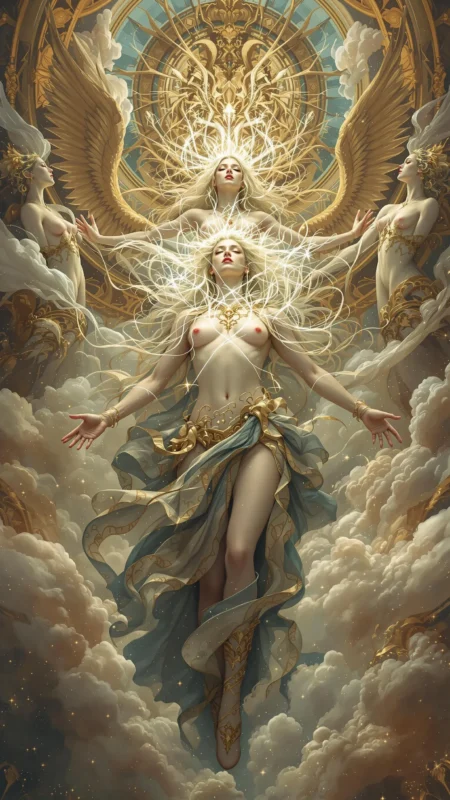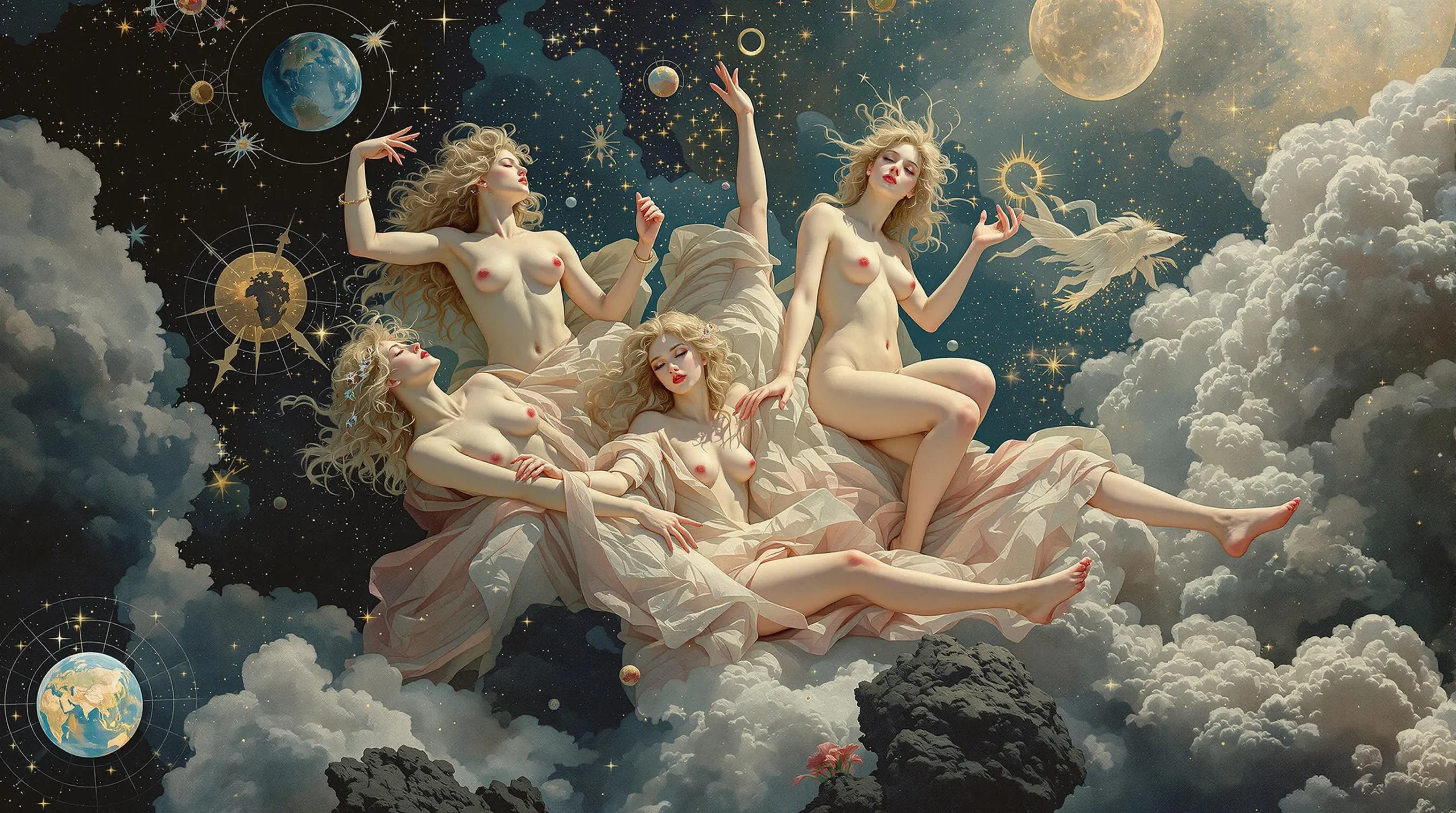


Fates

Archetype Meaning & Symbolism

Inevitable, impersonal, ancient, unyielding, collaborative, meticulous, rhythmic, patient, indifferent, creative

  • The things that were, the things that are, and the things that are to be.

If Fates is part of your personal mythology, you may...

Believe

  • You may believe that everything happens for a reason, each event a necessary stitch in a pattern whose full beauty is beyond your immediate comprehension.
  • You may believe that true freedom lies not in defying fate, but in embracing it with courage and creativity, finding the infinite space for choice within the finite boundaries of your life's thread.
  • You may believe that your life has an inherent purpose and meaning, not one you must invent, but one you are called to discover and embody.

Fear

  • You may fear that your destiny is tragic or insignificant, that your thread is fated to be short, tangled, or woven into a dark and painful corner of the tapestry.
  • You may fear a profound sense of powerlessness, the chilling realization that your will, your dreams, and your struggles are ultimately irrelevant against the unchangeable decree of fate.
  • You may fear that you are misreading the signs, failing to live up to your allotted role, and therefore dishonoring the integrity of your own existence.

Strength

  • You may possess a deep well of resilience, an ability to weather loss and disappointment with a grace born of acceptance.
  • You may cultivate a calm and centered presence, unburdened by the corrosive anxiety of infinite choice and the regret of the 'what if.'
  • You may have an extraordinary capacity to find meaning and purpose in all circumstances, viewing even suffering as a crucial element of a larger, coherent story.

Weakness

  • You may exhibit a tendency toward passivity or fatalism, using 'destiny' as an excuse for inaction and avoiding the difficult work of making choices.
  • You may struggle to take full personal responsibility for your actions, deflecting accountability by attributing all consequences to a preordained plan.
  • You may develop a form of emotional detachment, viewing your own life and the lives of others from a distance, as if you were all merely characters in a play.

The Symbolism & Meaning of Fates

The Fates are not gods of whim or passion: they are cosmic accountants, weavers of a fabric so vast that even Zeus was said to be subject to their design. In your personal mythology, they may represent the humbling recognition of an order that precedes your own consciousness. They are the architecture of reality, the unwritten laws of cause and effect, the silent rhythm of birth, life, and death. To welcome them is to acknowledge that your life is a single thread, miraculously unique yet part of a universal weave. It is to find the sacred in the structure of things, in the elegant, and sometimes cruel, geometry of what must be.

Their symbolism is potent. The thread is your timeline, your very life force. The spindle is the turning world, pulling you into being. The shears are the stark, non-negotiable fact of mortality. In a modern context, where the self is often seen as a project of infinite reinvention, the Fates offer a counter-narrative. They suggest that freedom is not found in limitless choice, but in the masterful navigation of your given circumstances. Your mythos may become less about forging a path out of nothing and more about discovering the beauty and meaning of the path laid for you, learning to dance to a music whose composition you had no hand in.

Engaging with the Fates could mean seeing patterns where others see chaos. A chance encounter, a sudden obstacle, a surprising gift: these may no longer feel random. They could be interpreted as the work of Lachesis, carefully measuring and allotting the next twist in your story. This perspective doesn't demand passivity. It instead invites a deep, attentive presence. It asks you to feel the texture of your thread, to notice how it intertwines with others, to appreciate the strength it possesses, not in spite of its limits, but because of them.


Fates Relationships With Other Archetypes

The Crossroads

The Crossroads may present itself as the very heart of mortal agency, a place where paths diverge and a life's direction is chosen with the trembling hand of free will. It is a stage set for a grand soliloquy of decision. To The Fates, however, this nexus of possibility could be little more than an ornate knot in a thread whose length and destination were determined long ago. The agonizing choice a traveler makes there is, perhaps, simply the moment the weaver’s hand guides the shuttle to the left instead of the right, a movement foreseen before the loom was even warped. The illusion of choice might be the most profound and cruel elegance in their design, a flourish that makes the tapestry of destiny not just a pattern to be observed, but a drama to be felt by the very threads that compose it.

The Unraveling Sweater

If The Fates are the eternal weavers, then the Unraveling Sweater could be seen as their silent, persistent antagonist—entropy given a humble, domestic form. Yet, this may be a misreading of their purpose. The slow dissolution of a garment, the snag that becomes a hole, the return of a complex form to a simple string, need not be a failure of the initial weave. Perhaps the final snip of the shears is not always a sudden, violent act. It can also be a slow, deliberate loosening, a life coming undone not by a singular tragedy but by the patient, gravitational pull of time itself. The Fates, one might say, do not merely create the fabric of being; they also preside over its necessary and graceful decay, understanding that a pattern is defined as much by its eventual absence as by its momentary presence.

The Storyteller

The Storyteller stands as a mortal echo of The Fates, a miniaturist attempting to render an ocean on a canvas the size of a thumbnail. Both archetypes spin yarns, chart courses, and determine the fall of the final curtain. The profound difference, however, lies in the substance of their authority. A Storyteller's power is a fragile consensus, a world conjured from the conditional tense of “what if,” requiring the breath of an audience’s belief to keep it inflated. The Fates, by contrast, work in the stark, unchangeable indicative. Theirs is not a narrative told about reality; it is the unfolding grammar of reality itself. Where the Storyteller hopes to weave a compelling illusion, The Fates handle the very fibers of the real, their loom producing not a mirror of the world, but the world itself.

Using Fates in Every Day Life

Navigating Career Transitions

When a career path abruptly ends, one might not see it as personal failure but as the work of Atropos, the Inflexible, whose shears sever a thread that has reached its measured length. This isn't an ending born of malice, but of cosmic necessity. Such a perspective could allow for a period of stillness, a trust that Clotho, the Spinner, is already drafting a new fiber, a new beginning, from the raw material of this unexpected halt. The task then becomes not to fight the cut, but to feel for the vibration of the new thread beginning to form.

Processing Grief and Loss

To see a life through the lens of the Fates is to understand it as a complete tapestry, not a series of disconnected moments. The loss of a loved one could be perceived as the moment their thread, beautifully spun and woven into your own, reaches its final, measured knot. The grief is not denied, but it is held within a context of completion. Their life was not a sentence cut short: it was a poem of a specific length. This may allow for a different kind of remembrance, one that honors the integrity of their entire story, start to finish.

Making Major Life Decisions

Faced with a crossroads, the weight of choice can be paralyzing. An alignment with the Fates archetype, however, might shift the focus. Perhaps the path is already determined by Lachesis, the Allotter. The real choice, then, is not which road to take, but the grace with which you walk the one you are on. This belief could liberate you from the anxiety of the “what if,” fostering a commitment to the present reality and infusing your actions with a sense of purpose, regardless of the direction the path ultimately takes.

Fates is Known For

Clotho, The Spinner

She is the youngest, the one who spins the very thread of life from the distaff onto her spindle. She represents beginnings, the raw material of existence, the moment potential becomes actual.

Lachesis, The Allotter:

The measurer. She is the one who determines the length of the thread and assigns the events, fortunes, and hardships that will be woven into it. She represents the substance and duration of a life's story.

Atropos, The Inflexible:

She is the eldest and the cutter of the thread, the one who chooses the moment and manner of death. Her name means “unturning,” and with her shears, she ends a life, representing the inevitability of conclusion.

How Fates Might Affect Your Personal Mythology

How Fates Might Affect Your Mythos

When the Fates enter your personal mythos, your life story may shift from a picaresque novel of your own authoring to a great epic poem whose meter and rhyme scheme are set by a force beyond you. You are still the protagonist, but your heroism is defined by how you inhabit your verses, not by trying to rewrite the stanza. Events that once seemed like plot holes or editorial errors: sudden losses, confusing detours, periods of fallow waiting: could be re-contextualized as necessary narrative devices. They are the caesuras that give the line its rhythm, the tragic turns that make the final meaning resonate.

Your personal myth may become one of discovery rather than creation. You are not inventing your purpose from whole cloth, but uncovering the purpose that was spun for you at the dawn of your being. This transforms your journey into a sacred pilgrimage. The goal is to align with your destiny, to read the signs woven into the fabric of your days. Your personal mythology becomes a tapestry viewed from the back: a mess of knots and threads that only reveals its grand design when seen from the other side, a perspective you might only glimpse in moments of deep intuition or at the very end.

How Fates Might Affect Your Sense of Self

An intimacy with the Fates could profoundly alter your conception of self. The relentless pressure to be self-made, to achieve a particular version of success, may soften. Your identity might feel less like a project to be managed and more like a reality to be embodied. This can be deeply liberating. The self is no longer a fragile construction of ego and achievement, but a resilient thread, part of something eternal and unbreakable. You are you not because of what you've done, but because of what you are: a specific, necessary strand in the cosmic weave.

This may cultivate a quiet confidence, a sense of self that is not dependent on external validation. Your worth is inherent, measured and allotted by Lachesis herself. Failures may feel less personal, successes less ego-inflating. They are simply events woven into your thread. This could lead to a state of radical acceptance: an embrace of your own nature, your own history, and your own unchangeable past. You are exactly who and where you are supposed to be, and the only task is to be there fully.

How Fates Might Affect Your Beliefs About The World

To see the world through the eyes of the Fates is to suspect a hidden order beneath the surface of apparent chaos. History is not one damned thing after another: it is a story, its plot advancing inexorably. Social and political upheavals, technological revolutions, cultural shifts: all could be seen as the grand turning of Clotho's spindle, spinning new realities for humanity's tapestry. It is a worldview that finds solace in structure, even when that structure is incomprehensible or painful. It suggests that nothing is truly wasted, that every event serves the larger pattern.

This perspective may lead one away from frantic activism toward a more patient, enduring form of engagement. The goal is not to force change single-handedly, but to align one's actions with the perceived direction of the weave. It can foster a long-term perspective, a trust that the arc of the moral universe, like a thread measured by Lachesis, is long but bends toward a purpose. It is a worldview that makes room for mystery, for the humbling idea that the most important truths are not human inventions but cosmic givens.

How Fates Might Affect Your Relationships

In the realm of relationships, the Fates introduce a sense of sacred inevitability. The people who enter your life may be seen not as random acquaintances but as fated companions, their threads destined to intertwine with yours for a season. A brief, intense friendship might be a knot that strengthens both threads for a future challenge. A painful breakup could be the necessary snip of Atropos's shears, freeing both individuals to be woven into new sections of the tapestry. This view doesn't diminish the love or pain, but frames it within a meaningful, purposeful context.

This could change how you approach connection itself. There may be less striving, less anxiety about finding “the one.” Instead, there might be a deep appreciation for the ones who are here now. Each interaction becomes significant. You might see your role not as possessing another, but as weaving alongside them for a time. It could lead to a greater capacity for letting go, understanding that some threads are meant to run parallel for a lifetime, while others are meant only to cross once, creating a single, brilliant point of color in the overall design.

How Fates Might Affect Your Role in Life

The Fates suggest your role in life is not a matter of choice, but of destiny. It is the part you were spun to play. This doesn't necessarily mean a specific job or social position, but rather a way of being, a unique quality that your thread contributes to the whole. You might be a thread of vibrant color that inspires others, a strong, foundational thread that provides stability, or a silvery thread that brings moments of luminosity and insight. Your life's work becomes discerning and then fulfilling this innate role with integrity and grace.

This can alleviate the modern burden of having to invent a purpose for oneself. The pressure is off. Your purpose already exists, woven into your very fiber. The challenge shifts from 'What should I do with my life?' to 'Who was I born to be?'. Living in alignment with this archetype could mean feeling a profound sense of place and necessity. You are not an accident. You are a required element of the pattern, and your role is to be authentically, unapologetically yourself, thus allowing the tapestry to become what it was always meant to be.

Dream Interpretation of Fates

In a positive dream context, the Fates may appear as serene, focused artisans. To dream of them weaving a beautiful, strong, or brightly colored thread for you could symbolize a period of profound alignment with your life's path. You may feel that you are in a state of 'flow,' where opportunities and events seem to unfold effortlessly and meaningfully. Seeing a complex but beautiful tapestry might suggest a growing appreciation for the intricate journey of your life, including its challenges. It can be an affirmation from the subconscious that you are on the right track, fulfilling your destiny.

Conversely, a nightmare involving the Fates can be deeply unsettling. Dreaming of Atropos approaching with her shears might signify a primal fear of death, an abrupt ending, or a loss of control. A tangled, knotted, or frayed thread could represent feelings of confusion, being trapped in a difficult situation, or facing conflicting duties and desires. If the Fates appear menacing or indifferent to your pleas, it may reflect a waking sense of powerlessness against forces you cannot change, a fear that your destiny is one of suffering or insignificance.

How Fates Archetype Might Affect Your Needs

How Fates Might Affect Your Physiological Needs

From a mythological perspective, the Fates' influence on physiological needs could manifest as a deep trust in the body's innate wisdom and rhythms. The body itself is a text woven by destiny. The pang of hunger, the need for sleep, the cycle of hormones: these are not inconveniences to be bio-hacked into submission, but the very rhythm of the thread being spun. One might honor these signals as sacred communiques from the source of one's being, tending to the body as a caretaker of a fated instrument.

This perspective could lead to a release from anxiety surrounding health and aging. The body's eventual decay is not a failure but the natural course of the thread, as designed by Lachesis and concluded by Atropos. This acceptance may not remove the desire for health, but it could reframe it. The goal is not to achieve immortality or a perfect physique, but to inhabit the allotted vessel with grace and gratitude for the duration of its measure, respecting its limits and honoring its cycles.

How Fates Might Affect Your Ideas of Belonging

With the Fates as part of your mythos, the need for love and belonging finds its ultimate satisfaction in the tapestry itself. You belong not because you are accepted by a specific tribe or partner, but because your thread is fundamentally, irrevocably woven with all other threads. Solitude may lose its sting, as you understand that no thread is ever truly alone: it is defined by its relationship to the threads around it, even those it never touches directly. Belonging is a cosmic fact, not a social achievement.

This can transform the nature of love. Love may be seen as the recognition of a fated intertwining. There is less frantic searching and more patient recognition. You love people not just for who they are, but for the role their thread plays alongside yours. This perspective could foster a more universal, compassionate love: an appreciation for the whole of humanity as a single, complex, and beautiful fabric, where every single strand is essential for the integrity of the pattern.

How Fates Might Affect Your Feelings of Safety

A personal mythology incorporating the Fates may redefine the need for safety. True safety might not be found in building walls, accumulating wealth, or controlling one's environment. These efforts are, in the face of destiny, ultimately futile. Instead, a profound sense of security could arise from radical trust in the weave. The belief that whatever happens, be it fortune or disaster, is part of your allotted path can foster an extraordinary calm in the face of uncertainty.

This doesn't imply recklessness, but rather a shift in focus. Safety is not freedom from harm, but the unbreakable knowledge that you cannot befall a fate that was not already yours. This could cultivate a resilient spirit, one that doesn't shatter when plans go awry. Security becomes an internal state, an unwavering faith in the integrity of your own story. You are safe not because nothing bad will happen, but because whatever happens is part of a coherent, albeit mysterious, whole.

How Fates Might Affect Your Views of Esteem

Esteem, in a world governed by the Fates, is not measured by accomplishments, status, or external praise. These are merely the colors and textures woven into your thread by Lachesis. True esteem, a deep and unshakable self-respect, could come from the quality of your participation in the weaving. It is the pride in being a well-spun thread, whether it is long or short, brilliant or muted. It is the dignity of fulfilling your given role with grace, courage, and awareness.

This shifts the locus of validation from the external to the internal. You may seek to live in such a way that honors the gift of your unique thread. The central question for self-esteem becomes: 'Am I living authentically within the destiny I've been given?' This fosters a quiet confidence that is not easily swayed by the opinions of others or the whims of fortune. It is the esteem that comes from knowing you are an essential and irreplaceable part of a grand and meaningful design.

Shadow of Fates

The shadow of the Fates manifests as a crippling fatalism. When this archetype dominates the psyche, life ceases to be a dance with destiny and becomes a prison of predestination. Initiative withers, hope curdles into resignation. One might refuse to act, to love, or to strive, believing any effort to be futile against the ironclad will of the weavers. It is the cold, gray belief that your thread is already woven into a pattern of mediocrity or tragedy, and there is nothing to do but endure it. This shadow aspect drains the world of color and possibility, turning the profound mystery of fate into a simple, brutal jail sentence.

Conversely, the shadow can appear as a manic rebellion against fate, a Promethean desire to seize the shears from Atropos and become the master of all destiny. This individual cannot abide by uncertainty or lack of control. They might ruthlessly cut people or opportunities from their life that do not fit their rigid plan, denying the organic, mysterious unfolding of the weave. They try to force the threads, creating a brittle, artificial pattern devoid of grace. This is the shadow of control, which, in its terror of the unknown, destroys the very possibility of a beautiful, fated surprise.

Pros & Cons of Fates in Your Mythology

Pros

  • It can provide a powerful framework for radical acceptance, dramatically reducing anxiety about the future and regret about the past.
  • It fosters a deep and abiding sense of meaning, suggesting that every moment of one's life is an integral part of a larger, coherent, and purposeful narrative.
  • It has the potential to cultivate profound patience, resilience, and a quiet strength in the face of adversity, loss, and the unknown.

Cons

  • It can foster a dangerous passivity and a lack of personal accountability, allowing one to blame 'fate' for poor choices or inaction.
  • It may lead to feelings of profound powerlessness, depression, or resignation if one comes to believe their destiny is inescapably tragic or unfulfilling.
  • It might cultivate emotional detachment or a cold worldview, where individuals are seen not as unique beings with agency, but as mere instruments or plot points in a cosmic drama.