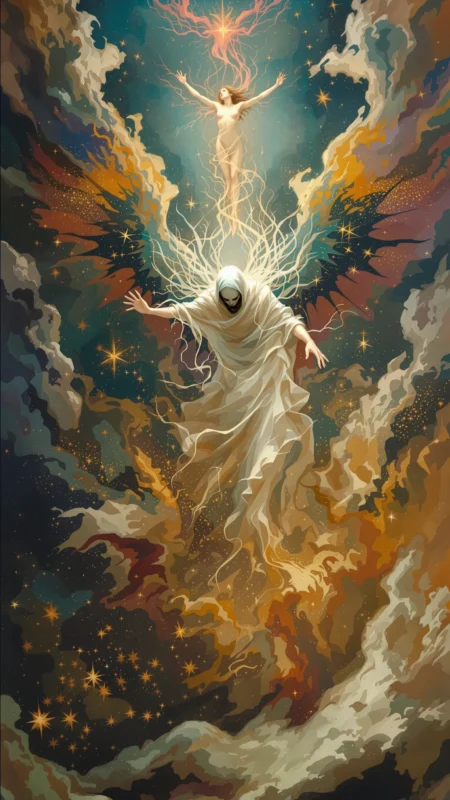


Exorcism

Archetype Meaning & Symbolism

Purging, confrontational, liberating, cathartic, ritualistic, severe, clarifying, focused, final, definitive

  • What you name, you can banish. Speak its true name, and watch it flee the house you have built.

If Exorcism is part of your personal mythology, you may...

Believe

  • That some negative forces or patterns are not meant to be integrated or understood, but must be decisively and completely expelled.

  • That true personal freedom requires radical, often painful, acts of severance from the people, places, and beliefs that hold you captive.

  • That intention, ritual, and the spoken word have a tangible power to reshape one's inner and outer reality.

Fear

  • A deep, abiding fear of psychic or emotional contamination; the terror of being subtly influenced, controlled, or drained by the energies of others.

  • The horrifying possibility that the 'demon' you are trying to cast out is not a foreign invader at all, but a fundamental, inextricable part of your own self.

  • The fear of failure: that the ritual won't work, that the entity is too powerful, and that you will be left in a state of permanent possession, having tried and lost.

Strength

  • A surgical ability to diagnose the root cause of a personal or interpersonal problem, cutting through confusion to name the core issue with unnerving precision.

  • The immense courage to make clean, definitive breaks. You do not linger in toxic situations, but sever ties with a finality that others may find both admirable and terrifying.

  • A profound and unshakable sense of personal sovereignty. You are the ultimate authority in your own life, a belief that grants you immense agency and power.

Weakness

  • A tendency toward dualism and black-and-white thinking. Situations and people are often categorized as either 'pure' or 'corrupt', with little room for the messy nuance of reality.

  • A risk of social isolation. Your quickness to excise anyone deemed a 'toxic influence' can lead to a revolving door of relationships and a life devoid of long-term, imperfect connections.

  • The potential for self-mutilation. In your zeal to be pure, you might misidentify a valuable, albeit challenging, part of your own shadow as an enemy and attempt to destroy it, thereby impoverishing your own soul.

The Symbolism & Meaning of Exorcism

In the modern psyche, the Exorcism archetype rarely concerns itself with sulfur and brimstone. Its theater is the quiet landscape of the self, and its demons are the stubborn tenants of our own making: the persistent echo of a cruel remark from childhood, the addictive lure of a destructive habit, the creeping paralysis of imposter syndrome. To embody this archetype is to refuse to coexist with these squatters. It is to believe that certain parts of our inner life are not misunderstood fragments to be integrated, but foreign invaders to be expelled. The personal mythology becomes one of purification, where the protagonist’s main task is to keep their inner temple clean, to guard the gates against psychic intrusion.

The ritual is the thing. It is the mechanism that elevates a simple decision into a sacred act. This is not just 'I will stop thinking negatively'; it is the writing of the negative thoughts on paper and burying them under a new moon. It's not just 'I'm leaving this job'; it's a deliberate, final walk out of the building, leaving a symbolic token behind. These rituals provide a grammar for the unspeakable, creating a tangible boundary between the past self and the emerging one. They are psychological theater, performances for an audience of one, designed to convince the deepest parts of the mind that a profound and irreversible change has occurred. The power lies in the doing, in the solemnity of the act that declares: this is over.

Ultimately, the archetype of Exorcism symbolizes a radical form of agency. It posits that you are the sole authority of your inner world. It refutes the notion that we are merely an accumulation of our experiences, suggesting instead that we can curate our own consciousness. It is an act of profound, sometimes violent, editing of the personal narrative. It is the moment in the story where the hero ceases to be haunted and becomes the one who cleanses the house. This act may leave a scar, a void where something once was, but it is a clean wound, a space made holy by its emptiness, ready for something new to be built upon the newly consecrated ground.


Exorcism Relationships With Other Archetypes

The Shadow:

The Exorcism archetype has a profoundly contentious relationship with The Shadow. While some schools of thought, like those of the Alchemist or the Healer, seek to understand and integrate the Shadow, Exorcism sees certain aspects of it as irredeemable and toxic. It draws a hard line in the psychic sand. When a shadow aspect—a deep-seated rage, a corrosive envy—is deemed a foreign entity rather than a rejected part of the self, the Exorcism archetype is invoked not to listen, but to banish. This can be a necessary act of psychic survival, but it is a fraught one, for in casting out a demon, one always risks casting out an angel that has been misidentified in the dark.

The Haunted House:

The Haunted House is the landscape upon which the Exorcism archetype operates. The House is the self, the body, the psyche, and the haunting is the trauma, the memory, the obsession that has taken up residence without permission. The Exorcism archetype is the agent called in when the haunting becomes unbearable, when the whispers in the walls become screams. It is the force that moves through the corridors of the mind, opening shuttered windows and salting the thresholds. Without the Haunted House, the Exorcist has no purpose; without the Exorcist, the Haunted House remains a prison for its inhabitant.

The Sovereign:

The Exorcism is the ultimate tool of The Sovereign archetype. The Sovereign's primary role is to rule the kingdom of the self with authority and wisdom, and this rule requires the power to expel threats to its domain. The Exorcism is the declaration of that sovereignty. It is the royal decree that banishes the traitorous thought, the debilitating fear, or the influence of another that seeks to usurp the throne. Each successful exorcism reinforces The Sovereign’s power, clarifying the borders of its kingdom and asserting its absolute right to determine who and what is allowed to reside within them.

Using Exorcism in Every Day Life

Ending a Toxic Relationship

The end of a relationship might be framed not as a simple breakup, but as a formal exorcism. This involves a conscious ritual: clearing the home of the other’s belongings, writing a final, unsent letter that names every hurt and every tie, and then ceremonially burning it. It is an act of reclaiming one’s psychic space, of declaring the influence of the other to be an unwelcome spirit that must be cast out, allowing the self to once again be the sole sovereign of its own domain.

Overcoming Creative Block

For the artist, the writer, the creator, creative block can feel like a possession by the spirit of doubt. The Exorcism archetype provides a method for confrontation. One might personify the block, give it a name—The Gray Critic, The Censor—and engage in a dialogue, demanding to know its purpose before commanding it to leave. The act of creation itself becomes the exorcising ritual, each word typed, each stroke of the brush a chant that drives the parasitic silence away.

Releasing Generational Trauma

One might realize they are carrying a weight that is not their own: a grandparent’s fear, a parent’s shame. The Exorcism archetype offers a way to formally renounce this inheritance. This could be a pilgrimage to an ancestral land to speak the names of these burdens and leave them there, or a quiet, private ceremony to cut the ethereal cords of inherited pain. It is a declaration of psychic independence, an assertion that the ghosts of the past will no longer haunt the rooms of the present.

Exorcism is Known For

Confrontation with the Intangible

Exorcism is known for making the abstract concrete. It takes a vague feeling of dread, a persistent negative thought pattern, or a self-destructive habit and gives it form, a name, and a face, turning an internal struggle into a direct confrontation with a distinct entity that can be addressed and expelled.

The Power of Naming

Central to this archetype is the principle that to name a thing is to gain power over it. The act of precisely identifying and articulating the 'demon'—be it 'the fear of failure' or 'my father's anger'—is the critical first step. The name is a handle, a leash by which the unwanted presence can be dragged into the light and cast out.

Ritualistic Expulsion

It is not merely a decision but a performance. Exorcism is defined by its use of ritual: specific words, symbolic objects, and deliberate actions that mark a definitive and often dramatic separation. This transforms a mental shift into a memorable, physical event that solidifies the change and marks a point of no return.

How Exorcism Might Affect Your Personal Mythology

How Exorcism Might Affect Your Mythos

When the Exorcism archetype is a cornerstone of your personal mythos, your life story is not one of gentle evolution but of dramatic purges and rebirths. The narrative is punctuated by distinct 'before' and 'after' moments, each centered around a great expulsion. There was the 'you' before you cast out the spirit of your family's expectations, and the 'you' after. There was the era when you were possessed by a consuming relationship, and the freedom that came after the rite of severance. Your mythos becomes a chronicle of cleansings.

You may see yourself as a guardian of a sacred space, a protagonist whose primary quest is to achieve and maintain a state of inner purity. The villains in your story are not external dragons but internal phantoms, parasitic ideas, and haunting memories. Your greatest victories are not treasures won but burdens cast off. This narrative structure can be incredibly empowering, framing you as an active, powerful agent in your own life, but it can also be lonely, as the great battles are fought in absolute silence, within the chambers of your own mind.

How Exorcism Might Affect Your Sense of Self

Your sense of self may be forged in the crucible of these confrontations. You may not see yourself as a fixed entity, but as a territory that must be defended. This can lead to a powerful, resilient self-concept, one that knows how to identify and eject what is not authentically 'you'. The self becomes defined by what it is not: not the anxiety, not the trauma, not the addiction. This creates a clear, sharp outline of your identity, but the core can sometimes feel strangely empty, as if it exists only in opposition to the things it has banished.

There is also a risk of self-alienation. In the zeal to purify, you might misidentify a core part of your own shadow—your anger, your vulnerability—as a demon to be exorcised. In casting it out, you may cast out a vital part of your own humanity. This can lead to a fragmented sense of self, a feeling of being a pristine but hollow vessel. The quest for purity, if taken to its extreme, can result in a self that is so thoroughly 'cleansed' it becomes sterile, lacking the messy, complex, and fertile soil of the integrated psyche.

How Exorcism Might Affect Your Beliefs About The World

Your view of the world may become one of vigilant discernment. You might perceive reality as a place teeming with invisible influences, competing ideologies, and psychic contagions all vying for a foothold in your consciousness. Advertising, social media, political rhetoric, even casual conversations—all may be scanned for their potential to 'possess' or corrupt. The world is not a neutral space; it is a battleground of energies, and one must be constantly armed with ritual and resolve to maintain one's own psychic frequency.

This perspective fosters a deep appreciation for authenticity and a sharp intolerance for manipulation. You might see society as largely 'possessed' by collective delusions—consumerism, celebrity worship, political extremism—and feel a duty to remain consciously separate. This can lead to a clear-sighted, critical perspective, but it can also verge on paranoia. The belief that one must constantly perform exorcisms on the influences of the world can create a state of permanent, exhausting siege warfare, where true peace is impossible because the potential for invasion is everywhere.

How Exorcism Might Affect Your Relationships

In relationships, you may operate like a meticulous gatekeeper. You might be acutely sensitive to the 'energy' of others, quickly discerning whether their influence is one that nurtures or drains. Friendships and romantic partnerships are subject to a kind of spiritual hygiene. You may require a high degree of consciousness and self-awareness from those you allow into your inner circle, and you may be swift and decisive in 'exorcising' individuals who demonstrate toxic or manipulative behavior. This creates a small, trusted, but intensely loyal circle.

However, this approach can make true intimacy a challenge. The fear of being 'possessed' by another's needs, moods, or desires can create a barrier to the kind of deep, messy entanglement that love often requires. You might hold partners at arm's length, constantly scanning for signs of encroachment on your sovereignty. The act of merging, of becoming a 'we', may feel threatening. The archetype, in its drive to maintain the purity of the self, can inadvertently create a fortress of solitude, safe from intrusion but also sealed off from the profound, transformative power of unconditional connection.

How Exorcism Might Affect Your Role in Life

Your role within your family, workplace, or community may become that of the Purifier or the Truth-Teller. You are the one who names the unspoken dysfunction, the one who refuses to participate in the collective denial. When a project is failing because of a toxic team member, you are the one who speaks the name of the problem and demands its removal. In a family gathering where a painful history is being ignored, you may be the one who performs the verbal 'exorcism' that forces the ghost into the light. This role is vital and necessary, but it is not beloved. You may be respected for your courage and clarity, but also feared for your severity.

This can lead to a sense of being an outsider, a necessary but uncomfortable presence. Like a medieval exorcist, you are called upon in times of crisis but kept at a distance in times of peace. You may feel that your purpose is to perform these difficult, thankless tasks of cleansing so that others may live in greater harmony. It is a role of immense responsibility and potential loneliness, the burden of being the one who is willing to look the demon in the eye when everyone else is pretending it isn't there.

Dream Interpretation of Exorcism

In a positive context, dreaming of performing or witnessing an exorcism can be profoundly liberating. It may symbolize a major psychological breakthrough, the final, successful expulsion of a long-held fear, a limiting belief, or the lingering influence of a past trauma. The dream is an affirmation from the subconscious that you have successfully reclaimed a part of yourself. Waking from such a dream, you might feel lighter, clearer, and more powerful, as if a literal weight has been lifted from your spirit. It is the psyche’s celebratory ritual for a victorious battle.

Conversely, a negative dream of exorcism could be deeply disturbing. It might manifest as an exorcism being performed on you against your will, or one where you are trying to cast out a demon that looks exactly like you. This could suggest a violent internal conflict, a form of psychic civil war where you are trying to annihilate a part of yourself that you have judged as unacceptable. It points not to integration but to self-rejection. Such a dream is a warning from the subconscious that the drive for purity has become pathological, and that you risk destroying a vital part of yourself in your quest to be 'clean'.

How Exorcism Archetype Might Affect Your Needs

How Exorcism Might Affect Your Physiological Needs

The need for purity, central to the Exorcism archetype, may manifest in a deep focus on the body as a temple to be kept free from contamination. This could translate into rigorous dietary habits, detoxification protocols, fasting, or intense exercise routines designed to 'purge' the system of impurities. The body is not just a physical vessel; it is a direct reflection of the psychic state. A feeling of mental 'fog' might be met with a juice cleanse, a sense of emotional toxicity with a punishing workout.

This connection can be a powerful tool for holistic health, creating a strong mind-body link. However, it can also pathologize normal bodily functions. A common cold might be interpreted not as a virus, but as a physical manifestation of a psychic impurity that needs to be expelled. This can lead to anxiety around health and a constant, restless striving for an unattainable state of physical and spiritual immaculateness, where the body is never quite clean enough.

How Exorcism Might Affect Your Ideas of Belonging

Belongingness is often conditional and deeply tribal. You may feel a sense of kinship only with others who have undergone similar processes of purification, those who also 'speak the language' of boundaries, energy, and psychic sovereignty. This can create incredibly strong, intense bonds within a select in-group, a feeling of belonging with a tribe of fellow warriors who understand the necessity of the fight. This is the comfort of the coven, the solace of the support group.

However, this can also foster a profound sense of alienation from the wider world. You might view the 'unawakened' masses as being helplessly 'possessed' by cultural programming or negative influences, making genuine connection with them feel difficult or even dangerous. The strict criteria for entry into your inner circle can leave you feeling isolated. The deep desire to belong may be in constant conflict with the even deeper need to remain uncontaminated, creating a painful push-pull between connection and self-preservation.

How Exorcism Might Affect Your Feelings of Safety

For you, safety is not a passive state but an active, ongoing process of boundary maintenance and threat expulsion. True security doesn't come from building higher walls, but from possessing the power and vigilance to identify and eject any intruder who breaches them. You may feel a constant, low-level need to patrol your psychic and emotional perimeter, checking for unwanted influences or energetic attachments. Safety is a verb: it is the act of saying 'no', of cutting cords, of cleansing your space.

This creates a profound sense of personal agency and resilience. You do not feel like a helpless victim of circumstance because you believe you have the ultimate power to control your inner domain. The downside is a potential for hyper-vigilance. The world can seem full of potential psychic threats, requiring constant monitoring. This can make it difficult to ever truly relax, to let your guard down. The feeling of safety is contingent on your unwavering diligence, which can be an exhausting, never-ending responsibility.

How Exorcism Might Affect Your Views of Esteem

Self-esteem may be directly tethered to your ability to maintain your inner purity and control. Each successful 'exorcism'—beating a craving, cutting off a toxic friend, conquering a negative thought loop—is a significant victory that provides a powerful boost to your sense of self-worth. You feel competent, strong, and in control of your destiny. Your esteem is built upon a foundation of self-discipline and sovereignty.

This foundation, however, can be brittle. A perceived failure—a relapse into an old habit, a moment of weakness where you let a boundary be crossed—can trigger a catastrophic collapse of self-esteem. If your worth is defined by your 'purity', then any 'contamination' can feel like a total invalidation of the self. This creates a performance-based esteem that is contingent on constant success in the internal war, leading to immense pressure and a deep-seated fear of failure or regression.

Shadow of Exorcism

The shadow of the Exorcism archetype is a chilling puritanism. It is a descent into fanaticism where the individual becomes a hunter, seeing demons not only within, but everywhere. They become a walking inquisition, obsessed with cleansing the world of its perceived impurities. Other people's flaws become evidence of possession, differing opinions are heretical contaminations, and art that explores darkness is seen as a demonic portal. The personal quest for purity metastasizes into a crusade against the perceived corruption of others, making the person harsh, intolerant, and relentlessly judgmental. They exorcise joy, spontaneity, and complexity from their own life and the lives of those around them, leaving a sterile, righteous void.

Another shadow aspect is the great hollowing out. In the dramatic act of casting out a major life element—a career that defined you, a marriage that shaped you, a belief that anchored you—there is a risk of taking too much. The exorcism can be so 'successful' that it removes not just the sickness but a vital organ along with it. The person is left in a state of profound emptiness, a psychic silence where a great battle was once waged. They are free from the 'demon', but they are also free from a core part of their own story and identity, leaving a clean, desolate space that feels haunted by absence itself.

Pros & Cons of Exorcism in Your Mythology

Pros

  • It provides a potent narrative framework for enacting radical, life-altering change and overcoming deeply entrenched negative patterns.

  • It cultivates a powerful sense of personal agency and sovereignty, replacing feelings of victimhood with a belief in one's own ability to control their inner world.

  • It is an unparalleled tool for establishing and maintaining strong, healthy boundaries in all aspects of life, from relationships to the workplace.

Cons

  • It can foster a harsh, unforgiving dualism, leading to an inability to tolerate imperfection in oneself and others, which can result in profound social isolation.

  • It carries the significant psychological risk of creating a schism within the self, violently disowning parts of one's own shadow rather than seeking healthy integration.

  • It can create a state of hyper-vigilance and perpetual crisis, as one is always on the hunt for the next inner enemy to defeat, making true peace and relaxation feel impossible.