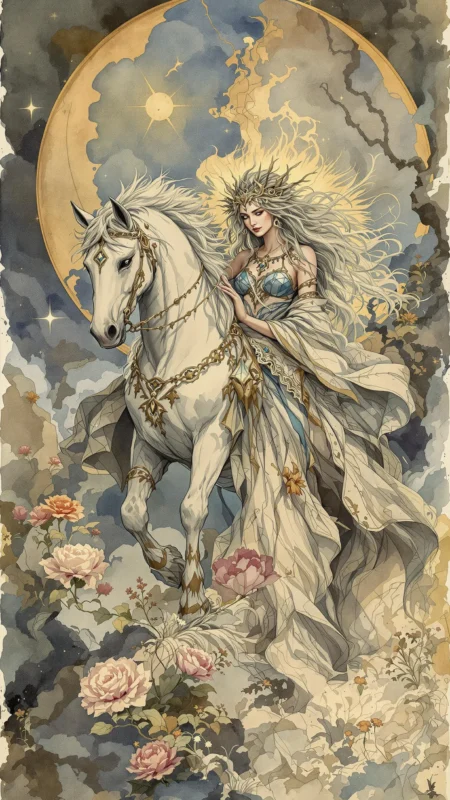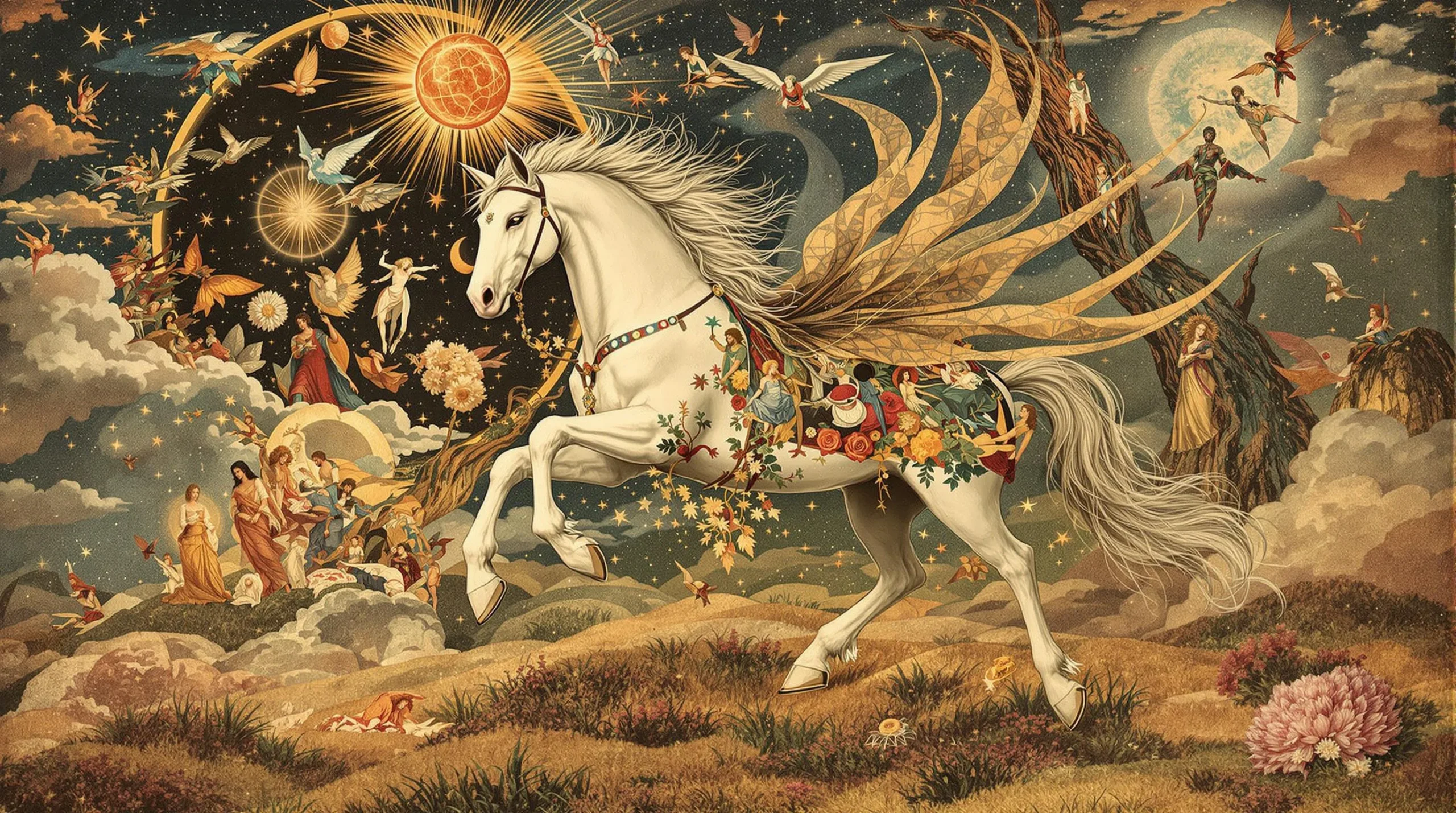


Epona

Archetype Meaning & Symbolism

Sovereign, Nurturing, Feral, Enduring, Liminal, Protective, Instinctual, Grounded, Swift, Mysterious

  • The path is not a line to be followed, but a rhythm to be felt in the earth beneath your feet. Trust the gait of your own soul.

If Epona is part of your personal mythology, you may...

Believe

  • The journey itself is the sacred destination; meaning is found in movement, not arrival.
  • True strength is quiet endurance, the ability to carry on, not the aggressive display of power.
  • There is a wild, instinctual part of the soul that must be honored, protected, and kept free.

Fear

  • Being trapped, tethered, or fenced in, having your freedom of movement curtailed in any way.
  • Losing the path, becoming hopelessly lost in the wilderness without a sense of direction.
  • Failing those who depend on you, the inability to carry a burden you have taken on.

Strength

  • A profound, almost supernatural resilience and stamina, allowing you to endure long periods of hardship.
  • A deep, instinctual loyalty and a fierce, protective instinct for your chosen 'herd' or loved ones.
  • The ability to navigate major life transitions and liminal spaces with an innate grace and sense of purpose.

Weakness

  • A deep-seated restlessness that may make it difficult to settle, put down roots, or enjoy periods of stillness.
  • A tendency to take on the burdens of others to your own detriment, carrying them until you reach exhaustion.
  • An instinct to flee from difficult emotional confrontations rather than facing them, prioritizing movement over resolution.

The Symbolism & Meaning of Epona

In the contemporary personal mythos, Epona is not merely a goddess of horses but a symbol of the motive force within the soul. She represents the engine of our own life's journey, that powerful, instinctual energy that carries us through triumph and ordeal. To claim her as part of your story is to acknowledge a deep, almost feral, connection to your own endurance. She is the quiet strength that surfaces on the third day of a crisis, the second wind in a marathon of grief, the inexplicable ability to place one foot in front of the other when the path ahead is obscured in fog. She is the sovereignty that comes not from a crown, but from the unshakeable knowledge that you can carry yourself.

Epona’s meaning unfolds in the spaces between: between civilization and the wild, between the conscious self and the instinctual body, between this life and whatever comes next. She is the patroness of transitions. Her presence in one's mythology could signify a life defined by meaningful passages rather than static achievements. You may feel most yourself not when you have arrived, but when you are fully underway. She asks you to honor the journey as a sacred destination in itself and to find stability not in walls and fences, but in your own forward momentum. She is the grace of a powerful body in motion, a reminder that some part of us must always remain untamed and free to roam.

Her symbolism is also deeply connected to a form of nurturing that is less about comfort and more about empowerment. Like a mare teaching her foal to run with the herd, Epona’s care is about fostering resilience. In your mythos, you may find yourself drawn to relationships where you can provide this sturdy, load-bearing support. You might carry the burdens of others, not to enable weakness, but to lend them the strength to reach the next stage of their own journey. She is the patroness of loyal companionship, the silent understanding that passes between two beings who have traveled a long way together, a connection forged in the dust of a shared road.


Epona Relationships With Other Archetypes

The Rider

The Rider may represent the conscious will, the thinking mind that believes it holds the reins. Yet, the relationship with The Epona is rarely one of simple command. It is, perhaps, a profound and delicate negotiation between intention and instinct. The reins are not so much instruments of control as they are lines of communication, a sensitive membrane through which the Rider might feel the deep, terrestrial wisdom of the creature beneath. A true union is not achieved through breaking the spirit, but through learning its language—the subtle shift of weight that signals doubt, the surge of power that speaks of a hidden path. This partnership could be a metaphor for the soul's own journey toward integration, the struggle to have the calculating ego ride in harmony with, rather than in opposition to, the wild and intuitive heart.

The Open Road

The Open Road is a silent promise, a ribbon of potential stretching toward a vanishing point. It is The Epona that gives it a pulse, a percussive rhythm of hoofbeats that transforms a mere line on a map into a lived story. Without this kinetic spirit, the Road is perhaps only a theory of distance, a dormant question. The Epona, in turn, may find its purpose in the endless invitation of the Road; its powerful muscles are for traversing, its forward gaze is for the horizon. Their relationship could be seen as the dance between possibility and actuality, between the abstract allure of freedom and the thundering, dust-kicking, wind-in-the-mane reality of being free.

The Stable

In the quiet architecture of The Stable, The Epona finds a necessary counterpoint to its own nature. This space is not merely a shelter; it is a repository of stillness, a place where the scent of hay and worn leather offers a temporary truce with the ceaseless momentum of the world. The Stable could represent the comfort of the known, the security of a pause, a place for mending and rejuvenation. Yet, its very walls present a dialectic. It is a sanctuary that, if lingered in too long, may become a cage. The relationship suggests a fundamental tension within the psyche: the need for both exhilarating freedom and profound rest, and the wisdom required to know when a haven has started to feel like a tether.

Using Epona in Every Day Life

Navigating a Creative Block

When inspiration feels like a distant country, the Epona archetype could suggest that the solution is not to force the idea, but to move. Not aimless wandering, but a purposeful journey: a long walk without a map, a drive along an unknown road, the physical act of traversing space to unstick the mind. The movement itself becomes the ritual, a way of telling the psyche that you are ready for the next stage, trusting that the rhythm of your feet on the pavement will jostle the necessary insight loose. It is a faith in momentum over static effort.

Guiding a Loved One Through Crisis

To have Epona in your mythos may mean you are called upon to be the steady presence for someone else's difficult passage. You are not there to solve their problem or point the way, but to be the strong back, the unwavering companion. You offer the quiet support that says, "I will walk this dark road with you. I can carry this weight for a while." It is an act of profound, non-verbal loyalty, a commitment to enduring the journey alongside another, providing stability when their own legs feel weak.

Embracing a Major Life Transition

Facing a monumental shift—a new career, a move to a new city, the end of a long relationship—can feel like being lost in the wilderness. Epona teaches the art of the threshold. Instead of fearing the unknown, you may learn to see this liminal state as sacred territory. Your role is not to rush across but to inhabit the transition fully. This period becomes a pilgrimage. You understand that this journey between one life and the next requires its own pace, its own rituals, and its own kind of strength: the strength to keep moving forward, even when the destination is not yet in sight.

Epona is Known For

Protector of Journeys

She is the unseen companion on the long road, the guardian of travelers, stables, and all who undertake a significant passage from one point, or one state of being, to another. Her presence ensures safe travels and a steady path.

Symbol of Sovereignty and Fertility

Often depicted with a key, a cornucopia, or a foal, Epona represents the connection between a leader's right to rule and the prosperity of the land. Her energy is one of abundance, life, and the inherent power that comes from being deeply rooted to a place and purpose.

Guardian of the Threshold

As a psychopomp, Epona is a guide between worlds

life and death, the conscious and unconscious, the known and the unknown. She stands at the crossroads, facilitating passage and ensuring that souls reach their proper destination.

How Epona Might Affect Your Personal Mythology

How Epona Might Affect Your Mythos

When Epona gallops into the landscape of your personal mythos, your life story may cease to be a linear plot with a clear beginning, middle, and end. Instead, it becomes a pilgrimage, a series of significant journeys across varied terrain. The major chapters of your life might be framed not by what you achieved, but by the passages you navigated. The narrative shifts from a goal-oriented quest for a final treasure to an ongoing exploration of inner and outer worlds. Your mythos is not about conquering the mountain; it is about honoring the long, arduous, and beautiful climb. You may see yourself as a perpetual traveler, forever moving between states of being, with each transition holding its own sacred importance.

Furthermore, your personal mythos could become deeply entwined with the concept of a wild, sovereign self that coexists with your more civilized persona. This is the part of your story that cannot be tamed, the narrative thread that always leads back to the open field, the dark wood, the untrodden path. This Epona-self is your source of power, your reservoir of instinct and endurance. Your life's challenges might be interpreted as attempts by the world to fence in this wildness, and your triumphs as moments when you successfully protected its freedom. Your story becomes one of integration: how the rider (the conscious mind) learns to trust and work in harmony with the powerful, instinctual horse (the soul).

How Epona Might Affect Your Sense of Self

With Epona as an internal archetype, your perception of self may be rooted in a profound sense of resilience. You might see yourself not as fragile, but as possessing an immense capacity for endurance. The scars you carry are not signs of damage, but marks of distances traveled, proof of the ordeals you have carried yourself through. There may be a quiet dignity in this self-concept, a sovereignty that doesn't need to be announced but is simply felt, like the solid presence of a large animal. You may identify as a carrier, someone with a strong back, both literally and metaphorically, capable of bearing significant emotional or spiritual weight for yourself and for others.

This may also foster a dualistic sense of self. On one hand, you are a functional member of the herd, a reliable presence within your community. On the other, there is a feral, solitary part of you that requires vast open spaces and freedom from constraint. This is not a contradiction to be resolved, but a polarity to be lived. You might feel a constant, low-level tension between your desire for connection and your non-negotiable need for autonomy. Your truest self might be found in that liminal space, the rider who is one with her mount, a perfect synthesis of conscious intention and wild, instinctual power.

How Epona Might Affect Your Beliefs About The World

Your view of the world may be transformed from a static map of destinations into a dynamic landscape of pathways and horizons. Life is not a series of fortified locations to be captured and held, but a vast territory to be traversed. Obstacles are not blockades, but changes in terrain that require a different gait, a new approach. You might develop a deep appreciation for the journey itself, believing that meaning is found in the movement, not in the arrival. The world becomes a place of constant, fluid transition, and you see the beauty in its impermanence and endless potential for passage.

This perspective could also instill a belief in unseen forces of protection and guidance. Just as ancient travelers felt Epona’s presence on a dangerous road, you may feel a subtle, guiding hand in your own life. You may trust that even when you feel lost, there is an instinctual current carrying you forward, a larger rhythm at play. This fosters a worldview based on faith in the process, a trust in your own intuitive GPS. The world is not a hostile place to be feared, but a grand, mysterious path that unfolds before you, inviting you to journey onward with courage and grace.

How Epona Might Affect Your Relationships

In relationships, you may function as the steady, reliable companion. You are the one people turn to when they are facing a difficult passage, for you have an innate ability to shoulder burdens and offer unwavering support without judgment. Your love is expressed not through effusive words, but through acts of steadfast presence: showing up, listening, and walking alongside. You may forge your deepest bonds with a small 'herd' of trusted souls, individuals with whom you share a direction and a mutual understanding that goes beyond language. Loyalty is your highest virtue, and a breach of it is the deepest wound.

However, the Epona archetype may also introduce a powerful need for freedom within your connections. You might resist any relationship that feels like a tether or a cage. You need partners and friends who understand your requirement for open space, who can love you without trying to fence you in. This can create a dynamic of profound closeness punctuated by periods of necessary distance. You are not fleeing intimacy; you are preserving the wild part of your soul that is the very source of your strength and loyalty. Your ideal relationship is a shared journey, two sovereign beings traveling the same road, side by side, for a time.

How Epona Might Affect Your Role in Life

Your perceived role in life might be that of a guide or a guardian of passages. You may feel a calling to help others navigate the significant thresholds of their lives: birth, death, marriage, divorce, career changes. You are a psychopomp for the living, a midwife of transition. This role is not about giving advice or drawing maps, but about providing the steady, protective energy that allows others to find their own way. You might be the calm presence in the chaos, the one who holds the space for transformation to occur safely. Your purpose is found in facilitating movement for others, ensuring they don't get stuck at the crossroads.

Alternatively, you may see your role as a keeper of the wild. In a world that seeks to tame, pave over, and control everything, you feel a deep responsibility to protect the untamed spaces, both in the outer world and within the human psyche. You might be an advocate for nature, for instinct, for the parts of humanity that are messy, unpredictable, and free. Your role is to remind others that we need the wilderness, that our strength and vitality as a species depend on honoring the Epona within. You stand for the idea that not everything should be broken, saddled, and ridden; some things must simply be allowed to run free.

Dream Interpretation of Epona

To dream of Epona in a positive context, such as riding a strong, willing horse or being guided by one through a beautiful landscape, often signifies a harmonious relationship with your own life force and instinct. It may suggest that you are successfully navigating a major life transition, possessed of the strength and endurance needed for the journey ahead. The horse's health and gait reflect your own inner state: a powerful gallop indicates rapid progress and confidence, while a steady trot suggests patience and resilience. Seeing Epona with a foal could symbolize the birth of a new project, idea, or even a new phase of your own identity, one that you are prepared to nurture and protect.

In a negative context, a dream of Epona could be deeply unsettling. A horse that is sick, injured, or trapped in a small enclosure might point to a part of your soul that feels stifled, your life force drained, or your instincts ignored. You may feel stuck in a situation, unable to move forward. To be thrown from the horse, or to see it stampeding out of control, could represent a dangerous disconnect from your primal energies. Your instincts may be running rampant, causing chaos in your life because your conscious mind has lost the reins. Such a dream is a powerful call to examine where you have confined your spirit or lost control of your own power.

How Epona Archetype Might Affect Your Needs

How Epona Might Affect Your Physiological Needs

When Epona informs your personal mythology, your physiological needs are viewed through the lens of fuel for a long and sacred journey. Food is not for pleasure or emotional comfort alone, but for sustenance. You may develop a practical, instinctual relationship with nourishment, knowing precisely what your body needs to maintain its strength and endurance. The body itself is not an object to be perfected or shamed, but a vessel, a reliable mount that must be cared for. There is a reverence for its strength, its resilience, its ability to carry you through the world. Sleep is not a surrender but a necessary tethering for the night, a sacred rest to prepare for the next day's travel.

This archetype may also cultivate a profound connection to the body's rhythms and signals. You might feel your energy levels shift with the seasons, your instincts sharpening in times of crisis. Physical sensations are not just data points but a form of communication from the deep self. A knot in the stomach is a warning from the gut; a surge of adrenaline is a call to action. You learn to listen to the wisdom of the flesh, trusting its signals about what is safe, what is nourishing, and when it is time to move. Your body is your primary landscape, the very earth from which your mythos grows.

How Epona Might Affect Your Ideas of Belonging

With Epona shaping your mythos, belonging is less about finding a permanent place in a static community and more about finding your herd. You connect most deeply with a small, select group of individuals who are moving in the same direction, sharing the same journey. Love and friendship are defined by loyalty, mutual support, and a shared understanding that transcends words. It's the unspoken bond between fellow travelers. You may feel a deep sense of belonging not to a town or a nation, but to the road itself, and to those who walk it with you. Intimacy is the quiet act of sharing the load on a long march.

This need for a 'herd' does not negate the archetype's demand for freedom. You may feel most loved when a partner or friend understands your need for solitude and space, recognizing it not as rejection but as a necessary part of your nature. Belongingness is paradoxical: it is the security of the herd combined with the freedom of the open plains. You give and receive love best when it is not a cage, however gilded. The deepest connection you can feel is with someone who can run alongside you, at their own pace, respecting your sovereign path as they follow their own.

How Epona Might Affect Your Feelings of Safety

From an Epona perspective, safety is not found in high walls or locked doors, but in mobility and awareness. True security lies in the ability to sense danger before it arrives and the strength and speed to move away from it. You may have a finely-tuned 'flight' instinct, which is not about cowardice but about the wisdom of choosing your battles and conserving energy. Your sense of safety is portable. It's an internal state of vigilance and readiness that you carry with you, allowing you to feel secure even in unfamiliar territory. You trust your capacity to navigate threats more than you trust any external structure to protect you.

This mythos could also manifest as a feeling of being under the protection of a powerful guardian spirit. You may move through the world with a quiet confidence, feeling that you are not entirely alone. This sense of being watched over, of being accompanied on your journey by an unseen, benevolent force, provides a deep and abiding sense of safety. It's the belief that no matter how dark or treacherous the road becomes, there is a strength greater than your own that ensures your passage. Safety, then, is a matter of faith: faith in your instincts, faith in your endurance, and faith in your guide.

How Epona Might Affect Your Views of Esteem

Esteem, within the Epona mythos, is earned through endurance and self-sovereignty. Your self-worth is not derived from external accolades or social status, but from the quiet, internal knowledge of your own strength. It is the pride of the marathon runner, not the sprinter. You respect yourself for the distances you have traveled, the burdens you have carried, and the storms you have weathered. Esteem is the solid, grounded feeling that comes from knowing you can rely on yourself, that your own back is strong enough, your own spirit untamable. You command respect not by demanding it, but through your quiet competence and resilience.

This also means you may place a high value on usefulness and reliability. Gaining the esteem of others comes from being a trustworthy companion on the journey. People respect you because they know they can count on you in a crisis, that your presence is a source of stability. Your reputation is built on your actions, not your words. The greatest honor someone can pay you is to trust you with their vulnerability, to allow you to walk with them through their darkest valley. Your esteem is tied to your role as a protector and a carrier, a pillar of strength for your chosen herd.

Shadow of Epona

The shadow of Epona emerges when the sacred journey becomes a frantic, endless flight. In this state, the need for movement sours into an inability to ever be still. You become a perpetual refugee from your own inner world, mistaking restlessness for freedom. Relationships are abandoned, projects left unfinished, and roots never take hold, all sacrificed to the desperate need to keep moving, lest something catch up to you. Here, Epona is not a strong steed but a spooked mare, bolting from imagined threats, trampling delicate connections underfoot in a panic for the ever-receding horizon. There is no joy in this journey, only the grim, exhausting momentum of escape.

Conversely, the shadow can manifest as the beast of burden. The strength to carry for others becomes a pathological inability to say no, a co-dependent need to be needed. You become a stable for everyone else's problems, your own strong back slowly breaking under the weight. Your own journey is completely forgotten, subsumed by the needs of your 'herd.' In this shadow form, Epona's sovereignty is lost. She is no longer a wild goddess but a dray horse, endlessly pulling a cart that isn't hers, tethered by a sense of obligation and a fear of being useless. Her feral spirit is extinguished, replaced by a hollow, plodding servitude.

Pros & Cons of Epona in Your Mythology

Pros

  • You possess a profound inner strength and resilience that allows you to weather life's harshest storms and longest winters.
  • You are an exceptionally loyal and supportive companion, capable of helping others through their most difficult passages with unwavering steadiness.
  • You have a deep connection to your own instincts and an innate ability to navigate change and transition with grace.

Cons

  • You may struggle with a powerful restlessness, finding it difficult to put down roots or feel content in one place, always feeling the pull of the next horizon.
  • Your instinct to carry the burdens of others can easily lead to your own exhaustion and a chronic neglect of your own needs and journey.
  • You might instinctively flee from difficult emotional conflicts rather than confronting them, prizing the freedom of movement over the hard work of resolution.