

Eden

Archetype Meaning & Symbolism

Pristine, innocent, harmonious, naive, contained, fertile, timeless, vulnerable, utopian, stagnant

  • Before the choice, there was only being. The price of knowing was the peace of not needing to.

If Eden is part of your personal mythology, you may...

Believe

  • There is a state of grace, a way of being in the world that is simple and pure, and it is possible to live there.

    The natural world is inherently good, and it is human complexity, society, and technology that corrupt and destroy.

    True happiness lies not in striving and achieving, but in returning to a simpler, more authentic version of oneself.

Fear

  • The irrevocable loss of innocence, either your own or that of someone you love.

    Being exiled: cast out from the group, the relationship, or the place that feels like home.

    Complexity and ambiguity: the 'serpent' of knowledge that complicates simple truths and forces painful choices.

Strength

  • A powerful and inspiring idealism, a vision of what a more beautiful and harmonious world could look like.

    The ability to create oases of peace and sanctuary for yourself and others, a talent for cultivating beauty in small spaces.

    A deep appreciation for the simple, profound joys of being: the taste of fresh water, the warmth of the sun, the quiet of a morning.

Weakness

  • A profound naivete that can leave you vulnerable to deception or unprepared for the world's harsh realities.

    A resistance to necessary growth and change, a tendency to cling to a comfortable past even when it has become a prison.

    Unrealistic expectations in relationships, leading to a cycle of idealization and disillusionment.

The Symbolism & Meaning of Eden

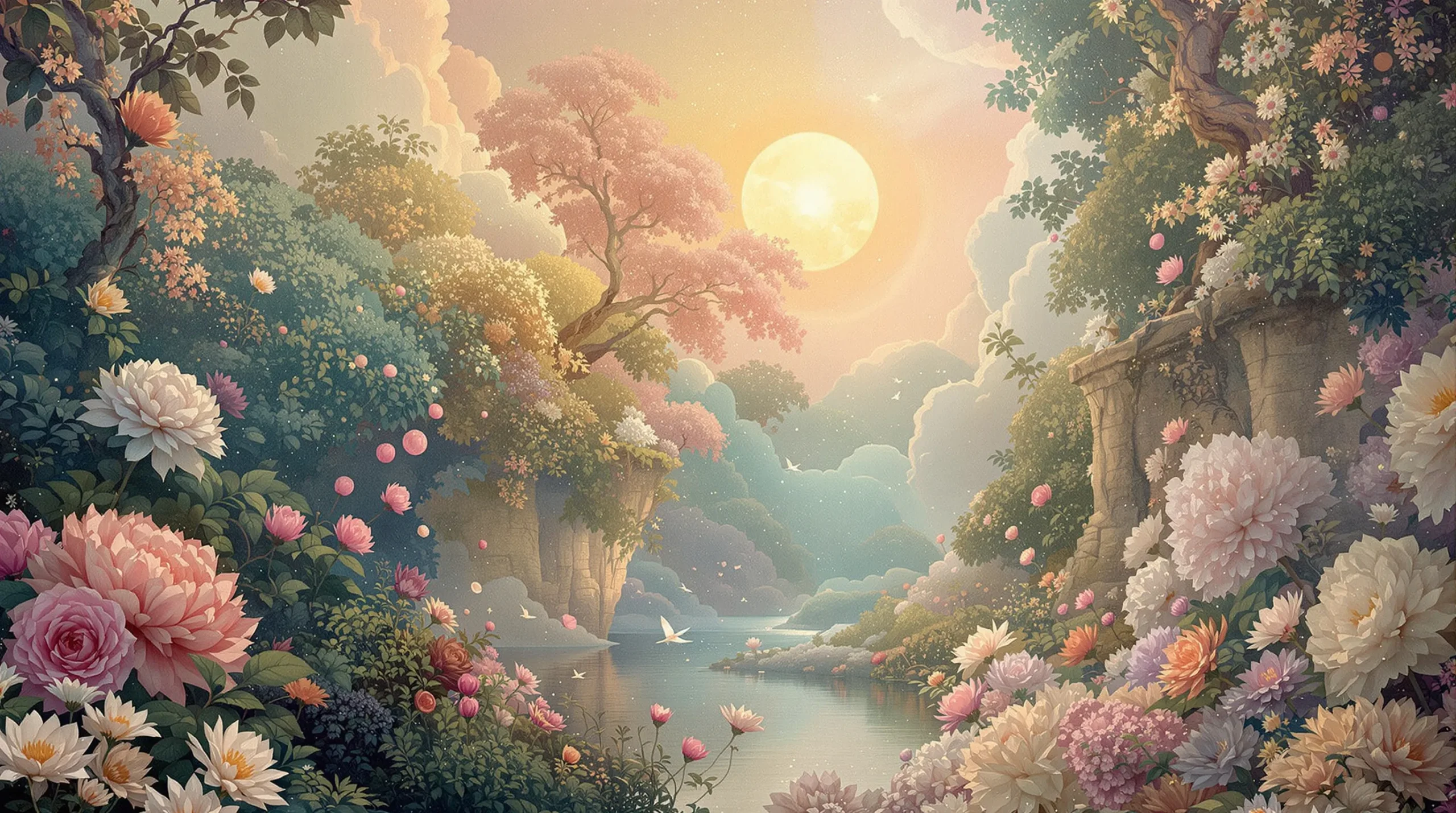
In the personal mythos, Eden is not a historical place but a psychological geography. It may represent the unblemished landscape of early childhood, a time before the complexities of identity and the wounds of experience set in. This internal garden is a place of profound safety and wholeness, a memory, real or imagined, that serves as a touchstone for what peace feels like. The scent of a particular flower, the quality of late afternoon light, a snatch of a lullaby: these are the keys that can momentarily unlock its gates. To have Eden in your mythos is to carry the blueprint of perfect belonging within you, a state to which you unconsciously compare all subsequent experiences of home.

Eden also symbolizes a dangerous and seductive naivete. It is the allure of the simple answer, the comfort of the unexamined life, the desire to remain untouched by the world's harsh realities. It is the golden cage of blissful ignorance. Its walls, meant to protect, can also prevent growth. The essential drama of an Eden-inflected mythos is the inevitable arrival of the serpent: the catalyst, the truth-teller, the disruption that forces an exit from the garden. The serpent is not purely evil; it is the agent of consciousness, and the fall from grace is also a fall into the richness and tragedy of a fully lived life.

Ultimately, the archetype evolves from a memory of the past into a vision for the future. The goal is no longer to return to the unconscious innocence of the original garden, but to cultivate a new one with full awareness. This is a paradise built not on ignorance but on wisdom, a place of peace consciously carved out of the wilderness of experience. It is the integration of innocence and knowledge: knowing the world is full of snakes, and planting a garden anyway. This cultivated Eden is a testament to resilience, a space of personal sovereignty where one can be both safe and free.


Eden Relationships With Other Archetypes

The Serpent:

The Serpent is Eden's necessary antagonist and catalyst. Where Eden represents static, unconscious perfection, the Serpent embodies forbidden knowledge, change, and the alluring whisper of a world beyond the garden walls. It does not represent evil so much as the principle of disruption that is essential for growth. In a personal myth, the Serpent may manifest as a person, an idea, or a crisis that shatters one's comfortable reality, forcing an uncomfortable but necessary evolution. The relationship is not one of simple opposition, but of a profound, mythic interdependence: without the Serpent, the soul remains a beautiful, sleeping seed that never breaks ground.

The Wanderer:

The Wanderer is the soul in exile from Eden. This archetype carries the memory of the garden like a phantom limb, a constant, aching awareness of a home that can never be fully reclaimed. Every new landscape, every new relationship is measured against the lost paradise. The Wanderer's journey is fueled by this sacred nostalgia, a quest not just for a physical place but for a feeling of wholeness. Their path is defined by the tension between the memory of a perfect beginning and the reality of an imperfect world. The Wanderer is the part of us that knows what has been lost and is compelled to spend a lifetime searching for it.

The Creator:

While the original Eden may have been a divine gift, the Creator archetype embodies the human drive to build new Edens. This is the artist, the gardener, the parent, the community builder: anyone who attempts to manifest a vision of harmony and beauty in a fallen world. The Creator takes the raw materials of their own experience—both the memory of paradise and the pain of its loss—and forges them into something new. Their work is a conscious act of reclamation, an attempt to build a garden not of ignorance, but of hard-won wisdom, a sanctuary built with full knowledge of the wilderness that lies just outside the walls.

Using Eden in Every Day Life

Navigating Career Dissatisfaction:

When your work feels like a barren wasteland of spreadsheets and deadlines, the Eden archetype invites you to cultivate a small garden. This may not mean quitting your job, but rather identifying a corner of your professional life where you can plant something for its own sake: a passion project without a clear ROI, a mentorship offered without expectation, a moment of pure, unmonitored creativity. It is about creating a small, walled space of meaning within the larger, chaotic wilderness of corporate life.

Healing from a Relationship's End:

After the shattering of a shared world, you may feel exiled into a lonely desert. The Eden archetype could guide you not to seek a new paradise in another person immediately, but to rediscover the one that exists within the self. This is a time for tending to your own inner landscape: rediscovering simple joys, nourishing your body, and finding comfort in your own silent company. It is about remembering that you were a complete ecosystem before you became part of a shared one.

Overcoming Creative Blocks:

The pressure to create something new, something knowing and complex, can be paralyzing. Eden suggests a return to innocence. Instead of trying to write the great novel, perhaps you simply write a sentence about the color of the sky. Instead of composing a symphony, you listen to the rhythm of your own breath. It is a radical act of stripping away the burden of knowledge and expectation to find the simple, fertile ground where the first, tender shoots of an idea can emerge without judgment.

Eden is Known For

Innocence

A state of perfect, pre-conscious harmony where there is no separation between self and world, no knowledge of good and evil, and no experience of shame or suffering. It is a condition of pure being.

The Fall:

The moment of transition from innocence to experience, often triggered by a choice or the acquisition of forbidden knowledge. This act results in exile from the perfect state and the beginning of the human story of struggle and striving.

The Search for Paradise:

The deep, often unconscious, human longing to return to that initial state of grace. This quest fuels art, religion, and the individual's search for meaning, love, and a place to call home.

How Eden Might Affect Your Personal Mythology

How Eden Might Affect Your Mythos

When Eden is a cornerstone of your personal mythos, your life story may be framed as a narrative of exile and return. The defining event is not your birth, but 'The Fall': the first heartbreak, the disillusioning experience, the moment the world revealed its sharp edges. Everything before that moment is a golden-hued prologue, a lost world of perfect unity. Your story's central tension becomes the quest to recapture that feeling of grace. You might structure your life as a series of attempts to rebuild the garden's walls, seeking out relationships, careers, and homes that promise to restore that initial state of blissful harmony.

This mythic structure could color your perception of progress. Growth might not feel like a triumphant forward march, but like a painful, meandering path away from a cherished origin. You may interpret struggles and challenges not as opportunities but as further evidence of your exile, cosmic punishments for a long-forgotten transgression. The ultimate goal of your quest may be a kind of spiritual homecoming, a final chapter where you find or create a place—be it a state of mind, a relationship, or a physical home—that feels like you have finally, after a long journey, returned to the garden's embrace.

How Eden Might Affect Your Sense of Self

Your sense of self may be anchored in a concept of innate purity or original innocence. You might perceive a core 'true self' that is fundamentally good, simple, and untainted, existing separately from the mistakes you have made or the compromises you have endured. This can be a source of profound resilience, a belief in a part of you that can never be truly corrupted. You may feel a deep disconnect between this inner, Edenic self and the persona you must present to the 'fallen' outer world, leading to a feeling of being a secret exile in your own life.

Conversely, this archetype can foster a fragile self-concept. If your worth is tied to this idea of unspoiled perfection, any personal failing or moral compromise can feel catastrophic. A single mistake might feel like a complete and total fall from grace, casting you out of your own self-esteem. This could lead to a relentless perfectionism, an impossible effort to maintain a flawless record, or to a state of chronic shame, a feeling that you are irrevocably 'ruined' and unworthy of returning to a state of grace.

How Eden Might Affect Your Beliefs About The World

You may view the world through a lens of profound loss and nostalgia. Society, with its complexities, conflicts, and compromises, could appear as a corrupted, noisy, and broken version of a simpler, more authentic reality. This can manifest as a deep romanticism: a belief that a better way of life existed in the past and that modern progress is a grand mistake. You might find yourself drawn to back-to-the-land movements, minimalist philosophies, or any ideology that promises a return to a more 'natural' and harmonious state of being.

This perspective may also cultivate a powerful idealism. Believing in a possible Eden, you may be driven to try and create it on Earth. This could fuel a passion for social justice, environmentalism, or any cause that aims to heal a perceived wound in the world. You might see the world not as hopelessly fallen, but as a garden that has been neglected, a place that, with enough care and effort, can be restored to its original beauty. The world is a paradise lost, but not a paradise beyond redemption.

How Eden Might Affect Your Relationships

In relationships, you may be searching for a perfect, seamless union: a two-person Eden. You might project this ideal onto a new partner, seeing them not as a complex individual but as the missing half of your harmonious whole. The early stages of a relationship, the 'honeymoon phase,' can feel like a blissful return to the garden. You might seek a partner with whom you can create a private, walled-off world, a sanctuary safe from the intrusions and judgments of others.

This deep yearning for perfect harmony can make conflict feel like a profound threat. A disagreement is not just a disagreement; it is a crack in the garden wall, a serpent in paradise. The normal, messy realities of a long-term relationship—individual growth, differing needs, inevitable friction—may be interpreted as a catastrophic failure, an expulsion from the shared paradise. This could lead to a pattern of serial monogamy, leaving relationships the moment they cease to be perfectly harmonious, forever seeking an ideal that cannot withstand the pressures of reality.

How Eden Might Affect Your Role in Life

You might perceive your role in life as that of the Guardian. Your purpose could be to protect the innocence, beauty, and peace that still exist in the world. This could manifest as being a devoted parent shielding a child, an artist capturing fleeting moments of grace, or a conservationist protecting a piece of wilderness. You may feel a deep, personal responsibility to stand guard at the gates of whatever small gardens you can find or cultivate, preserving them against the encroachment of a harsh and cynical world.

Alternatively, you may feel your role is that of the Perpetual Exile. You may feel fundamentally homeless in the world, a wanderer who doesn't quite belong anywhere. This role involves a constant search for a place or a community that feels like a return to Eden. You might be the seeker, the pilgrim, the one who is always looking beyond the horizon for a land that mirrors the landscape of your soul. Your purpose, in this mythos, is not to arrive, but to embody the poignant, sacred journey of longing itself.

Dream Interpretation of Eden

In a positive context, dreaming of a lush, vibrant garden or a pristine, untouched landscape may symbolize a connection to your core self and a state of inner peace. It could represent a period of healing, creativity, and effortless growth. Finding yourself in such a place might suggest you have found a sanctuary in your waking life: a fulfilling relationship, a meaningful project, or a state of psychological well-being. The dream may be an affirmation from your unconscious that you are in a state of grace, nourished and safe. It can be an invitation to simply be, without striving or struggle.

In a negative light, a dream of Eden can be unsettling. Dreaming of a withered, dying garden may point to a loss of vitality, inspiration, or hope. If you find yourself locked out of the garden, peering through the gates, it could symbolize feelings of shame, alienation, or a belief that you are unworthy of happiness and peace. Being expelled from the garden in a dream might reflect a recent 'fall' in your waking life: a painful disillusionment, a betrayal, or a mistake that has left you feeling exiled from your own sense of goodness.

How Eden Archetype Might Affect Your Needs

How Eden Might Affect Your Physiological Needs

The Eden archetype might translate physiologically into a deep-seated need for purity and naturalism. You may feel your body operates best in a state as close to its 'original' design as possible. This could manifest as a preference for organic, unprocessed foods—literally, the fruits of the garden—and a suspicion of synthetic chemicals, pharmaceuticals, or complex industrial food products. The body is not a machine to be optimized, but a garden to be tended, and anything artificial is seen as a potential poison.

There could also be a profound need for a pristine physical environment. You might feel a visceral aversion to pollution, loud noises, and the clutter of modern urban life. Your physiological well-being could be directly tied to your access to clean air, natural light, and green spaces. A weekend spent hiking in an old-growth forest might feel more restorative than any amount of sleep, as it is a return to the natural state your body mythologically recognizes as home. Chronic stress might be interpreted as the body's reaction to its exile from this natural, harmonious environment.

How Eden Might Affect Your Ideas of Belonging

The need for belongingness may be a desire for a state of perfect, pre-verbal union. True belonging is not just acceptance; it is a seamless merging with a partner, family, or community, a state where individual boundaries are soft and there is no friction of difference. You might yearn for a connection so pure that words are unnecessary, a silent, intuitive understanding that mirrors the imagined harmony of the garden.

This ideal can make the everyday realities of human connection feel like a constant falling short. When friends or loved ones assert their separateness, their different opinions and desires, it may feel like a small betrayal, a crack in the unity. You might struggle with the idea that true love requires navigating conflict and difference, instead believing that if a relationship were 'right,' it would be effortlessly harmonious. This can lead to a feeling of profound loneliness even when surrounded by people, a perpetual exile from the perfect communion you seek.

How Eden Might Affect Your Feelings of Safety

Safety, through the lens of Eden, is equated with containment and harmony. A sense of security may come from being inside a protected, predictable, and beautiful space where the chaos of the outside world cannot intrude. This could be a meticulously kept home, a carefully curated social circle, or a highly structured routine. The walls of the garden are paramount; safety lies in the clear demarcation between the known, peaceful interior and the unknown, dangerous exterior.

This can lead to a state of hyper-vigilance regarding boundaries. Any breach of these boundaries—an unexpected visitor, a disruptive event, an unwelcome piece of news—might feel like a profound violation, a threat to the entire ecosystem of your life. The fear is not just of physical harm, but of contamination. The 'serpent' could be any foreign element that introduces complexity and unpredictability into your sanctuary, and you may expend enormous energy trying to keep the gates locked and guarded against all such intrusions.

How Eden Might Affect Your Views of Esteem

Your esteem needs may be deeply intertwined with a sense of purity and rightness. Self-worth could be derived from feeling 'good,' 'natural,' or untainted by the moral compromises of the world. You might feel a quiet pride in your simple tastes, your sincerity, or your ability to remain apart from the fray. Esteem is not about achievement or recognition from the outside world, but about maintaining a state of inner, unblemished grace.

The fragility of this position is its greatest challenge. Esteem built on a foundation of innocence can be shattered by a single significant mistake. This mistake becomes 'The Fall,' a singular event that redefines you as 'flawed' or 'corrupted.' It can be incredibly difficult to integrate this new, more complex self-image. You may struggle with self-forgiveness, feeling that you have been permanently cast out from your own approval. The journey then becomes one of learning that esteem can be rebuilt from the rubble of experience, a new garden cultivated in the knowledge of both innocence and failure.

Shadow of Eden

The shadow of Eden is a willful ignorance that masquerades as purity. It is the refusal to engage with the difficult, messy, and complex aspects of life, preferring a fragile, curated reality. In this state, the garden becomes a prison, its walls built to keep out not just danger, but life itself. This can manifest as a judgmental simplicity, a quiet condescension toward those who are entangled in the 'fallen' world of ambition, conflict, and compromise. It is a spiritual stagnation, a choice to remain an un-sprouted seed in the name of preserving a perfect, unbroken shell. The individual may become emotionally stunted, incapable of handling conflict or ambiguity, and may demand an impossible purity from themselves and others.

When this shadow is projected outward, it becomes the tyrannical impulse to create a utopia. It is the belief that a perfect society can be engineered by eliminating all dissent, complexity, and inconvenient humanity. This shadow archetype fuels the desire to 'cleanse' the world, to enforce a single, monolithic vision of the good. It is the garden that must be defended by rooting out every weed, every snake, every element that does not conform. The paradise it seeks to build is sterile and lifeless, a world where the price of harmony is freedom, consciousness, and the beautiful, terrible gift of choice.

Pros & Cons of Eden in Your Mythology

Pros

  • You possess a strong inner compass pointing toward peace and harmony, which can guide you to make life-affirming choices.

    You have a natural ability to appreciate beauty and find profound joy in simple, sensory experiences.

    Your idealism can be a powerful motivating force for creating positive change, both in your own life and in the wider world.

Cons

  • You may be easily disillusioned when reality does not live up to your pristine ideals.

    A fear of conflict and complexity can lead to avoidance, preventing you from resolving issues or growing through challenges.

    You might be perceived by others as naive, unrealistic, or out of touch with the way the world works.